Why Are Czech Collections So Strangely Compelling?
The Czech Republic has one of Europe’s richest landscapes of strange collections, but its oddity culture is not confined to novelty museums.
Page outline Jump by section
Introduction
The most rewarding sites are those that make their status clear. Sedlec Ossuary is a consecrated burial place rather than a horror attraction; the Hrdlička Museum of Man is an academic collection, not a freak show; Prague’s alchemy museums mix documented history with reconstruction and legend. Understanding those differences is essential, because the Czech strange-museum landscape thrives precisely where religion, scholarship, tourism and storytelling overlap.

Why Czech curiosity culture feels distinctive
The country’s unusual collections have deep historical roots. Prague became an important centre of European collecting under Holy Roman Emperor Rudolf II, who established his court there in the late sixteenth century. His famous art chamber brought together paintings, precious stones, natural specimens, scientific instruments, clocks, mechanical devices and other exceptional objects intended to represent the wider world in miniature. This was not simply an untidy store of marvels: inventories and surviving accounts suggest an organised collection shaped by Renaissance ideas about nature, art and knowledge.[europeana.eu]europeana.eucabinets of curiosities and the wunderkammer of rudolf ii in pragueCabinets of curiosities and the Wunderkammer of Rudolf II…26 Nov 2024 — This blog attempts to understand cabinets of curiosit…
Much of Rudolf’s collection did not remain in Prague. Parts were moved to Vienna, while Swedish troops carried away major holdings during the sack of Prague in 1648. Surviving pieces are now scattered among institutions including the National Gallery Prague, Vienna’s Kunsthistorisches Museum and collections elsewhere in Europe. The original art chamber is therefore best understood as a lost ancestor of the modern Czech curiosity museum: influential, often invoked, but no longer visitable as a complete historical display.[habsburger.net]habsburger.netPlundered in 1648 by Swedish forces when Prague was captured, only parts of it are today…Read more…
This legacy still shapes the way Prague is marketed. Alchemy, astrology, automata, secret laboratories and eccentric scholars are recurring themes in visitor attractions. Yet the country’s strangest collections also grow from other traditions: Catholic treatment of the dead, university anthropology, regional ghost stories, mechanical craft, Communist-era bunkers and a national fondness for playful absurdity.
Bones, mummies and sacred displays
Sedlec Ossuary: devotional space or macabre spectacle?
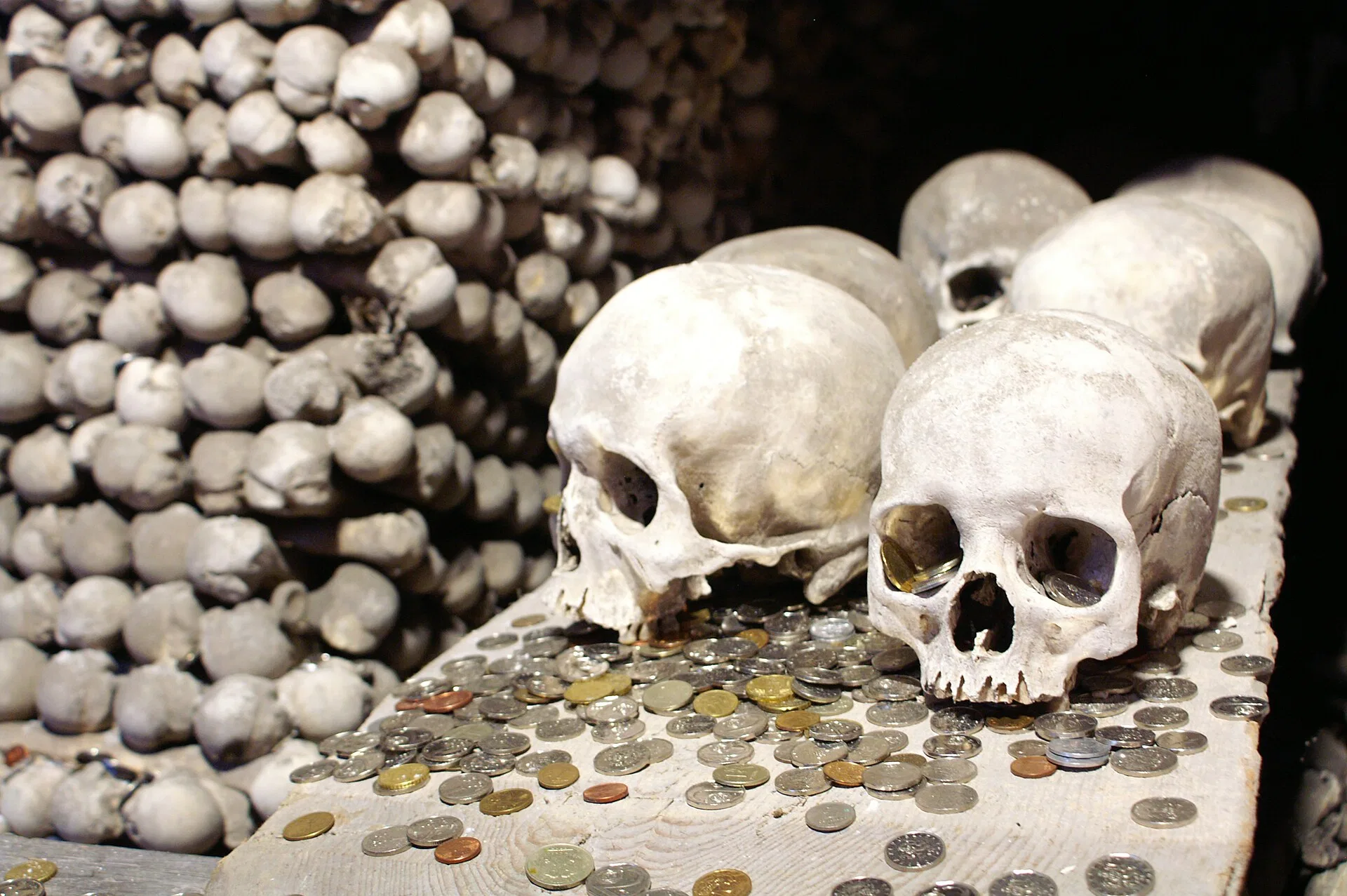
Sedlec Ossuary, beneath the Cemetery Church of All Saints near Kutná Hora, is the Czech Republic’s most internationally famous strange collection. Thousands of human bones are arranged into pyramids, garlands, coats of arms and an elaborate chandelier. The effect is visually theatrical, but the site is not an invented chamber of horrors. It developed from a medieval cemetery associated with a Cistercian monastery, and the bones belong to people whose graves were cleared as the burial ground was reorganised. The decorative arrangement largely dates from the nineteenth century.[VisitCzechia]visitczechia.comIf you are up for an unrepeatable experience, you can actually enter the ossuary at night during the summer months, when the impression t…
For visitors, the crucial distinction is that Sedlec remains a religious and funerary place. Its human remains are not props, archaeological curios or medical specimens. The display reflects a Christian tradition in which bones can serve as reminders of mortality, resurrection and the equality of the dead. Modern tourism often emphasises the chandelier and the sheer density of skulls, but the deeper subject is remembrance rather than horror.
That tension explains why Sedlec matters. It demonstrates how easily a sacred site can be reframed by photography, social media and dark-tourism marketing. A respectful visit treats the ossuary as a chapel containing the dead, not merely as an unusual background for pictures.
Brno’s underground city of bones
The ossuary beneath the Church of St James in Brno offers a different experience. Its chambers hold remains transferred from an overcrowded urban churchyard, and the site is commonly presented as one of Europe’s largest ossuaries. Unlike Sedlec, where bones form recognisable decorative structures, Brno’s remains are displayed within a carefully designed underground memorial environment.[VisitCzechia]visitczechia.comOssuary of St. James in Brno | VisitCzechiaJames in Brno and is the second largest in Europe, the chilling primacy is held by…
The ossuary was rediscovered during surveys of Brno’s historic underground spaces. Today’s presentation combines archaeology, architectural conservation and memorial design. It feels less like a flamboyant bone chapel and more like a descent into the hidden infrastructure of an old European city, where repeated burials, disease outbreaks and limited cemetery space created vast secondary deposits of human remains.
Brno also contains the Capuchin crypt, where environmental conditions naturally preserved the bodies of friars and other individuals. The mummies are not artificial creations in the Egyptian sense; their preservation resulted largely from airflow and the crypt’s physical conditions. Here again, religious burial practice and visitor curiosity coexist. The bodies may appear startlingly exposed to modern audiences, but they were preserved within a Christian institution that used death as a subject of contemplation.
The reliquary of Saint Maurus
At Bečov Castle, the Reliquary of Saint Maurus introduces another form of bodily collection: the preservation of saints’ remains inside a richly decorated medieval shrine. Made in the early thirteenth century and associated with relics of several saints, the reliquary was hidden beneath the floor of the castle chapel during the upheavals surrounding the end of the Second World War. It was recovered in 1985 following a search that has since become almost as famous as the object itself.[VisitCzechia]visitczechia.comOpen source on visitczechia.com.
This is not an occult object, although treasure-hunt retellings can make it sound like one. It belongs to the medieval Christian culture of relics, in which physical remains and objects associated with holy people were treated as sources of spiritual connection and prestige. The castle’s interpretation also addresses the cult of saints’ bodies, giving visitors a stronger framework than they would receive from seeing an ornate box without religious context.[zamek-becov.cz]zamek-becov.czOpen source on zamek-becov.cz.
Prague’s alchemy: history, reconstruction and legend
Prague’s reputation as a city of alchemists rests on real historical foundations. Rudolf II’s court attracted physicians, astronomers, instrument makers and experimenters at a time when the boundaries between chemistry, medicine, astrology and natural philosophy were not drawn as they are today. Figures such as John Dee and Edward Kelley became associated with the imperial city, while later stories attached alchemy and demonic bargains to buildings including the so-called Faust House.[Prague City Tourism]prague.euedward kelley wizard from englandedward kelley wizard from england
The Museum of Alchemists and Magicians of Old Prague occupies a house traditionally connected with Kelley. Its exhibits use reconstructed laboratories, cauldrons, figures and theatrical settings to introduce Rudolfine alchemy and Prague legends. It is a visitor attraction rather than a major research museum, and its strongest value lies in atmosphere and storytelling. The historical setting is relevant, but individual displays should not be assumed to be original sixteenth-century laboratory equipment.[Prague City Tourism]prague.euOpen source on prague.eu.
Speculum Alchemiae presents itself somewhat differently. Located in a historic building in Prague’s Old Town, it centres on underground rooms and a workshop exposed during reconstruction. The attraction connects the site to Renaissance alchemy and to the reign of Rudolf II. Its architecture and hidden spaces are genuinely interesting, but claims about secret imperial laboratories require care: discovery narratives, later reconstruction and tourism interpretation can become difficult to separate.[Prague City Tourism]prague.euCity Tourism Speculum AlchemiaeCity Tourism Speculum Alchemiae
The best way to approach both sites is to distinguish three layers:
- Documented history: Rudolf II’s collecting, court patronage and interest in natural philosophy.
- Plausible material history: old cellars, workshops, apothecary practices and early experimental equipment.
- Legend and presentation: secret tunnels, magical powers, Faustian bargains and heavily staged laboratories.
That distinction does not spoil the experience. It makes Prague’s alchemy attractions more interesting by showing how genuine history becomes urban mythology and, eventually, a commercial museum product.
Ghosts, devils and regional folklore
The Museum of Prague Ghosts and Legends is an openly theatrical attraction near Charles Bridge. Its underground “spirit alley” stages characters from Prague tales using figures, scenery and interactive effects. Visitors should expect folklore brought to life rather than a collection of authenticated paranormal evidence. Its subject is not whether ghosts exist, but how stories of headless figures, restless lovers and supernatural punishments have become part of the city’s identity.[Prague City Tourism]prague.euOpen source on prague.eu.
A comparable regional attraction in Plzeň presents ghosts, witches, water spirits, dragons and other beings associated with local stories. The displays are family-oriented and deliberately playful. Their value lies in making regional folklore visible, especially stories that might otherwise survive only in specialist publications, oral retellings or children’s books.[Muzeum Strašidel]muzeumstrasidel.czMuzeum Strašidel The Museum of ghosts and fairy talesMuzeum Strašidel The Museum of ghosts and fairy tales
Such places differ from ethnographic museums. They rarely offer a systematic history of belief, and reconstructed monsters may owe as much to modern entertainment design as to older descriptions. Even so, they reveal which beings remain recognisable enough to be commercialised. The repeated appearance of devils, witches, water spirits and castle ghosts reflects a Czech storytelling landscape in which supernatural figures are often mischievous, local and morally instructive rather than purely terrifying.
Pelhřimov’s tourism offer pushes this mixture of folklore and play further, with attractions built around ghosts, devils and an interactive vision of hell. These are best treated as themed experiences, not preserved ritual sites or evidence of continuing occult practice. Their significance lies in how traditional imagery is adapted for children, domestic tourism and humorous spectacle.[pelhrimovsko.cz]pelhrimovsko.czOpen source on pelhrimovsko.cz.
Scientific collections that confront the body
The Hrdlička Museum of Man at Charles University is among the country’s most serious unusual museums. This small academic institution covers human evolution, individual development, pathology and death. Its paleopathology holdings include human remains showing injury and disease, allowing visitors to see how researchers identify illness in past populations.[HMČ]muzeumcloveka.czOpen source on muzeumcloveka.cz.
Unlike commercial medical-oddity exhibitions, the museum belongs to a university and places specimens within anthropology and biological science. Its collections include skulls, skeletons, casts and materials gathered during earlier phases of physical anthropology. That academic pedigree gives the displays authority, but it also raises ethical questions familiar to museums worldwide: who collected the remains, whether consent was possible, how older racial classifications shaped interpretation and how institutions should display human bodies today.
The museum’s historical displays should therefore be read on two levels. They provide evidence about human biology and disease, but they also document the development of anthropology itself, including assumptions that modern researchers may reject. The strange object is not only the specimen in the case; it is sometimes the old scientific framework through which the specimen was once classified.
The Czech Museum of Music offers a gentler form of scientific curiosity. Its collections include glass harmonicas, microtonal instruments, unusual two-headed brass instruments and automatophones—mechanisms that produce music automatically. These objects sit at the meeting point of acoustics, craft and invention, recalling the mechanical wonders once prized in Renaissance art chambers.[Národní muzeum]nm.czNárodní muzeum Man – Instrument – MusicNárodní muzeum Man – Instrument – Music
Records, absurdity and invented national heroes
The Museum of Records and Curiosities in Pelhřimov represents the modern, cheerful end of Czech collecting. Spread through a historic gate and associated displays, it preserves oversized, miniature, laboriously handmade and record-breaking objects. The wider town reinforces the theme with public curiosities and references to Czech record holders.[pelhrimovsko.cz]pelhrimovsko.czOpen source on pelhrimovsko.cz.
This is a commercial and participatory form of collecting rather than an academic one. Objects matter because somebody made them exceptionally large, small, numerous or difficult. A conventional museum asks whether an object is historically representative; a records museum asks whether anyone else has done the same thing more dramatically.
The appeal fits a wider Czech tradition of affectionate absurdity, exemplified by Jára Cimrman, a fictional genius created by Ladislav Smoljak and Zdeněk Svěrák. Cimrman is presented as a playwright, inventor, traveller, athlete and overlooked contributor to almost every major achievement. Prague’s dedicated theatre sustains the fiction through performances, invented scholarship and mock historical authority.[Prague City Tourism]prague.euOpen source on prague.eu.
Cimrman-related displays are effectively museums of a hoax whose audience understands the joke. They imitate archives, commemorative institutions and nationalist hero worship while inviting visitors to participate in the pretence. This makes Cimrman especially relevant to Czech curiosity culture: he is not a forged historical figure intended to deceive, but a collective fictional character used to parody the way nations manufacture great men.
How to judge what you are seeing
The Czech Republic’s strange attractions become easier to understand when they are grouped by curatorial purpose rather than by how eerie they look.
Sacred and funerary sites include Sedlec Ossuary, the Brno ossuary, Capuchin crypts and the Reliquary of Saint Maurus. Human remains here belong to religious, memorial or burial traditions. Visitor behaviour should reflect that status.
Academic collections include the Hrdlička Museum of Man and specialist holdings within national or university museums. Their objects are interpreted through research, although older collecting practices and classifications may need critical explanation.
Historic collections and fragments include surviving objects connected with Rudolf II’s art chamber. These have strong documentation, but the original Prague collection was dispersed and cannot now be experienced intact.[Die Welt der Habsburger]habsburger.netPlundered in 1648 by Swedish forces when Prague was captured, only parts of it are today…Read more…
Folklore attractions stage ghosts, devils, witches and legendary beings. They preserve stories through scenery and performance rather than through authenticated supernatural artefacts.
Commercial reconstructions include several alchemy and illusion museums. These may occupy historic buildings and draw on genuine people or events, but atmosphere commonly takes priority over provenance.
Participatory curiosity museums celebrate records, eccentric craftsmanship and humorous invention. Their authority comes from documented feats or public engagement rather than antiquity.
What the strange museums reveal
The Czech Republic’s most unusual collections are not united by a single obsession with the macabre. They reveal several different ways of managing wonder. Bones become religious memorials; diseased skeletons become scientific evidence; mechanical instruments become histories of invention; legends become family entertainment; and a fictional polymath becomes a vehicle for national self-mockery.
Prague naturally dominates because Rudolf II’s court left the city with an enduring reputation for alchemy, astrology and collecting. Yet some of the most revealing sites lie elsewhere: Kutná Hora turns burial history into monumental sacred art, Brno exposes the crowded world beneath a medieval city, Bečov preserves a reliquary with an extraordinary modern rediscovery story, and Pelhřimov converts eccentric achievement into a civic identity.
The country’s strange-history landscape is therefore strongest when visited with two questions in mind: what kind of institution is presenting the object, and what does it ask the visitor to believe? Sometimes the answer is religious faith, sometimes scientific interpretation, sometimes folklore and sometimes nothing more demanding than a willingness to enjoy a well-made joke.
Amazon book picks
Further Reading
Books and field guides related to Why Are Czech Collections So Strangely Compelling?. Use these as the next step if you want deeper reading beyond the article.
Cabinets of Curiosities
"Maurie`s' tour of strange objects is entertaining and fascinating." --Antiques And The Arts Weekly
The Secret History of the World
First published 2008. Subjects: Errors, inventions, Secret societies, Nonfiction, World history, History.
eBay marketplace picks
Marketplace Samples
Live-tested eBay searches with available results related to this page.
Selected fromcabinet curiosities decor oneBay.co.uk.
Endnotes
1.
Source: europeana.eu
Title: cabinets of curiosities and the wunderkammer of rudolf ii in prague
Link:https://www.europeana.eu/en/stories/cabinets-of-curiosities-and-the-wunderkammer-of-rudolf-ii-in-prague
Source snippet
Cabinets of curiosities and the Wunderkammer of Rudolf II...26 Nov 2024 — This blog attempts to understand cabinets of curiosit...
2.
Source: khm.at
Link:https://www.khm.at/en/exhibitions/kunstkammer
3.
Source: habsburger.net
Link:https://www.habsburger.net/en/chapter/kunst-und-wunderkammer-emperor-rudolf-ii
Source snippet
Plundered in 1648 by Swedish forces when Prague was captured, only parts of it are today...Read more...
4.
Source: visitczechia.com
Link:https://www.visitczechia.com/en-us/things-to-do/places/landmarks/archeology/c-kutna-hora-sedlec-ossuary
Source snippet
If you are up for an unrepeatable experience, you can actually enter the ossuary at night during the summer months, when the impression t...
5.
Source: visitczechia.com
Link:https://www.visitczechia.com/en-us/things-to-do/places/landmarks/religious-monuments/c-brno-st-james-ossuary
Source snippet
Ossuary of St. James in Brno | VisitCzechiaJames in Brno and is the second largest in Europe, the chilling primacy is held by...
6.
Source: visitczechia.com
Link:https://www.visitczechia.com/en-us/news/2025/09/n-reliquary-of-saint-maurus-in-becov
7.
Source: zamek-becov.cz
Link:https://www.zamek-becov.cz/en/visitors-information/tours/1581-the-st-maurus-s-shrine
8.
Source: zamek-becov.cz
Link:https://www.zamek-becov.cz/en/visitors-information/tours/119794-exhibition-the-cult-of-saints-bodies
9.
Source: prague.eu
Title: edward kelley wizard from england
Link:https://prague.eu/en/home/discover/prague-phenomenon/prague-stories/edward-kelley-wizard-from-england/
10.
Source: prague.eu
Link:https://prague.eu/en/home/discover/prague-phenomenon/prague-stories/fausts-prague/
11.
Source: prague.eu
Link:https://prague.eu/en/objevujte/museum-of-alchemists-and-magicians-of-old-prague-muzeum-alchymistu-a-magu-stare-prahy/
12.
Source: prague.eu
Title: City Tourism Speculum Alchemiae
Link:https://prague.eu/en/objevujte/speculum-alchemiae-mirror-of-alchemy-zrcadlo-alchymie/
13.
Source: prague.eu
Link:https://prague.eu/en/objevujte/museum-of-prague-ghosts-and-legends-muzeum-prazskych-povesti-a-strasidel/
14.
Source: pelhrimovsko.cz
Link:https://www.pelhrimovsko.cz/en/
15.
Source: pelhrimovsko.cz
Link:https://www.pelhrimovsko.cz/en/tourist-attractions.htm
16.
Source: prague.eu
Link:https://prague.eu/en/objevujte/hrdlicka-museum-of-man-faculty-of-science-charles-university/
17.
Source: pelhrimovsko.cz
Link:https://www.pelhrimovsko.cz/en/tourist-service/museum-of-records-curiosities/museum-of-records.htm
18.
Source: visitczechia.com
Link:https://www.visitczechia.com/en-us/things-to-do/places/landmarks/cities/t-pelhrimov
19.
Source: visitczechia.com
Link:https://www.visitczechia.com/en-us/things-to-do/places/culture/museums-and-galleries/c-museum-of-records-and-curiosities-pelhrimov
20.
Source: prague.eu
Link:https://prague.eu/en/objevujte/zizkov-theater-of-jara-cimrman/
21.
Source: visitczechia.com
Link:https://www.visitczechia.com/en-us/news/2026/05/n-unique-objects-in-czech-museums
22.
Source: visitczechia.com
Link:https://www.visitczechia.com/fr-fr/things-to-do/places/culture/museums-and-galleries/c-museum-of-records-and-curiosities-pelhrimov
23.
Source: cms.visitczechia.com
Title: Cz CB Inspirational monthly unusual accomodation 2
Link:https://cms.visitczechia.com/cms/getmedia/693b2eee-a077-406b-b044-febf98edda52/CzCB-Inspirational-monthly-unusual-accomodation_2.pdf
24.
Source: alchemy.com
Link:https://www.alchemy.com/
25.
Source: prague.eu
Link:https://prague.eu/en/objevujte/alchymist-coffee-museum/
26.
Source: prague.eu
Link:https://prague.eu/en/objevujte/museum-of-fantastic-illusions-muzeum-fantastickych-iluzi/
27.
Source: prague.eu
Link:https://prague.eu/en/objevujte-kategorie/museums/
28.
Source: prague.eu
Link:https://prague.eu/en/sitemap/
29.
Source: prague.eu
Title: church of st joseph kostel sv josefa
Link:https://prague.eu/en/objevujte/church-of-st-joseph-kostel-sv-josefa/
30.
Source: prague.eu
Link:https://prague.eu/en/spiritual-prague/
31.
Source: prague.eu
Link:https://prague.eu/en/objevujte/prague-castle-mihulka-powder-tower-prasna-vez-mihulka/
32.
Source: prague.eu
Link:https://prague.eu/en/gifts-infused-with-pragues-spirit/
33.
Source: prague.eu
Link:https://prague.eu/en/objevujte-kategorie/culture/
34.
Source: prague.eu
Link:https://prague.eu/en/objevujte/prague-castle-prazsky-hrad/
35.
Source: pelhrimovsko.cz
Link:https://www.pelhrimovsko.cz/cz/co-v-pelhrimove/muzeum-rekordu-a-kuriozit.htm
36.
Source: pelhrimovsko.cz
Link:https://www.pelhrimovsko.cz/en/tourist-service/golden-czech-hands-exposition/golden-czech-hands.htm
37.
Source: zamek-becov.cz
Title: Relikviář sv. Maura
Link:https://www.zamek-becov.cz/cs/informace-pro-navstevniky/prohlidkove-okruhy/1581-relikviar-sv-maura
38.
Source: zamek-becov.cz
Link:https://zamek-becov.cz/en/visitors-information/tours/131951-castle-chapel
39.
Source: zamek-becov.cz
Title: Treasures of Bečov
Link:https://www.zamek-becov.cz/en/treasures-of-becov
40.
Source: ngprague.cz
Link:https://www.ngprague.cz/en/about/page/our-collections
Source snippet
Národní galerie PrahaOur collections | National Gallery PragueEmperor Rudolf II's legendary Kunstkammer, representing over 400 years of c...
41.
Source: atlasobscura.com
Title: speculum alchemiae
Link:https://www.atlasobscura.com/places/speculum-alchemiae
42.
Source: muzeumstrasidel.cz
Title: Muzeum Strašidel The Museum of ghosts and fairy tales
Link:https://www.muzeumstrasidel.cz/en
43.
Source: muzeumcloveka.cz
Link:https://muzeumcloveka.cz/en/permanent-exhibition/paleopathology-collection
44.
Source: nm.cz
Title: Národní muzeum Man – Instrument – Music
Link:https://www.nm.cz/en/czech-museum-of-music/man-instrument-music
45.
Source: nm.cz
Title: Národní muzeum Collection of musical instruments
Link:https://www.nm.cz/en/collections/collection-of-musical-instruments
46.
Source: Wikipedia
Link:https://en.wikipedia.org/wiki/Alchemy
47.
Source: nm.cz
Title: Czech Museum of Music
Link:https://www.nm.cz/en/about-us/departments/czech-museum-of-music
48.
Source: nm.cz
Title: Člověk – nástroj – hudba
Link:https://www.nm.cz/navstivte-nas/program/expozice/clovek-nastroj-hudba
49.
Source: nm.cz
Title: Anthropology collection
Link:https://www.nm.cz/en/collections/anthropology-collection
50.
Source: muzeumcloveka.cz
Link:https://muzeumcloveka.cz/en/permanent-exhibition
51.
Source: muzeumcloveka.cz
Link:https://muzeumcloveka.cz/en/history
52.
Source: muzeumcloveka.cz
Link:https://muzeumcloveka.cz/en/
53.
Source: muzeumcloveka.cz
Link:https://muzeumcloveka.cz/en/home
54.
Source: muzeumcloveka.cz
Link:https://muzeumcloveka.cz/en/contact
Additional References
55.
Source: upm.cz
Link:https://www.upm.cz/en/artlife/hall-b/
56.
Source: muzeummost.cz
Link:https://www.muzeummost.cz/en/admission
57.
Source: facebook.com
Link:https://www.facebook.com/groups/traveltipsprague/posts/933789025265319/
58.
Source: muzeumpe.cz
Link:https://www.muzeumpe.cz/kontakt/
59.
Source: kidvoyage.com
Link:https://kidvoyage.com/things-to-do/czech-republic/prague/museum-alchemists-magicians
60.
Source: tourismato.cz
Link:https://www.tourismato.cz/en/muzea/okres-pelhrimov
61.
Source: muzeumpe.cz
Link:https://www.muzeumpe.cz/
62.
Source: muzeumpe.cz
Link:https://www.muzeumpe.cz/muzeum/
63.
Source: atlasobscura.com
Link:https://www.atlasobscura.com/places/the-museum-of-alchemists-and-magicians-of-old-prague-prague-czechia
64.
Source: musoleum.cz
Link:https://musoleum.cz/en/visit