Where Mauritania Keeps Its Strangest Stories
Mauritania does not have a large circuit of purpose-built oddity museums.
Page outline Jump by section
Introduction
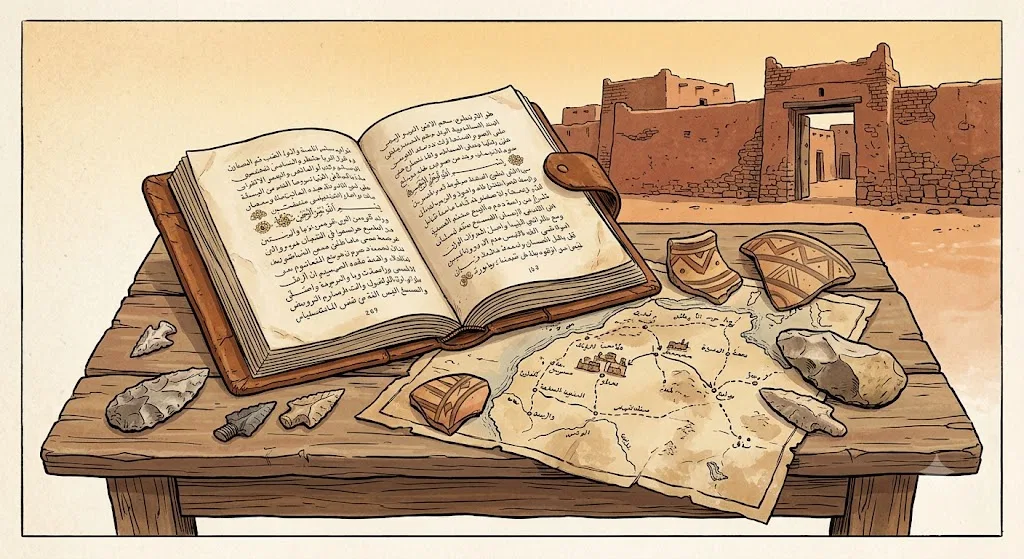
The country’s outstanding unusual collections are the manuscript libraries of Chinguetti. These are not modern museums but privately inherited working archives, preserved by families in an ancient trading and scholarly settlement. Ouadane adds a more eccentric local museum containing prehistoric objects, manuscripts, maps and reported remnants of twentieth-century warfare. In Nouakchott, the National Museum provides the archaeological framework that explains both places. Beyond conventional collections, the enormous Richat Structure has become a kind of open-air mystery exhibit: a natural geological formation repeatedly marketed online as a possible Atlantis, despite clear scientific explanations.[unesco.org]unesco.orgConnecting generations through safeguarding and enhancing the protection of the Desert Libraries of MauritaniaThe official visit of Audrey Azoulay, UNESCO Director-General, to Chinguetti during the Festival of Cities of Heritage on 13 December 202…
Together, these sites reveal a Mauritanian approach to preservation that is often personal, improvised and inseparable from living communities. The interest lies less in theatrical displays of monsters or magic than in the uncertain boundary between library, shrine-like heritage, archaeological storehouse, family inheritance and tourist attraction.
Chinguetti’s desert libraries
Chinguetti’s manuscript libraries are Mauritania’s clearest answer to the cabinet of curiosity. Behind thick walls in the old town, family custodians preserve handwritten volumes covering religion, law, grammar, poetry, mathematics, astronomy and medicine. Many books are bound in leather, written on paper vulnerable to heat, dust and insects, and stored in buildings never designed to meet modern archival standards. A visit may involve a custodian opening boxes or cupboards and displaying selected manuscripts on a mat rather than guiding visitors through labelled cases.[theguardian.com]theguardian.comThe Guardian Mauritania's hidden manuscripts | Mauritania | The Guardianreading an ancient Koranic manuscript in Chinguetti…. Precious Arabic manuscripts from western Africa are under threat as Mauritania's…
This intimacy is what makes the experience unusual. The libraries remain inherited collections, not fully public institutions. Their contents accumulated through scholarship, pilgrimage and trans-Saharan trade, and ownership has traditionally remained with particular families. Visitors are therefore entering a domestic or semi-private space in which the keeper is simultaneously owner, interpreter and conservator.
The surviving libraries form part of a much larger intellectual landscape. Chinguetti developed as a caravan settlement and centre of Islamic learning, while the wider group of historic towns comprising Chinguetti, Ouadane, Tichitt and Oualata preserves the urban pattern of trading and religious centres founded from the eleventh and twelfth centuries onwards. UNESCO describes these towns as focal points of Islamic culture whose courtyard houses and narrow streets reflect the traditional life of the western Sahara.[UNESCO World Heritage Centre]whc.unesco.orgOpen source on unesco.org.
What visitors actually see
Access is variable. Some family libraries receive tourists by local arrangement, while others are private or open only intermittently. Recent reporting found that only two of Chinguetti’s surviving family-run libraries were regularly open to the public, although figures differ between sources because collections close, merge, move or are counted in different ways. Estimates for the number of manuscripts in the town also range from a little over 2,000 surviving volumes in currently operating libraries to more than 4,000 manuscripts across a larger group of non-government collections. These discrepancies are a warning against treating promotional totals as a precise catalogue.[The Guardian]theguardian.comKnown as Africa's "city of libraries," this UNESCO World Heritage site is home to centuries-old manuscripts encompassing religious, scien…
A typical presentation concentrates on visually striking books: pages filled with careful handwriting, decorated religious texts, astronomical diagrams or volumes said to be several centuries old. Interpretation may be oral rather than written, and detailed information about provenance, dating or restoration is not always available in the room. Visitors should therefore distinguish between what can be directly observed and stories attached to an object by tradition, tourism or family memory.
The libraries are devotional and scholarly as well as visitor-facing. Many manuscripts concern religious teaching and jurisprudence, but descriptions of the collections also identify works on geometry, medicine, poetry and other fields. Their importance is not that they conceal forbidden knowledge. It is that they demonstrate how written scholarship circulated through Saharan communities often wrongly imagined as intellectually isolated.[theguardian.com]theguardian.comThe Guardian Mauritania's hidden manuscripts | Mauritania | The Guardianreading an ancient Koranic manuscript in Chinguetti…. Precious Arabic manuscripts from western Africa are under threat as Mauritania's…
Preservation is part of the spectacle
The precarious condition of the books has become inseparable from their public image. Sand encroachment, extreme temperature changes, insects, poor storage, population decline and reduced tourism all threaten the libraries. In some cases, preservation has historically amounted to keeping manuscripts behind thick walls and handling them as carefully as local resources allow, rather than maintaining controlled humidity, specialist storage or a formal conservation laboratory.[washingtonpost.com]washingtonpost.commauritania libraries desertmauritania libraries desert
UNESCO-backed work has supplied conservation equipment, trained local participants and promoted the libraries as heritage belonging to younger generations as well as to individual families. Restoration projects have also attempted to repair library buildings with traditional materials and techniques. Such interventions create a difficult balance: removing manuscripts to a central facility might improve physical protection, but it could weaken the family custodianship that allowed them to survive.[UNESCO]unesco.orgConnecting generations through safeguarding and enhancing the protection of the Desert Libraries of MauritaniaThe official visit of Audrey Azoulay, UNESCO Director-General, to Chinguetti during the Festival of Cities of Heritage on 13 December 202…
For a visitor interested in unusual museums, this tension is central. Chinguetti is not a polished “museum of lost knowledge”. It is a dispersed archive whose vulnerability, private ownership and incomplete cataloguing are part of the experience. That makes it more compelling than a themed attraction, but also harder to interpret confidently.
Ouadane’s mixed collection
Ouadane’s small local museum is one of Mauritania’s most eccentric conventional collections. Accounts describe a mixture stretching from prehistory to recent history: stone tools, ceramics, manuscripts, maps, ethnographic material and rockets or rocket fragments associated with fighting connected to the Western Sahara conflict. The combination resembles an old-fashioned local curiosity room, where objects are gathered because they belong to the place rather than because they fit a single academic category.[Africa]africa.comIts collections present elements from the Neolithic to the colonial period, with lithic materials, ceramics, Arabic manuscripts and maps…
That variety gives the museum its appeal, but documentation is limited. There is little accessible evidence of a detailed online catalogue, professional conservation programme or reliably published visitor schedule. Claims about individual military objects are repeated across museum directories without extensive provenance records. They are plausible in the region’s modern historical setting, but should not be treated as independently verified simply because they appear in a display.
The museum makes most sense when seen alongside Ouadane itself. The ruined settlement was once part of the trans-Saharan network carrying salt and other goods. Its surviving walls, mosques and tightly packed buildings belong to the same UNESCO-listed group as Chinguetti. Here the entire old town functions as an archaeological exhibit: abandoned structures, repaired houses and fragments of urban fabric communicate the rise and decline of a caravan centre more effectively than isolated objects could.[unesco.org]whc.unesco.orgOpen source on unesco.org.
Ouadane also demonstrates how unusual collections can emerge outside major institutions. A prehistoric tool, an old manuscript and a missile fragment appear unrelated in a formal classification system. Within a local museum, however, they become successive traces of occupation, trade, learning, colonial intervention and regional conflict.

The National Museum’s buried cities
The National Museum in Nouakchott is more conventional, but its archaeological galleries contain some of the objects most relevant to Mauritania’s strange-history landscape. Published descriptions identify stone tools, pottery fragments, arrowheads and material excavated from historic sites including Tichitt, Ouadane, Aoudaghost, Azougui and Koumbi Saleh. Its ethnographic displays include clothing and objects associated with the country’s different communities.[momaa.org]momaa.orgNational Museum of MauritaniaThe museum is renowned for its impressive archaeological and ethnographic collections. Phone 26 46 26…
The unusual quality comes from the civilisations behind the fragments. Mauritania contains the remains of trading towns that once connected North Africa, the Sahara and the Sahel. Objects that may look modest in a display case — a sherd, scale, inscription or worked stone — are evidence of settlements transformed by shifting trade routes, political change and advancing desert conditions.
For anyone visiting Chinguetti or Ouadane, the National Museum provides useful context that the family libraries and local displays may lack. It connects manuscripts and ruined buildings with longer archaeological sequences, including prehistoric communities and medieval commercial centres. Yet publicly available visitor information remains uneven, and online museum descriptions often repeat a small set of facts. Opening arrangements and gallery access are best checked locally rather than assumed from directory pages.
The institution’s role is also broader than that of a single exhibition venue. Accounts place the museum in a building shared with national research, library and manuscript-conservation bodies. This concentration of museum, library and research functions reflects the relatively small institutional environment in which Mauritania’s portable heritage is studied and protected.[Wikipedia]WikipediaNational Museum of MauritaniaNational Museum of Mauritania
The Eye of the Sahara: geology turned into legend
About 40 kilometres across, the Richat Structure near Ouadane is one of the world’s most recognisable geological formations from orbit. Its concentric rings create an enormous bull’s-eye in the desert, earning it the popular name “Eye of the Sahara”. Astronauts and satellite imagery have made it far more legible from above than it is from ground level.[NASA Science]science.nasa.govScience Eyeing the Richat StructureScience Eyeing the Richat Structure
The structure is not a museum, but it belongs in Mauritania’s curiosity landscape because it has become an internationally consumed mystery object. Online videos, travel marketing and speculative writing repeatedly identify it as a possible location of Atlantis, usually because its rings are compared with descriptions of the legendary city. This interpretation is not supported by recognised geological or archaeological evidence.
Scientific accounts describe the Richat Structure as a deeply eroded geological dome shaped by uplift, intrusion and long-term erosion, not as an impact crater or the remains of a built city. NASA imagery shows how different rock layers form the rings as erosion exposes them. The structure’s visual resemblance to a designed target is real; the leap from resemblance to lost civilisation is not.[nasa.gov]nasa.govThe Richat structure in the African nation of MauritaniaThe Richat structure in the African nation of Mauritania
The Atlantis story is nevertheless important as modern folklore. It shows how an unusual landscape can be detached from its local history and reinterpreted through a globally familiar legend. Ouadane’s genuine archaeology, manuscript culture and caravan heritage risk becoming supporting scenery for a claim that attracts more online attention precisely because it is more sensational.
Visitors expecting visible walls, canals or a recognisable ruined metropolis are likely to be disappointed. On the ground, the Richat Structure is a vast area of ridges, broken rock and desert tracks. Its shape is best understood through maps, aerial photographs and satellite images. It is therefore less an archaeological mystery than a lesson in scale: the “exhibit” only becomes obvious when the viewer is far enough away.
What Mauritania does not have
There is little reliable evidence for permanent Mauritanian museums devoted specifically to witchcraft, occultism, cryptids, UFOs, medical oddities, crime or death. Articles that imply a hidden network of such attractions usually broaden ordinary archaeological or ethnographic sites into something more sensational than the documentation supports.
That absence is informative. Mauritania’s unusual heritage is dominated by manuscript custodianship, Saharan archaeology, caravan towns and geological spectacle. Religious material is generally presented as scholarly or devotional heritage, not as occult curiosity. Folklore may be carried through oral interpretation, domestic objects and local accounts rather than separated into a dedicated folklore museum.
The country’s strongest curiosity sites can be understood through four different models:
- Family archive: Chinguetti’s privately inherited manuscript libraries.
- Local cabinet: Ouadane’s mixed archaeological, historical and military collection.
- National archaeological display: the National Museum’s material from prehistoric and abandoned settlements.
- Landscape mystery: the Richat Structure, where sound geology competes with modern Atlantis folklore.
This is a narrower field than in countries with established museums of witchcraft or medical history, but it is not a lesser one. Mauritania’s distinctive collections raise unusually direct questions about who owns heritage, whether private custodianship can coexist with public access, and how fragile objects survive when formal museum infrastructure is limited.
Visiting responsibly
Seeing these collections requires more preparation than visiting a conventional city museum. Chinguetti and Ouadane are remote desert settlements, access to private libraries may depend on introductions or local guides, and advertised opening hours may not reflect current circumstances. Manuscripts should never be touched, opened or photographed without the custodian’s permission.
Visitors should also resist treating family libraries as theatrical relic rooms. The books are inherited intellectual and religious property. A respectful visit allows the custodian to decide which objects are shown and how they are discussed. Paying an agreed admission charge or guide fee supports the people maintaining the collection, although payment does not turn private heritage into unrestricted public property.
Travel conditions require separate attention. As of March 2026, the UK Foreign, Commonwealth and Development Office advised against travel to parts of Mauritania, with the level of risk varying by region. Anyone planning to reach the Adrar settlements or the Richat Structure should consult the current regional map, obtain appropriate insurance and use experienced local transport rather than relying on old travel accounts.[GOV.UK]GOV.UKMauritania travel adviceMauritania travel advice
The most rewarding route begins with the National Museum’s archaeological context, continues to Chinguetti’s libraries and old town, and then moves through Ouadane’s ruins, local collection and surrounding desert. Seen in that order, Mauritania’s curiosities form a coherent story: objects from vanished settlements enter national cases, books remain with the families who inherited them, and a natural ringed landscape accumulates myths that reveal as much about modern tourism as about the Sahara itself.
Amazon book picks
Further Reading
Books and field guides related to Where Mauritania Keeps Its Strangest Stories. Use these as the next step if you want deeper reading beyond the article.
The Silk Roads: A New History of the World
Far more than a history of the Silk Roads, this book is truly a revelatory new history of the world, promising to destabilize notions of...
Sahara: A Natural History
In a book that is beautifully written and full of surprises, Marq de Villiers and Sheila Hirtle describe the Sahara desert in all its rem...
The golden trade of the Moors
First published 1958. Subjects: History, Commerce, Africa, west, history.
eBay marketplace picks
Marketplace Samples
Live-tested eBay searches with available results related to this page.
Selected fromSahara art print oneBay.co.uk.
Endnotes
1.
Source: unesco.org
Link:https://www.unesco.org/en/culture-emergencies/heritage-emergency-fund/connecting-generations-through-safeguarding-and-enhancing-protection-[desert-libraries
Source snippet
The official visit of Audrey Azoulay, UNESCO Director-General, to Chinguetti during the Festival of Cities of Heritage on 13 December 202...
2.
Source: momaa.org
Link:https://momaa.org/directory/national-museum-of-mauritania/?srsltid=AfmBOoo8b5FFoBWWRjXmAQrVhuMdYI9ZdkdvwclgPRkEJiB1r5pSR6IU
Source snippet
National Museum of MauritaniaThe museum is renowned for its impressive archaeological and ethnographic collections. Phone 26 46 26...
3.
Source: africa.com
Link:https://africa.com/museums-of-mauritania
Source snippet
Its collections present elements from the Neolithic to the colonial period, with lithic materials, ceramics, Arabic manuscripts and maps...
4.
Source: science.nasa.gov
Title: Science The Eye of the Sahara
Link:https://science.nasa.gov/earth/earth-observatory/the-eye-of-sahara-150060/
Source snippet
Taken by an astronaut onboard the International Space Station (ISS), this photograph places the Richat Structure—a geologic feature in Ma...
5.
Source: ifla.org
Link:https://www.ifla.org/events/manuscript-preservation-in-the-historic-city-of-chinguetti-mauritania-webinar/
Source snippet
In Chinguetti, more than 4,000 of these manuscripts are distributed among 17 non-government libraries...
6.
Source: whc.unesco.org
Link:https://whc.unesco.org/en/list/750/
7.
Source: whc.unesco.org
Link:https://whc.unesco.org/en/urban-heritage-atlas/ancient-ksour/
8.
Source: Wikipedia
Link:https://en.wikipedia.org/wiki/Museum_of_Ouadane
9.
Source: Wikipedia
Link:https://en.wikipedia.org/wiki/Ouadane
10.
Source: whc.unesco.org
Link:https://whc.unesco.org/en/activities/1307/
11.
Source: Wikipedia
Title: National Museum of Mauritania
Link:https://en.wikipedia.org/wiki/National_Museum_of_Mauritania
12.
Source: science.nasa.gov
Title: Science Eyeing the Richat Structure
Link:https://science.nasa.gov/earth/earth-observatory/eyeing-the-richat-structure/
13.
Source: science.nasa.gov
Title: Science Richat Structure, Mauritania
Link:https://science.nasa.gov/earth/earth-observatory/richat-structure-mauritania-4602/
14.
Source: nasa.gov
Title: The Richat structure in the African nation of Mauritania
Link:https://www.nasa.gov/image-article/richat-structure-african-nation-of-mauritania/
15.
Source: jpl.nasa.gov
Link:https://www.jpl.nasa.gov/images/pia04963-richat-structure-mauritania/
16.
Source: GOV.UK
Title: Mauritania travel advice
Link:https://www.gov.uk/foreign-travel-advice/mauritania
17.
Source: nasa.gov
Title: Richat Structure, Mauritania
Link:https://www.nasa.gov/image-article/richat-structure-mauritania/
18.
Source: eol.jsc.nasa.gov
Title: Richat Structure
Link:https://eol.jsc.nasa.gov/Collections/EarthObservatory/articles/RichatStructure.htm
19.
Source: science.nasa.gov
Title: richat structure mauritania
Link:https://science.nasa.gov/photojournal/richat-structure-mauritania/
20.
Source: science.nasa.gov
Title: richat structure mauritania anaglyph landsat image over srtm elevation
Link:https://science.nasa.gov/photojournal/richat-structure-mauritania-anaglyph-landsat-image-over-srtm-elevation/
21.
Source: science.nasa.gov
Title: richat structure in mauritania 2861
Link:https://science.nasa.gov/earth/earth-observatory/richat-structure-in-mauritania-2861/
22.
Source: science.nasa.gov
Title: richat structure mauritania 2561
Link:https://science.nasa.gov/earth/earth-observatory/richat-structure-mauritania-2561/
23.
Source: science.nasa.gov
Title: bulls eye the richat structure mauritania 9262
Link:https://science.nasa.gov/earth/earth-observatory/bulls-eye-the-richat-structure-mauritania-9262/
24.
Source: whc.unesco.org
Link:https://whc.unesco.org/en/documents/113120
25.
Source: unesco.org
Title: honours africas rich documentary heritage new inscriptions memory world register
Link:https://www.unesco.org/en/articles/unesco-honours-africas-rich-documentary-heritage-new-inscriptions-memory-world-register
26.
Source: unesco.org
Title: documentary heritage 74 new entries unescos memory world register
Link:https://www.unesco.org/en/articles/documentary-heritage-74-new-entries-unescos-memory-world-register
27.
Source: whc.unesco.org
Link:https://whc.unesco.org/en/list/750/assistance/
28.
Source: unesdoc.unesco.org
Link:https://unesdoc.unesco.org/ark%3A/48223/pf0000121335
29.
Source: whc.unesco.org
Link:https://whc.unesco.org/archive/repcom96.htm
30.
Source: whc.unesco.org
Link:https://whc.unesco.org/en/activities/774/
31.
Source: unesdoc.unesco.org
Title: pf0000397944 eng
Link:https://unesdoc.unesco.org/ark%3A/48223/pf0000397944_eng
32.
Source: whc.unesco.org
Link:https://whc.unesco.org/en/list/750/gallery/
33.
Source: whc.unesco.org
Title: index en
Link:https://whc.unesco.org/archive/websites/mail-20200918/index-en.html
34.
Source: unesdoc.unesco.org
Link:https://unesdoc.unesco.org/ark%3A/48223/pf0000392834
35.
Source: whc.unesco.org
Link:https://whc.unesco.org/en/list/750/documents/
36.
Source: unesdoc.unesco.org
Link:https://unesdoc.unesco.org/ark%3A/48223/pf0000395417.locale%3Den
37.
Source: whc.unesco.org
Link:https://whc.unesco.org/en/decisions/2999/
38.
Source: whc.unesco.org
Link:https://whc.unesco.org/en/documents/113114
39.
Source: unesdoc.unesco.org
Link:https://unesdoc.unesco.org/ark%3A/48223/pf0000133046
40.
Source: whc.unesco.org
Link:https://whc.unesco.org/document/154180
41.
Source: whc.unesco.org
Link:https://whc.unesco.org/fr/etatsparties/mr
42.
Source: unesdoc.unesco.org
Link:https://unesdoc.unesco.org/ark%3A/48223/pf0000380165
43.
Source: whc.unesco.org
Link:https://whc.unesco.org/en/list/750/maps/
44.
Source: whc.unesco.org
Title: tool image bootstrap.cfm
Link:https://whc.unesco.org/include/tool_image_bootstrap.cfm?gallery=site&id=113133&id_site=750
45.
Source: whc.unesco.org
Title: tool image bootstrap.cfm
Link:https://whc.unesco.org/include/tool_image_bootstrap.cfm?id=113118
46.
Source: unesco.org
Title: Contributions Secteurs 221 EX
Link:https://www.unesco.org/sites/default/files/medias/fichiers/2025/02/Contributions%20Secteurs%20221%20EX.pdf
47.
Source: whc.unesco.org
Link:https://whc.unesco.org/en/documents/113113
48.
Source: whc.unesco.org
Title: tool image bootstrap.cfm
Link:https://whc.unesco.org/include/tool_image_bootstrap.cfm?id=113117
49.
Source: whc.unesco.org
Link:https://whc.unesco.org/en/statesparties/mr
50.
Source: momaa.org
Link:https://momaa.org/directory/national-museum-of-mauritania/?srsltid=AfmBOooGdjpNagWm8Z2QE0nfdZazYPtVDWaLw9PFxJUS83BS-Nyz_zar
51.
Source: Wikipedia
Link:https://en.wikipedia.org/wiki/Chinguetti
52.
Source: assets.publishing.service.gov.uk
Link:https://assets.publishing.service.gov.uk/media/6160303c8fa8f52983494816/FCDO__TA__027_-_Mauritania_Travel_Advice_Ed3.pdf
53.
Source: culture.gov.mr
Link:https://www.culture.gov.mr/fr/node/1286
54.
Source: smartraveller.gov.au
Link:https://www.smartraveller.gov.au/destinations/africa/mauritania
55.
Source: theguardian.com
Title: The Guardian Mauritania’s hidden manuscripts | Mauritania | The Guardian
Link:https://www.theguardian.com/world/2010/jul/27/mauritania-heritage-books-libraries
Source snippet
reading an ancient Koranic manuscript in Chinguetti.... Precious Arabic manuscripts from western Africa are under threat as Mauritania's...
56.
Source: theguardian.com
Link:https://www.theguardian.com/world/2025/nov/12/city-of-libraries-chinguetti-mauritania-sahara-unesco-preservation
Source snippet
Known as Africa's "city of libraries," this UNESCO World Heritage site is home to centuries-old manuscripts encompassing religious, scien...
57.
Source: washingtonpost.com
Title: mauritania libraries desert
Link:https://www.washingtonpost.com/world/interactive/2023/mauritania-libraries-desert/
58.
Source: apnews.com
Link:https://apnews.com/article/fddd80d31620355b06afca4cc9f94d99
59.
Source: humbo.com
Link:https://humbo.com/mr/ouadane
60.
Source: africanworldheritagesites.org
Link:https://www.africanworldheritagesites.org/cultural-places/trans-sahara-trading-routes/ancient-ksour-of-mauritania.html
61.
Source: travel.state.gov
Link:https://travel.state.gov/content/travel/en/international-travel/International-Travel-Country-Information-Pages/Mauritania.html
62.
Source: africanrockart.britishmuseum.org
Link:https://africanrockart.britishmuseum.org/country/mauritania/
63.
Source: ireland.ie
Link:https://www.ireland.ie/en/dfa/overseas-travel/advice/mauritania/
64.
Source: ami.mr
Link:https://ami.mr/en/culture
65.
Source: undiscovered-destinations.com
Link:https://undiscovered-destinations.com/destination/mauritania/
66.
Source: africabib.org
Link:https://www.africabib.org/rec.php?RID=244149488
67.
Source: archaeolist.com
Link:https://archaeolist.com/sites/mauritania/ouadane
Additional References
68.
Source: youtube.com
Title: Ancient Ksour of Ouadane, Chinguetti, Tichitt and Oualata
Link:https://www.youtube.com/watch?v=docvWgE7FPo
Source snippet
Chinguetti desert libraries manuscripts Mauritania Mauritania: Ancient manuscripts attract tourists to historic desert city africanews...
69.
Source: youtube.com
Title: Mauritania: Ancient manuscripts attract tourists to historic desert city
Link:https://www.youtube.com/watch?v=0womjW92Uq8
Source snippet
FULL Presentation at the Ancient Desert Library in Chinguetti - Mauritania...
70.
Source: youtube.com
Title: Desert libraries in Mauritania: Treasures in need of protection
Link:https://www.youtube.com/watch?v=3DUtVeI1BRM
Source snippet
Mauritania: Ancient manuscripts attract tourists to historic desert city...
71.
Source: youtube.com
Title: FULL Presentation at the Ancient Desert Library in Chinguetti
Link:https://www.youtube.com/watch?v=UPfxfjlMspg
Source snippet
Weird Places: Mauritania's Eye of the Sahara...
72.
Source: mauriweb.info
Link:https://mauriweb.info/node/14963
73.
Source: facebook.com
Link:https://www.facebook.com/anre.john/posts/imagine-preserving-books-the-way-others-preserve-gold-hidden-in-the-deserts-of-m/27255541644073492/
74.
Source: kanaga-at.com
Link:https://www.kanaga-at.com/en/trip-info/mauritania-en/chinguetti-and-the-desert-libraries/
75.
Source: facebook.com
Link:https://www.facebook.com/groups/Archaeology.Prehistoric/posts/877365389079338/
76.
Source: evendo.com
Link:https://evendo.com/locations/mauritania/nema/attraction/mauritanian-national-museum
77.
Source: smithsonianmag.com
Link:https://www.smithsonianmag.com/travel/endangered-site-chinguetti-mauritania-54168194/