Within Strange Indonesia
When Death Becomes Museum, Memory and Ritual
Indonesia's death collections range from university research displays to ancestral figures and graves that remain part of living family practice.
On this page
- Inside Surabaya's university museum of death
- Toraja graves, effigies and preserved ancestors
- Ethics, authority and the display of human remains
Page outline Jump by section
Introduction
Indonesia’s most distinctive death-related collections are not confined to conventional museums. They exist across three overlapping worlds: university research collections that study mortality, ancestral landscapes where the dead remain active members of family life, and public heritage sites that visitors can enter but which still function as places of remembrance. That combination makes Indonesia unusual. Rather than separating museums from ritual, many death-related collections sit at the boundary between scholarship, tourism, religion and continuing family obligation.
For visitors interested in unusual museums, the country offers both a purpose-built museum dedicated to death and living mortuary traditions in which graves, effigies and even the bodies of ancestors remain part of everyday cultural practice. Understanding the difference between an educational display and an active ritual landscape is essential, because the ethical questions surrounding human remains, sacred objects and photography are often as important as the collections themselves.
When death becomes a subject of study
Inside Surabaya’s university museum of death
Indonesia’s closest equivalent to a dedicated death museum is the Ethnography Museum and Centre for Death Studies at Airlangga University in Surabaya. Established originally as an ethnographic museum and relaunched in 2016 with death as its central exhibition theme, it is widely described as Indonesia’s first university museum devoted specifically to mortality and funerary culture. Its purpose is educational rather than sensational, bringing together anthropology, archaeology and physical anthropology to examine how different Indonesian communities understand death.[indonesia.travel]indonesia.travelVisit Indonesia Unair Museum & Center for Ethnographic Studies SurabayaVisit Indonesia Unair Museum & Center for Ethnographic Studies Surabaya
Instead of presenting death as horror, the museum explains how burial customs express ideas about family, religion, social status and the relationship between the living and the deceased. Exhibitions have included funerary equipment, grave models, skeletal material used for teaching, comparative displays of regional mortuary traditions and interpretations of how different ethnic groups mark death. The museum also functions as a research centre, supporting academic work in anthropology and forensic studies rather than operating solely as a public attraction.[Universitas Airlangga Official Website]unair.ac.idUniversitas Airlangga Official WebsiteDepartment of Anthropology: Pioneer of Indonesian Physical Anthropology Studies - Universitas Airla…
Its continuing academic role is significant. Staff regularly organise educational activities such as bone-identification workshops and public outreach, illustrating that the collection is intended to develop understanding of human biology, archaeology and cultural diversity rather than simply display unusual objects.[Museum Kematian]museoetno.fisip.unair.ac.idMuseum Kematian- Museum KematianMuseum Kematian- Museum Kematian
More than a curiosity
The museum occupies an unusual position within Indonesia’s museum landscape. It is simultaneously:
- a university teaching collection;
- a research centre for anthropology and death studies;
- a public museum with visitor access; and
- an example of how museums can interpret mortality without relying on shock value.
Its exhibitions deliberately frame death as a universal human experience expressed through different cultural traditions rather than as something supernatural or macabre. That educational framing distinguishes it from commercial “museum of death” attractions found elsewhere in the world.[indonesia.travel]indonesia.travelVisit Indonesia Unair Museum & Center for Ethnographic Studies SurabayaVisit Indonesia Unair Museum & Center for Ethnographic Studies Surabaya
Toraja graves, effigies and preserved ancestors
The most internationally recognised death-related heritage in Indonesia lies not inside a museum building but across the ritual landscape of Tana Toraja in South Sulawesi. Here, cliff burials, rock-cut tombs, family mausoleums and carved ancestral effigies attract visitors from around the world while remaining active places of family remembrance.
The carved wooden figures, often called ancestral effigies in English, are not decorative sculptures created for tourists. They represent particular deceased individuals and traditionally overlook burial sites from niches carved into limestone cliffs. Their purpose is commemorative and symbolic, maintaining a continuing relationship between ancestors and descendants rather than functioning as museum exhibits. Anthropologists generally interpret them as expressions of lineage, social identity and continuing kinship obligations rather than literal portraits.[Visit Indonesia]indonesia.travelVisit Indonesia Unair Museum & Center for Ethnographic Studies SurabayaVisit Indonesia Unair Museum & Center for Ethnographic Studies Surabaya
Equally distinctive are the region’s elaborate funerals. In many Toraja communities, death is understood as a gradual social transition rather than an immediate separation. Families may postpone final ceremonies while preparing the substantial resources required for ritual obligations. During this period the deceased may continue to be treated with remarkable familiarity within the household before the full funeral is held. These practices are frequently simplified in travel writing, but their primary meaning remains religious and familial rather than theatrical.[UMAC]umac.icom.museumInternational committee for university muse…
One of the best-known traditions is the periodic care of ancestors after burial. During certain ceremonies, relatives may clean graves, repair coffins and respectfully care for the remains of family members as part of continuing remembrance. Although widely photographed, these ceremonies are not performances staged for visitors. Their timing, participation and meaning are determined by families and local custom.
Why these places are not simply open-air museums
Visitors sometimes describe Toraja as an “open-air museum of death”, but that comparison is only partly accurate.
Unlike museum collections:
- the graves remain family property;
- the effigies continue to have ritual significance;
- ceremonies are organised by descendants rather than heritage managers;
- access varies according to local custom and family permission.
Tourism has undoubtedly increased international visibility, yet the underlying social system has not disappeared. Heritage protection, local government, religious practice and tourism coexist, sometimes comfortably and sometimes with tension over commercialisation, photography and visitor behaviour.
For this reason, many scholars prefer to describe the region as a living cultural landscape rather than a museum. The distinction matters because visitors encounter places that remain spiritually meaningful to local communities rather than historical displays removed from everyday life.

Ethics, authority and the display of human remains
Indonesia illustrates several different approaches to displaying the dead.
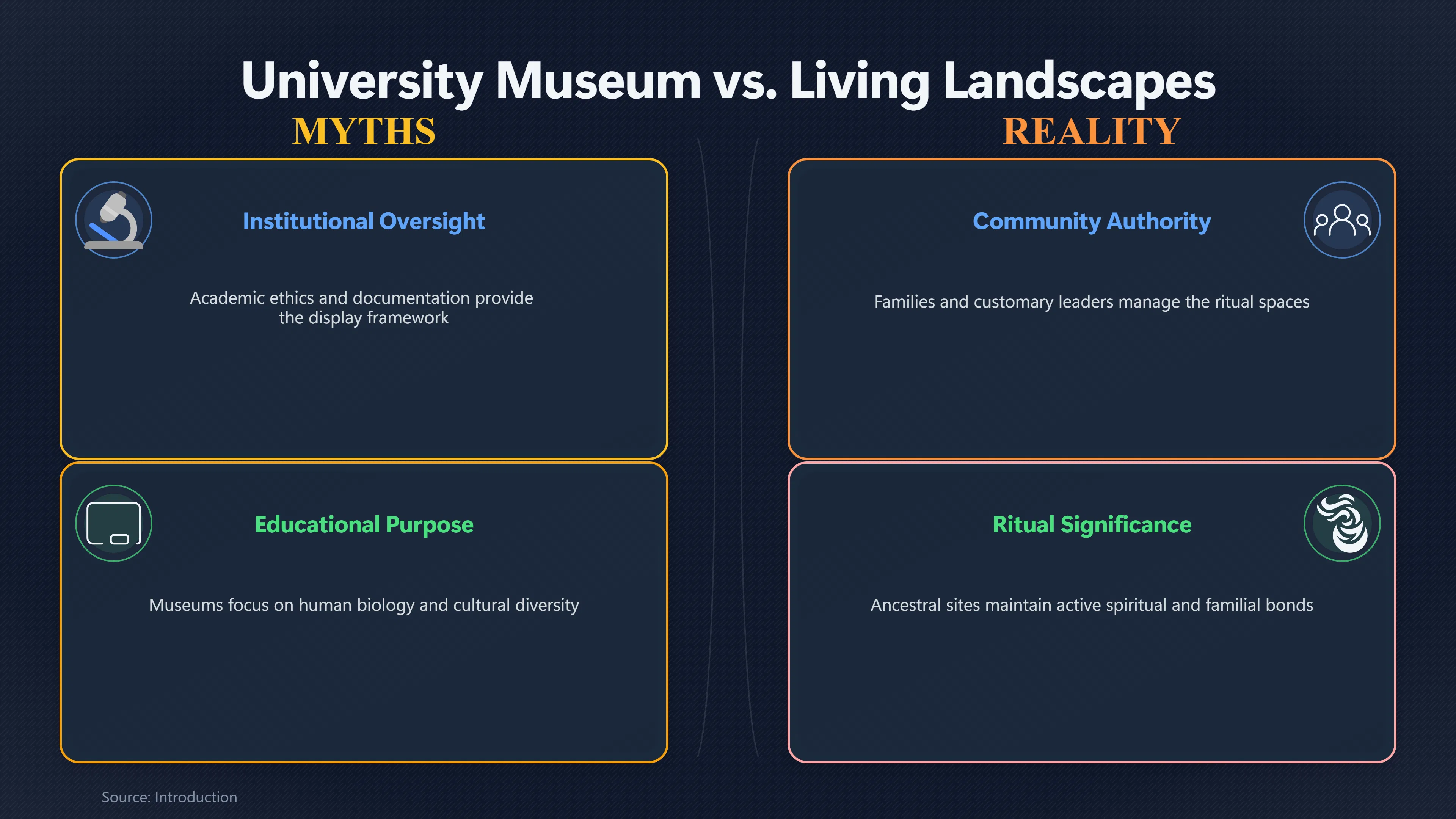
Within a university museum, skeletal remains and mortuary artefacts are interpreted through research, teaching and public education. Institutional oversight, academic ethics and documentation provide a framework for explaining why particular objects are displayed and how they contribute to knowledge.[Universitas Airlangga]scholar.unair.ac.idUniversitas Airlangga Ethnography Museum and Center of Death StudyUniversitas AirlanggaEthnography Museum and Center of Death Study - Universitas Airlangga…
Within living ritual landscapes such as Toraja, however, authority usually rests with families, customary leaders and local communities rather than museum curators. Human remains are encountered because they remain embedded within continuing cultural practice.
These contrasting settings create different ethical expectations:
- Consent and community authority. Museums increasingly recognise the importance of working with source communities when displaying human remains or culturally sensitive funerary material.
- Photography. Images that may seem appropriate in a museum can be inappropriate during active ceremonies or within sacred burial spaces.
- Interpretation. Tourist narratives sometimes exaggerate unusual customs while overlooking their religious and social meaning.
- Respectful behaviour. Visitors are entering places of remembrance, not theatrical attractions, even when access is permitted.
These issues mirror international debates about human remains in museums while taking on additional complexity because many Indonesian mortuary traditions continue to evolve rather than belonging solely to the past.
What makes Indonesia distinctive
Many countries possess museums displaying mummies, skeletons or archaeological burials. Indonesia is distinctive because its most memorable death-related collections span both institutional and living contexts.
A visitor can move from an academic museum explaining funerary anthropology in Surabaya to ancestral landscapes where the dead remain woven into contemporary family life. Rather than presenting death as either scientific specimen or historical curiosity, Indonesia demonstrates how remembrance, research, tourism and ritual can exist simultaneously.
For anyone exploring the country’s stranger museums and unusual heritage, these places reveal something deeper than macabre curiosity. They show how collections associated with death can become vehicles for education, identity and continuing relationships between the living and their ancestors, making them among the most culturally significant and ethically complex attractions in Indonesia.
Amazon book picks
Further Reading
Books and field guides related to When Death Becomes Museum, Memory and Ritual. Use these as the next step if you want deeper reading beyond the article.
The Art of Not Being Governed
From the acclaimed author and scholar James C. Scott, the compelling tale of Asian peoples who until recently have stemmed the vast tide...
The Work of the Dead: A Cultural History of Mortal Remains
The meaning of our concern for mortal remains—from antiquity through the twentieth century The Greek philosopher Diogenes said that when...
Death and the Regeneration of Life
It is a classical anthropological paradox that symbols of rebirth and fertility are frequently found in funerary rituals throughout the w...
eBay marketplace picks
Marketplace Samples
Live-tested eBay searches with available results related to this page.
Selected fromToraja art oneBay.co.uk.
Current eBay listing
Toraja rice field Framed Wall Art Poster Canvas Print Picture

Current eBay listing
My love in Toraja Framed Wall Art Poster Canvas Print Picture
Endnotes
1.
Source: indonesia.travel
Title: Visit Indonesia Unair Museum & Center for Ethnographic Studies Surabaya
Link:https://www.indonesia.travel/th/en/destination/java/east-java/museum-dan-pusat-kajian-etnografi-universitas-airlangga
2.
Source: kebudayaan.kemdikbud.go.id
Link:https://kebudayaan.kemdikbud.go.id/dpk/museum-kematian-di-universitas-airlangga/
3.
Source: scholar.unair.ac.id
Title: Universitas Airlangga Ethnography Museum and Center of Death Study
Link:https://scholar.unair.ac.id/en/organisations/ethnography-museum-and-center-of-death-study/
Source snippet
Universitas AirlanggaEthnography Museum and Center of Death Study - Universitas Airlangga...
4.
Source: unair.ac.id
Link:https://unair.ac.id/department-of-anthropology-pioneer-of-indonesian-physical-anthropology-studies/
Source snippet
Universitas Airlangga Official WebsiteDepartment of Anthropology: Pioneer of Indonesian Physical Anthropology Studies - Universitas Airla...
5.
Source: unair.ac.id
Link:https://unair.ac.id/museum-etnografi-unair-tawarkan-pengalaman-menarik-soal-kematian/
Source snippet
Universitas Airlangga Official WebsiteMuseum Etnografi UNAIR, Tawarkan Pengalaman Menarik soal Kematian - Universitas Airlangga Official...
6.
Source: museoetno.fisip.unair.ac.id
Title: Museum Kematian- Museum Kematian
Link:https://museoetno.fisip.unair.ac.id/
7.
Source: scholar.unair.ac.id
Title: Universitas Airlangga RESEARCH CENTER MUSEUM ETHNOGRAPHY AND DEATH STUDIES
Link:https://scholar.unair.ac.id/en/organisations/research-center-museum-ethnography-and-death-studies/
Source snippet
Universitas AirlanggaRESEARCH CENTER MUSEUM ETHNOGRAPHY AND DEATH STUDIES - Universitas Airlangga...
8.
Source: umac.icom.museum
Link:https://umac.icom.museum/wp-content/uploads/2022/09/UMACj-14-2-Prague-2022-v2.pdf
Source snippet
International committee for university muse...
9.
Source: scholar.unair.ac.id
Link:https://scholar.unair.ac.id/en/clippings/menjelajahi-museum-unik-di-indonesia-museum-etnografi-kematian-un/
Source snippet
Museum Unik di Indonesia, Museum Etnografi Kematian Unair - Universitas AirlanggaDecember 20, 2022 — MENJELAJAHI MUSEUM UNIK DI INDONESIA...
Published: December 20, 2022
10.
Source: scholar.unair.ac.id
Title: unair.ac.id Pusat Kajian Etnografi
Link:https://scholar.unair.ac.id/en/organisations/pusat-kajian-etnografi/
11.
Source: scholar.unair.ac.id
Title: unair.ac.id ILM U KEDOKTERAN FORENSIK & MEDIKOLEGAL
Link:https://scholar.unair.ac.id/en/organisations/ilmu-kedokteran-forensik-medikolegal/
Additional References
12.
Source: youtube.com
Title: The Village Where Bodies Are Not Buried
Link:https://www.youtube.com/watch?v=LxTVmlUf1ic
Source snippet
Airlangga University Museum of Death Ethnography Surabaya Get To Know More About "Museum Kematian" At Airlangga University (Final Project...
13.
Source: youtube.com
Title: Exploring the Museum of Death at Universitas Airlangga: A Journey Beyond Life
Link:https://www.youtube.com/watch?v=pKYJp9tVkCs
Source snippet
Inside Indonesia's Toraja Funeral Rituals: A Celebration of Life and Death...
14.
Source: youtube.com
Title: Inside Indonesia’s Toraja Funeral Rituals: A Celebration of Life and Death
Link:https://www.youtube.com/watch?v=5RISDrwzdpQ
Source snippet
I Lived with the Death Tribe of Indonesia...
15.
Source: youtube.com
Link:https://www.youtube.com/watch?v=nSu-afmYNZ8
Source snippet
Exploring the Museum of Death at Universitas Airlangga: A Journey Beyond Life...
16.
Source: museum.kemenbud.go.id
Link:https://museum.kemenbud.go.id/museum/profile/museum%2Bdan%2Bpusat%2Bkajian%2Betnografi%2Buniversitas%2Bairlangga
17.
Source: youtube.com
Title: I Lived with the Death Tribe of Indonesia
Link:https://www.youtube.com/watch?v=oe0-T_hBi6o
Source snippet
The Village Where Bodies Are Not Buried - TRUNYAN VILLAGE BALI...
18.
Source: thejakartapost.com
Title: Surabaya museum of death highlights Indonesian funeral traditions
Link:https://www.thejakartapost.com/life/2018/10/18/surabaya-museum-of-death-highlights-indonesian-funeral-traditions.html