Within Croatia Curiosities
Are Vodnjan's Preserved Saints Really Mummies
Vodnjan's holy bodies are devotional relics, natural preservation mysteries and tourist curiosities at the same time.
On this page
- What the church collection contains
- Mummification claims and scientific uncertainty
- Sacred relics, tourism and respectful viewing
Page outline Jump by section
Introduction
The preserved bodies in the Church of Saint Blaise in Vodnjan are among Croatia’s most unusual religious collections. They are often described as “Vodnjan’s mummies”, but that label can be misleading. The bodies are displayed primarily as Catholic relics for devotion rather than as archaeological specimens, while their remarkable state of preservation has also attracted scientists, historians and curious travellers. The result is a rare place where faith, forensic investigation and heritage tourism overlap.
The central question is not whether the bodies exist—they do—but why they remain so well preserved. Religious visitors may regard them as signs of sanctity, whereas researchers have explored natural mummification, environmental conditions and possible historical interventions. The available evidence does not fully resolve the question, making Vodnjan one of Croatia’s most intriguing examples of a collection that is simultaneously sacred, scientifically interesting and culturally distinctive.[Hrčak]hrcak.srce.hrHrčak Mummified saints of the Northern Croatian LittoralHrčakMummified saints of the Northern Croatian LittoralJune 15, 2012…
What the church collection contains
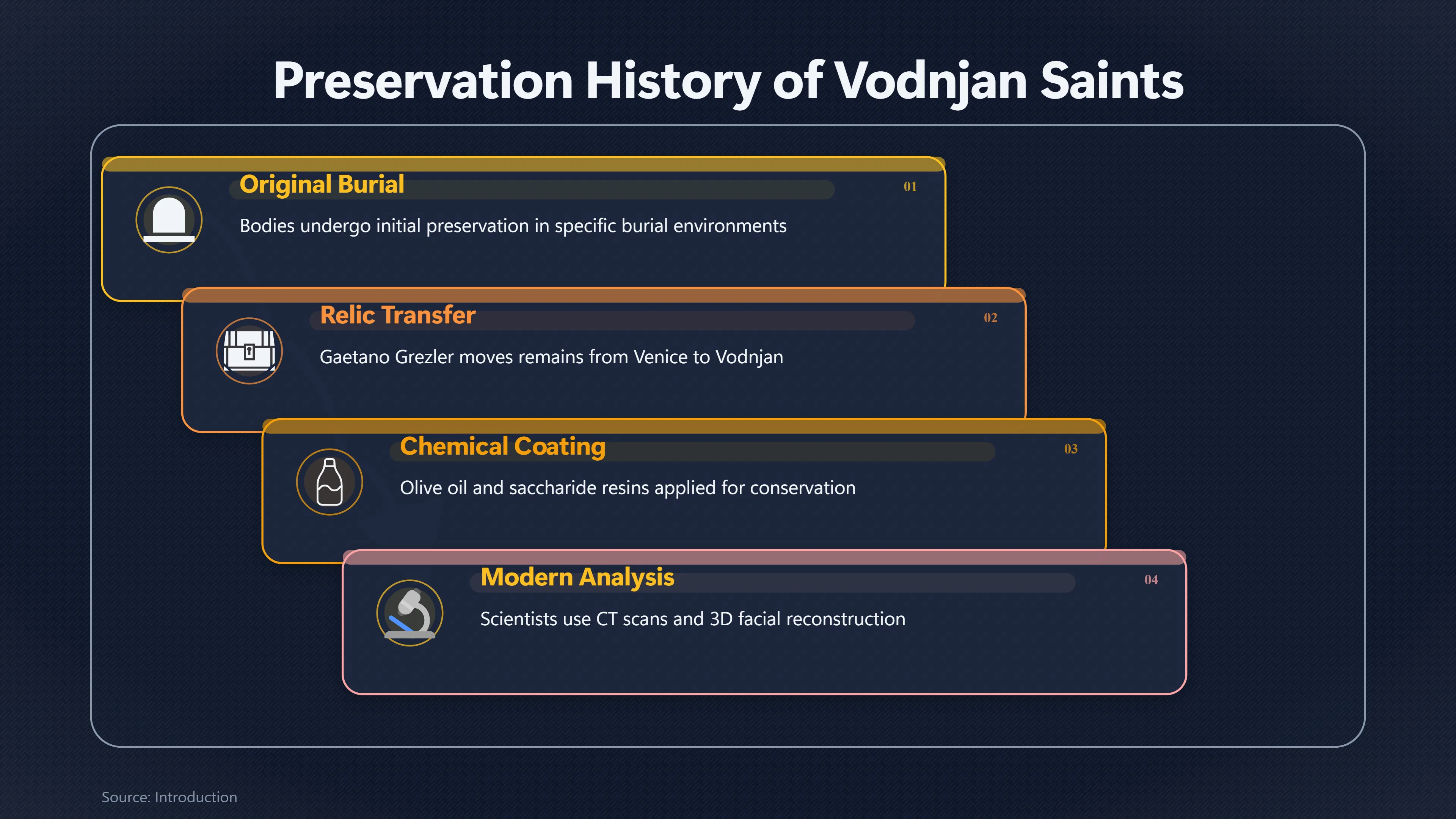
The Church of Saint Blaise in Vodnjan houses one of the largest collections of Christian relics in Croatia. The treasury contains hundreds of relics associated with around 250 saints, gathered largely through the activities of the painter and collector Gaetano Grezler, who transferred many relics from Venice to Vodnjan in the early nineteenth century.[Croatia Week]croatiaweek.comCroatia Week A history of sacral relics in Croatia | Croatia WeekCroatia WeekA history of sacral relics in Croatia | Croatia WeekJuly 26, 2024…
The collection’s greatest attraction is a small group of preserved human remains. Three bodies are substantially intact:
- Blessed Leon Bembo[zupavodnjan.com]zupavodnjan.comSource details in endnotes.
- Saint Giovanni Olini
- Saint Nicolosa Bursa[sciencedirect.com]sciencedirect.comFacial reconstruction of mummified remains of Christian Saint-Nicolosa Bursa - ScienceDirect…
Alongside them are partially preserved remains attributed to Saint Barbara, Saint Sebastian and Saint Mary of Egypt, as well as numerous reliquaries containing bones, tissues and other sacred relics.[Hrčak]hrcak.srce.hrHrčak Mummified saints of the Northern Croatian LittoralHrčakMummified saints of the Northern Croatian LittoralJune 15, 2012…
Unlike Egyptian mummies, these bodies were not originally intended as preserved exhibits. They are displayed because they are revered as relics within the Catholic tradition. Their placement inside a functioning church rather than a secular museum shapes how visitors encounter them: the atmosphere is devotional first and touristic second.
Are they really mummies?
Calling the preserved saints “mummies” is convenient but scientifically imprecise.
In archaeology, a mummy is simply a body whose soft tissues have survived after death, regardless of whether preservation occurred naturally or artificially. By that definition, the Vodnjan bodies qualify as mummified remains. However, they differ markedly from deliberately embalmed Egyptian mummies because there is no convincing evidence that they underwent comparable embalming procedures.[Hrčak]hrcak.srce.hrHrčak Mummified saints of the Northern Croatian LittoralHrčakMummified saints of the Northern Croatian LittoralJune 15, 2012…
Researchers instead describe several competing possibilities.
Natural preservation
One explanation is that the bodies underwent natural mummification after burial. Under suitable conditions, dehydration can halt normal decay before bacteria destroy soft tissues. Similar naturally preserved religious bodies are known elsewhere in Europe.
Academic reviews of the Vodnjan collection note that this is currently the most plausible broad explanation, although the precise burial environments of the individuals remain incompletely documented.[Hrčak]hrcak.srce.hrHrčak Mummified saints of the Northern Croatian LittoralHrčakMummified saints of the Northern Croatian LittoralJune 15, 2012…
Later conservation and restoration
Scientific examinations have complicated the popular story that the bodies have remained entirely untouched.
Analysis of skin samples from two of the preserved bodies found coatings containing olive oil and a saccharide-based resin. Researchers concluded that these substances were probably applied after the bodies entered the Vodnjan collection during the early nineteenth century, possibly by Gaetano Grezler himself as part of conservation or presentation. The coatings would not explain the original preservation, but they almost certainly influenced the bodies’ present appearance.[ResearchGate]researchgate.netOpen source on researchgate.net.
The same research also identified evidence of post-mortem alterations, including the removal of certain body parts, possibly for relic distribution or medieval devotional practices. This shows that the remains have a complex history rather than existing in an untouched state since death.[ResearchGate]researchgate.netOpen source on researchgate.net.
Miracle and incorruptibility
Within Catholic devotional tradition, unusually preserved bodies are sometimes regarded as signs of exceptional holiness. Local believers have long viewed the Vodnjan saints through this spiritual lens, and many visitors continue to regard their preservation as miraculous.
Academic authors acknowledge this longstanding belief while noting that miracle claims lie outside the scope of scientific testing. Their reviews argue that further palaeopathological and bioarchaeological research is needed before stronger conclusions about the preservation process can be drawn.[Hrčak]hrcak.srce.hrHrčak Mummified saints of the Northern Croatian LittoralHrčakMummified saints of the Northern Croatian LittoralJune 15, 2012…
What science has and has not established
The Vodnjan bodies have been investigated using modern methods, but they remain only partially studied.
Recent research has included:
- visual examination of preserved soft tissues;
- chemical analysis of surface coatings;
- CT scanning of some remains;
- forensic anthropology;
- facial reconstruction of Saint Nicolosa Bursa using medical imaging and 3D modelling.[researchgate.net]researchgate.netOpen source on researchgate.net.
These studies have improved understanding of the collection without eliminating uncertainty.
Researchers have not demonstrated a unique preservation mechanism exclusive to Vodnjan. Nor have they shown that supernatural preservation can be scientifically verified. Instead, the evidence points towards a combination of natural preservation, historical handling, later conservation treatments and centuries of careful custodianship. Important questions—including the precise environmental conditions surrounding the original burials—remain open.[srce.hr]hrcak.srce.hrHrčak Mummified saints of the Northern Croatian LittoralHrčakMummified saints of the Northern Croatian LittoralJune 15, 2012…
Sacred relics, tourism and respectful viewing
Visitors often arrive expecting a “museum of mummies”, but that expectation misses the collection’s primary purpose.
The Church of Saint Blaise is an active place of worship. The preserved bodies are displayed as sacred relics within a religious setting, and many pilgrims visit for prayer rather than curiosity. Tourism has undoubtedly increased the site’s international profile, yet the presentation continues to emphasise devotion over spectacle.[Croatia Week]croatiaweek.comCroatia Week A history of sacral relics in Croatia | Croatia WeekCroatia WeekA history of sacral relics in Croatia | Croatia WeekJuly 26, 2024…
For travellers interested in Croatia’s stranger heritage, Vodnjan stands apart because it combines several identities at once:
- a historic parish church;[hrcak.srce.hr]hrcak.srce.hr15, 2…
- one of the country’s richest reliquary collections;
- an unusual example of naturally preserved human remains;
- an ongoing subject of scientific investigation;
- a destination for religious pilgrimage.
That combination makes it distinctive within Croatia’s wider landscape of unusual collections. Unlike commercial novelty museums, the interest here comes not from theatrical presentation but from the unresolved coexistence of religious belief, historical conservation and scientific inquiry.
The most balanced interpretation is therefore neither that the preserved saints have been conclusively explained nor that they defy all natural explanation. Instead, Vodnjan demonstrates how a single collection can hold different meanings for different audiences: sacred evidence of sanctity for believers, valuable biological material for researchers, and one of Croatia’s most remarkable cultural curiosities for visitors.[srce.hr]hrcak.srce.hrHrčak Mummified saints of the Northern Croatian LittoralHrčakMummified saints of the Northern Croatian LittoralJune 15, 2012…
Amazon book picks
Further Reading
Books and field guides related to Are Vodnjan's Preserved Saints Really Mummies. Use these as the next step if you want deeper reading beyond the article.
The Rough Guide to Croatia
Provides coverage of all the sights and attractions of Croatia, from walking a circuit of Dubrovnik's city walls, exploring the labyrinth...
The Cult of the Saints: Its Rise and Function in Latin Christ...
A new edition of the "brilliantly original and highly sophisticated" study of saint worship after the fall of the Roman Empire ( Library...
The Archaeology of Death and Burial
The archaeology of death and burial is central to our attempts to understand vanished societies. Through the remains of funerary rituals...
eBay marketplace picks
Marketplace Samples
Live-tested eBay searches with available results related to this page.
Selected fromcrucifix decor oneBay.co.uk.

Endnotes
1.
Source: researchgate.net
Link:https://www.researchgate.net/publication/321157804_Medieval_mummies_from_the_parish_treasury_in_Vodnjan_Croatia
2.
Source: sciencedirect.com
Link:https://www.sciencedirect.com/science/article/abs/pii/S1296207418308951
Source snippet
Facial reconstruction of mummified remains of Christian Saint-Nicolosa Bursa - ScienceDirect...
3.
Source: researchgate.net
Link:https://www.researchgate.net/publication/362998291_Anthropological_individualization_of_relics_from_sarcophagus_stored_in_Vodnjan_monastery_Vodnjan_Croatia
4.
Source: sciencedirect.com
Title: Facial reconstruction of mummified remains of Christian Saint-Nicolosa Bursa
Link:https://www.sciencedirect.com/science/article/pii/S1296207418308951
5.
Source: sciencedirect.com
Title: The effect of the method of burial on adipocere formation
Link:https://www.sciencedirect.com/science/article/pii/S0379073804006358
6.
Source: researchgate.net
Link:https://www.researchgate.net/publication/232698290_Mummified_saints_of_the_Northern_Croatian_Littoral
7.
Source: hrcak.srce.hr
Title: Hrčak Mummified saints of the Northern Croatian Littoral
Link:https://hrcak.srce.hr/en/91135
Source snippet
HrčakMummified saints of the Northern Croatian LittoralJune 15, 2012...
Published: June 15, 2012
8.
Source: croatiaweek.com
Title: Croatia Week A history of sacral relics in Croatia | Croatia Week
Link:https://www.croatiaweek.com/a-history-of-sacral-relics-in-croatia/
Source snippet
Croatia WeekA history of sacral relics in Croatia | Croatia WeekJuly 26, 2024...
Published: July 26, 2024
9.
Source: hrcak.srce.hr
Link:https://hrcak.srce.hr/index.php/en/clanak/28309
10.
Source: hrcak.srce.hr
Link:https://hrcak.srce.hr/ojs/index.php/amha/article/view/19421
Source snippet
saints of the Northern Croatian Littoral | Acta medico-historica Adriatica: AMHAAugust 12, 2022 — MUMMIFIED SAINTS OF THE NORTHERN CROAT...
Published: August 12, 2022
11.
Source: hrcak.srce.hr
Link:https://hrcak.srce.hr/index.php/en/clanak/473690
Source snippet
15, 2...
0
2
- Preliminary communication https://doi.org/10.17018/portal.2024.9 Collection of Sacral Art of the parish church of St Bla
12.
Source: hrcak.srce.hr
Title: hr Mummified saints of the Northern Croatian Littoral
Link:https://hrcak.srce.hr/en/clanak/134739
13.
Source: hrcak.srce.hr
Title: hr Mummified saints of the Northern Croatian Littoral
Link:https://hrcak.srce.hr/clanak/134739
14.
Source: visit-croatia.hr
Link:https://www.visit-croatia.hr/en/destinations/istria/pula-region/vodnjan
Additional References
15.
Source: youtube.com
Link:https://www.youtube.com/watch?v=fP8q5tdVo7s
Source snippet
Tragom Istre 5: Posjeta BRIJUNIMA, omiljenom mjestu DRUGA TITA. Priče o MUMIJAMA IZ VODNJANA...
16.
Source: istrianet.org
Title: Istria on the Internet
Link:https://www.istrianet.org/istria/architecture/churches/vodnjan/mummies1-eng.htm
Source snippet
Istria on the Internet - Architecture - Churches and Cemeteries - Vodnjan (Dignano)...
17.
Source: youtube.com
Title: Pazin Cave & Vodnjan | Zipline, Mummies & Istria’s Best Olive Oil
Link:https://www.youtube.com/watch?v=T2pSmXsGSnM
Source snippet
[4K] Vodnjan, Istria, Croatia (videoturysta.eu)...
18.
Source: youtube.com
Title: [4K] Vodnjan, Istria, Croatia (videoturysta.eu)
Link:https://www.youtube.com/watch?v=npPeJAjzyHk
Source snippet
Izdvojeno - Neraspadnuta tijela svetaca i relikvije u Vodnjanu...
19.
Source: st-open.unist.hr
Link:https://st-open.unist.hr/index.php/st-open/article/view/80
20.
Source: hrz.hr
Link:https://www.hrz.hr/en/professional-services/archive/
21.
Source: zupavodnjan.com
Link:https://zupavodnjan.com/en/museum/collection-contents
22.
Source: zupavodnjan.com
Link:https://zupavodnjan.com/en/vodnjan-parish/donations
23.
Source: zupavodnjan.com
Link:https://zupavodnjan.com/en/holy-bodies
24.
Source: eurekamag.com
Link:https://eurekamag.com/research/106/127/106127511.php