Within Congo Curiosities
Was the Ishango Bone an Ancient Calculator?
The Ishango Bone may record counting, patterns or lunar cycles, but no single explanation has been proved.
On this page
- What the notches and quartz point look like
- The main mathematical and lunar interpretations
- Why the original remains in Belgium
Page outline Jump by section
Introduction
The Ishango Bone is one of the Democratic Republic of the Congo’s most remarkable archaeological discoveries and one of the world’s most debated prehistoric objects. Found near Lake Edward at the archaeological site of Ishango, the small carved bone has become famous because its carefully grouped notches may represent one of humanity’s earliest attempts to record numbers or recognise patterns. Yet despite decades of study, no single explanation has won universal acceptance. Rather than proving that prehistoric people invented advanced mathematics, the bone demonstrates something equally fascinating: that people living around 20,000 years ago deliberately engraved information in ways that still challenge modern interpretation.[Institute of Natural Sciences]naturalsciences.beInstitute of Natural Sciences The Ishango Bone | Institute of Natural SciencesInstitute of Natural Sciences The Ishango Bone | Institute of Natural Sciences

For visitors interested in unusual archaeological treasures, the Ishango Bone occupies a unique place in the DR Congo’s heritage. It is simultaneously a scientific artefact, a cultural symbol and an enduring mystery whose meaning remains unresolved.
What the notches and quartz point look like
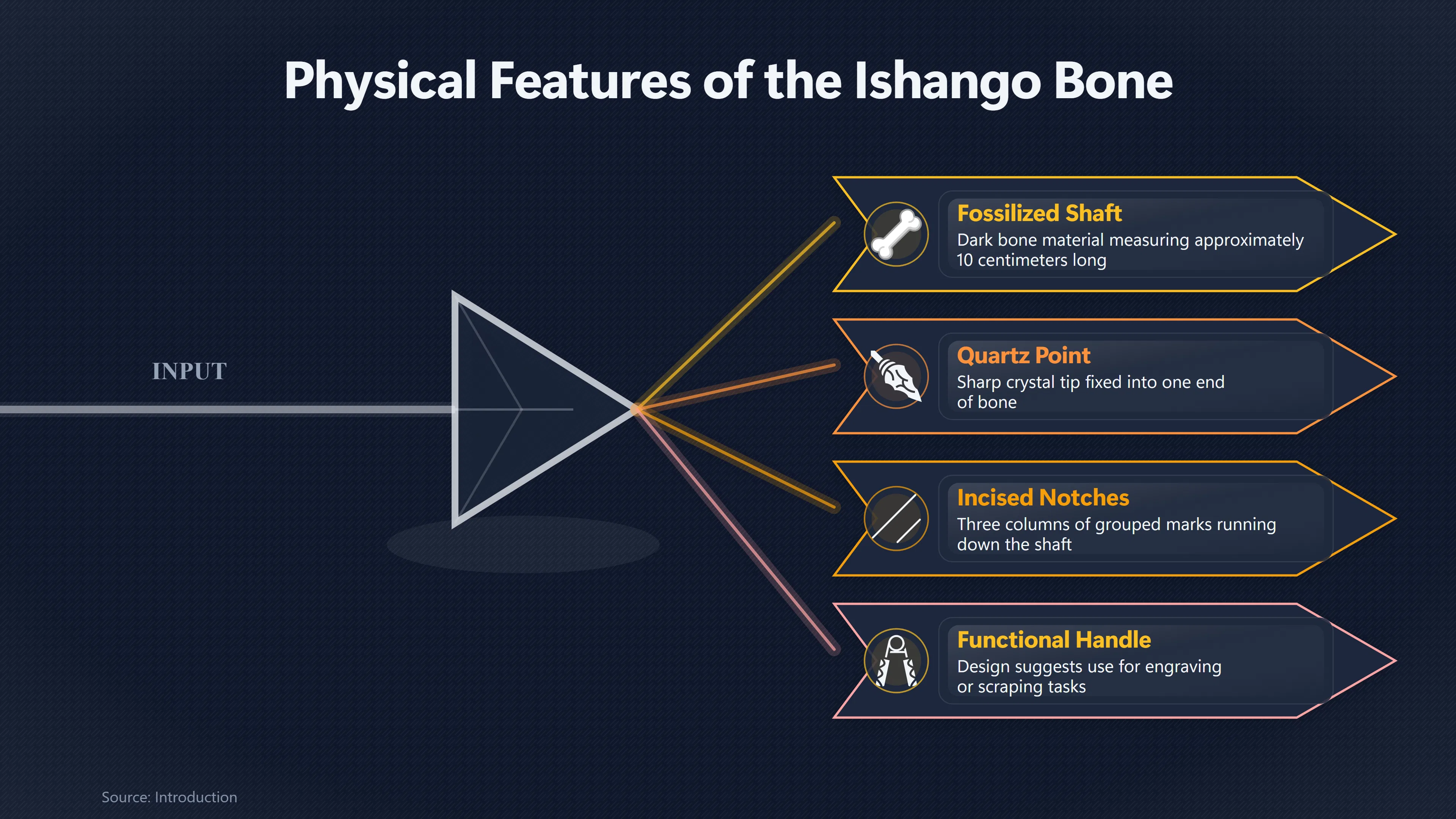
The artefact itself is surprisingly modest. It is about 10 centimetres long and consists of a dark fossilised bone with a small piece of quartz fixed into one end, giving it the appearance of a handle fitted with a sharp point. Archaeologists believe the quartz could have been used for engraving, scraping or other practical work rather than existing purely as decoration.[Institute of Natural Sciences]naturalsciences.beInstitute of Natural Sciences The Ishango Bone | Institute of Natural SciencesInstitute of Natural Sciences The Ishango Bone | Institute of Natural Sciences
Its real intrigue lies in the incised marks running down the shaft. These are arranged in three separate columns, with the cuts grouped into distinct clusters rather than carved randomly. Some groups appear to double earlier groups—for example three beside six, four beside eight and five beside ten—while other sequences have inspired mathematical interpretations involving addition or number patterns. Because the marks are organised rather than evenly spaced, most researchers agree they were intentional, even if their precise purpose remains unknown.[Institute of Natural Sciences]naturalsciences.beInstitute of Natural Sciences The Ishango Bone | Institute of Natural SciencesInstitute of Natural Sciences The Ishango Bone | Institute of Natural Sciences
The Ishango excavation produced many other archaeological finds, including harpoon points, quartz tools and additional bones bearing notches. This wider context suggests that making marked bones was not unique to a single object, although none has attracted the same attention as the famous specimen.[ishango.naturalsciences.be]ishango.naturalsciences.beOpen source on naturalsciences.be.
The main mathematical and lunar interpretations
Since its discovery by Belgian geologist Jean de Heinzelin during excavations in the 1950s, several competing explanations have been proposed. None has been conclusively demonstrated, and each explains some features better than others.[ishango.naturalsciences.be]ishango.naturalsciences.beOpen source on naturalsciences.be.
The main interpretations include:
- A tally stick. Many archaeologists regard this as the safest explanation. The notches may simply record quantities—perhaps animals, fish, days or traded goods. Similar tally marks appear on prehistoric objects from many parts of the world, making this the least speculative interpretation.[ishango.naturalsciences.be]ishango.naturalsciences.beOpen source on naturalsciences.be.
- A mathematical tool. De Heinzelin himself suggested that some notch groupings hinted at arithmetic, including doubling and numerical relationships. Later researchers expanded this idea, proposing that the bone may demonstrate early addition, subtraction or structured counting rather than simple record keeping.[Institute of Natural Sciences]naturalsciences.beInstitute of Natural Sciences The Ishango Bone | Institute of Natural SciencesInstitute of Natural Sciences The Ishango Bone | Institute of Natural Sciences
- Prime numbers or advanced arithmetic. One influential interpretation argued that one column represents prime numbers between 10 and 20, leading to popular descriptions of the bone as the world’s oldest mathematical instrument. While this idea captured public imagination, many specialists consider it difficult to prove because alternative explanations fit the same markings and because it assumes mathematical concepts that leave no independent archaeological evidence from the same period.[math.buffalo.edu]math.buffalo.eduan old Mathematical Objectan old Mathematical Object
- A base-12 calculating aid. More recent mathematical studies have suggested the grouped notches could reflect counting based on twelve, using three and four as subsidiary units. Advocates compare the object to a primitive calculating device rather than a modern calculator. This remains an interesting but debated hypothesis rather than an accepted conclusion.[arXiv]arxiv.orgDoes the Ishango Bone Indicate Knowledge of the Base 12? An Interpretation of a Prehistoric Discovery, the First Mathematical Tool o…
- A lunar calendar. Archaeologist Alexander Marshack proposed that microscopic examination showed the marks recorded phases of the Moon over several months. This interpretation has also been widely discussed, especially in popular books, but many archaeologists argue that the evidence does not uniquely support a lunar record over other forms of notation.[Wikipedia]WikipediaIshango boneIshango bone

Why no single explanation has prevailed
The continuing debate exists because the Ishango Bone lacks the context that would make its purpose obvious. There is no accompanying inscription, no comparable object with an agreed meaning and no written tradition from which to interpret the markings.
Several practical problems limit certainty:
- The marks are open to more than one numerical grouping.
- Different researchers count and interpret some notches differently.
- Similar prehistoric notched bones elsewhere served a variety of purposes.
- The object’s practical quartz point suggests it was also a working tool, making it possible that the markings were only one aspect of its use.[ishango.naturalsciences.be]ishango.naturalsciences.beOpen source on naturalsciences.be.
As a result, most archaeologists distinguish between what is well supported and what remains speculative. It is widely accepted that the notches were deliberately organised. It is not accepted that they definitively prove knowledge of prime numbers, a calendar, or sophisticated arithmetic.
Why the original remains in Belgium
The original Ishango Bone is housed at the Royal Belgian Institute of Natural Sciences in Brussels. It was taken there after its discovery by Jean de Heinzelin, who worked for the institute during the Belgian colonial period, and it has remained in its collections ever since.[Institute of Natural Sciences]naturalsciences.beInstitute of Natural Sciences The Ishango Bone | Institute of Natural SciencesInstitute of Natural Sciences The Ishango Bone | Institute of Natural Sciences
Its location also reflects a broader issue affecting Congolese cultural heritage. Many important archaeological and ethnographic objects collected during the colonial era are preserved in European museums rather than in the Democratic Republic of the Congo. The Ishango Bone has therefore become part of wider discussions about colonial collecting, museum stewardship and the future return of African cultural heritage.
For visitors to Brussels, the institute has exhibited the bone and developed educational material explaining both its archaeological discovery and the competing theories surrounding its meaning. The wider Ishango archaeological collection, including thousands of excavated artefacts, is likewise preserved there.[Institute of Natural Sciences]naturalsciences.beInstitute of Natural Sciences The Ishango Bone | Institute of Natural SciencesInstitute of Natural Sciences The Ishango Bone | Institute of Natural Sciences
Why the Ishango Bone still matters
The enduring importance of the Ishango Bone is not that it conclusively rewrites the history of mathematics, but that it demonstrates the intellectual sophistication of prehistoric communities living in what is now the Democratic Republic of the Congo. Whether the notches recorded counts, lunar observations or numerical relationships, they reveal deliberate symbolic behaviour long before writing emerged.
Within the DR Congo’s landscape of unusual heritage, the Ishango Bone stands apart because its mystery has survived every attempt at explanation. Unlike many archaeological puzzles that eventually receive a broadly accepted interpretation, this small carved bone continues to invite fresh analysis while reminding researchers that prehistoric evidence often preserves questions better than answers.[naturalsciences.be]naturalsciences.beInstitute of Natural Sciences The Ishango Bone | Institute of Natural SciencesInstitute of Natural Sciences The Ishango Bone | Institute of Natural Sciences
Amazon book picks
Further Reading
Books and field guides related to Was the Ishango Bone an Ancient Calculator?. Use these as the next step if you want deeper reading beyond the article.
The Crest of the Peacock: Non-European Roots of Mathematics
From the Ishango Bone of central Africa and the Inca quipu of South America to the dawn of modern mathematics, The Crest of the Peacock m...
The Universal History of Numbers
"Georges Ifrah is the man. This book, quite simply, rules. . . . It is outstanding . . . a mind-boggling and enriching experience." –The...
The Math Book
First published 2009. Subjects: History, Mathematics, Mathematics, history, Discoveries in science, Popular works.
eBay marketplace picks
Marketplace Samples
Live-tested eBay searches with available results related to this page.
Selected fromMakes DR Congo's Collections patch oneBay.co.uk.

Endnotes
1.
Source: naturalsciences.be
Title: Institute of Natural Sciences The Ishango Bone | Institute of Natural Sciences
Link:https://www.naturalsciences.be/en/museum/exhibitions-activities/exhibitions/250-years-of-natural-sciences/the-ishango-bone
2.
Source: Wikipedia
Title: Ishango bone
Link:https://en.wikipedia.org/wiki/Ishango_bone
3.
Source: ishango.naturalsciences.be
Link:https://ishango.naturalsciences.be/en/en-ishango-18.html
4.
Source: ishango.naturalsciences.be
Link:https://ishango.naturalsciences.be/en/en-ishango-13.html
5.
Source: ishango.naturalsciences.be
Link:https://ishango.naturalsciences.be/en/en-ishango-19.html
6.
Source: ishango.naturalsciences.be
Link:https://ishango.naturalsciences.be/en/en-ishango-09.html
7.
Source: math.buffalo.edu
Title: an old Mathematical Object
Link:https://www.math.buffalo.edu/mad/Ancient-Africa/ishango.html
8.
Source: arxiv.org
Link:https://arxiv.org/abs/1204.1019
Source snippet
Does the Ishango Bone Indicate Knowledge of the Base 12? An Interpretation of a Prehistoric Discovery, the First Mathematical Tool o...
9.
Source: ishango.naturalsciences.be
Title: been-ishango-17ISHANGO HARPOONS iframe Image BARBED POINTS?
Link:https://ishango.naturalsciences.be/en/en-ishango-17.html
Source snippet
* * * Hundreds of barbed points in excellent condition were found during the archaeological excavations. This is all that remains of the...
10.
Source: naturalsciences.be
Title: der ishango knochen
Link:https://www.naturalsciences.be/de/museum/ausstellungen-und-aktivitaten/ausstellungen/250-jahre-naturwissenschftan/der-ishango-knochen
Source snippet
Der Ishango-Knochen | Institut für NaturwissenschaftenDER ISHANGO-KNOCHEN Image Der Ishango-Knochen wurde 1950 bei Ausgrabungsarbeiten, d...
Additional References
11.
Source: researchgate.net
Link:https://www.researchgate.net/publication/390639355_Decoding_the_Ishango_Bone_Unveiling_Prehistoric_Mathematical_Art
12.
Source: researchgate.net
Title: Research Gate(PDF) An interpretation of the Ishango rods
Link:https://www.researchgate.net/publication/257880584_An_interpretation_of_the_Ishango_rods
Source snippet
(PDF) An interpretation of the Ishango rodsJanuary 1, 2008 — Conference Paper PDF Available AN INTERPRETATION OF THE ISHANGO RODS * Janua...
Published: January 1, 2008
13.
Source: daviddarling.info
Title: It has been dated to about 9,000 BC and was at first
Link:https://www.daviddarling.info/encyclopedia/I/Ishango_bone.html
Source snippet
Ishango boneISHANGO BONE Image: Ishango bone The Ishango bone is a bone tool handle discovered around 1960 in the African area of Ishango...
14.
Source: youtube.com
Title: This 25,000-Year-Old Bone Changes Everything We Know About Math
Link:https://www.youtube.com/watch?v=oUPggWB5Efg
Source snippet
The Ishango Bone: Proof That Africans Invented Mathematics...
15.
Source: youtube.com
Title: The Ishango Bone: Proof That Africans Invented Mathematics
Link:https://www.youtube.com/watch?v=9GQasag5ZQs
Source snippet
Africa's Oldest Mathematical Tool The Ishango Bone...
16.
Source: planetmath.org
Link:https://planetmath.org/ishangobone
Source snippet
Ishango boneMarch 22, 2013 — ISHANGO BONE The Ishango bone^{} is an ancient baboon bone with numerical markings on it which was unearthed...
Published: March 22, 2013
17.
Source: youtube.com
Title: Africa’s Oldest Mathematical Tool The Ishango Bone
Link:https://www.youtube.com/watch?v=K76PkC_bR_0
Source snippet
Ishango Bone: African cradle of Math and Computer Science...
18.
Source: youtube.com
Title: Ishango Bone: African cradle of Math and Computer Science
Link:https://www.youtube.com/watch?v=Hb1Fk_v6qHw
Source snippet
The Ishango Bone: Oldest Mathematical Tool...
19.
Source: youtube.com
Title: The Ishango Bone: Oldest Mathematical Tool
Link:https://www.youtube.com/watch?v=M3Gr6-_wh9U