Within Papua New Guinea Curiosities
Who Should Decide Where Sacred Objects Belong?
Decorated skulls and exported sacred objects reveal why return decisions require provenance research, community consultation and room for refusal.
On this page
- What decorated skulls meant in Sepik communities
- Why communities may reject a simple return
- Repatriation, restricted display and shared custody
Page outline Jump by section
Introduction
Questions about who should decide the future of Papua New Guinea’s sacred objects and ancestral human remains rarely have simple answers. Many collections held in museums overseas include decorated skulls, ancestral remains and ritual objects acquired during the colonial period or through early scientific expeditions. Some communities actively seek their return. Others ask for restricted access rather than public display. Still others conclude that certain objects should not come home at all because their ceremonial role has ended, their identities are uncertain, or they are believed to carry spiritual dangers. Modern repatriation therefore depends less on the idea that every object must be returned than on careful provenance research, consultation with descendant communities and respect for their decisions, whatever those decisions may be.
Who Should Decide Where Sacred Objects Belong?
Papua New Guinea presents one of the clearest examples of why repatriation cannot be reduced to a simple debate between museums and source countries. The country contains hundreds of culturally distinct communities whose traditions, beliefs and customary authority differ greatly. An object identified simply as “from Papua New Guinea” may originally have belonged to one clan, one ceremonial house or one lineage rather than to the nation as a whole.
For museums, this means that identifying the correct descendants is often the most difficult stage. Labels created a century ago may record only a river, district or colonial station. In many cases the people who made, used or cared for the objects have long since experienced profound social change through missionisation, migration and political transformation.
As a result, contemporary repatriation increasingly treats descendant communities—not only governments or museums—as the primary decision-makers. Their wishes may include permanent return, ceremonial reburial, restricted research access, continued overseas care under agreed conditions or, occasionally, refusal of repatriation altogether.[Museum für Naturkunde]museumfuernaturkunde.berlinOpen source on museumfuernaturkunde.berlin.
What Decorated Skulls Meant in Sepik Communities
Among the most striking objects found in overseas collections are decorated human skulls from the Sepik River region and parts of New Ireland and East New Britain. These were never simple curiosities.
In many Sepik societies, ancestral skulls formed part of ongoing relationships between the living and the dead. After natural decomposition, selected ancestral skulls could be modelled with clay or wax, painted and ornamented with shells, fibre and other materials to recreate the person’s face. Rather than functioning as anatomical specimens, they became powerful ritual presences associated with memory, protection and ceremonial authority.
Different regions used decorated skulls differently. In New Ireland, ancestral skulls could become incorporated into ceremonial traditions connected with major ritual cycles. Some were eventually discarded after ceremonies, much as other ritual objects were intentionally allowed to decay once they had fulfilled their purpose. This means that the cultural biography of a skull may include creation, ritual use and deliberate disposal rather than permanent preservation.[The National]thenational.com.pgThe National Bringing back the skulls | The NationalThe National Bringing back the skulls | The National
European collectors, missionaries and scientists often removed these objects because they appeared unusual or visually striking. Collection records frequently failed to distinguish between ancestral skulls, enemy trophies or ritual reconstructions, creating uncertainty that still complicates museum catalogues today.[The National]thenational.com.pgThe National Bringing back the skulls | The NationalThe National Bringing back the skulls | The National
Why Communities May Reject a Simple Return
One of the most surprising developments in recent years is that some Papua New Guinean communities have declined offers to receive decorated skulls back from European museums.
Research linked to Germany’s Übersee Museum found that identifying the original communities required years of historical and oral-history work. During consultation, some descendants questioned whether the objects should return at all. Traditional ceremonial systems had changed dramatically, many spirit houses no longer existed, and some decorated skulls were believed to have become spiritually dangerous or disconnected from their original ritual context.[The National]thenational.com.pgThe National Bringing back the skulls | The NationalThe National Bringing back the skulls | The National
Media reporting on consultations with Iatmul communities along the Sepik River described concerns that certain ritual skulls might represent enemies rather than revered ancestors, making them inappropriate for reintroduction into village life. Some participants reportedly viewed them as potentially harmful rather than culturally useful. Instead of demanding physical return, community members sometimes preferred respectful care elsewhere or other forms of acknowledgement.[The Times]thetimes.co.ukThe Times Papua New Guinea tribe rejects return of 'cursed' ritual skullsThe skulls, collected by missionaries in the early 20th century and made by the Iatmul "crocodile" people from human remains, were feared…
These cases challenge a common assumption that restitution always means shipping objects back to their country of origin. Community consent can include declining an offer.
Provenance Matters More Than Possession
Before any return can occur, museums increasingly undertake detailed provenance research—investigating exactly how an object or human remain entered a collection.
For Papua New Guinean material, this research often asks:
- Was the object collected through exchange, purchase, gift or coercion?
- Does documentation identify a named individual or community?
- Is the item an ancestral remain, a ritual object or an archaeological find?
- Do living descendants recognise cultural responsibilities towards it?
- Would public display conflict with customary restrictions?
Answers are often incomplete. Colonial collectors sometimes recorded little more than a place name, while later museum catalogues repeated earlier assumptions without verification. Modern provenance projects therefore combine archival research with oral history and consultation inside Papua New Guinea itself.[Museum für Naturkunde]museumfuernaturkunde.berlinOpen source on museumfuernaturkunde.berlin.
A Recent Example of Community-Led Repatriation
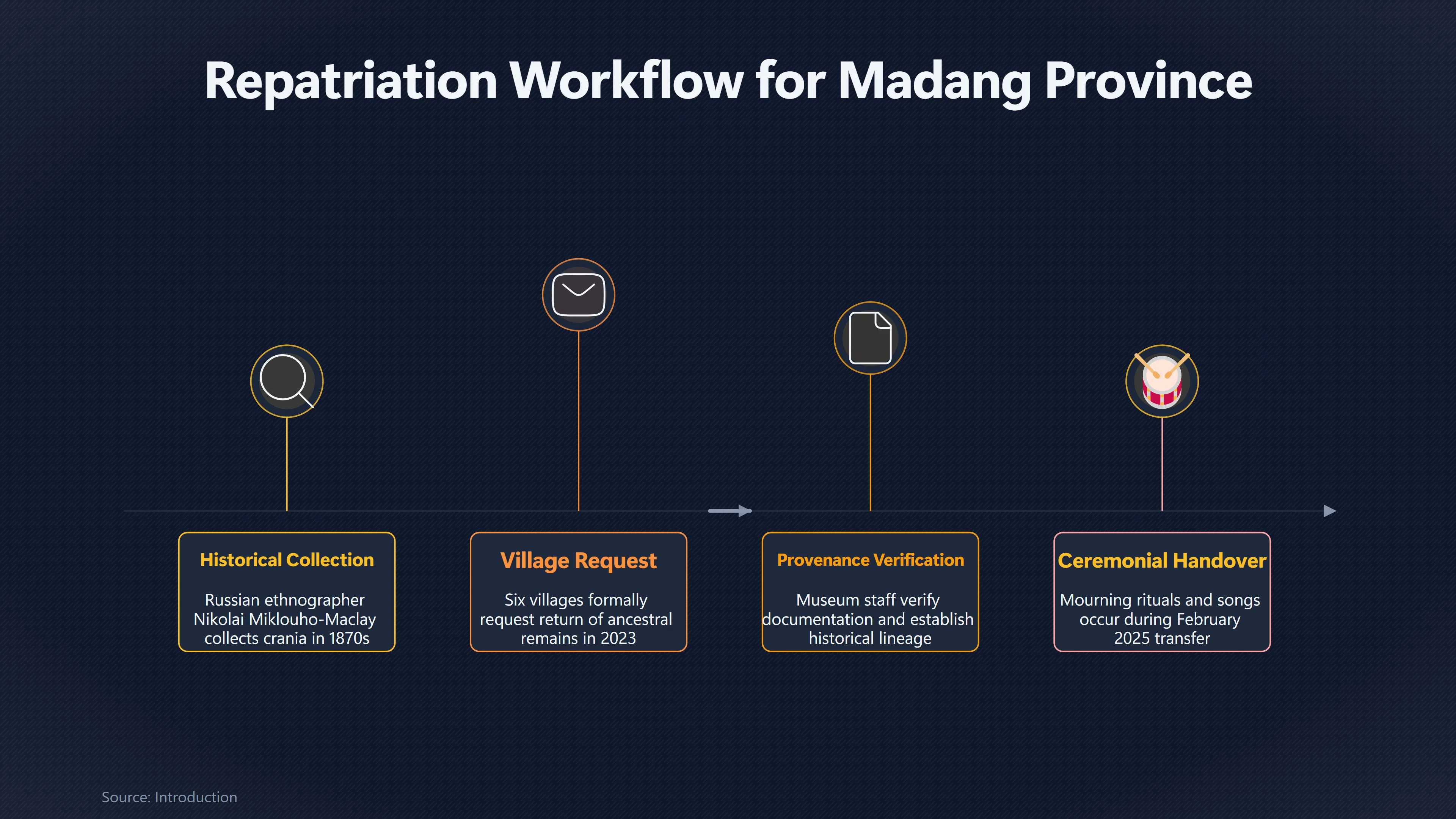
A contrasting example comes from Madang Province, where the return of sixteen human crania from the University of Sydney’s Chau Chak Wing Museum demonstrates what carefully documented repatriation can look like.
The remains had been collected during Russian ethnographer Nikolai Miklouho-Maclay’s expedition in the 1870s and later entered Australian museum collections. After leaders from six villages requested their return in 2023, museum staff worked with community representatives to verify documentation, establish provenance and organise an agreed transfer. Ceremonies in February 2025 involved mourning rituals, songs, dancing and formal handover to descendant communities. Museum staff emphasised that the process depended on extensive consultation rather than a unilateral institutional decision. Some of the individuals whose remains were returned were still remembered by name within their communities.[edu.au]sydney.edu.auThe University of SydneyChau Chak Wing Museum returns human remains to Papua New Guinea - The University of SydneyMarch 4, 2025…
The case illustrates that successful repatriation requires much more than transporting objects. Identification, documentation, cultural protocol and community authority are equally important.
Repatriation, Restricted Display and Shared Custody
Modern museums increasingly recognise that there is no single ethical outcome for every collection.
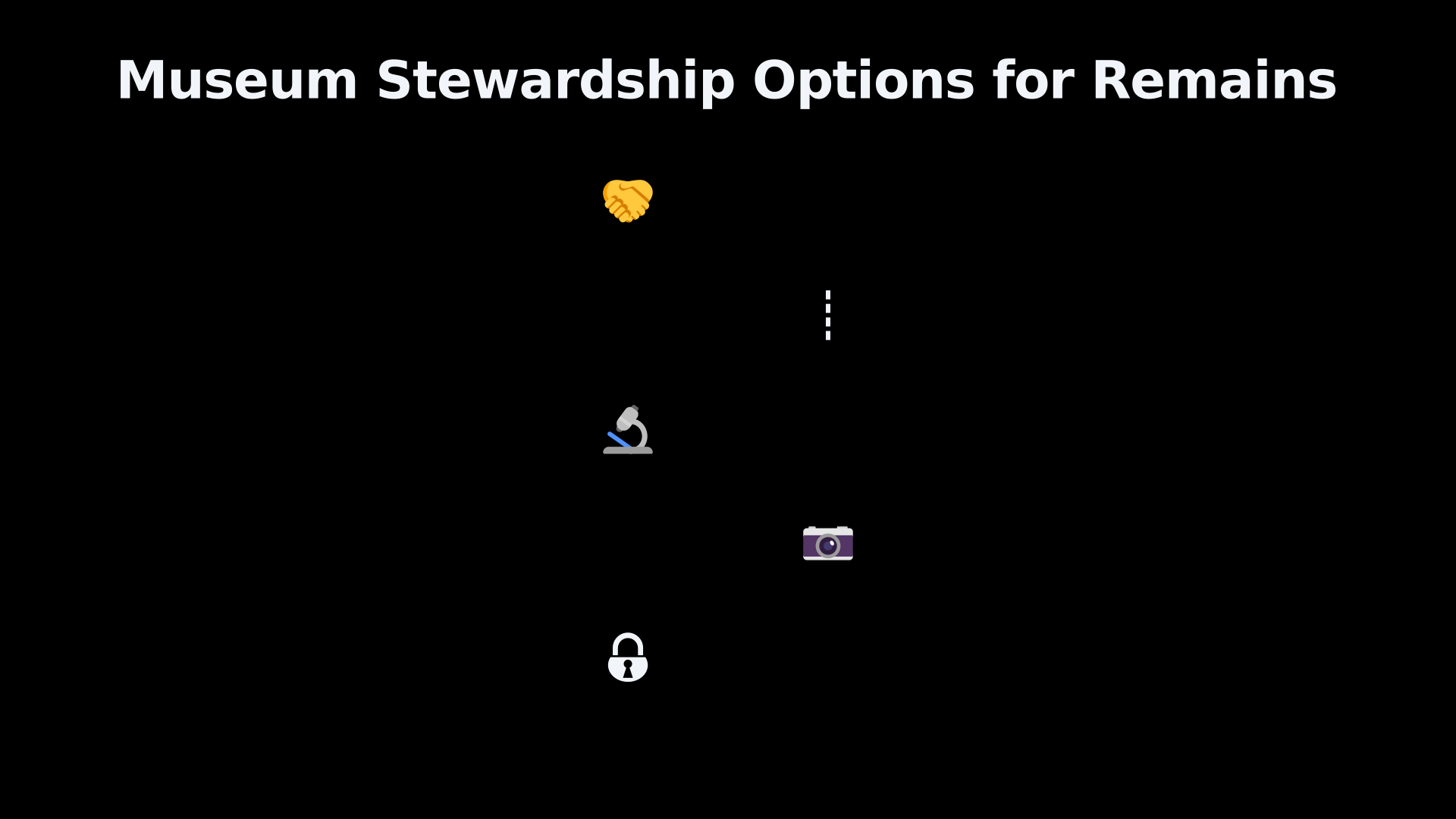
Possible approaches include:
- Permanent repatriation, where ownership and physical custody return to descendant communities.
- Restricted display, in which museums remove human remains from ordinary galleries or display them only with community approval.
- Shared stewardship, allowing research, conservation or exhibition under agreements negotiated with originating communities.
- Digital access, where communities receive detailed records, photography or documentation even if physical movement is delayed.
- Respectful retention, when communities themselves conclude that an object’s return would be inappropriate.
These options acknowledge that museums have responsibilities extending beyond legal ownership. Ethical stewardship increasingly depends upon dialogue rather than assumptions about what descendant communities should want.

Why This Debate Matters for Papua New Guinea’s Curiosity Heritage
For visitors interested in Papua New Guinea’s unusual collections, decorated skulls are often among the most visually memorable objects encountered in museums abroad. Yet their greatest significance lies not in their appearance but in the questions they raise.
Each skull or ancestral object carries intertwined histories of ritual life, colonial collecting, scientific research and contemporary cultural renewal. The most important stories are therefore no longer about how unusual these objects look in display cases. They concern who has the authority to speak for them, whether their histories can be reconstructed with confidence, and how museums and communities negotiate futures that respect both cultural traditions and historical realities.
In Papua New Guinea, those negotiations increasingly demonstrate that successful repatriation is measured not simply by the number of objects returned, but by whether descendant communities are genuinely able to decide what should happen next.
Amazon book picks
Further Reading
Books and field guides related to Who Should Decide Where Sacred Objects Belong?. Use these as the next step if you want deeper reading beyond the article.
Plundered Skulls and Stolen Spirits
A leading anthropologist "explores the fraught project of repatriating Native American sacred objects in this moving and thoughtful work"...
Museums and Restitution
This book examines contemporary approaches to restitution from the perspective of museums. It focuses on the ways in which these institut...
Decolonizing Museums
Museum exhibitions focusing on Native American history have long been curator controlled. However, a shift is occurring, giving Indigenou...
eBay marketplace picks
Marketplace Samples
Live-tested eBay searches with available results related to this page.
Selected fromOceanic collectible oneBay.co.uk.
Endnotes
1.
Source: museumfuernaturkunde.berlin
Link:https://www.museumfuernaturkunde.berlin/en/research-colonial-provenance-human-remains-museum-fur-naturkunde
2.
Source: thenational.com.pg
Title: The National Bringing back the skulls | The National
Link:https://www.thenational.com.pg/bringing-back-the-skulls/
3.
Source: thetimes.co.uk
Title: The Times Papua New Guinea tribe rejects return of ‘cursed’ ritual skulls
Link:https://www.thetimes.co.uk/article/papua-new-guinea-tribe-rejects-return-of-cursed-ritual-skulls-qnshvx65d
Source snippet
The skulls, collected by missionaries in the early 20th century and made by the Iatmul "crocodile" people from human remains, were feared...
4.
Source: sydney.edu.au
Link:https://www.sydney.edu.au/news-opinion/news/2025/03/04/chau-chak-wing-museum-returns-human-remains-to-papua-new-guinea.html
Source snippet
The University of SydneyChau Chak Wing Museum returns human remains to Papua New Guinea - The University of SydneyMarch 4, 2025...
Published: March 4, 2025
5.
Source: theartnewspaper.com
Link:https://www.theartnewspaper.com/2025/03/03/all-about-grief-and-mourning-sydney-museum-repatriates-human-remains-to-papua-new-guinea
Source snippet
The Art Newspaper - International art news and events...
6.
Source: journals.jcu.edu.au
Link:https://journals.jcu.edu.au/index.php/etropic/article/view/3983
7.
Source: britishmuseum.org
Link:https://www.britishmuseum.org/our-work/departments/human-remains
8.
Source: whc.unesco.org
Link:https://whc.unesco.org/en/decisions/1487/
Additional References
9.
Source: culturalpropertynews.org
Link:https://culturalpropertynews.org/papuan-tribes-refuse-return-of-ritual-skulls-citing-curses-and-loss-of-relevance/
Source snippet
Cultural Property NewsPapuan Tribes Refuse Return of Ritual Skulls, Citing Curses and Loss of Relevance - Cultural Property News...
10.
Source: youtube.com
Link:https://www.youtube.com/watch?v=nsvzPfPLlIk
Source snippet
"Papua New Guinea" human remains repatriation museum Cressida Fforde: Provenancing Indigenous Human Remains for Repatriation Intellectual...
11.
Source: fijiglobalnews.com
Title: Ancestors Reunited: The Return of Lost Skulls to Papua New Guinea
Link:https://fijiglobalnews.com/ancestors-reunited-the-return-of-lost-skulls-to-papua-new-guinea/
Source snippet
March 4, 2025 — Image: Ancestors Reunited: The Return of Lost Skulls to Papua New Guinea ANCESTORS REUNITED: THE RETURN OF...
Published: March 4, 2025
12.
Source: abc.net.au
Title: human skulls returned to rai coast papua new guinea
Link:https://www.abc.net.au/news/2025-03-02/human-skulls-returned-to-rai-coast-papua-new-guinea/104984342
Source snippet
ABC NewsHuman skulls taken for scientific research in 1800s returned to Papua New Guinea's Rai Coast - ABC News...
13.
Source: youtube.com
Link:https://www.youtube.com/watch?v=RODMqBYqpKk
Source snippet
Cressida Fforde: Provenancing Indigenous Human Remains for Repatriation...
14.
Source: restitutionmatters.org
Title: An uncomfortable possession
Link:https://restitutionmatters.org/publication/an-uncomfortable-possession-book/
Source snippet
book | RM*[restitution matters]September 17, 2025 — AN UNCOMFORTABLE POSSESSION – BOOK * Book * Missiemuseum Steyl * 01 Sep 2025 * Papua...
Published: September 17, 2025
15.
Source: youtube.com
Title: Cressida Fforde: Provenancing Indigenous Human Remains for Repatriation
Link:https://www.youtube.com/watch?v=C4dnSdRj_bI
Source snippet
Roundtable on Repatriation of Indigenous Ancestral Remains and Objects...
16.
Source: youtube.com
Title: “Repatriation of Clan Objects and Human Remains”
Link:https://www.youtube.com/watch?v=hPmtm9M0brI
Source snippet
Torres Strait islanders reclaim their ancestral bones (Papua New Guinea, Australia)...
17.
Source: youtube.com
Title: Roundtable on Repatriation of Indigenous Ancestral Remains and Objects
Link:https://www.youtube.com/watch?v=1vOnfWsglg4
Source snippet
Repatriation of Clan Objects and Human Remains...
18.
Source: brooklynmuseum.org
Link:https://www.brooklynmuseum.org/objects/80173