Within Romania Curiosities
Why Brad's Natural Gold Looks Almost Alive
Brad's native-gold specimens turn geology into a cabinet of forms that resemble leaves, animals and maps.
On this page
- How native gold forms
- The shapes visitors think they recognise
- Mining history behind the spectacle
Page outline Jump by section
Introduction
The Gold Museum at Brad, in Romania’s Apuseni Mountains, is unusual because its most memorable exhibits were not carved, polished or sculpted by people. Instead, they are natural pieces of native gold whose shapes resemble ferns, feathers, lizards, maps and other familiar forms. These specimens turn a geological collection into something that feels like a cabinet of natural curiosities, inviting visitors to see accidental sculpture created over millions of years rather than artistic design. The museum combines this visual fascination with the mining history of one of Europe’s richest historic gold regions, making it one of Romania’s most distinctive museums for anyone interested in unusual natural objects as well as industrial heritage.[PRIMĂRIA MUNICIPIULUI BRAD]primariabrad.roPRIMĂRIA MUNICIPIULUI BRADMuzeul Aurului din BradPRIMĂRIA MUNICIPIULUI BRADApril 12, 2019…
Why Brad’s natural gold looks almost alive
The museum’s most striking exhibits are examples of native gold—gold that crystallised naturally underground instead of being melted and shaped by humans. Unlike the smooth nuggets that many people imagine, native gold can grow as delicate leaves, wires, branching dendrites, plates and intricate crystal clusters, depending on the chemistry of mineral-rich fluids and the spaces available inside the surrounding rock.[PRIMĂRIA MUNICIPIULUI BRAD]primariabrad.roPRIMĂRIA MUNICIPIULUI BRADMuzeul Aurului din BradPRIMĂRIA MUNICIPIULUI BRADApril 12, 2019…
At Brad, visitors quickly discover that these geological processes can produce surprisingly organic-looking forms. Thin branching crystals resemble ferns or coral, flattened sheets look like leaves or feathers, while more irregular growths suggest animals in motion. These likenesses are entirely accidental. The human brain naturally recognises familiar patterns—a psychological tendency known as pareidolia—but the specimens themselves are products of mineral growth rather than intentional design. Their appeal comes from the tension between scientific explanation and visual imagination.[PRIMĂRIA MUNICIPIULUI BRAD]primariabrad.roPRIMĂRIA MUNICIPIULUI BRADMuzeul Aurului din BradPRIMĂRIA MUNICIPIULUI BRADApril 12, 2019…
Because the museum preserves these pieces in the condition in which miners recovered them, they remain examples of natural mineralogy rather than jewellery or decorative metalwork. Their scientific importance therefore matches their visual appeal.[PRIMĂRIA MUNICIPIULUI BRAD]primariabrad.roPRIMĂRIA MUNICIPIULUI BRADNOAPTEA MUZEELORMUZEUL AURULUI BRAD - PRIMĂRIA MUNICIPIULUI BRAD…
How native gold forms
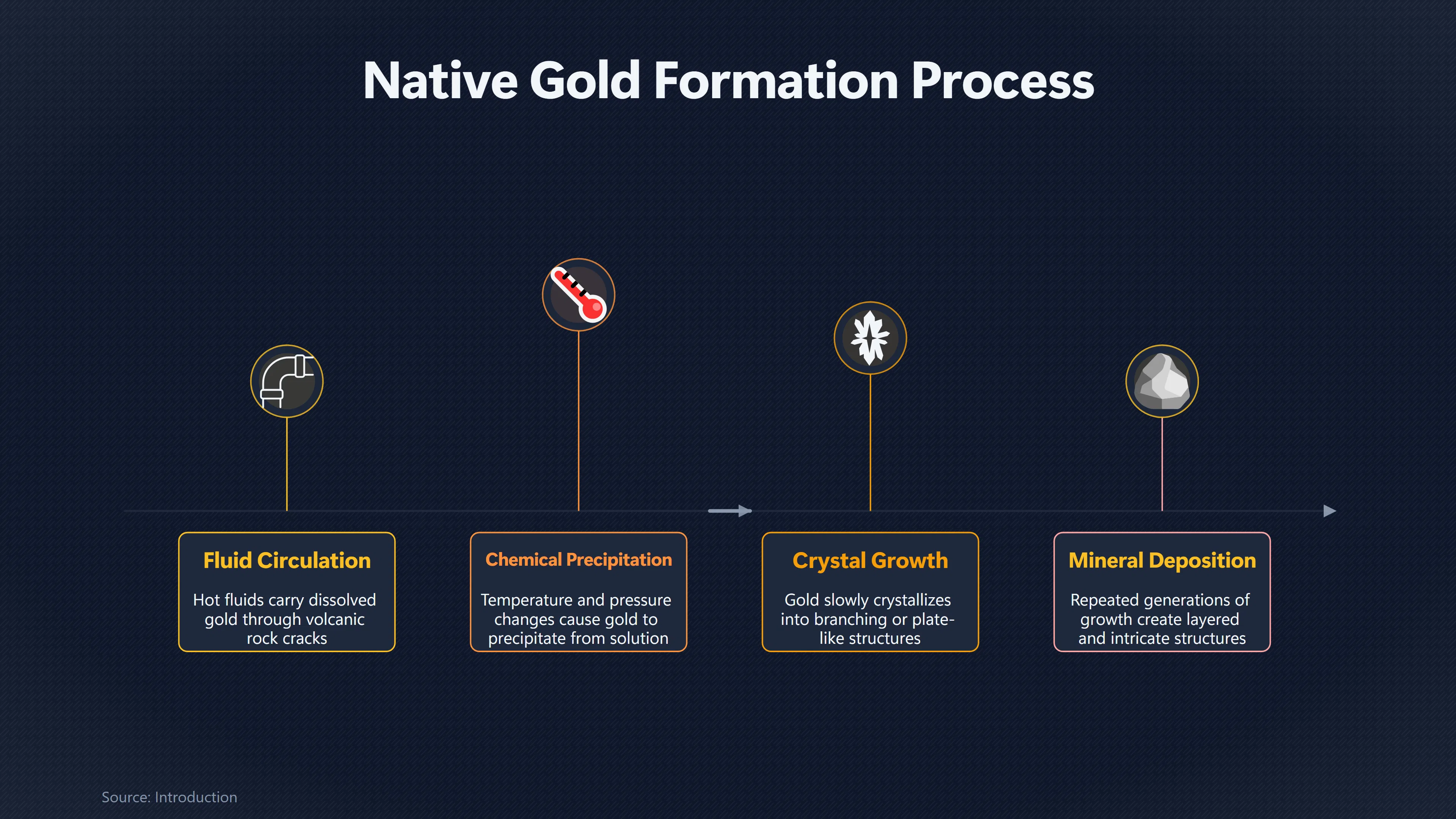
The unusual shapes begin deep underground, where hot fluids carrying dissolved gold circulate through cracks in volcanic and metamorphic rocks. As temperature, pressure or chemistry changes, the dissolved gold precipitates from solution and slowly crystallises.
The exact appearance depends on several factors:
- Available space: open cavities allow branching and more elaborate crystal growth.
- Growth speed: slow crystallisation often produces well-defined crystals, while faster deposition creates irregular or feather-like forms.
- Associated minerals: gold frequently grows alongside quartz, telluride minerals and sulphides, influencing the final appearance.
- Repeated mineral deposition: several generations of crystal growth can create layered or highly intricate structures.
Rather than forming uniform blocks, native gold often develops into extremely thin plates, filaments or dendritic branches. These fragile structures are rare because many are damaged during mining or processing. The Brad collection is therefore valuable not simply because it contains gold, but because so many specimens survived with their natural forms intact.[PRIMĂRIA MUNICIPIULUI BRAD]primariabrad.roPRIMĂRIA MUNICIPIULUI BRADMuzeul Aurului din BradPRIMĂRIA MUNICIPIULUI BRADApril 12, 2019…
The shapes visitors think they recognise
One reason the museum has become famous beyond geological circles is its tradition of giving memorable names to particularly distinctive specimens. These names are descriptive rather than scientific, helping visitors remember pieces that would otherwise appear as anonymous mineral samples.
Among the best-known examples are specimens nicknamed:
- The Map of Romania
- Eminescu’s Feather
- The Fern
- The Golden Lizards
- The Bear
- The Bride
- Avram Iancu’s Cannon
- The Golden Dodecahedron, also popularly called The Ballerina
These names reflect visual resemblance rather than geological classification. A branching crystal may suggest a fern frond, while another specimen’s outline resembles a reptile or a map. The famous dodecahedral crystal is especially admired because its remarkably regular crystal faces are exceptionally uncommon in natural gold.[primariabrad.ro]primariabrad.roPRIMĂRIA MUNICIPIULUI BRADNOAPTEA MUZEELORMUZEUL AURULUI BRAD - PRIMĂRIA MUNICIPIULUI BRAD…
This practice places the museum somewhere between a scientific mineral collection and a traditional curiosity cabinet. Visitors are encouraged to appreciate both the mineralogical processes that produced each specimen and the imaginative responses they inspire.
Mining history behind the spectacle
The museum’s natural sculptures cannot be separated from the history of mining around Brad. The surrounding Metaliferi and Apuseni Mountains have supplied gold since antiquity, with archaeological evidence pointing to mining activity extending back roughly two millennia. Later Roman, Habsburg and modern industrial mining all contributed to the region’s reputation as one of Romania’s principal gold-producing districts.[PRIMĂRIA MUNICIPIULUI BRAD]primariabrad.roPRIMĂRIA MUNICIPIULUI BRADMuzeul Aurului din BradPRIMĂRIA MUNICIPIULUI BRADApril 12, 2019…
The museum itself grew from mining-company collections assembled during the late nineteenth century. The earliest surviving visitor register dates from 1912, showing that the collection was already established by then with several hundred specimens. Over time it expanded through discoveries from local mines as well as exchanges with other mineral collections, eventually becoming one of Europe’s most important public collections of native gold.[PRIMĂRIA MUNICIPIULUI BRAD]primariabrad.roPRIMĂRIA MUNICIPIULUI BRADNOAPTEA MUZEELORMUZEUL AURULUI BRAD - PRIMĂRIA MUNICIPIULUI BRAD…
Today the displays place the spectacular specimens alongside mining tools, archaeological finds and minerals from the wider region. This broader context reminds visitors that every remarkable crystal originated through generations of exploration and extraction rather than being isolated natural curiosities.
Science, imagination and credibility
The Gold Museum is unusual because it encourages wonder without relying on myths or paranormal claims. The “animals”, “plants” and “maps” exist only as visual comparisons. Their forms arise through recognised geological processes, and the specimens are catalogued as mineralogical objects rather than mysterious artefacts.[PRIMĂRIA MUNICIPIULUI BRAD]primariabrad.roPRIMĂRIA MUNICIPIULUI BRADMuzeul Aurului din BradPRIMĂRIA MUNICIPIULUI BRADApril 12, 2019…
That combination gives the museum a distinctive place within Romania’s landscape of unusual collections. Many curiosity museums depend on folklore, legends or human-made oddities. Brad instead demonstrates that ordinary geological processes can produce objects that appear almost artistic. Nature becomes the sculptor, while the museum provides the setting in which visitors can appreciate how mineral growth, mining history and human imagination combine to transform raw gold into some of Romania’s most memorable natural curiosities.
Amazon book picks
Further Reading
Books and field guides related to Why Brad's Natural Gold Looks Almost Alive. Use these as the next step if you want deeper reading beyond the article.
The Story of Earth: The First 4.5 Billion Years, from Stardus...
Hailed by The New York Times for writing “with wonderful clarity about science . . . that effortlessly teaches as it zips along,” nationa...
The Gold Mine
A thrilling adventure novel from global sensation Wilbur Smith that brings to life all the dangers and excitements of the gold mining ind...
Annals of the Former World
Like the terrain it covers, Annals of the Former World tells a many-layered tale, and the reader may choose one of many paths through it,...

The Map that Changed the World
Rating: 3.2/5 from 5 Google Books ratings
The fascinating story of William Smith, the orphaned son of an English country blacksmith, who became obsessed with creating the world's...
eBay marketplace picks
Marketplace Samples
Live-tested eBay searches with available results related to this page.
Selected fromgeology collectible oneBay.co.uk.
Endnotes
1.
Source: primariabrad.ro
Title: PRIMĂRIA MUNICIPIULUI BRADMuzeul Aurului din Brad
Link:https://primariabrad.ro/muzeul-aurului-din-brad/
Source snippet
PRIMĂRIA MUNICIPIULUI BRADApril 12, 2019...
Published: April 12, 2019
2.
Source: agerpres.ro
Title: DOZA DE CULTURĂ: Muzeul Aurului din Brad
Link:https://agerpres.ro/documentare/2019/11/04/doza-de-cultura-muzeul-aurului-din-brad–397680
Source snippet
DOZA DE CULTURĂ: Muzeul Aurului din Brad - AGERPRES...
3.
Source: museum.wales
Title: Mineral Database
Link:https://museum.wales/mineralogy-of-wales/database/?mineral=94&name=Gold
4.
Source: youtube.com
Title: GOLD MUSEUM
Link:https://www.youtube.com/watch?v=r7c9qndjbnQ
Source snippet
BRAD ROMANIA...
5.
Source: mindat.org
Title: The Gold Museum
Link:https://www.mindat.org/museum-563.html
Source snippet
The Gold Museum...
6.
Source: primariabrad.ro
Title: PRIMĂRIA MUNICIPIULUI BRADNOAPTEA MUZEELOR
Link:https://primariabrad.ro/noaptea-muzeelor-muzeul-aurului-brad/
Source snippet
MUZEUL AURULUI BRAD - PRIMĂRIA MUNICIPIULUI BRAD...
7.
Source: mgmh.fas.harvard.edu
Title: mineral collection
Link:https://mgmh.fas.harvard.edu/mineral-collection
8.
Source: nhm.ac.uk
Link:https://www.nhm.ac.uk/our-science/research/projects/mineral-sciences/collections.html
Additional References
9.
Source: imperialtransilvania.com
Link:https://www.imperialtransilvania.com/it/2017/11/28/leggi-notizia/argomenti/places-of-interest-1/articolo/il-museo-delloro-di-brad-una-localita-simbolo-dellattivita-mineraria-e-dellestrazione-de.html
Source snippet
e mineralogica unica in Europa - ImperialTransilvaniaMay 28, 2024 — Punti di interesse 28 maggio 2024 IL "MUSEO DELL'ORO" DI BRAD, UNA LO...
Published: May 28, 2024
10.
Source: imperialtransilvania.com
Link:https://www.imperialtransilvania.com/ro/2022/02/06/citeste-stirea/argomenti/places-of-interest-1/articolo/muzeul-auruluidin-brad-localitate-simbol-al-mineritului-aurifer-in-romania-detine-o-colec.html
Source snippet
May 28, 2024 — Puncte de interes 28 mai 2024 „MUZEUL AURULUI”DIN BRAD, LOCALITATE SIMBOL AL MINERITULUI AURIFER ÎN RO...
Published: May 28, 2024
11.
Source: worldrecordacademy.org
Title: World’s Most Valuable 4,5 kg of Native Gold, The Gold Museum in Brad, Romania
Link:https://www.worldrecordacademy.org/2025/3/worlds-most-valuable-4-5-kg-of-native-gold-the-gold-museum-in-brad-romania-sets-world-record-425163
Source snippet
March 30, 2025 — WORLD'S MOST VALUABLE 4,5 KG OF NATIVE GOLD, THE GOLD MUSEUM IN BRAD, ROMANIA SETS WORLD RECORD March 30, 2025 Brad, Hun...
Published: March 30, 2025
12.
Source: ghidulmuzeelor.cimec.ro
Title: ro Romanian Museums and Collections Database
Link:https://ghidulmuzeelor.cimec.ro/idEN.asp?-muzeul-aurului-brad-hunedoara=&k=382
Source snippet
Museums and Collections Database - INP (cIMeC)June 30, 2026 — MUSEUMS AND COLLECTIONS IN ROMANIA MUSEUM OF GOLD Name: Museum of Gold Loca...
Published: June 30, 2026
13.
Source: youtube.com
Title: Romania’s Glittering Secret: Gold & Quartz of Rosia Montana
Link:https://www.youtube.com/watch?v=Yc5hyxzTwg8
Source snippet
Gold Museum Brad Romania GOLD MUSEUM BRAD ROMANIA ada Wittenberger...
14.
Source: sciencedirect.com
Link:https://www.sciencedirect.com/science/article/pii/S0168583X04003337
15.
Source: mindat.org
Link:https://www.mindat.org/gl/156379
16.
Source: visitromania.ro
Link:https://visitromania.ro/en/attraction/brad/muzeul-etnografic-brad
17.
Source: nhm.org
Link:https://nhm.org/research-collections/departments-and-programs/mineral-sciences
18.
Source: visitromania.ro
Link:https://visitromania.ro/en/attraction/brad/muzeul-aurului-brad