Where Ocean Knowledge Meets Nuclear Ruins
The Marshall Islands does not have a large circuit of eccentric museums devoted to ghosts, monsters, witchcraft or medical curiosities. Its strange-heritage landscape is smaller, more serious and, in some ways, more extraordinary.
Page outline Jump by section
Introduction
The main conventional destination is the Alele Museum, Library and National Archives in Majuro, where navigation models, canoe culture, historic photographs, tools and records are brought together. Beyond it, a working canoe organisation functions partly as a living collection, while Bikini Atoll presents an entire contaminated landscape and underwater “ghost fleet” as a difficult, ethically charged kind of open-air museum. These places are not novelty attractions. They preserve systems of knowledge, colonial encounters, displacement and environmental damage that continue to shape Marshallese life.[facebook.com]facebook.comAlele Museum & Public Library | MajuroVisit Alele Museum — where the stories, traditions, and resilience of the Marshallese peopl…
Where to start: Alele Museum in Majuro
Alele Museum, Library and National Archives is the closest thing the Marshall Islands has to a national cabinet of curiosities. It combines a public museum, research collections, archival holdings and the country’s only public library. Its displays are relatively modest in scale, but they introduce many of the objects that make Marshallese cultural history so distinctive: canoe models, fishing equipment, woven materials, jewellery, tools and navigation charts. Recent visitor reports describe a small institution whose strength lies more in information and interpretation than in elaborate exhibition design.[tripadvisor.co.uk]tripadvisor.co.ukALELE MUSEUM, LIBRARY AND NATIONAL ARCHIVES31 Aug 2018 — The Alele Museum showcases a wide variety of important documents, alo…
The museum’s name is especially appropriate. An alele is traditionally understood as a basket or container used to hold a family’s valuables. The institution performs a similar role at national level, preserving objects and records from islands separated by great distances of ocean. Its importance therefore exceeds what a visitor might assume from the size of the galleries: this is simultaneously a museum, memory store, educational centre and archival safeguard in a country where heat, humidity, salt air and limited resources make long-term preservation difficult.[Wikipedia]WikipediaAlele Museum & Public LibraryAlele Museum & Public Library
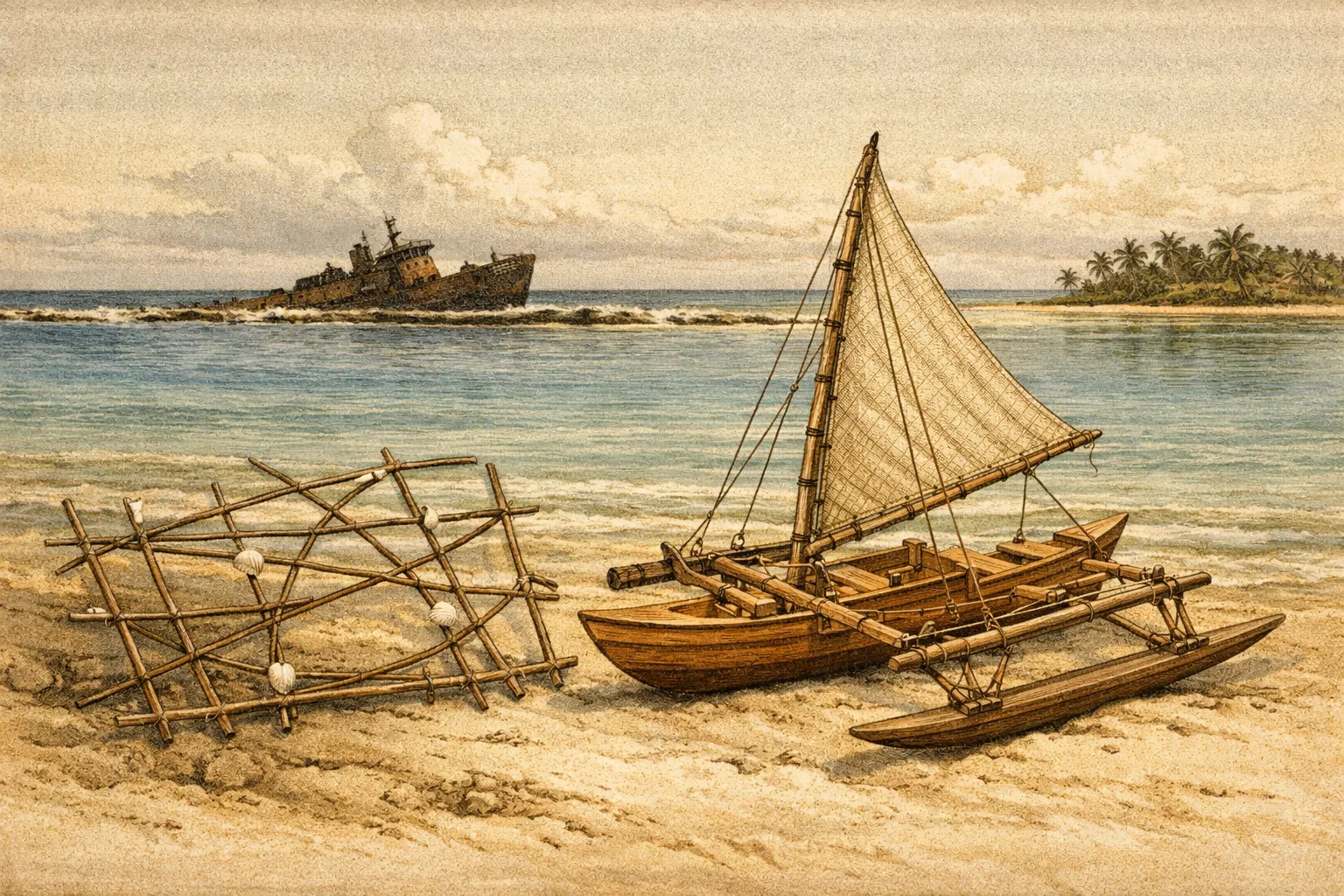
The most unusual objects are the Marshallese navigation charts commonly called “stick charts”. These delicate frameworks look at first like abstract sculptures or improvised diagrams. Curved and straight elements represent patterns of ocean swell and the ways waves bend, reflect or interact around islands; shells may indicate land. Some charts taught general principles, while others represented particular groups of islands. They were usually studied and memorised before travel rather than handled like European maps during a voyage.[si.edu]ocean.si.eduOpen source on si.edu.
That distinction matters. A stick chart is not simply an exotic substitute for a printed nautical map. It is a model of relationships between water, land, bodily sensation and memory. Skilled navigators could detect islands beyond visual range by reading changes in wave motion through the movement of a canoe. Researchers have described the tradition as a sophisticated form of wave piloting, although aspects of the hydrodynamics behind particular reported wave paths remain debated. The charts are therefore unusual both as artefacts and as evidence of a scientific system developed through generations of close observation.[sciencedirect.com]sciencedirect.comOpen source on sciencedirect.com.
Visitors should not expect a polished, technology-heavy national museum on the scale of institutions in larger countries. Published opening hours differ between listings, and small Pacific institutions can close for maintenance, public holidays or operational reasons. Checking locally before visiting is sensible. The museum’s value lies in its concentration of original material and local historical knowledge, not theatrical presentation.[trip.com]us.trip.comalele museum library and national archives 50659400alele museum library and national archives 50659400
A living collection of canoes and sea knowledge
Waan Aelõñ in Majel, commonly known as WAM or Canoes of the Marshall Islands, offers a different kind of museum experience. It is a vocational and cultural organisation rather than a conventional collecting institution, but its visitor centre displays Marshallese canoes and explains their history. More importantly, canoe building and sailing remain active practices there rather than subjects sealed behind glass.[canoesmarshallislands.com]canoesmarshallislands.comCanoes of the Marshall Islands – Waan Aelõñ in MajelShowcasing Marshallese canoes and their history, the Waan Aelon in Majel's Visitors C…
This makes WAM particularly useful for understanding the navigation charts at Alele. A chart can appear cryptic when separated from the canoe, the lagoon and the movement of water. At WAM, visitors can see how hull design, outrigger construction, sailing skill and environmental knowledge fit together. Traditional model canoes are also produced as training exercises, with miniature paddles and structural details echoing full-sized craft. The resulting objects sit somewhere between educational models, saleable handicrafts and records of maritime engineering.[canoesmarshallislands.com]canoesmarshallislands.comOpen source on canoesmarshallislands.com.
The organisation’s public-facing work is best understood as living heritage rather than historical reconstruction. It preserves practical expertise by teaching people to build, repair and sail canoes. That makes it less like a museum of vanished technology and more like a workshop in which a threatened knowledge system remains usable. For travellers interested in strange collections, this is a reminder that some of the Marshall Islands’ most remarkable “exhibits” are skills embodied by craftspeople and navigators, not rare objects owned by an institution.
Bikini Atoll as a nuclear open-air museum
Bikini Atoll is the country’s most internationally famous heritage site and its most unsettling. Between 1946 and 1958, the United States conducted 23 nuclear tests at Bikini. Across Bikini and Enewetak, the wider Marshall Islands testing programme involved 67 detonations. The explosions transformed reefs, islands and lagoon environments, displaced communities and exposed people to radioactive fallout. UNESCO inscribed the Bikini Atoll Nuclear Test Site on the World Heritage List in 2010 as material testimony to the beginning of the nuclear age and its effects on civilian populations.[nuclearmuseum.org]ahf.nuclearmuseum.orgNuclear Museum Marshall IslandsNuclear Museum Marshall Islands
The atoll is unusual because almost everything within the heritage landscape can be read as an exhibit: bomb craters, bunkers, abandoned infrastructure, altered islands and military vessels sunk during Operation Crossroads. It is not a museum in the ordinary sense, but an enormous assemblage of artefacts embedded in land and water. Some remains are spectacular, yet their meaning cannot be separated from the forced displacement of Bikini’s people or the long failure to achieve secure resettlement.
The best-known episode is the Castle Bravo test of 1 March 1954. The device produced a yield of about 15 megatons, far greater than its planners expected. Radioactive debris spread over inhabited atolls and affected US personnel and the crew of the Japanese fishing vessel Lucky Dragon No. 5. The event became a defining symbol of the dangers of atmospheric nuclear testing and helped intensify international opposition to nuclear weapons.[National Security Archive]nsarchive.gwu.educastle bravo 70 worst nuclear test us historycastle bravo 70 worst nuclear test us history
Bikini’s underwater remains have since been commercialised as an elite wreck-diving destination. The lagoon contains warships associated with the nuclear tests, including major vessels sunk during Operation Crossroads. Current expeditions generally operate by specialist liveaboard rather than through an ordinary resort, and the diving is aimed at experienced technical wreck divers. Access is remote, expensive and tightly organised; it is not a casual excursion from Majuro.[bluewaterdivetravel.com]bluewaterdivetravel.combikini atoll divingbikini atoll diving
Calling the wrecks a “ghost fleet” is evocative but can obscure the ethical issue. They are simultaneously archaeological remains, military hardware, artificial reefs, commercial attractions and evidence from experiments conducted after islanders had been removed from their homeland. UNESCO has also noted risks associated with unexploded ordnance, fuel and the condition of submerged vessels, while identifying the need for stronger visitor interpretation and documentation.[UNESCO World Heritage Centre]whc.unesco.orgWorld Heritage Centre UNESCO World Heritage CentreWorld Heritage Centre UNESCO World Heritage Centre
The site should therefore be approached less as an adventure playground than as a memorial landscape. Its strange appeal comes from the collision of recognisable museum categories that normally remain separate: battlefield archaeology, industrial ruins, environmental history, shipwreck tourism and testimony to human displacement.
Runit Dome: an artefact too large to collect
On Runit Island in Enewetak Atoll, a broad concrete cap covers a bomb crater filled with radioactive debris gathered during a US clean-up operation. Known as Runit Dome, Cactus Dome or “the Tomb”, it has become one of the most disturbing structures associated with the nuclear legacy of the Marshall Islands. It resembles a monumental piece of land art, but it is a waste-containment structure rather than a memorial designed for visitors.[marshallislands.llnl.gov]marshallislands.llnl.govRunit DomeRunit Dome
The dome is frequently described in dramatic media coverage as a leaking nuclear coffin on the brink of collapse. The reality requires more care. Scientists and official assessments have acknowledged ageing, cracking and broader environmental concerns, but have also pointed out that surrounding sediments and lagoon environments were already contaminated. A breach would not necessarily create the simple, sudden catastrophe implied by some headlines. That does not make the site harmless; it means that the problem is a contaminated landscape, not merely one concrete lid.[marshallislands.llnl.gov]marshallislands.llnl.govRunit DomeRunit Dome
Runit Dome is not a normal public attraction and should not be treated as one. Its importance within the country’s curiosity culture is interpretive: it is a single, unmistakable object through which people attempt to comprehend an otherwise dispersed nuclear legacy. Like an oversized museum artefact, it condenses policy decisions, military engineering, radioactive waste and unresolved responsibility into one visible form.

The deBrum collection and a vanished house museum
The Joachim deBrum collection represents another remarkable strand of Marshallese collecting history. Joachim deBrum, associated with Likiep Atoll, assembled books, papers, photographs, recordings and household objects documenting life during periods of German and Japanese colonial influence and rapid technological change. His glass-plate photographs are especially valuable because they provide an extensive visual record made by a Pacific Islander rather than solely by missionaries, colonial officials or visiting ethnographers. The documentary collection is now closely associated with preservation and cataloguing work at Alele.[imls.gov]imls.govRepublic of the Marshall IslandsAlele, the only public library in the Marshall Islands, supported access to information through its techn…
The deBrum family house on Likiep once functioned as something close to a historic house museum. Conservation records describe a plantation-era residence retaining books, furniture and other family material. Older documentation treated it as an exceptional surviving example of Micronesian plantation architecture, combining imported materials and furnishings with the complicated history of commerce and colonial rule in the islands.[researchgate.net]researchgate.netResearch Gate The Joachim De Brum House, Likiep Atoll, Marshall IslandsResearch Gate The Joachim De Brum House, Likiep Atoll, Marshall Islands
Its present condition is poorly documented in authoritative public sources. Recent informal accounts report that the museum closed and that much of the house has been lost, with surviving furniture kept elsewhere by family members. These claims are plausible but should be treated cautiously until confirmed by local heritage authorities. Visitors should not assume that a functioning museum remains on Likiep merely because older travel or heritage references describe one.[The Adventures of Sugar Shack]svsugarshack.comThe Adventures of Sugar Shack Tag Archives: de Brum houseThe Adventures of Sugar Shack Tag Archives: de Brum house
The case illustrates a wider problem in the Marshall Islands: vulnerable buildings and collections may disappear faster than catalogue records or tourism descriptions are updated. In such circumstances, archives, copied photographs and digitised records can become the principal surviving “museum” even when the original setting has deteriorated.
What is absent, and why that matters
There is no well-documented Marshallese equivalent of a European witchcraft museum, cryptid collection, UFO attraction or commercial chamber of horrors. Folklore, spirituality and unusual beliefs certainly form part of Marshallese culture, but reliable public information does not show them being packaged into dedicated oddity museums. Inventing such a circuit would misrepresent the country.
Instead, the Marshall Islands’ distinctive collection culture grows from geography and history. A small population is spread across remote atolls; many heritage objects were taken abroad during colonial and scientific collecting; local institutions work with limited conservation space and funding; and some of the country’s most important “collections” are landscapes, oral histories and practical skills. National law regulates the removal and export of culturally significant artefacts and recognises both museum curation and the existence of private collections, reflecting the sensitivity surrounding material heritage.[marshall.csu.edu.au]marshall.csu.edu.auOpen source on edu.au.
This also explains why Marshallese navigation charts are often easier to find in major overseas museums than in extensive displays within the islands themselves. The Smithsonian, British Museum, Metropolitan Museum of Art and other institutions hold examples. Those collections increase international awareness, but they also detach the charts from the communities, languages and seafaring practices that make them intelligible.[si.edu]si.edunmnhanthropology 8552873nmnhanthropology 8552873
How to visit responsibly
For most travellers, Alele Museum and the WAM visitor centre in Majuro form the practical core of an unusual-heritage itinerary. Together they connect preserved objects with living canoe knowledge. Opening arrangements should be checked directly, particularly around public holidays or institutional events.
Bikini Atoll belongs in a different category. Visiting requires specialist planning, permission and a self-sufficient operator. Diving expeditions should be chosen for their technical safety, local authorisation and quality of historical interpretation, not simply their promise of access to dramatic wrecks.[Marshall Islands Guide]infomarshallislands.comOpen source on infomarshallislands.com.
Runit Dome and remote heritage sites should never be approached as unsupervised ruins to be explored, climbed upon or sampled. Radioactive contamination, unexploded ordnance, difficult transport and community authority all impose real limits. Artefacts should not be removed from historic sites, beaches, wrecks or abandoned structures.
The most rewarding approach is to resist the urge to search for freak exhibits. In the Marshall Islands, strangeness lies in objects that overturn familiar ideas of maps, museums and monuments: a web of fibres that records invisible waves; a canoe workshop that keeps an intellectual tradition alive; a lagoon filled with nuclear-age shipwrecks; and a concrete dome that has become a global symbol of waste, memory and unfinished responsibility.
Amazon book picks
Further Reading
Books and field guides related to Where Ocean Knowledge Meets Nuclear Ruins. Use these as the next step if you want deeper reading beyond the article.
We, the Navigators: The Ancient Art of Pacific Landfinding
First published 1972. Subjects: Navigation, Micronesians, Polynesians, Micronésiens, Entdeckung.
Sea People: The Puzzle of Polynesia
A blend of Jared Diamond’s Guns, Germs, and Steel and Simon Winchester’s Pacific, a thrilling intellectual detective story that looks dee...
eBay marketplace picks
Marketplace Samples
Live-tested eBay searches with available results related to this page.
Selected fromcanoe model oneBay.co.uk.
Endnotes
1.
Source: facebook.com
Link:https://www.facebook.com/alelemuseum/?locale=en_GB
Source snippet
Alele Museum & Public Library | MajuroVisit Alele Museum — where the stories, traditions, and resilience of the Marshallese peopl...
2.
Source: canoesmarshallislands.com
Link:https://www.canoesmarshallislands.com/
Source snippet
Canoes of the Marshall Islands – Waan Aelõñ in MajelShowcasing Marshallese canoes and their history, the Waan Aelon in Majel's Visitors C...
3.
Source: whc.unesco.org
Title: World Heritage Centre Bikini Atoll Nuclear Test Site
Link:https://whc.unesco.org/en/list/1339/
4.
Source: imls.gov
Link:https://www.imls.gov/find-funding/funding-opportunities/grants-state/state-profiles/republic-marshall-islands
Source snippet
Republic of the Marshall IslandsAlele, the only public library in the Marshall Islands, supported access to information through its techn...
5.
Source: Wikipedia
Title: Alele Museum & Public Library
Link:https://en.wikipedia.org/wiki/Alele_Museum_%26_Public_Library
6.
Source: sciencedirect.com
Link:https://www.sciencedirect.com/science/article/pii/S0315086085710300
7.
Source: arxiv.org
Link:https://arxiv.org/abs/1802.09151
8.
Source: us.trip.com
Title: alele museum library and national archives 50659400
Link:https://us.trip.com/travel-guide/attraction/majuro/alele-museum-library-and-national-archives-50659400/
9.
Source: canoesmarshallislands.com
Link:https://www.canoesmarshallislands.com/category/product/
10.
Source: marshallislands.llnl.gov
Title: Bikini Atoll
Link:https://marshallislands.llnl.gov/affected-areas/bikini-atoll
11.
Source: whc.unesco.org
Title: World Heritage Centre UNESCO World Heritage Centre
Link:https://whc.unesco.org/en/decisions/3999
12.
Source: whc.unesco.org
Title: World Heritage Centre UNESCO World Heritage Centre
Link:https://whc.unesco.org/en/compendium/285
13.
Source: marshallislands.llnl.gov
Title: Runit Dome
Link:https://marshallislands.llnl.gov/affected-areas/runit-dome
14.
Source: researchgate.net
Title: Research Gate The Joachim De Brum House, Likiep Atoll, Marshall Islands
Link:https://www.researchgate.net/publication/237280310_The_Joachim_De_Brum_House_Likiep_Atoll_Marshall_Islands-an_outstanding_example_of_Micronesian_plantation_architecture
15.
Source: marshall.csu.edu.au
Link:https://marshall.csu.edu.au/Marshalls/html/PDF_downloads/JC-Report-151.pdf
16.
Source: marshall.csu.edu.au
Link:https://marshall.csu.edu.au/Marshalls/html/RMILAW/HPA1991.html
17.
Source: marshall.csu.edu.au
Title: Reg Export
Link:https://marshall.csu.edu.au/Marshalls/html/RMILAW/Reg_Export.html
18.
Source: unesco.org
Title: UNESC O statement on Aldabra Atoll
Link:https://www.unesco.org/en/articles/unesco-statement-aldabra-atoll-world-heritage-property
19.
Source: unesco.org
Link:https://www.unesco.org/en/underwater-heritage/access
21.
Source: whc.unesco.org
Link:https://whc.unesco.org/fr/list/1339/
22.
Source: whc.unesco.org
Link:https://whc.unesco.org/en/documents/105316
23.
Source: marshall.csu.edu.au
Title: Reg Human
Link:https://marshall.csu.edu.au/Marshalls/html/RMILAW/Reg_Human.html
25.
Source: whc.unesco.org
Link:https://whc.unesco.org/en/list/1339/documents/
26.
Source: facebook.com
Link:https://www.facebook.com/archaeologymag/posts/from-the-archives-this-stick-chart-from-the-marshall-islands-represents-the-inte/803656868462284/
27.
Source: facebook.com
Link:https://www.facebook.com/paradisescom/posts/-experience-the-living-history-of-the-marshall-islands-at-alele-museumlocated-in/1105436838278328/
28.
Source: facebook.com
Link:https://www.facebook.com/YoungPioneerTours/posts/today-ypts-least-visited-countries-spring-tour-continued-in-the-marshall-islands/1433421875485074/
29.
Source: facebook.com
Link:https://www.facebook.com/SouthPacificPocketGuide/posts/alele-museum-in-majuro-a-fascinating-insight-into-marshallese-culture-and-histor/1620684280059721/
30.
Source: facebook.com
Link:https://www.facebook.com/alelemuseum/
31.
Source: facebook.com
Link:https://www.facebook.com/wam.rmi/
32.
Source: facebook.com
Link:https://www.facebook.com/greenpeace.international/posts/this-is-the-runit-dome-in-the-marshall-islands-built-by-the-us-to-contain-radioa/1103535281807782/
33.
Source: Wikipedia
Link:https://en.wikipedia.org/wiki/Alele
34.
Source: Wikipedia
Title: Nuclear testing at Bikini Atoll
Link:https://en.wikipedia.org/wiki/Nuclear_testing_at_Bikini_Atoll
35.
Source: Wikipedia
Title: Marshall Islands stick chart
Link:https://en.wikipedia.org/wiki/Marshall_Islands_stick_chart
36.
Source: Wikipedia
Title: Runit Island
Link:https://en.wikipedia.org/wiki/Runit_Island
37.
Source: Wikipedia
Title: Debrum House
Link:https://en.wikipedia.org/wiki/Debrum_House
38.
Source: marshallislands.llnl.gov
Link:https://marshallislands.llnl.gov/
39.
Source: marshall.csu.edu.au
Link:https://marshall.csu.edu.au/MJHSS/Issue2006/MJHSS2006_141.pdf
40.
Source: marshall.csu.edu.au
Link:https://marshall.csu.edu.au/Marshalls/html/RMILAW/Historic_Overview.html
41.
Source: marshall.csu.edu.au
Link:https://marshall.csu.edu.au/history.html
42.
Source: marshall.csu.edu.au
Title: National Archives Act
Link:https://marshall.csu.edu.au/Marshalls/html/RMILAW/National_Archives_Act.html
43.
Source: marshall.csu.edu.au
Link:https://marshall.csu.edu.au/FSM/FSM_History.html
44.
Source: marshall.csu.edu.au
Link:https://marshall.csu.edu.au/CNMI/CNMI_History.html
45.
Source: marshall.csu.edu.au
Link:https://marshall.csu.edu.au/Marshalls/index2.html
46.
Source: nationalarchives.gov.uk
Link:https://www.nationalarchives.gov.uk/visit/plan-your-visit/opening-times/
47.
Source: tripadvisor.com
Title: Bikini Atoll
Link:https://www.tripadvisor.com/Attraction_Review-g301393-d635233-Reviews-Bikini_Atoll-Majuro.html
48.
Source: tripadvisor.com
Title: Canoes of the Marshall Islands
Link:https://www.tripadvisor.com/Attraction_Review-g301393-d27454475-Reviews-Canoes_of_the_Marshall_Islands-Majuro.html
49.
Source: imls.gov
Link:https://www.imls.gov/sites/default/files/state-profiles/plans/marshallislands5yearplan.pdf
50.
Source: audiovis.nac.gov.pl
Link:https://audiovis.nac.gov.pl/obraz/233825/
51.
Source: tripadvisor.co.uk
Link:https://www.tripadvisor.co.uk/Attraction_Review-g301393-d6416687-Reviews-Alele_Museum_Library_and_National_Archives-Majuro.html
Source snippet
ALELE MUSEUM, LIBRARY AND NATIONAL ARCHIVES31 Aug 2018 — The Alele Museum showcases a wide variety of important documents, alo...
52.
Source: southpacificislands.travel
Link:https://southpacificislands.travel/alele-museum-in-marshall-islands/
Source snippet
Pacific Tourism OrganisationAlele Museum in Marshall IslandsLocated in downtown Majuro, open M-F 9AM-12PM and 1PM-4PM. Call Alele at 625...
53.
Source: ocean.si.edu
Link:https://ocean.si.edu/human-connections/history-cultures/navigating-waters-micronesian-stick-charts
54.
Source: britishmuseum.org
Link:https://www.britishmuseum.org/collection/object/E_Oc1941
55.
Source: infomarshallislands.com
Link:https://www.infomarshallislands.com/sail-on-a-canoe/
56.
Source: ahf.nuclearmuseum.org
Title: Nuclear Museum Marshall Islands
Link:https://ahf.nuclearmuseum.org/ahf/location/marshall-islands/
57.
Source: nsarchive.gwu.edu
Title: castle bravo 70 worst nuclear test us history
Link:https://nsarchive.gwu.edu/briefing-book/nuclear-vault/2024-02-29/castle-bravo-70-worst-nuclear-test-us-history
58.
Source: bluewaterdivetravel.com
Title: bikini atoll diving
Link:https://www.bluewaterdivetravel.com/destination/bikini-atoll-diving
59.
Source: indiestrader.com
Link:https://indiestrader.com/bikini-atoll/
60.
Source: svsugarshack.com
Title: The Adventures of Sugar Shack Tag Archives: de Brum house
Link:https://www.svsugarshack.com/tag/debrum-house/
61.
Source: svsugarshack.com
Title: The Adventures of Sugar Shack Likiep Archives
Link:https://www.svsugarshack.com/category/locations/marshall-islands/likiep/
62.
Source: si.edu
Title: nmnhanthropology 8552873
Link:https://www.si.edu/object/nmnhanthropology_8552873
63.
Source: metmuseum.org
Title: The Metropolitan Museum of Art Marshall Islands artist
Link:https://www.metmuseum.org/art/collection/search/311297
64.
Source: britishmuseum.org
Link:https://www.britishmuseum.org/collection/search?keyword=EOC10661
65.
Source: infomarshallislands.com
Link:https://www.infomarshallislands.com/bikini-atoll/
66.
Source: jmberlin.de
Link:https://www.jmberlin.de/en/collection
67.
Source: erm.ee
Link:https://www.erm.ee/en/collections-and-research/collections/
68.
Source: infomarshallislands.com
Link:https://www.infomarshallislands.com/atolls-a-w/likiep-atoll/an-original-debrum-house-on-likiep-photo-karen-earnshaw/
69.
Source: wisdomlib.org
Link:https://www.wisdomlib.org/definition/alele
70.
Source: alelemuseum.tripod.com
Link:https://alelemuseum.tripod.com/Museum.html
71.
Source: allthatsinteresting.com
Title: runit dome
Link:https://allthatsinteresting.com/runit-dome
72.
Source: mei.ngo
Link:https://www.mei.ngo/nuclear
73.
Source: en.wiktionary.org
Link:https://en.wiktionary.org/wiki/Alele
Additional References
74.
Source: files.eric.ed.gov
Link:https://files.eric.ed.gov/fulltext/ED616484.pdf
75.
Source: npgallery.nps.gov
Link:https://npgallery.nps.gov/GetAsset/aedd2125-a953-4d07-beb4-914dd53f2d90
76.
Source: youtube.com
Title: The Ancient Stick Maps That Tackle Unsolvable Physics
Link:https://www.youtube.com/watch?v=0cc35RyshdE
Source snippet
Visit to the Alele Museum, Majuro Atoll, Marshall Islands...
77.
Source: steller.co
Link:https://steller.co/p/alele-museum-and-4VPY2LxYYhnt32Rzx2uHrFU
78.
Source: familysearch.org
Link:https://www.familysearch.org/en/surname?surname=alele
79.
Source: instagram.com
Link:https://www.instagram.com/alwaysalele/
80.
Source: opendestinations.org
Link:https://opendestinations.org/attraction/bikini-atoll
81.
Source: bikiniatoll.com
Link:https://www.bikiniatoll.com/divetour.html
82.
Source: michpo.org
Link:https://www.michpo.org/about
83.
Source: lib.cam.ac.uk
Link:https://www.lib.cam.ac.uk/rcs/projects-exhibitions/marshall-islands-sailing-charts