Where Liechtenstein Keeps Its Strangest Stories
Liechtenstein does not have a large circuit of dedicated witchcraft, UFO, cryptid or medical-oddity museums.
Page outline Jump by section
Introduction
For visitors seeking the unusual, the strongest starting points are the Liechtenstein Treasure Chamber and National Museum in Vaduz, followed by the Walser Museum and Legends Trail in Triesenberg. The Postal Museum, Farmhouse Museum and volunteer-run Lawena Museum are more specialised, but reveal how this tiny country preserves objects that might disappear into storage elsewhere.[landesmuseum.li]landesmuseum.liLiechtenstein TreasureChamberIn addition to Fabergé's famous Apple Blossom Egg, other eggs, some of which are set with precious stones, a…
Where the strangest objects are kept
The Treasure Chamber: moon dust beside imperial eggs
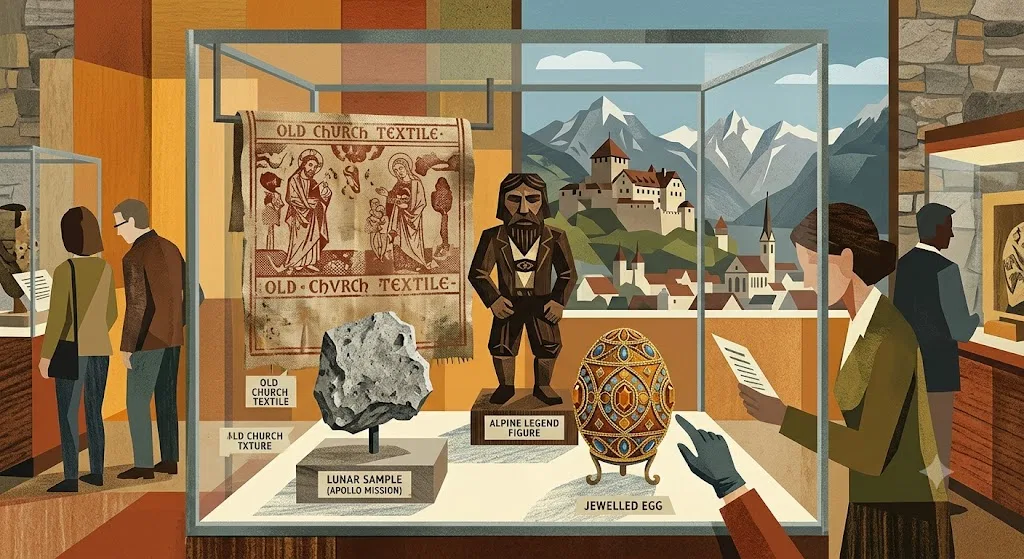
The Liechtenstein Treasure Chamber is the country’s clearest cabinet of curiosities. It is a public museum in central Vaduz, operated as part of the Liechtenstein National Museum, but its atmosphere is closer to a concentrated treasury than a conventional historical gallery. Weapons, ceremonial gifts and objects associated with the princely family sit alongside two collections with especially unusual appeal: lunar material from the Apollo programme and an extraordinary gathering of decorated Easter eggs.[landesmuseum.li]landesmuseum.liLiechtenstein TreasureChamberIn addition to Fabergé's famous Apple Blossom Egg, other eggs, some of which are set with precious stones, a…
Liechtenstein received fragments of Moon rock connected with Apollo 11 and Apollo 17, together with national flags carried on the missions. The link was not simply diplomatic flattery. Balzers AG, a Liechtenstein-based industrial company, supplied protective coatings used in the Apollo programme. The display therefore links an apparently otherworldly relic to the country’s less visible history of precision engineering. Visitors are looking at genuine space-programme material, not meteorites marketed loosely as “Moon stones” or a speculative extraterrestrial exhibit.[landesmuseum.li]landesmuseum.liLiechtenstein TreasureChamberIn addition to Fabergé's famous Apple Blossom Egg, other eggs, some of which are set with precious stones, a…
The nearby Easter eggs are stranger in a different way. Liechtenstein collector Adulf Peter Goop assembled objects made from gold, silver, porcelain, glass, gemstones and enamel; the museum describes the resulting group as the most diverse collection of its kind in the world. Its centrepiece is the Apple Blossom Egg by Fabergé, accompanied by other pieces made by leading jewellers of the Russian imperial period. This is a private collecting obsession transformed into a national possession: Goop donated his collection to Liechtenstein, and objects once gathered through personal enthusiasm now form one of the country’s most prominent visitor attractions.[landesmuseum.li]landesmuseum.liLiechtenstein TreasureChamberIn addition to Fabergé's famous Apple Blossom Egg, other eggs, some of which are set with precious stones, a…
The chamber also displays part of Goop’s collection of Rhine views by the nineteenth-century artist Johann Ludwig Bleuler. Goop acquired 77 of the 80 known pictures in the series, turning a sequence of river landscapes into another near-completist collection. The paintings are less bizarre than the lunar fragments or jewelled eggs, but they help explain the museum’s character: rarity in Liechtenstein is often presented through concentrated, highly selective collecting rather than theatrical spectacle.[landesmuseum.li]landesmuseum.liLiechtenstein TreasureChamberIn addition to Fabergé's famous Apple Blossom Egg, other eggs, some of which are set with precious stones, a…

The National Museum’s cabinet-like side
Liechtenstein’s National Museum is broader than the project’s usual idea of a strange museum. It covers archaeology, political history, customs, natural history, industry and the country’s physical landscape. Yet its breadth creates startling transitions. The institution itself promotes a route running “from dinosaur bones to huge fasting cloths to modern industry”, an unusually compressed journey through deep time, religion and technological development.[landesmuseum.li]landesmuseum.liLiechtenstein NationalMuseumFrom dinosaur bones to huge fasting cloths to modern industry: experience the history, culture and nature of…
The enormous fasting cloth is a particularly distinctive survival. Such cloths were used to screen or veil church interiors during Lent, placing them somewhere between devotional object, sacred theatre and monumental textile. The example associated with Bendern parish church is preserved as an original object in the national collection. Rather than presenting religion only through paintings or precious metalwork, the museum retains an artefact that once altered how an entire worshipping community experienced sacred space.[Wikipedia]WikipediaLiechtensteinisches LandesmuseumLiechtensteinisches Landesmuseum
Natural-history material provides another curiosity strand. Dinosaur remains, geology and local wildlife allow the museum to frame Liechtenstein not merely as a modern microstate but as a fragment of Alpine deep history. The displays are academically curated rather than Fortean: they do not promote mystery animals, lost civilisations or archaeological anomalies. Their unusual quality comes from scale and juxtaposition, with prehistoric remains, church treasures, farming tools and industrial equipment used to construct the story of a country only about 25 kilometres long.[landesmuseum.li]landesmuseum.liLiechtenstein NationalMuseumFrom dinosaur bones to huge fasting cloths to modern industry: experience the history, culture and nature of…
Temporary exhibitions have sometimes pushed further into curiosity territory, including themes such as prison art, legends and fairy tales, pyramids, memorial pictures made with human hair, and death at Pompeii. These should not be assumed to be permanently available, but they show that the institution has treated eccentric, uncanny and emotionally charged material as legitimate museum subjects rather than leaving them entirely to commercial attractions.[Wikipedia]WikipediaRainer VollkommerRainer Vollkommer
Folklore preserved beyond the display case
Liechtenstein’s richest public presentation of supernatural tradition is found in Triesenberg, where the Walser Museum documents the descendants of migrants from the Swiss Valais who settled in the mountain area during the Middle Ages. The museum is fundamentally a local-history institution, displaying domestic objects, agricultural equipment, woodworking and livestock traditions. Its importance to strange-history visitors lies in the way material culture is connected to a living body of legends, dialect and Alpine identity.[walsermuseum.li]walsermuseum.li8 am – 12 pm and 3 pm – 6 pm…
A historical Walser house supplements the main exhibition. Its rooms reconstruct modest nineteenth-century domestic life, while the museum also preserves an old Alpine cabin and wooden sculptures by the local artist Rudolf Schädler. This is not an “occult museum”, and everyday tools greatly outnumber supernatural artefacts. Nevertheless, the setting makes the folklore credible as community history: stories of spirits and uncanny beings are presented alongside the kitchens, farming practices and isolated mountain environment in which those stories circulated.[Visit Liechtenstein]en.tourismus.liVisit Liechtenstein Walser Museum, TriesenbergVisit LiechtensteinWalser Museum, Triesenberg - LiechtensteinThe Walser Museum documents the culture and history of the Valais immigrants…
The associated Walser Legends Trail takes the collection outdoors. Carved figures and storytelling stations introduce visitors to selected tales from the region’s larger folklore tradition. Liechtenstein’s recorded legends include dragons, devils, giants, dwarfs, hidden treasure, witches, ghosts, supernatural night processions and troublesome household beings. The country’s Historical Lexicon notes that one major published collection contained 205 legends, with a later supplement adding 31 more.[walsersagenweg.li]walsersagenweg.liOpen source on walsersagenweg.li.
The trail should be understood as heritage interpretation, not an assertion that its creatures were real. It revives traditional narratives through tourism, sculpture and landscape, allowing visitors to encounter folklore in the sort of forests and steep terrain that shaped it. Compared with a glass-case museum, the experience is more atmospheric and more openly tourist-led, but it remains attached to a municipal museum and documented regional tradition rather than an invented monster franchise.[walsersagenweg.li]walsersagenweg.liOpen source on walsersagenweg.li.
Witch trials without a witch museum
Liechtenstein has no prominent permanent museum devoted exclusively to witchcraft, despite possessing one of the darkest witch-persecution histories associated with its region. The absence matters because travellers searching for a “Liechtenstein witch museum” may encounter scattered references and assume that a dedicated attraction exists. The subject is better approached through historical scholarship, the National Museum’s wider interpretation of early modern society and Triesenberg’s folklore displays.
The major persecutions took place before the modern Principality of Liechtenstein was created. Trials in the territories of Vaduz and Schellenberg became especially severe in the late seventeenth century. The Historical Lexicon describes the proceedings of 1679–80 as the second-largest witch-trial series of its period after the Salzburg persecutions, and records serious procedural abuses, including unusually cruel forms of torture. An imperial investigation eventually helped bring the prosecutions to an end.[historisches-lexikon.li]historisches-lexikon.liHexenverfolgung – Historisches LexikonHexenverfolgung – Historisches Lexikon
This history should not be blurred with the legends displayed around Triesenberg. Folkloric witches, magical beings and ghost stories belong to traditions of storytelling; the trials involved real accusations, coercive interrogation, confiscation and execution. The distinction is essential in any responsible presentation. Liechtenstein’s historical sources also show how difficult it could be for ordinary people, and even some clergy, to distinguish condemned “magic” from accepted Catholic practices involving blessed or protective objects.[historisches-lexikon.li]historisches-lexikon.liMagie – Historisches LexikonMagie – Historisches Lexikon
The persecutions even influenced the country’s later political development. According to the Historical Lexicon, the disorder surrounding the trials worsened an existing financial and governmental crisis under the Counts of Hohenems. That crisis contributed to the sale of Schellenberg in 1699 and Vaduz in 1712 to the House of Liechtenstein, whose name the principality later took. Witch-trial history is therefore not a macabre footnote: it is entangled with the transfer of the territories that became the modern state.[historisches-lexikon.li]historisches-lexikon.liHexenverfolgung – Historisches LexikonHexenverfolgung – Historisches Lexikon
Small museums built around obsessive subjects
The Liechtenstein Postal Museum is one of the country’s most specialised collections. It holds a copy of every postage stamp issued by Liechtenstein’s postal service, turning a tiny printed object into a near-complete visual archive of statehood. For much of the twentieth century, stamps were among Liechtenstein’s most internationally familiar products, collected far beyond the country by people who might never visit it.[landesmuseum.li]landesmuseum.liOpen source on landesmuseum.li.
Its appeal is not merely philatelic. Stamps compress rulers, landscapes, animals, religious images, anniversaries and national myths into miniature official pictures. A complete run allows visitors to watch the country repeatedly redesign itself for an outside audience. The museum is public and institutionally curated, rather than a dealer’s showroom, although it naturally sits close to the commercial culture of collecting, limited issues and rarity.
The Lawena Museum in Triesen applies the same concentrated attention to electricity. Located at a hydroelectric power station built in 1927 and still operating, it contains roughly 500 objects dating from around 1900 onwards. Many can reportedly be demonstrated in working order. Domestic appliances, consumer electronics and measuring instruments show electricity not as an abstract discovery but as a force that changed cooking, work, entertainment and industry.[Switzerland Tourism]myswitzerland.comSwitzerland TourismLawena MuseumLiechtensteinische Kraftwerke operates an electrical museum at the Lawena power station in Triesen. The p…
Lawena is unusual partly because it is volunteer-led and embedded in functioning infrastructure. It resembles a living technical collection more than a polished national gallery. Visitors should verify access arrangements in advance: smaller Liechtenstein museums and heritage buildings may use limited opening days, seasonal schedules or guided visits rather than continuous daily admission.[Switzerland Tourism]myswitzerland.comSwitzerland TourismLawena MuseumLiechtensteinische Kraftwerke operates an electrical museum at the Lawena power station in Triesen. The p…
Houses preserved as collection objects
At the Farmhouse Museum in Schellenberg, the main curiosity is the building itself. The timber house dates from 1518 and has been moved more than once, following its owners before becoming a museum. It is known as the Biedermann House after the family who occupied it for more than 150 years.[landesmuseum.li]landesmuseum.liOpen source on landesmuseum.li.
The structure preserves a late-medieval arrangement of living and working spaces, making it effectively a three-dimensional collection item large enough to walk through. This matters in Liechtenstein because comparatively few early buildings survived the country’s rapid twentieth-century transformation. The museum does not rely on supernatural stories or spectacular treasures; its strangeness lies in encountering an entire centuries-old house that proved mobile, adaptable and ultimately collectable.[landesmuseum.li]landesmuseum.liOpen source on landesmuseum.li.
Access is more restricted than at the central Vaduz museums. Published schedules have typically been seasonal and limited to selected Sundays, so a spontaneous visit is less reliable than one to the Treasure Chamber or National Museum. That limited access also reflects the site’s character: it is a preserved historic environment, not a high-throughput tourist attraction.[landesmuseum.li]landesmuseum.liOpen source on landesmuseum.li.
What Liechtenstein’s curiosity culture reveals
Liechtenstein’s unusual collections do not form a single “weird museum” scene. Instead, they reveal three overlapping habits of preservation.
First, valuable objects often enter public view through private collecting. Adulf Peter Goop’s Easter eggs and Rhine pictures are the clearest example, while the much larger Princely Collections remain a major private art holding associated with the ruling family. The latter encompass more than 30,000 objects across five centuries, although much of the collection is connected to the family’s palaces and exhibitions in Vienna rather than being continuously displayed as a public museum inside Liechtenstein.[landesmuseum.li]landesmuseum.liLiechtenstein TreasureChamberIn addition to Fabergé's famous Apple Blossom Egg, other eggs, some of which are set with precious stones, a…
Second, local identity is preserved through small, intensely focused institutions. A complete national stamp archive, an electrical museum within a working power station and an inhabited landscape interpreted through Walser legends would be side galleries in a larger country. In Liechtenstein, each can serve as a distinct cultural destination.
Third, the country generally treats strange material cautiously. Moon rocks are explained through documented industrial history; legends are identified as folklore; witch persecutions belong to legal and social history rather than Halloween entertainment. The collections may be eccentric, but they are rarely presented as evidence for paranormal claims.
For the curious traveller, that restraint is part of the attraction. Liechtenstein’s most memorable objects are not gathered to prove that the impossible happened. They show how a very small state has turned private passions, fragile buildings, folk memory, sacred textiles, miniature images and even fragments of another world into evidence of who it believes itself to be.
Amazon book picks
Further Reading
Books and field guides related to Where Liechtenstein Keeps Its Strangest Stories. Use these as the next step if you want deeper reading beyond the article.
Cabinets of Curiosities
"Maurie`s' tour of strange objects is entertaining and fascinating." --Antiques And The Arts Weekly
The Museum of Other People
A TLS BEST BOOK OF 2023 'A formidable work' Nigel Barley, author of The Innocent Anthropologist 'Should be required reading' Richard Lamb...
eBay marketplace picks
Marketplace Samples
Live-tested eBay searches with available results related to this page.
Selected fromalpine poster oneBay.co.uk.
Endnotes
1.
Source: landesmuseum.li
Link:https://www.landesmuseum.li/en/our-museums/treasurechamber
Source snippet
Liechtenstein TreasureChamberIn addition to Fabergé's famous Apple Blossom Egg, other eggs, some of which are set with precious stones, a...
2.
Source: landesmuseum.li
Link:https://www.landesmuseum.li/en/our-museums/nationalmuseum
Source snippet
Liechtenstein NationalMuseumFrom dinosaur bones to huge fasting cloths to modern industry: experience the history, culture and nature of...
3.
Source: walsermuseum.li
Link:https://walsermuseum.li/en
Source snippet
8 am – 12 pm and 3 pm – 6 pm...
4.
Source: Wikipedia
Title: Liechtensteinisches Landesmuseum
Link:https://de.wikipedia.org/wiki/Liechtensteinisches_Landesmuseum
5.
Source: Wikipedia
Title: Rainer Vollkommer
Link:https://en.wikipedia.org/wiki/Rainer_Vollkommer
6.
Source: walsersagenweg.li
Link:https://walsersagenweg.li/en/sagen
7.
Source: historisches-lexikon.li
Title: Sagen und Legenden
Link:https://historisches-lexikon.li/Sagen_und_Legenden
8.
Source: historisches-lexikon.li
Title: Hexenverfolgung – Historisches Lexikon
Link:https://historisches-lexikon.li/Hexenverfolgung
9.
Source: historisches-lexikon.li
Link:https://historisches-lexikon.li/Folter
10.
Source: news.historisches-lexikon.li
Link:https://news.historisches-lexikon.li/maria-eberle-und-das-ende-der-hexenverfolgungen
11.
Source: historisches-lexikon.li
Title: Magie – Historisches Lexikon
Link:https://historisches-lexikon.li/Magie
12.
Source: landesmuseum.li
Link:https://www.landesmuseum.li/en/our-museums/postalmuseum
13.
Source: landesmuseum.li
Link:https://www.landesmuseum.li/en/
14.
Source: landesmuseum.li
Link:https://www.landesmuseum.li/en/our-museums/farmhousemuseum
15.
Source: landesmuseum.li
Link:https://www.landesmuseum.li/en/exhibitions/die-beziehung-liechtenstein-schweiz-philatelistisch-erz%C3%A4hlt
16.
Source: historisches-lexikon.li
Title: Tobelhocker – Historisches Lexikon
Link:https://historisches-lexikon.li/Tobelhocker
17.
Source: historisches-lexikon.li
Title: Walser, Andreas Josef – Historisches Lexikon
Link:https://historisches-lexikon.li/Walser%2C_Andreas_Josef
18.
Source: historisches-lexikon.li
Title: Kriminalität – Historisches Lexikon
Link:https://historisches-lexikon.li/Kriminalit%C3%A4t
19.
Source: historisches-lexikon.li
Title: Carolina – Historisches Lexikon
Link:https://historisches-lexikon.li/Carolina
20.
Source: historisches-lexikon.li
Title: Köberle (Köberlin, Köberl), Johann Christoph – Historisches Lexikon
Link:https://historisches-lexikon.li/K%C3%B6berle_%28K%C3%B6berlin%2C_K%C3%B6berl%29%2C_Johann_Christoph
21.
Source: historisches-lexikon.li
Title: Rheinberger, Andreas – Historisches Lexikon
Link:https://historisches-lexikon.li/Rheinberger%2C_Andreas
22.
Source: historisches-lexikon.li
Title: Eberle (Eberlin), Maria – Historisches Lexikon
Link:https://historisches-lexikon.li/Eberle_%28Eberlin%29%2C_Maria
23.
Source: historisches-lexikon.li
Title: Moser, Johann Baptist – Historisches Lexikon
Link:https://historisches-lexikon.li/Moser%2C_Johann_Baptist
24.
Source: historisches-lexikon.li
Title: Öhri, Johann (Hans) – Historisches Lexikon
Link:https://historisches-lexikon.li/%C3%96hri%2C_Johann_%28Hans%29
25.
Source: historisches-lexikon.li
Title: Schreiber, Jakob – Historisches Lexikon
Link:https://historisches-lexikon.li/Schreiber%2C_Jakob
26.
Source: historisches-lexikon.li
Title: Negele, Johannes – Historisches Lexikon
Link:https://historisches-lexikon.li/Negele%2C_Johannes
27.
Source: historisches-lexikon.li
Title: Hartmann, Gerold – Historisches Lexikon
Link:https://historisches-lexikon.li/Hartmann%2C_Gerold
28.
Source: historisches-lexikon.li
Title: Liechtenstein (Land) – Historisches Lexikon
Link:https://historisches-lexikon.li/Liechtenstein_%28Land%29
29.
Source: Wikipedia
Title: Liechtenstein witch trials
Link:https://en.wikipedia.org/wiki/Liechtenstein_witch_trials
30.
Source: Wikipedia
Link:https://en.wikipedia.org/wiki/Lawena
31.
Source: walsermuseum.li
Link:https://walsermuseum.li/en/videos
32.
Source: landesmuseum.li
Link:https://www.landesmuseum.li/en/about-us/history
33.
Source: landesmuseum.li
Title: postmuseum dauerausstellung
Link:https://www.landesmuseum.li/de/unsere-haeuser/postmuseum-dauerausstellung
35.
Source: landesmuseum.li
Title: du mein liebster schatz liebesbriefe im wandel der zeit
Link:https://www.landesmuseum.li/en/exhibitions/du-mein-liebster-schatz-liebesbriefe-im-wandel-der-zeit
36.
Source: shop.landesmuseum.li
Title: li Briefmarkenjahrgänge | Online Shop
Link:https://shop.landesmuseum.li/kategorie/briefmarken-muenzen/briefmarkenjahrgaenge/
37.
Source: landesmuseum.li
Title: staatsfeiertag im landesmuseum
Link:https://www.landesmuseum.li/en/events/staatsfeiertag-im-landesmuseum
38.
Source: landesmuseum.li
Link:https://www.landesmuseum.li/en/collection/collection
39.
Source: landesmuseum.li
Link:https://www.landesmuseum.li/en/visit
40.
Source: landesmuseum.li
Title: dass man sich seiner etwas mehr erinnern würde die briefmarken von eugen verling
Link:https://www.landesmuseum.li/en/exhibitions/dass-man-sich-seiner-etwas-mehr-erinnern-w%C3%BCrde-die-briefmarken-von-eugen-verling
41.
Source: youtube.com
Title: Schatzkammer Liechtenstein = TREASURE CHAMBER
Link:https://www.youtube.com/watch?v=K-qrJYhkH6U
Source snippet
Liechtenstein National Museum...
42.
Source: youtube.com
Title: Liechtenstein National Museum
Link:https://www.youtube.com/watch?v=H0WCoCfktms
Source snippet
Postal Museum Liechtenstein, European Museum of the Year (EMYA) 2020 Nominee...
43.
Source: myswitzerland.com
Link:https://www.myswitzerland.com/en-gb/experiences/lawena-museum/
Source snippet
Switzerland TourismLawena MuseumLiechtensteinische Kraftwerke operates an electrical museum at the Lawena power station in Triesen. The p...
44.
Source: en.tourismus.li
Link:https://en.tourismus.li/map/poi/liechtensteinisches-landesmuseum-a6cb2da3-e9af-4f96-9ae2-033a7d9c8541.html
Source snippet
Visit LiechtensteinLiechtenstein NationalMuseum, VaduzThe Liechtenstein NationalMuseum offers an insight into the most diverse areas of L...
45.
Source: en.tourismus.li
Title: Visit Liechtenstein Walser Museum, Triesenberg
Link:https://en.tourismus.li/map/poi/walsermuseum-e7e9eda4-f07a-4f43-bb4b-f58006674111.html
Source snippet
Visit LiechtensteinWalser Museum, Triesenberg - LiechtensteinThe Walser Museum documents the culture and history of the Valais immigrants...
46.
Source: myswitzerland.com
Link:https://www.myswitzerland.com/en/experiences/triesenberg-walser-museum/
47.
Source: en.tourismus.li
Title: Visit Liechtenstein Package “On the trail of the Walser”
Link:https://en.tourismus.li/map/poi/auf-den-spuren-der-walser-889a0771-98e6-4da0-a061-4681344142e2.html
48.
Source: en.tourismus.li
Title: Visit Liechtenstein Lawena Museum, Triesen
Link:https://en.tourismus.li/map/poi/lawena-museum-31066b72-dc8d-465c-95f3-c14681e138b1.html
49.
Source: en.tourismus.li
Link:https://en.tourismus.li/entdecken/ganzjaehrig/museen.html
50.
Source: en.tourismus.li
Title: li Sens Unik + CRIMER (Vaduz,
Link:https://en.tourismus.li/map/poi/sens-unik-crimer-047b525a-ae42-4e0f-b8b3-d9ef854a87c6.html
51.
Source: en.tourismus.li
Link:https://en.tourismus.li/reiseland/unser-land/feiertage-brauchtum/top-sagen-liechtensteins.html
Additional References
52.
Source: youtube.com
Link:https://www.youtube.com/watch?v=tZCvox8qyQY
Source snippet
half day trip to LIECHTENSTEIN 🇱🇮 explore postal museum, Vaduz castle, and Alps view...
53.
Source: youtube.com
Title: Liechtenstein Trail
Link:https://www.youtube.com/watch?v=LHR8zJGiqRI
Source snippet
Hula hooping in Old Town Vaduz 🇱🇮 Lisa Niver, We Said Go Travel · 50 views...
54.
Source: youtube.com
Link:https://www.youtube.com/watch?v=Jx1BmF2PaNY
Source snippet
Liechtenstein Trail - Treasure Chamber...
55.
Source: facebook.com
Link:https://www.facebook.com/EuropeanMuseumForum/posts/and-now-it-is-time-to-announce-the-european-museum-of-the-year-the-european-muse/1385656343597353/
56.
Source: atlasobscura.com
Link:https://www.atlasobscura.com/things-to-do/liechtenstein/museums
57.
Source: dewiki.de
Link:https://dewiki.de/Lexikon/Historisches_Lexikon_des_F%C3%BCrstentums_Liechtenstein
58.
Source: opulentroutes.com
Link:https://www.opulentroutes.com/services/experiences-in-liechtenstein/
59.
Source: liechtenstein-institut.li
Link:https://liechtenstein-institut.li/en/research-projects/historisches-lexikon-des-fuerstentums-liechtenstein-online-ehlfl
60.
Source: liechtenstein-institut.li
Link:https://liechtenstein-institut.li/forschungsprojekte/historisches-lexikon-des-fuerstentums-liechtenstein-online-ehlfl
61.
Source: elbelabe.eu
Link:https://www.elbelabe.eu/en/discover/interesting-places/