Within Suriname Curiosities
How Suriname's Koto Dress Learned to Speak
The Koto Museum reveals how elaborate Afro-Surinamese garments and folded headwraps carried identity, memory and social messages.
On this page
- How koto dress developed under colonial rule
- What headwrap folds could communicate
- Why the Koto Museum preserves women's knowledge
Page outline Jump by section
Introduction
Suriname’s koto dress is more than a historical costume: it is a record of memory, identity and social knowledge carried on the body. The complete outfit, worn especially by Afro-Surinamese women, combines a wide skirt, jacket, cloth and the famous folded headwrap known as the angisa. Its unusual feature is that meaning is not only placed in the fabric itself but also in the way the garment is arranged. Folds, names, patterns and occasions could communicate social messages, personal character, community events and shared histories.[Surinaams Museum]surinaamsmuseum.netSurinaams Museum Creolen – surinaamsmuseumSurinaams Museum Creolen – surinaamsmuseum
The Koto Museum in Paramaribo preserves this tradition as a living archive rather than simply displaying old clothing. Founded around the collection and knowledge of Christine van Russel-Henar, the museum presents koto and angisa as objects connected to women’s creativity, family memory and cultural expression. Visitors encounter garments, household objects and explanations of how clothing once functioned as a form of visual communication.[Het Koto Museum]kotomuseum.srHet Koto MuseumHet Koto MuseumNovember 21, 2009…
How koto dress developed under colonial rule
The koto emerged within the complicated social world of colonial Suriname. It developed during the Dutch colonial period among Afro-Surinamese women, shaped by conditions of slavery, plantation society and later free community life. The National Archives of the United Kingdom notes that the style’s development was connected with colonial rules requiring women to wear more covering garments, while later generations transformed the clothing into a distinct expression of identity and status.[The National Archives]nationalarchives.gov.ukThe National Archives Tracing Suriname’s textile historiesThe National ArchivesTracing Suriname’s textile histories - The National ArchivesApril 27, 2026…
This history makes the koto unusual: it was not simply a preserved “traditional outfit” passed unchanged through centuries. It was adapted by women who gave new meanings to clothing imposed within a colonial system. Researchers at the Research Center for Material Culture describe the koto as a garment through which Afro-Surinamese women negotiated identity, heritage and the legacy of colonial power.[Research Center for Material Culture]materialculture.nlOpen source on materialculture.nl.
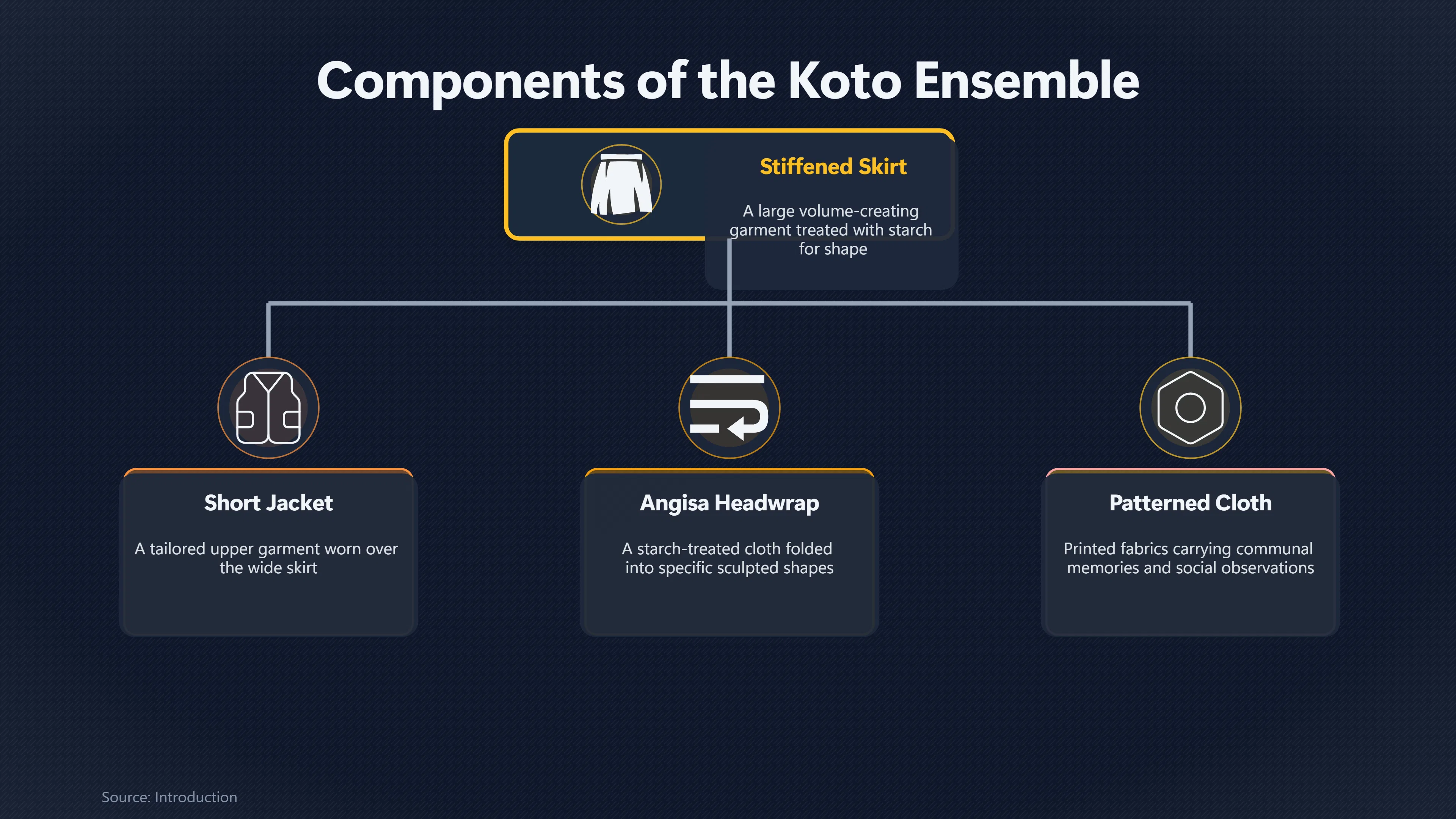
The name koto can refer both to the main skirt and to the complete ensemble. A kotomisi — literally a woman wearing koto — traditionally wears a large, stiffened skirt, a short jacket and an angisa headcloth. The shape of the clothing is deliberately striking: starch and layered fabric create volume, making the wearer occupy physical space rather than disappear into it.[Wereldmuseum Rotterdam]rotterdam.wereldmuseum.nlRotterdam Fashion and heritage from Surinam | Wereldmuseum RotterdamWereldmuseum RotterdamFashion and heritage from Surinam | Wereldmuseum Rotterdam…
The fabric itself could carry messages. Special cloth patterns were created for important moments such as the abolition of slavery, independence celebrations, religious events and royal occasions. Some patterns became associated with sayings or social observations, turning printed cloth into a kind of communal memory.[Surinaams Museum]surinaamsmuseum.netSurinaams Museum Creolen – surinaamsmuseumSurinaams Museum Creolen – surinaamsmuseum
What headwrap folds could communicate
The angisa is where the idea of a “hidden language” becomes most visible. Unlike an ordinary headscarf, the angisa is carefully prepared, stiffened and folded into specific shapes. The Koto Museum explains that the cloth was treated with starch so it became firm enough to hold its sculpted form, almost like a wearable object rather than a loose piece of fabric.[Het Koto Museum]kotomuseum.srHet Koto Museum HoofddoekenHet Koto MuseumHoofddoeken - Het Koto Museum…
Traditionally, different folding styles could have recognised meanings. Some were linked with personal messages, emotions or social situations. The Koto Museum’s documentation of angisa traditions describes how particular tying methods could communicate messages, while research into Surinamese textile history notes that hundreds of tying variations existed, with meanings attached to their forms and names.[Het Koto Museum]kotomuseum.srHet Koto Museum Angisa ToriHet Koto MuseumAngisa Tori - Het Koto Museum…
This has often been described as a “secret language”, especially because some interpretations connect the angisa with communication among enslaved women whose movements and speech were restricted. The strongest evidence is that angisa styles carried shared cultural meanings and social information; the more dramatic claim that every fold operated as a complete hidden code between enslaved people is harder to verify historically. The tradition is therefore best understood as a sophisticated system of visual expression rather than a simple substitute language.[The National Archives]nationalarchives.gov.ukThe National Archives Tracing Suriname’s textile historiesThe National ArchivesTracing Suriname’s textile histories - The National ArchivesApril 27, 2026…
The names given to angisa styles reveal how this system worked. Some names reflected personalities, situations or observations about everyday life. The Koto Museum records that women once took pride in creating and naming their own styles, with a fold or colour chosen to express particular qualities. Contemporary makers have also created new names, showing that the tradition can still evolve rather than existing only as a historical reconstruction.[Het Koto Museum]kotomuseum.srHet Koto Museum Naamgeving van de AngisaHet Koto MuseumNaamgeving van de Angisa - Het Koto Museum…
Why the Koto Museum preserves women’s knowledge
The Koto Museum is important because much of the knowledge surrounding koto and angisa depends on practical skills: folding, starching, sewing, naming and remembering. These are forms of expertise that are easily lost if museums preserve only finished garments without recording the people who know how they were made and worn.[Het Koto Museum]kotomuseum.srHet Koto Museum Over onsHet Koto MuseumOver ons - Het Koto Museum…
Rather than presenting koto as a decorative costume, the museum frames it as a collection of stories. Its displays include traditional clothing alongside domestic objects and historical settings intended to evoke the homes and lives of earlier generations of kotomisi. The museum describes itself as a place where visitors learn the historical value and stories connected to koto and angisa.[Het Koto Museum]kotomuseum.srHet Koto Museum ContactHet Koto MuseumContact - Het Koto Museum…
The collection also fits into a wider debate about who controls cultural memory. Many colonial-era collections of Surinamese material culture were gathered by outsiders, while newer heritage work increasingly emphasises community knowledge and the voices of descendants. Collaborative research on Afro-Surinamese costume has explored how museums can move beyond treating clothing as an object and instead recognise the skills, experiences and identities attached to wearing it.[Research Center for Material Culture]materialculture.nlOpen source on materialculture.nl.
Why koto remains a living archive
Today, koto is still worn during commemorations, cultural events and celebrations. One of the most visible examples is Keti Koti, the annual remembrance of the abolition of slavery, where Afro-Surinamese women wear koto as a statement of heritage and remembrance.[Wereldmuseum Rotterdam]rotterdam.wereldmuseum.nlRotterdam Fashion and heritage from Surinam | Wereldmuseum RotterdamWereldmuseum RotterdamFashion and heritage from Surinam | Wereldmuseum Rotterdam…
Its continued use shows why the garment belongs in Suriname’s unusual heritage landscape. The mystery of the koto is not that it hides an unknown secret waiting to be decoded. Its deeper significance is that ordinary materials — cotton, starch, folds and patterns — became a way for women to preserve identity through periods of forced change.
The Koto Museum preserves that mechanism of memory: clothing that once expressed status, emotion and belonging now records the creativity and resilience of the people who carried those meanings forward.[Het Koto Museum]kotomuseum.srHet Koto Museum Angisa ToriHet Koto MuseumAngisa Tori - Het Koto Museum…
Amazon book picks
Further Reading
Books and field guides related to How Suriname's Koto Dress Learned to Speak. Use these as the next step if you want deeper reading beyond the article.
The Black Jacobins
A powerful and impassioned historical account of the largest successful revolt by enslaved people in history: the Haitian Revolution of 1...
The Social Life of Things
The meaning that people attribute to things necessarily derives from human transactions and motivations, particularly from how those thin...
Fashion and Its Social Agendas
It has long been said that clothes make the man (or woman), but is it still true today? If so, how has the information clothes convey cha...
Slave Culture : Nationalist Theory and the Foundations of Bla...
How were blacks in American slavery formed, out of a multiplicity of African ethnic peoples, into a single people? In this major study of...
eBay marketplace picks
Marketplace Samples
Live-tested eBay searches with available results related to this page.
Selected fromfashion history poster oneBay.co.uk.


Endnotes
1.
Source: rotterdam.wereldmuseum.nl
Title: Rotterdam Fashion and heritage from Surinam | Wereldmuseum Rotterdam
Link:https://rotterdam.wereldmuseum.nl/en/collection-stories/fashion-and-heritage-from-surinam
Source snippet
Wereldmuseum RotterdamFashion and heritage from Surinam | Wereldmuseum Rotterdam...
2.
Source: leiden.wereldmuseum.nl
Link:https://leiden.wereldmuseum.nl/en/collection-stories/a-headscarf-with-a-secret-language
3.
Source: youtube.com
Title: Keti Koti Amsterdam
Link:https://www.youtube.com/watch?v=6F3hN8b_QcI
Source snippet
Het Koto Museum - Infomercial...
4.
Source: youtube.com
Title: Het Koto Museum
Link:https://www.youtube.com/watch?v=NBAX2ssdf38
Source snippet
Kotoshow with musical accompaniment by Baas B Almere Haven 2025h...
5.
Source: surinaamsmuseum.net
Title: Surinaams Museum Creolen – surinaamsmuseum
Link:https://www.surinaamsmuseum.net/creolen/
6.
Source: kotomuseum.sr
Title: Het Koto Museum Angisa Tori
Link:https://kotomuseum.sr/publicaties/angisa-tori
Source snippet
Het Koto MuseumAngisa Tori - Het Koto Museum...
7.
Source: kotomuseum.sr
Link:https://kotomuseum.sr/
Source snippet
Het Koto MuseumHet Koto MuseumNovember 21, 2009...
Published: November 21, 2009
8.
Source: kotomuseum.sr
Title: Het Koto Museum Over ons
Link:https://kotomuseum.sr/over-ons
Source snippet
Het Koto MuseumOver ons - Het Koto Museum...
9.
Source: nationalarchives.gov.uk
Title: The National Archives Tracing Suriname’s textile histories
Link:https://www.nationalarchives.gov.uk/professional-guidance-and-services/our-research-and-academic-collaboration/our-research-projects/research-projects/from-our-students/tracing-suriname-textile-histories/
Source snippet
The National ArchivesTracing Suriname’s textile histories - The National ArchivesApril 27, 2026...
Published: April 27, 2026
10.
Source: materialculture.nl
Link:https://www.materialculture.nl/en/research/projects/koto
11.
Source: kotomuseum.sr
Title: Het Koto Museum Hoofddoeken
Link:https://kotomuseum.sr/hoofddoeken
Source snippet
Het Koto MuseumHoofddoeken - Het Koto Museum...
12.
Source: kotomuseum.sr
Title: Het Koto Museum Naamgeving van de Angisa
Link:https://kotomuseum.sr/hoofddoeken/naamgeving-van-de-angisa
Source snippet
Het Koto MuseumNaamgeving van de Angisa - Het Koto Museum...
13.
Source: materialculture.nl
Link:https://www.materialculture.nl/en/research/projects/collection-research-technique-andas-experience-afro-surinamese-costume
Source snippet
Research Center for Material CultureCollection Research | The technique and/as experience of Afro-Surinamese costume | Research Center fo...
14.
Source: kotomuseum.sr
Title: Het Koto Museum Contact
Link:https://kotomuseum.sr/contact
Source snippet
Het Koto MuseumContact - Het Koto Museum...
15.
Source: kristinagaddy.com
Title: Het Koto Museum: Preserving Suriname’s History
Link:https://www.kristinagaddy.com/blog/het-koto-museum-preserving-surinames-history
16.
Source: materialculture.nl
Title: Mini ‘Brown Bag’ Research Session | Research Center for Material Culture
Link:https://www.materialculture.nl/en/events/mini-brown-bag-research-session-0
17.
Source: ensie.nl
Link:https://www.ensie.nl/surinaams-woordenboek/koto
18.
Source: ensie.nl
Link:https://www.ensie.nl/surinaams-woordenboek/angisa
19.
Source: surinaamsmuseum.net
Title: Museumstof 22: weri yu angisa – surinaamsmuseum
Link:https://www.surinaamsmuseum.net/2002/11/15/museumstof-22-weri-yu-angisa/
20.
Source: surinaamsmuseum.org
Link:https://surinaamsmuseum.org/collectie/
21.
Source: kotomuseum.sr
Title: Prodo Fu Koto
Link:https://kotomuseum.sr/publicaties/prodo-fu-koto
22.
Source: kotomuseum.sr
Title: Het binden van de Angisa
Link:https://kotomuseum.sr/hoofddoeken/het-binden-van-de-angisa
23.
Source: encyclo.nl
Link:https://www.encyclo.nl/begrip/angisa
24.
Source: surinaamsmuseum.net
Title: sample page 2
Link:https://www.surinaamsmuseum.net/sample-page-2/
Additional References
25.
Source: commons.wikimedia.org
Title: Category:Koto Museum
Link:https://commons.wikimedia.org/wiki/Category%3AKoto_Museum
Source snippet
wikimedia.orgCategory:Koto Museum - Wikimedia CommonsFebruary 3, 2026 — CATEGORY:KOTO MUSEUM Help [Input] [Input] Tools [Button: move to...
Published: February 3, 2026
26.
Source: youtube.com
Link:https://www.youtube.com/watch?v=dLxHjAQI-tg
Source snippet
Joining the Keti Koti Bigri Spikri parade at the Kruiskade in Rotterdam...
27.
Source: youtube.com
Title: Joining the Keti Koti Bigri Spikri parade at the Kruiskade in Rotterdam
Link:https://www.youtube.com/watch?v=42jNy4R_l5o
Source snippet
The Traditional Outfit(Koto) For The People Of Suriname...
28.
Source: koninklijkeverzamelingen.nl
Link:https://www.koninklijkeverzamelingen.nl/collectie/afro-surinaamse-hoofddoek-angisa-58483
29.
Source: commons.wikimedia.org
Link:https://commons.wikimedia.org/wiki/File%3ATropenmuseum_Royal_Tropical_Institute_Objectnumber_3325-174_Model_van_een_Surinaams-Creoolse_hoof.jpg
30.
Source: dbnl.org
Link:https://www.dbnl.org/tekst/_oso001200701_01/_oso001200701_01_0023.php?q=taboedoorbrekend
31.
Source: opreisdoorsuriname.sr
Link:https://www.opreisdoorsuriname.sr/algemeen/toerisme/todo-paramaribo/musea-paramaribo/koto-museum
32.
Source: europeana.eu
Link:https://www.europeana.eu/en/item/2048221/europeana_fashion_103379
33.
Source: textilevaluechain.in
Link:https://textilevaluechain.in/2020/11/20/global-textiles-suriname/
34.
Source: dbnl.org
Title: Sranan. Cultuur in Suriname, Chandra van Binnendijk, Paul Faber
Link:https://www.dbnl.org/tekst/binn011sran01_01/binn011sran01_01_0008.php