Why Are Russia's Strangest Collections So Different?
Russia’s strange-museum landscape is not dominated by theatrical witchcraft attractions or polished paranormal franchises.
Page outline Jump by section
Introduction
The result is unusually varied. Some sites are major academic institutions; others are privately built tourist attractions, local passion projects or contested memorial museums. Their credibility therefore differs sharply. A preserved specimen in a scientific collection, a reconstructed folk spirit and an immersive bunker alarm may all be memorable, but they do not make the same kind of claim. Understanding who collected an object, why it is displayed and how much interpretation accompanies it is essential to appreciating Russia’s curiosity culture.
Why Russia’s oldest museum is still its strangest
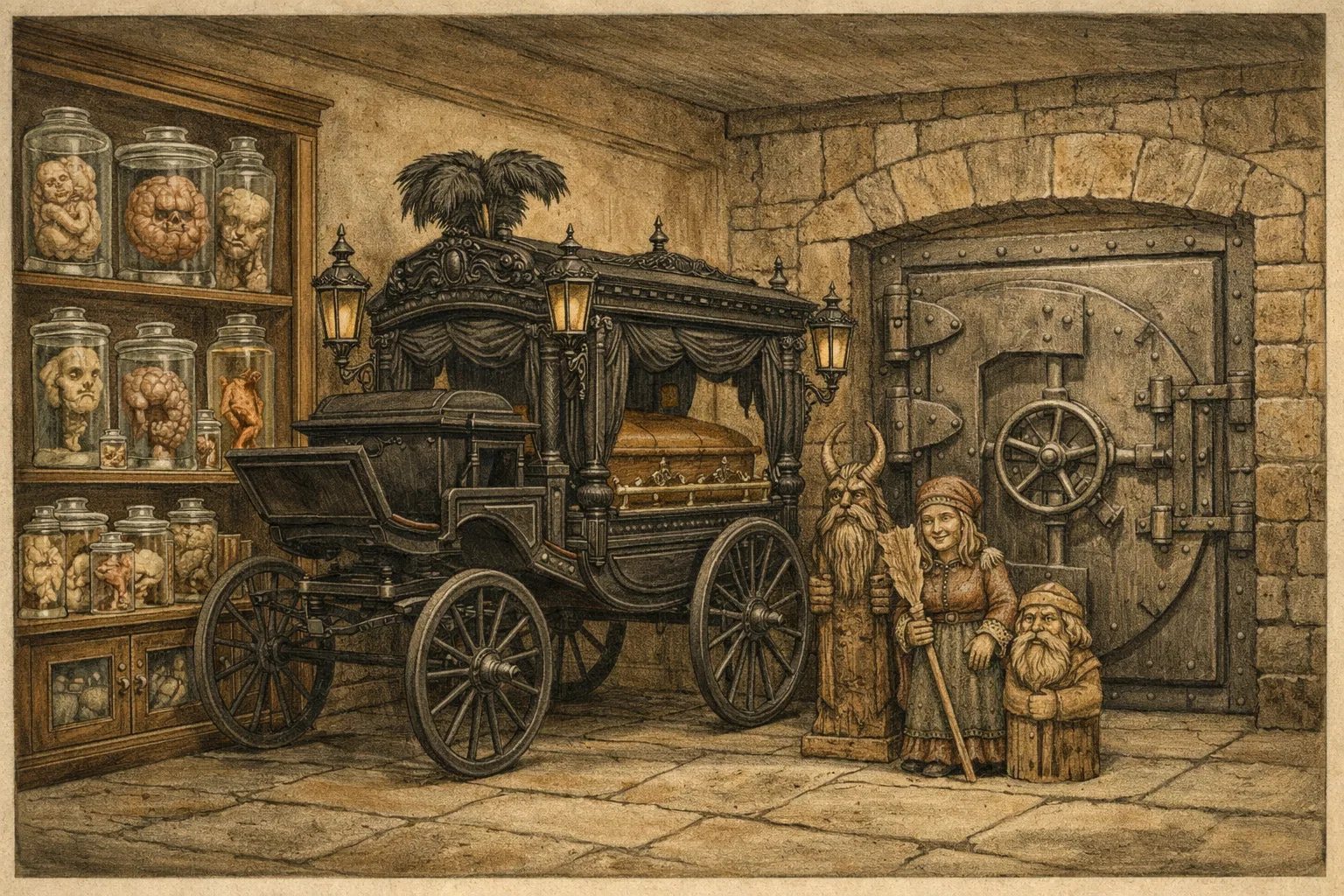
Saint Petersburg’s Kunstkamera, formally the Peter the Great Museum of Anthropology and Ethnography, is the unavoidable starting point. Founded from Peter the Great’s personal collections and opened to the public in the early eighteenth century, it developed from the European tradition of the cabinet of curiosities: a room in which rare natural specimens, scientific instruments, crafted objects and material gathered from distant societies were arranged as a miniature world. The museum now holds close to two million objects and is an active research institution rather than merely a preserved eccentric collection.[wikipedia.org]WikipediaOpen source on wikipedia.org.
Its popular reputation, however, rests heavily on anatomical preparations. Peter acquired major collections from the Dutch anatomist Frederik Ruysch and the natural-history collector Albertus Seba. He also ordered unusual human and animal births to be reported and preserved. These specimens were intended partly to counter the belief that congenital differences were supernatural omens or “monsters”. In principle, the display replaced fear and rumour with observation: bodily variation was to be treated as a natural phenomenon rather than evidence of witchcraft.[Wikipedia]WikipediaOpen source on wikipedia.org.
That Enlightenment purpose does not remove the discomfort of viewing human remains. Nor should the famous anatomical rooms obscure the institution’s much larger ethnographic holdings, assembled during Russian exploration, imperial expansion and academic fieldwork. Modern visitors are therefore looking at several overlapping histories: the rise of public science, the collecting ambitions of an empire and an older museum culture in which bodies and cultural objects were often acquired without the consent expected today. Questions surrounding human remains and colonial-era ethnographic material now affect museums internationally, particularly where provenance, community authority and possible return have not been fully resolved.[wikipedia.org]WikipediaOpen source on wikipedia.org.
The Kunstkamera is credible as a scholarly museum, but its displays should not be approached as neutral windows onto either biology or foreign peoples. It matters because it shows how closely wonder, education and imperial possession were once connected. Russia’s national curiosity culture began not with a roadside oddity attraction, but with a ruler’s attempt to organise the whole world inside a museum.
Where death becomes a collection
The Museum of World Funeral Culture near Novosibirsk is one of Russia’s clearest examples of a modern specialist museum built around a subject that many institutions treat only indirectly. Located within a working memorial and cremation complex, it presents death not as a horror theme but as a history of ritual, fashion, technology and public mourning. Displays include hearses, mourning clothing, post-mortem photography, embalming and autopsy material, cremation history, funeral processions and reconstructed interiors associated with farewell ceremonies.[Visit Museums]visitmuseums.ruVisit MuseumsThe museum of world funeral cultureTwo buildings of the Museum are open for public and host the unique expositions and exhib…
Its scale separates it from a small commercial “museum of death”. Published descriptions identify extensive holdings of photographs, engravings, documents, paintings, sculptures, medals, mourning garments and other funeral objects, much of the material dating from the nineteenth and early twentieth centuries. The installation mixes authentic artefacts with staged settings, so visitors should distinguish between an original hearse or garment and a room designed to evoke a Victorian or modern ceremony.[Travel Russia Guide]russiaeguide.comTravel Russia Guide -Museum of World Funeral CultureTravel Russia Guide -Museum of World Funeral Culture
The museum is unusual because it treats the funeral industry itself as cultural heritage. Coffins, obituary cards and mourning dresses become evidence of changing ideas about class, religion, family and the acceptable visibility of grief. Some displays may feel macabre, particularly those concerning autopsy or post-mortem images, but the curatorial argument is broader than shock: every society creates material systems for handling death.
This is also a useful contrast with Lenin’s Mausoleum in Moscow. Lenin’s preserved body has been publicly displayed since shortly after his death in 1924, turning embalming into a form of political permanence rather than private remembrance. The mausoleum is not a museum in the ordinary sense, yet it is among Russia’s most consequential public displays of a human body. Its meaning lies in the fusion of relic, state ritual and scientific preservation. Visitor access has varied over time, so current opening arrangements should be checked rather than assumed.[Wikipedia]WikipediaLenin's MausoleumLenin's Mausoleum
Together, the Novosibirsk museum and the mausoleum reveal two very different Russian treatments of the dead. One compares funeral customs across periods and societies; the other preserves one revolutionary leader as a continuing national symbol. Both demonstrate that a body on display is never merely biological. It is curated through belief, authority and political purpose.

Folklore museums: belief turned into characters
Russia has relatively few large museums devoted explicitly to witchcraft, but folklore and superstition appear in smaller private collections. A notable example is the Museum of Myths and Superstitions of the Russian People in Uglich. Descriptions portray it as a small, atmospheric museum in a wooden house, using dim interiors, crafted figures and domestic settings to embody supernatural beings and traditional beliefs. It is privately run and far closer to an artist-led folklore attraction than to an academic ethnography museum.[tripadvisor.com]tripadvisor.comOpen source on tripadvisor.com.
The distinction matters. Such displays generally do not provide physical evidence that supernatural beings existed. They give visual form to oral traditions: household spirits, forest beings, witches, omens and protective practices that once helped communities explain misfortune, dangerous places and uncertain events. Models and reconstructed rooms make those beliefs accessible, but they are interpretations produced by modern makers.
Visitors should therefore read the museum on two levels. The first is narrative pleasure: it offers an encounter with the uncanny figures of Russian storytelling. The second is social history. Folklore can reveal how people understood the home, wilderness, illness, harvests and death before scientific or official explanations were widely available. A spirit associated with a household boundary, for example, says as much about anxieties over domestic order as it does about supernatural belief.
The museum is also representative of a much wider private-museum movement. The Association of Private and People’s Museums of Russia says its catalogue contains more than 700 institutions. These range widely in professionalism and scale, but collectively they show how collectors and local entrepreneurs preserve subjects neglected by large state museums.[xn–80akahgvf5ajn1b2c.xn–p1ai]xn–80akahgvf5ajn1b2c.xn–p1aiOpen source on xn–80akahgvf5ajn1b2c.xn–p1ai.
This decentralised culture makes Russia fertile ground for eccentric collections, while also making verification difficult. Small museums may have irregular hours, limited foreign-language interpretation and a web presence dependent on travel directories rather than maintained institutional pages. A listing that still appears online does not always prove that a privately operated attraction is open on a particular date.
Medical science with an unsettling edge
Saint Petersburg’s Museum of Hygiene belongs to a different tradition: public education through graphic demonstration. Its old-fashioned exhibits explain disease prevention, anatomy, nutrition, sanitation and the effects of harmful habits. The best-known object is associated with Ivan Pavlov’s experimental dogs, placing a tangible specimen beside one of the most famous stories in the history of physiological research.[Atlas Obscura]atlasobscura.comAtlas Obscura Museum of Hygiene in Saint PetersburgAtlas Obscura Museum of Hygiene in Saint Petersburg
The museum’s strangeness comes partly from its presentation style. Hygiene museums developed to persuade audiences through direct visual evidence: anatomical models, diseased organs, preserved specimens and cautionary comparisons could communicate health messages more forcefully than printed advice. What now looks macabre or antiquated was once a modern form of mass education.
A visit therefore raises ethical as well as scientific questions. Pavlov’s work helped establish the experimental study of conditioned responses, but animal specimens also remind viewers that foundational research depended on living subjects. A preserved laboratory animal is simultaneously evidence, memorial and institutional trophy. The value of the display lies not only in seeing a famous specimen, but in considering how museums narrate scientific achievement without erasing its costs.
The Russian Museum of Military Medicine, also in Saint Petersburg, expands this theme from the laboratory to the battlefield. Created during the Second World War and later assembled from earlier specialist collections, it holds material relating to military treatment, surgery, evacuation and the organisation of medical services. Its holdings are substantial and historically serious, although the subject naturally includes bodily trauma, medical instruments and the practical consequences of war.[Wikipedia]WikipediaRussian Museum of Military MedicineRussian Museum of Military Medicine
Neither institution is a carnival of medical oddities. Their unusual power comes from the closeness of their objects to pain, experimentation and survival. They are strongest when the visitor looks beyond the spectacle of a specimen and asks what medical institutions wanted the public to learn from it.
Dreams, psychology and outsider interpretation
The Sigmund Freud Dream Museum in Saint Petersburg is unusual for almost the opposite reason: it is built around interpretation rather than a large collection of original relics. Established within an academic setting, it uses two compact spaces to introduce Freud’s life and theories before moving into an installation inspired by dreams, psychoanalysis and the unstable relationship between image and meaning.[saint-petersburg.com]saint-petersburg.comsigmund freud dream museumsigmund freud dream museum
It should not be confused with Freud’s preserved homes in Vienna or London. The Saint Petersburg museum does not claim to reconstruct his authentic consulting room. Its founder described the project as a museum devoted to the history of psychoanalysis and dreams, deliberately creating a conceptual environment rather than an exact biographical interior.[ARTMargins Online]artmargins.comqsigmund freuds cabinet of dreamsq in st petersburgqsigmund freuds cabinet of dreamsq in st petersburg
This makes it closer to an art installation or philosophical cabinet than a conventional house museum. Mirrors, images and visual associations invite visitors to interpret the room, much as psychoanalysis asks people to search for latent meaning within dreams. The experience can be compelling, but its claims belong to intellectual and cultural history, not to a laboratory demonstration that Freud’s theories have been scientifically verified.
Its importance within Russia’s strange-museum landscape is precisely this ambiguity. The museum preserves an idea rather than a mass of objects. It turns a contested theory of the mind into a physical space where the visitor becomes part of the exhibit.
Bunkers and the performance of the Cold War
Bunker-42 in Moscow occupies a former classified underground facility roughly 65 metres below the city. It now combines a Cold War museum with guided entertainment and event functions. The surviving tunnels and heavy infrastructure are authentic parts of the site, while tours may employ alarms, films, staged procedures and other immersive devices to dramatise nuclear confrontation.[bunker42.com]bunker42.comОфициальный сайтBunker-42Официальный сайтBunker-42
That mixture makes it a useful example of commercialised difficult heritage. The bunker communicates the physical scale of civil-defence planning more effectively than a display case could: visitors descend, feel the confined environment and see how a protected command space was engineered. Yet the experience is also packaged as an adventure. Its official ticket structure and excursion-led format make clear that this is a visitor attraction as well as a historical site.[Официальный сайт]bunker42.comОфициальный сайтBunker-42Официальный сайтBunker-42
The main question is not whether the bunker is “real”, but where documentation ends and performance begins. Original architecture and equipment can establish the material history of the facility. Recreated alerts or role-playing illustrate atmosphere rather than prove what happened during a specific incident. Good interpretation should make that boundary visible.
Russia contains many military, prison and civil-defence sites with unusual potential, but their narratives are often politically sensitive. A bunker tour can comfortably celebrate engineering ingenuity while saying much less about fear, secrecy, coercion or the civilian consequences of nuclear policy. Visitors should notice not only what is displayed, but which historical questions remain outside the script.

When museums of repression become contested
Museums dealing with Soviet political repression occupy the most politically unstable part of Russia’s unusual heritage landscape. Moscow’s Gulag History Museum, founded to document forced labour, state terror and the experiences of prisoners, was abruptly closed in November 2024 on stated safety grounds. In February 2026, reports said its building would be repurposed for a museum centred on Nazi crimes against Soviet citizens.[themoscowtimes.com]themoscowtimes.comThe Moscow Times'Soviet Genocide' Museum to Replace Shuttered GulagThe Moscow Times'Soviet Genocide' Museum to Replace Shuttered Gulag
This is not simply a change in visitor availability. It alters which forms of suffering receive institutional space and how twentieth-century history is framed. Reporting in 2026 linked the museum’s replacement with wider pressure on memorials and organisations documenting Stalinist repression. The Russian authorities have defended changes to historical sites and symbols in different terms, while critics interpret them as an effort to narrow public memory around Soviet crimes.[Reuters]reuters.comThe embassies of the four countries condemned the removal, demanding restoration and warning against historical amnesia. They also stated…
Perm-36, a preserved former labour camp, offers an earlier example of curatorial conflict. It began as a memorial museum created by independent researchers, but control passed to a state institution in 2014. The International Coalition of Sites of Conscience reported that the original memorial organisation was removed and that the site’s mission changed substantially; subsequent accounts described reduced emphasis on Stalinist repression and political prisoners.[Sites of Conscience]archive.sitesofconscience.orgOpen source on sitesofconscience.org.
These cases matter to any discussion of strange museums because “strangeness” should not be reduced to amusing objects. A preserved prison compound or archive of confiscated belongings can be uncanny precisely because it exposes the administrative normality of persecution. Lists, doors, uniforms and ordinary personal possessions show how mass repression was made operational.
They also demonstrate that museums do not merely preserve contested history: they participate in the contest. Closure, reframing and changes in management can transform what a collection is allowed to mean. Anyone researching Russian prison or repression museums should check current institutional control, not rely on descriptions written when an earlier exhibition was still in place.
Frozen animals and museums made by the landscape
In Siberia and the Russian Far East, unusual collections are sometimes produced directly by the frozen ground. The Mammoth Museum Laboratory in Yakutsk studies and displays material recovered from the permafrost, a natural preservation environment capable of retaining hair, skin, tissue and stomach contents rather than only fossilised bone.
The continuing scientific relevance of such collections was demonstrated when a remarkably complete juvenile mammoth was recovered from the Batagaika crater in 2024. Researchers associated with the Yakutsk mammoth centre examined the body, whose head and trunk had survived unusually well. Other recent finds in the region have included preserved remains of a sabre-toothed cat cub and an ancient wolf.[Reuters]reuters.comYoung mammoth remains found nearly intact in Siberian permafrostYoung mammoth remains found nearly intact in Siberian permafrost
These are not cryptids or archaeological “anomalies”. Their strangeness is scientifically productive: soft tissue can reveal information unavailable from skeletons alone. At the same time, newly exposed carcasses are connected to the thawing and collapse of permafrost, so the spectacle of discovery is inseparable from environmental change.[Reuters]reuters.comYoung mammoth remains found nearly intact in Siberian permafrostYoung mammoth remains found nearly intact in Siberian permafrost
Farther west, the Permafrost Museum at Igarka was established from an underground research station in 1965. Its chambers are cut into permanently frozen ground, allowing visitors to enter the phenomenon rather than merely inspect specimens removed from it.[Visit Siberia]en.visitsiberia.infoOpen source on visitsiberia.info.
These museums are among Russia’s most distinctive because they blur the boundary between collection and setting. The cold chamber, frozen wall and preserved animal are parts of the same archive. Unlike a fabricated monster display, they need little theatrical enhancement: the uncanny effect comes from encountering biological time held temporarily in ice.
How to judge Russia’s unusual collections
Russia’s odd museums range from internationally significant research institutions to tiny private attractions, so a single standard of credibility is unhelpful. A better approach is to ask what kind of institution is making the claim.
Academic and scientific museums generally provide the strongest provenance and specialist expertise. The Kunstkamera, military-medical collections and mammoth research institutions preserve material for study as well as display. Their authority does not eliminate ethical problems, especially around human remains, animal experimentation or imperial collecting, but it does mean their objects usually have a documented institutional history.
Folklore museums preserve beliefs, stories and reconstructed traditions. Their figures should be understood as interpretations of cultural narratives, not zoological evidence for supernatural beings. Their quality depends on how clearly they explain sources, regional variation and the difference between historic belief and modern invention.
Commercial immersive attractions can make inaccessible history vivid. Bunker-42’s physical environment offers genuine historical value, even where alarms or scenarios are staged. The key is transparency about which elements are original, reconstructed or performed.
Memorial and prison museums require particular attention to governance. Their interpretation can change after a transfer of ownership, political intervention or closure. Older guidebooks may describe exhibitions that no longer exist in the same form.
Private curiosity museums often preserve subjects ignored elsewhere, but practical information can be fragile. Advance contact is sensible, particularly outside Moscow and Saint Petersburg, because opening hours, language provision and even continued operation may not be reliably reflected by third-party listings.
What makes Russia’s curiosity culture distinctive
Russia’s most memorable unusual collections are rarely strange for only one reason. The Kunstkamera combines science with imperial ambition. A funeral museum combines scholarship with theatrical interiors. A mammoth laboratory turns climate and geology into an archive. A bunker is both historical structure and commercial performance. A repression museum can become evidence not only of past violence but of present struggles over memory.
The strongest sites reward a double reading. Visitors can enjoy the immediate encounter—a preserved specimen, underground chamber, dream installation or folklore figure—while also asking who authorised its meaning. That question separates a curiosity from mere spectacle.
Russia’s strange-museum landscape ultimately concerns the management of uncertainty. Earlier collectors used specimens to challenge superstition; folklore museums give superstition a new visual life; scientific institutions extract knowledge from frozen bodies; political museums determine which memories remain public. What Russia preserves as strange therefore reveals what its institutions have considered dangerous, instructive, sacred, entertaining or too important to disappear.
Amazon book picks
Further Reading
Books and field guides related to Why Are Russia's Strangest Collections So Different?. Use these as the next step if you want deeper reading beyond the article.
The Story of Russia
A 2022 BOOK OF THE YEAR FOR: Sunday Times * Irish Times * Spectator * Financial Times * Telegraph * Aspects of History 'The history book...
The Lost Art of Finding Our Way
Long before GPS, Google Earth, and global transit, humans traveled vast distances using only environmental clues and simple instruments....
eBay marketplace picks
Marketplace Samples
Live-tested eBay searches with available results related to this page.
Selected fromRussian collectible oneBay.co.uk.
Endnotes
1.
Source: Wikipedia
Link:https://en.wikipedia.org/wiki/Kunstkamera
2.
Source: kunstkamera.ru
Link:https://www.kunstkamera.ru/en/
Source snippet
Saint Petersburg MuseumThe periodical covers a broad spectrum of modern scholarship in museum studies, history of science...
3.
Source: colonialcollections.nl
Link:https://www.colonialcollections.nl/en/events/
4.
Source: Wikipedia
Title: Lenin’s Mausoleum
Link:https://en.wikipedia.org/wiki/Lenin%27s_Mausoleum
5.
Source: tripadvisor.com
Link:https://www.tripadvisor.com/Attraction_Review-g951352-d2360274-Reviews-Museum_of_Myths_and_Superstitions_of_the_Russian_People-Uglich_Yaroslavl_Oblast_C.html
6.
Source: advantour.com
Link:https://www.advantour.com/russia/uglich/museum-of-myths.htm
7.
Source: xn–80akahgvf5ajn1b2c.xn–p1ai
Link:https://www.xn–80akahgvf5ajn1b2c.xn–p1ai/en/
8.
Source: Wikipedia
Title: Russian Museum of Military Medicine
Link:https://en.wikipedia.org/wiki/Russian_Museum_of_Military_Medicine
9.
Source: saint-petersburg.com
Title: sigmund freud dream museum
Link:https://www.saint-petersburg.com/museums/sigmund-freud-dream-museum/
10.
Source: artmargins.com
Title: qsigmund freuds cabinet of dreamsq in st petersburg
Link:https://artmargins.com/qsigmund-freuds-cabinet-of-dreamsq-in-st-petersburg/
11.
Source: bunker42.com
Title: Официальный сайтBunker-42
Link:https://bunker42.com/en/
12.
Source: tripadvisor.com
Link:https://www.tripadvisor.com/Attraction_Review-g298484-d2141443-Reviews-Bunker_42_Cold_War_Museum_at_Taganka-Moscow_Central_Russia.html
13.
Source: reuters.com
Link:https://www.reuters.com/world/europe/european-states-accuse-russia-trying-erase-memory-stalins-crimes-after-monument-2026-04-23/
Source snippet
The embassies of the four countries condemned the removal, demanding restoration and warning against historical amnesia. They also stated...
14.
Source: Wikipedia
Title: Perm 36
Link:https://en.wikipedia.org/wiki/Perm-36
15.
Source: reuters.com
Title: Young mammoth remains found nearly intact in Siberian permafrost
Link:https://www.reuters.com/science/young-mammoth-remains-found-nearly-intact-siberian-permafrost-2024-12-23/
16.
Source: Wikipedia
Title: Permafrost Museum
Link:https://en.wikipedia.org/wiki/Permafrost_Museum
17.
Source: colonialcollections.nl
Link:https://www.colonialcollections.nl/en/grants/
18.
Source: Wikipedia
Title: The Association of Private Museums of Russia
Link:https://en.wikipedia.org/wiki/The_Association_of_Private_Museums_of_Russia
19.
Source: saint-petersburg.com
Link:https://www.saint-petersburg.com/museums/kunstkammer-museum-antropology-ethnography/
20.
Source: saint-petersburg.com
Link:https://www.saint-petersburg.com/museums/museum-hygiene/
21.
Source: tripadvisor.com
Title: State Museum of GULAG’s History
Link:https://www.tripadvisor.com/Attraction_Review-g298484-d2341889-Reviews-State_Museum_of_GULAG_s_History-Moscow_Central_Russia.html
22.
Source: tripadvisor.com
Title: World Funeral Culture Museum
Link:https://www.tripadvisor.com/Attraction_Review-g298529-d6491503-Reviews-World_Funeral_Culture_Museum-Novosibirsk_Novosibirsky_District_Novosibirsk_Oblast.html
23.
Source: tripadvisor.com
Title: Mammoth Museum
Link:https://www.tripadvisor.com/Attraction_Review-g665309-d2593925-Reviews-Mammoth_Museum-Yakutsk_Sakha_Yakutia_Republic_Far_Eastern_District.html
24.
Source: journal.kunstkamera.ru
Link:https://journal.kunstkamera.ru/en
25.
Source: xn–80akahgvf5ajn1b2c.xn–p1ai
Link:https://www.xn–80akahgvf5ajn1b2c.xn–p1ai/en/about/project-geography/novosibirsk-oblast/the-world-funeral-culture-museum/
26.
Source: xn–80akahgvf5ajn1b2c.xn–p1ai
Link:https://www.xn–80akahgvf5ajn1b2c.xn–p1ai/en/about/project-geography/kaliningrad-region/museum-of-russian-superstitions/
27.
Source: en.freud.ru
Link:https://en.freud.ru/museum/guide
28.
Source: bunker42.com
Title: ZK P-42
Link:https://bunker42.com/en/events/special-facility-on-taganka/
29.
Source: visitmuseums.ru
Link:https://visitmuseums.ru/en/museum-8b4eac86-1f43-4a50-8461-33807a4942ba.html
Source snippet
Visit MuseumsThe museum of world funeral cultureTwo buildings of the Museum are open for public and host the unique expositions and exhib...
30.
Source: russiaeguide.com
Title: Travel Russia Guide -Museum of World Funeral Culture
Link:https://russiaeguide.com/museum-world-funeral-culture
31.
Source: atlasobscura.com
Title: Atlas Obscura Museum of Hygiene in Saint Petersburg
Link:https://www.atlasobscura.com/places/museum-of-hygiene
32.
Source: tripadvisor.co.uk
Title: Tripadvisor MUSEUM OF HYGIENE (MUZEI GIGIENY)
Link:https://www.tripadvisor.co.uk/Attraction_Review-g298507-d567039-Reviews-Museum_of_Hygiene_Muzei_Gigieny-St_Petersburg_Northwestern_District.html
33.
Source: themoscowtimes.com
Title: The Moscow Times’Soviet Genocide’ Museum to Replace Shuttered Gulag
Link:https://www.themoscowtimes.com/2026/02/20/soviet-genocide-museum-to-replace-shuttered-gulag-history-museum-in-moscow-a92007
34.
Source: en.zona.media
Link:https://en.zona.media/article/2026/02/20/gulagmuseum
35.
Source: archive.sitesofconscience.org
Link:https://archive.sitesofconscience.org/en/membership/gulag-museum-at-perm-36-russia/
36.
Source: en.visitsiberia.info
Link:https://en.visitsiberia.info/muzej-vechnoj-merzlotyi-v-igarke.html
37.
Source: tripadvisor.co.uk
Title: FREU D’S DREAM MUSEUM
Link:https://www.tripadvisor.co.uk/Attraction_Review-g298507-d2349328-Reviews-Freud_s_Dream_Museum-St_Petersburg_Northwestern_District.html
38.
Source: tripadvisor.co.uk
Link:https://www.tripadvisor.co.uk/Attraction_Review-g17843874-d2573339-Reviews-The_Memorial_Reserve_Museum_of_the_History_of_Political_Repression_Perm_36-Kuch.html
39.
Source: wildeast.blog
Title: strange museums
Link:https://wildeast.blog/en/strange-museums/
40.
Source: atlasobscura.com
Title: freuds dream museum
Link:https://www.atlasobscura.com/places/freuds-dream-museum
41.
Source: atlasobscura.com
Link:https://www.atlasobscura.com/places/kunstkamera
42.
Source: mpi.ysn.ru
Link:https://mpi.ysn.ru/en/facilities/museum
43.
Source: themoscowtimes.com
Link:https://www.themoscowtimes.com/2021/06/28/ivan-pavlov-museum-gets-a-high-tech-high-art-makeover-a74360
Additional References
44.
Source: lemonde.fr
Link:https://www.lemonde.fr/en/history/article/2026/01/30/yuri-dmitriev-the-russian-historian-imprisoned-for-denouncing-kremlin-attempts-to-rewrite-history_6749954_157.html
Source snippet
After a series of trials marked by procedural irregularities and behind-closed-doors hearings, Dmitriev was sentenced in 2021 to 15 years...
45.
Source: prlib.ru
Link:https://www.prlib.ru/en/collections/1175819
Source snippet
Yeltsin Presidential LibraryPeter the Great Museum of Anthropology and Ethnography...Throughout the 18th – 19th centuries the collection...
46.
Source: youtube.com
Title: From Stalin’s nuclear bunkers to modern shelters: Russia’s doomsday legacy
Link:https://www.youtube.com/watch?v=cBrLK2bWRAo
Source snippet
Kunstkamera Peter the Great Museum Saint Petersburg St. Petersburg, the Kunstkamera, La Specola and the Monsters of Ulisse Aldrovandi Mai...
47.
Source: materialculture.nl
Title: not public human remains decolonising disaster museum
Link:https://www.materialculture.nl/en/research/publications/not-public-human-remains-decolonising-disaster-museum
Source snippet
Research Center for Material Culturehuman remains': Decolonising disaster in the museum.3 Sept 2018 — Recently, the museum undertook a co...
48.
Source: jstor.org
Title: The Culture of the St
Link:https://www.jstor.org/stable/3086285
Source snippet
Petersburg Kunstkamera in...by A Anemone · 2000 · Cited by 60 — Russia's first museum, built to exhibit Peter's bizarre collection of an...
49.
Source: youtube.com
Link:https://www.youtube.com/watch?v=ul_uzeic1Cw
Source snippet
Mammoth Museum, Yakutsk, Russia (Siberia)...
50.
Source: youtube.com
Title: Bunker#42. Moscow. The Soviet era. The Cold War
Link:https://www.youtube.com/watch?v=cPoKG7VnTdY
Source snippet
THE MUSEUM OF DEATH IN NOVOSIBIRSK/THE ONLY ONE IN ALL OF RUSSIA/YOU HAVEN'T SEEN IT YET...
51.
Source: youtube.com
Title: Exploring the Kunstkamera—A Journey Through St. Petersburg’s Museum
Link:https://www.youtube.com/watch?v=lUZC2lLFl_U
Source snippet
Bunker#42. Moscow. The Soviet era. The Cold War...
52.
Source: youtube.com
Title: Mammoth Museum, Yakutsk, Russia (Siberia)
Link:https://www.youtube.com/watch?v=Kir_gkIJtV4
Source snippet
From Stalin’s nuclear bunkers to modern shelters: Russia’s doomsday legacy...
53.
Source: gw2ru.com
Link:https://www.gw2ru.com/arts/2109-moscow-kremlin-private-collectors