Why Mongolia's Strangest Collections Matter
Mongolia does not have a large, neatly labelled circuit of “weird museums” devoted to witchcraft, cryptids or medical horrors. Its stranger museum culture is more distinctive than that.
Page outline Jump by section
Introduction
For visitors, the strongest concentration is in Ulaanbaatar, where former palaces, temples and socialist institutions have been repurposed as museums. Beyond the capital, local museums and Gobi heritage sites connect the displayed objects to the landscapes from which they came. These collections matter because they sit at the meeting point of science, religion, state-building, tourism and cultural recovery. They are rarely cabinets of curiosities in the European sense; rather, they preserve things made uncanny by interrupted histories, sacred functions, illicit trade or dramatic rediscovery.
Dinosaurs returned from the black market
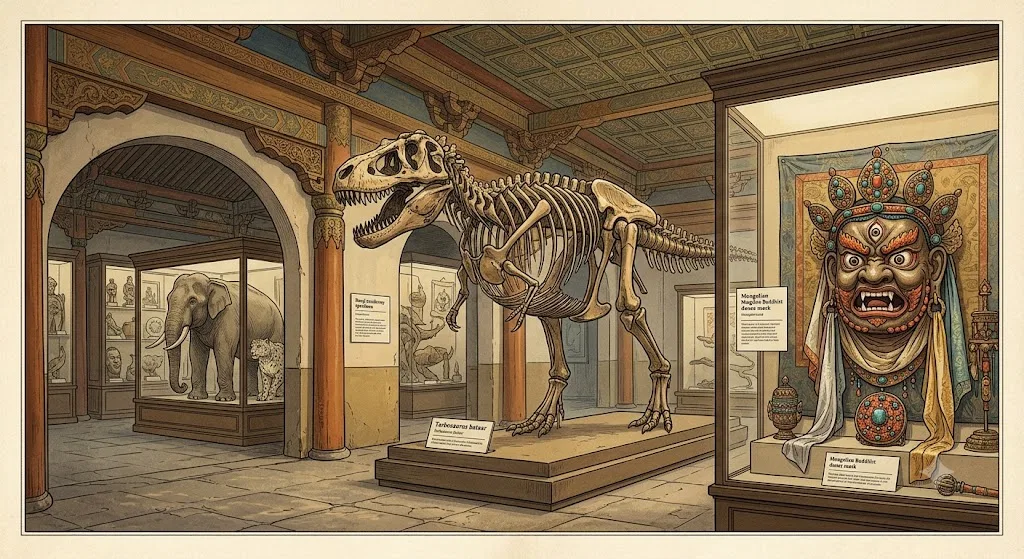
Mongolia’s most internationally recognisable curiosity collection is its assemblage of Gobi Desert fossils. The Natural History Museum in Ulaanbaatar holds dinosaur skeletons, eggs and other palaeontological specimens, including material associated with Tarbosaurus bataar, a large tyrannosaur closely related to Tyrannosaurus rex. The museum’s official site describes an active national institution with exhibitions, research work and plans for a much larger new building, rather than a small novelty attraction.[nhm.gov.mn]nhm.gov.mnБайгалийн түүхийн музейБайгалийн түүхийн музей
What makes the collection genuinely unusual is not simply the size of the fossils. Some of its best-known specimens have a second biography as stolen property. In 2012, Mongolian authorities challenged the attempted New York auction of a nearly complete Tarbosaurus skeleton. A subsequent United States investigation exposed the use of false customs descriptions and led to the recovery of numerous fossils believed to have been illegally removed from Mongolia. Returned specimens helped populate the dinosaur museum established in the former Lenin Museum building.[The New Yorker]newyorker.comThe New Yorker The Black Market for DinosaursProkopi pled guilty and cooperated with authorities, resulting in a significant expansion of the U.S. investigation into fossil smuggling…
That history changes how the exhibits should be read. A mounted dinosaur is both a scientific specimen and evidence in a continuing dispute over who controls fossils extracted from resource-rich countries. Mongolia prohibits the unauthorised export of its fossils, yet poaching has damaged sites, stripped bones of archaeological context and fed a lucrative international market. Recent reporting indicates that returned fossils remain central to the Ulaanbaatar display, while Mongolian researchers face the difficult task of reconnecting trafficked material with the places from which it was taken.[Financial Times]ft.comFinancial Times Dinosaur wars in the Gobi desertPaleontologist Mainbayar Buuvei, who is passionate about preserving Mongolia's fossil heritage, leads excavations and defends against ill…
Visitors can therefore expect a conventional natural-history presentation with an unusually sharp heritage-politics story underneath it. Labels may explain species and geological periods, but the most revealing context is the movement of fossils between desert excavation, private commerce, court proceedings and national restitution.
The collection is credible in scientific terms, but older travel accounts can create confusion about institutional names. The former Central Museum of Mongolian Dinosaurs was merged into the Natural History Museum in 2019, and references to the old dinosaur museum do not always describe a separate institution that still operates in its previous form.[Atlas Obscura]atlasobscura.comAtlas Obscura Natural History Museum of Mongolia in UlaanbaatarIt's the type of place where you can find protoceratops skulls, dinosaur eggs, and a full skeleton of Tarbosaurus bataar.Read more…

A royal palace filled with sacred art and stuffed animals
The Bogd Khaan Palace Museum is Mongolia’s closest equivalent to an aristocratic cabinet of curiosities. The complex was a residence of the country’s last monarch and senior Buddhist leader. Its collections now combine royal clothing, gifts, domestic furnishings, religious images, ceremonial objects and specimens from the ruler’s private animal collection. The World Monuments Fund describes it as a major repository of Mongolia’s political, religious and artistic history, while the museum’s digital collection records the transfer of royal possessions, Buddhist images and taxidermy into the new national museum system in 1926.[Google Arts & Culture]artsandculture.google.comGoogle Arts & CultureThe Bogd Khaan Palace Museum, Ulaanbaatar, Mongoliaethnographic artifacts owned by the Bogd Khaan, and the taxidermy…
The taxidermy is the element most likely to surprise an unsuspecting visitor. Stuffed animals once associated with the ruler’s private zoo occupy the same historical world as thrones, devotional objects and diplomatic presents. Accounts of the collection also identify the ornamented equipment of the Bogd Khaan’s elephant, an animal whose presence in Mongolia’s climate made it a celebrated royal curiosity.[Google]google.comOpen source on google.com.
This is not a modern “oddities museum” designed around shocks. Its strangeness comes from the survival of an entire royal environment in which zoological collecting, political display, personal amusement and sacred authority overlapped. A visitor moves through temple architecture and a European-style winter residence rather than a purpose-built gallery, so the site feels partly like a preserved household and partly like an early national museum.
The collection also reveals how Mongolia’s museum system emerged from political rupture. After the monarchy ended, possessions that had represented personal sovereignty and Buddhist authority were reclassified as public heritage. The palace consequently preserves not only the objects themselves but the moment when a royal and devotional collection became state property.[culture360.asef.org]culture360.asef.orgBogd Khaan Palace Museum, MongoliaBogd Khaan Palace Museum, Mongolia
Some popular descriptions mention especially extravagant objects, including a structure said to have been made from numerous snow-leopard skins. Such claims appear frequently in tourism material but are not always documented with the precision expected of a formal catalogue. They are best treated as leads to examine on site rather than unquestioned headline facts.
Wrathful masks, preserved clergy and temple museums
Mongolia’s Buddhist temple museums contain objects that can look monstrous or occult when detached from their religious setting. The most important corrective is that these are not “demon collections” in the sensational sense. Large fanged faces, skull ornaments and fierce guardian figures belong to a sophisticated Buddhist visual tradition in which terrifying forms can represent protection, discipline and the defeat of destructive states of mind.
The Choijin Lama Temple Museum in central Ulaanbaatar is especially important. Built in the early twentieth century, the complex preserves Buddhist sculpture, silk religious paintings and masks used in ceremonial dance. It survives amid modern towers, giving visitors the striking experience of entering an enclosed ritual landscape in the middle of the city.[discovermongolia.mn]discovermongolia.mnChoijin Lama monasteryChoijin Lama monastery
Its oversized masks are among Mongolia’s strongest pieces of strange visual culture. Such masks could be built from papier-mâché, painted and gilded, then enriched with coral, pearls, jewels, bone or other materials. Certain Mongolian examples were substantially larger than a human head, forcing performers to see through openings in the mouth rather than the eyes. They were sacred implements, stored and venerated in monasteries when not being worn.[Wikipedia]WikipediaSculpture of MongoliaSculpture of Mongolia
The temple’s reputation for the uncanny is strengthened by reports that it includes the embalmed remains of a religious figure alongside statues in the main sanctuary. Accessible visitor information identifies the body as that of Baldanchoimbolon, although detailed English-language institutional documentation is limited. This is a case where the basic presence of preserved remains is widely reported, but casual claims about identity, ritual meaning or preservation method should not be embellished beyond the available evidence.[GoGo.mn]mongolia.gogo.mnOpen source on gogo.mn.
The nearby Fine Arts Zanabazar Museum extends this religious-art trail through its holdings of statues, painted scrolls, masks and ceremonial clothing. Its purpose is art-historical rather than occult, yet its displays help explain the craft and symbolism behind objects that tourism writing often reduces to “scary masks”.[Wikipedia]WikipediaFine Arts Zanabazar MuseumFine Arts Zanabazar Museum
Together, these museums show why Mongolia’s unusual collections require cultural context. A wrathful face may appear macabre, but it was made for ritual transformation, not secular horror. The best visitor experience comes from asking what the object did, who was permitted to use it and how it survived the destruction of monasteries during the socialist period.
Mummies, rock tombs and misleading headlines
Mongolia’s dry and frozen landscapes have preserved human burials, clothing and organic materials that would normally disappear. These discoveries periodically become international curiosities, particularly when familiar-looking objects encourage playful modern comparisons.
A widely publicised burial excavated in the Altai region contained the remains of a woman and an exceptional group of grave goods, including clothing, riding equipment, household objects and patterned footwear. News coverage nicknamed her an ancient “sneaker wearer” because the boots bore striped decoration resembling a modern sports-shoe design. The resemblance made an effective viral image, but it was not evidence of a mysterious technological connection or lost modern fashion culture.[GQ]gq.comIs This 1,500-Year-Old Mummy the World's First Sneakerhead?Is This 1,500-Year-Old Mummy the World's First Sneakerhead?
Material from Altai rock burials was presented at the National Museum of Mongolia in a temporary exhibition that placed particular emphasis on textiles, boots, garments, sewing equipment and equestrian objects. A specialist visitor account noted that the popular story focused heavily on the shoes, while the exhibition itself offered a broader archaeological picture of burial custom and daily life.[Mummy Stories]mummystories.comMummy Stories Mummies at the National Museum of MongoliaMummy Stories Mummies at the National Museum of Mongolia
This distinction is important. Mongolia’s preserved bodies and grave assemblages are academically excavated archaeological finds, not carnival mummies. Their interest lies in preservation: leather, cloth, wood and other fragile materials can reveal social position, mobility, craft and burial practice far more vividly than bare bones alone.
Public access, however, is not always permanent. Temporary exhibitions move, objects undergo conservation and museum websites do not consistently provide detailed English-language object lists. Visitors specifically hoping to see human remains or a famous burial assemblage should verify the current exhibition rather than assuming that every widely reported discovery remains on display.
Political repression and the problem of vanished museums
One of Mongolia’s most affecting unusual museums was the Memorial Museum of the Victims of Political Repression. It dealt with the purges that devastated Mongolia’s religious, political and intellectual communities during the socialist period, particularly in the 1930s. Its subject placed it closer to a prison or state-terror museum than to a conventional national-history gallery.
The museum occupied a historically associated house in Ulaanbaatar, but the building was demolished in 2019 amid public criticism and wider concern about the treatment of older cultural buildings. Contemporary public discussion framed the loss not merely as the closure of a small museum but as a conflict over land, development and control of national memory.[Reddit]reddit.comOpen source on reddit.com.
Because the former site no longer functions as it once did, outdated travel listings can be misleading. Visitors may still find memorial material elsewhere, including twentieth-century displays at the National Museum of Mongolia and monuments commemorating victims of repression. The National Museum describes itself as the country’s principal institution for Mongolian history and traditional life, while its collections extend into modern political history.[en.nationalmuseum.mn]en.nationalmuseum.mnOpen source on nationalmuseum.mn.
The disappearance of the dedicated museum is itself significant within Mongolia’s curiosity landscape. Museums of repression preserve documents, personal possessions and photographs whose power comes from specificity: a name, an arrest record, a family object or evidence of a destroyed monastery. When such an institution closes, the objects may survive, but the focused narrative connecting them can be weakened.
This is also a warning about apparently current online attraction lists. Mongolia’s museum sector has changed substantially through mergers, demolitions and new national projects. Historical museums may remain culturally important even when their original buildings or displays no longer exist.
Sacred landscapes as open-air collections
Mongolia’s unusual heritage is not confined to glass cases. Sacred mountains, stone monuments, ruined monasteries and ritual landscapes function as dispersed collections in which stories, offerings and places are preserved together.
UNESCO describes Mongolian sacred-site worship as rooted in beliefs concerning invisible powers associated with the sky, earth, mountains and natural surroundings. Ceremonies and rules of conduct are passed between generations, making the landscape itself a living repository of religious knowledge.[ICH UNESCO]ich.unesco.orgOpen source on unesco.org.
This helps explain the piles of stones, offerings, prayer elements and ritual traces encountered on travel routes. They should not be treated as abandoned folk sculpture or freely collectible curios. Their significance depends on continued practice. At major sacred sites such as the Great Burkhan Khaldun area, traditional worship revived publicly after decades of socialist repression.[UNESCO World Heritage Centre]whc.unesco.orgOpen source on unesco.org.
Ruined monasteries such as Manzushir and surviving complexes in the Orkhon Valley add another layer. Their interest lies partly in absence: fragments, foundations and surviving devotional objects evoke institutions that were suppressed or destroyed. UNESCO’s documentation of the Orkhon Valley emphasises the long history of Mongolian Buddhism and the importance of monastic sites within the cultural landscape.[UNESCO World Heritage Centre]whc.unesco.orgOpen source on unesco.org.
For travellers interested in folklore and the uncanny, these places may be more rewarding than a commercial paranormal attraction. They retain active belief, contested memory and physical traces of destruction. The appropriate approach is closer to visiting a pilgrimage site or archaeological landscape than entering an entertainment venue.
What visitors should expect
Mongolia’s strange-collection trail is strongest when approached as a series of overlapping themes rather than a checklist of novelty museums.
- For fossils and scientific oddities: the Natural History Museum offers the clearest visitor-facing collection, with dinosaur smuggling and repatriation providing essential modern context.
- For royal curiosities: the Bogd Khaan Palace Museum combines taxidermy, personal possessions, religious objects and remnants of courtly display.
- For fierce sacred imagery: the Choijin Lama Temple Museum and Fine Arts Zanabazar Museum preserve ritual masks, guardian figures and ceremonial art.
- For archaeology and preserved burials: the National Museum is the most logical starting point, although particular human remains and grave assemblages may appear only in temporary exhibitions.
- For the history of state violence: verify current memorial displays rather than relying on old listings for the demolished political-repression museum.
- For living folklore and devotional practice: sacred mountains and former monastic landscapes provide context that an indoor museum cannot reproduce.
English interpretation varies, and institutional arrangements can change. Mongolia’s Natural History Museum, former dinosaur museum and newer Chinggis Khaan National Museum are sometimes confused in older articles. The latter is a large, modern historical institution with more than 10,000 original objects, but it should not be mistaken for the principal dinosaur collection.[chinggismuseum.com]chinggismuseum.comOpen source on chinggismuseum.com.
The Chinggis Khaan National Museum nevertheless has relevance to curiosity culture through its archaeological monuments, royal regalia, ritual objects and reconstructions of elite life. Its polished state narrative contrasts usefully with the more intimate atmosphere of the Bogd Khaan Palace and the surviving ritual environment of Choijin Lama.[chinggismuseum.com]chinggismuseum.comOpen source on chinggismuseum.com.
Why Mongolia’s curiosity culture matters
Mongolia’s most unusual collections are not united by a taste for deliberate eccentricity. They are united by recovery. Fossils return after international criminal cases. Buddhist masks survive institutional destruction. Royal animals and possessions become public heritage. Frozen burials return fragile clothing to view. Memories of political violence struggle to retain a dedicated physical home.
That pattern gives Mongolian museums a character different from commercially packaged oddity attractions. The strange object is often only the visible end of a larger story about ownership, sacred authority, disrupted tradition or national identity. A dinosaur skeleton is also repatriated evidence; a monstrous mask is also a venerated ritual instrument; a stuffed elephant is also a relic of monarchy; a striped boot is also part of an archaeological burial assemblage.
The country’s curiosity landscape is therefore relatively compact but unusually layered. Its best collections reward visitors who look beyond visual shock and ask how an object was used, why it survived, who claimed it and what changed when it entered a museum.
Amazon book picks
Further Reading
Books and field guides related to Why Mongolia's Strangest Collections Matter. Use these as the next step if you want deeper reading beyond the article.
The Secret History of the Mongol Queens
“A fascinating romp through the feminine side of the infamous Khan clan” (Booklist) by the author featured in Echoes of the Empire: Beyon...
Genghis Khan and the Making of the Modern World
Based on eight years of groundbreaking research in Mongolia, this history of the great conqueror argues that rather than a crude barbaria...
The Museum Experience
As the first book to take a "visitor's eye view" of the museum visit, The Museum Experience revolutionized the way museum professionals u...
The Mongols: A Very Short Introduction
The Mongols carved out the largest land-based empire in world history, stretching from Korea to Russia in the north and from China to Syr...
eBay marketplace picks
Marketplace Samples
Live-tested eBay searches with available results related to this page.
Selected fromMongolia travel poster oneBay.co.uk.
Endnotes
1.
Source: nhm.gov.mn
Title: Байгалийн түүхийн музей
Link:https://www.nhm.gov.mn/
2.
Source: nhm.gov.mn
Link:https://www.nhm.gov.mn/index.php/client/en
3.
Source: Wikipedia
Title: Central Museum of Dinosaurs of Mongolia
Link:https://en.wikipedia.org/wiki/Central_Museum_of_Dinosaurs_of_Mongolia
4.
Source: artsandculture.google.com
Link:https://artsandculture.google.com/partner/the-bogd-khaan-palace-museum
Source snippet
Google Arts & CultureThe Bogd Khaan Palace Museum, Ulaanbaatar, Mongoliaethnographic artifacts owned by the Bogd Khaan, and the taxidermy...
5.
Source: google.com
Link:https://www.google.com/culturalinstitute/browse/bogd%20khaan%20palace%20museum
6.
Source: culture360.asef.org
Title: Bogd Khaan Palace Museum, Mongolia
Link:https://culture360.asef.org/resources/bogd-khaan-palace-museum-mongolia/
7.
Source: discovermongolia.mn
Title: Choijin Lama monastery
Link:https://www.discovermongolia.mn/about-mongolia/destinations/northern-mongolia/choijin-lam-monastery
8.
Source: mongolian.travel
Link:https://www.mongolian.travel/the-monastery-of-choijin-lama/
9.
Source: Wikipedia
Title: Sculpture of Mongolia
Link:https://en.wikipedia.org/wiki/Sculpture_of_Mongolia
10.
Source: mongolia.gogo.mn
Link:https://mongolia.gogo.mn/r/jkj06
11.
Source: Wikipedia
Title: Fine Arts Zanabazar Museum
Link:https://en.wikipedia.org/wiki/Fine_Arts_Zanabazar_Museum
12.
Source: reddit.com
Link:https://www.reddit.com/r/mongolia/comments/degzkj
13.
Source: reddit.com
Link:https://www.reddit.com/r/mongolia/comments/deadam
14.
Source: reddit.com
Link:https://www.reddit.com/r/mongolia/comments/dd2kxj
15.
Source: en.nationalmuseum.mn
Link:https://en.nationalmuseum.mn/
16.
Source: en.nationalmuseum.mn
Title: ABOU T
Link:https://en.nationalmuseum.mn/about
17.
Source: ich.unesco.org
Link:https://ich.unesco.org/en/USL/mongolian-traditional-practices-of-worshipping-the-sacred-sites-00871
18.
Source: whc.unesco.org
Link:https://whc.unesco.org/document/152684
19.
Source: whc.unesco.org
Link:https://whc.unesco.org/uploads/nominations/1081rev.pdf
20.
Source: chinggismuseum.com
Link:https://chinggismuseum.com/en
21.
Source: chinggismuseum.com
Title: News, Releases |Chinggis Khaan National Museum
Link:https://chinggismuseum.com/en/blogs/69d756ea52e0eb5f2c61e237
22.
Source: discovermongolia.mn
Title: Museum of national history
Link:https://www.discovermongolia.mn/blogs/museum-of-national-history
23.
Source: Wikipedia
Link:https://en.wikipedia.org/wiki/Mongolia
24.
Source: Wikipedia
Title: History of Mongolia
Link:https://en.wikipedia.org/wiki/History_of_Mongolia
25.
Source: Wikipedia
Link:https://simple.wikipedia.org/wiki/Mongolia
26.
Source: whc.unesco.org
Link:https://whc.unesco.org/uploads/nominations/1440.pdf
27.
Source: ich.unesco.org
Title: mongol tuuli mongolian epic 00310
Link:https://ich.unesco.org/en/USL/mongol-tuuli-mongolian-epic-00310
28.
Source: ich.unesco.org
Title: 28234 EN.doc
Link:https://ich.unesco.org/doc/src/28234-EN.doc
29.
Source: whc.unesco.org
Link:https://whc.unesco.org/en/list/1389/
30.
Source: whc.unesco.org
Link:https://whc.unesco.org/document/1278
31.
Source: unesco.org
Link:https://www.unesco.org/en/memory-world/deger-e-ece-togtogsan-dursu-yin-tusbur-yig-burudkegsen-bicig-complete-record-body-imperial-order
32.
Source: mongolian.travel
Link:https://www.mongolian.travel/national-history-museum/
33.
Source: nhm.gov.mn
Link:https://www.nhm.gov.mn/client/en
36.
Source: nhm.gov.mn
Link:https://www.nhm.gov.mn/client/mn
37.
Source: GOV.UK
Link:https://www.gov.uk/foreign-travel-advice/mongolia
38.
Source: discovermongolia.mn
Link:https://www.discovermongolia.mn/
39.
Source: archaeology.wiki
Title: ashmolean returns ancient egyptian mummies to public view in 5m show
Link:https://www.archaeology.wiki/blog/2011/11/24/ashmolean-returns-ancient-egyptian-mummies-to-public-view-in-5m-show/
40.
Source: en.nationalmuseum.mn
Link:https://en.nationalmuseum.mn/collection-of-national-museum-of-mongolia
41.
Source: museums.io
Title: Choijin Lama Temple Museum
Link:https://museums.io/museums/77872
42.
Source: museum.om.gov.mn
Link:https://museum.om.gov.mn/Object/13
43.
Source: gomongolia.gov.mn
Link:https://www.gomongolia.gov.mn/
44.
Source: ncch.gov.mn
Title: МОНГОЛЫН ҮНДЭСНИЙ МУЗЕЙ- МОНГОЛЫН ҮНДЭСНИЙ МУЗЕЙ
Link:https://ncch.gov.mn/Museum/10
45.
Source: ncch.gov.mn
Title: БАЙГАЛИЙН ТҮҮХИЙН МУЗЕЙ- БАЙГАЛИЙН ТҮҮХИЙН МУЗЕЙ
Link:https://ncch.gov.mn/Museum/1
46.
Source: nmns.gov.mn
Link:https://nmns.gov.mn/client/en/article/433
47.
Source: travel.state.gov
Link:https://travel.state.gov/content/travel/en/international-travel/International-Travel-Country-Information-Pages/Mongolia.html
48.
Source: newyorker.com
Title: The New Yorker The Black Market for Dinosaurs
Link:https://www.newyorker.com/tech/annals-of-technology/the-black-market-for-dinosaurs
Source snippet
Prokopi pled guilty and cooperated with authorities, resulting in a significant expansion of the U.S. investigation into fossil smuggling...
49.
Source: newyorker.com
Link:https://www.newyorker.com/magazine/2013/01/28/bones-of-contention-paige-williams
Source snippet
The sale attracted attention because the dinosaur, which is closely related to Tyrannosaurus rex, was believed to have been illegally rem...
50.
Source: ft.com
Title: Financial Times Dinosaur wars in the Gobi desert
Link:https://www.ft.com/content/b8e0b827-bbfc-41b0-aa90-d0a45165a0b7
Source snippet
Paleontologist Mainbayar Buuvei, who is passionate about preserving Mongolia's fossil heritage, leads excavations and defends against ill...
51.
Source: atlasobscura.com
Title: Atlas Obscura Natural History Museum of Mongolia in Ulaanbaatar
Link:https://www.atlasobscura.com/places/central-museum-of-mongolian-dinosaurs
Source snippet
It's the type of place where you can find protoceratops skulls, dinosaur eggs, and a full skeleton of Tarbosaurus bataar.Read more...
52.
Source: gq.com
Title: Is This 1,500-Year-Old Mummy the World’s First Sneakerhead?
Link:https://www.gq.com/story/mummy-adidas-shoes
53.
Source: mummystories.com
Title: Mummy Stories Mummies at the National Museum of Mongolia
Link:https://www.mummystories.com/single-post/2020/01/23/mummies-at-the-national-museum-of-mongolia
54.
Source: visitulaanbaatar.net
Title: The Choijin Lama Temple Museum
Link:https://visitulaanbaatar.net/p/74
55.
Source: tripadvisor.co.uk
Title: Chinggis Khaan National Museum
Link:https://www.tripadvisor.co.uk/Attraction_Review-g293956-d23943079-Reviews-Chinggis_Khaan_National_Museum-Ulaanbaatar.html
56.
Source: depts.washington.edu
Link:https://depts.washington.edu/silkroad/museums/choijin/choijin.html
57.
Source: kids.nationalgeographic.com
Link:https://kids.nationalgeographic.com/geography/countries/article/mongolia
58.
Source: live2makan.com
Title: chinggis khaan national museum
Link:https://live2makan.com/2024/05/08/chinggis-khaan-national-museum/
59.
Source: atlasobscura.com
Link:https://www.atlasobscura.com/things-to-do/mongolia/museums
60.
Source: intrepidtravel.com
Link:https://www.intrepidtravel.com/uk/mongolia
61.
Source: theguardian.com
Link:https://www.theguardian.com/world/mongolia
62.
Source: en.wikivoyage.org
Link:https://en.wikivoyage.org/wiki/Mongolia
63.
Source: openfactbook.org
Link:https://openfactbook.org/countries/mongolia/
64.
Source: insightmongolia.com
Title: Choijin Lama Temple Museum
Link:https://insightmongolia.com/guides/choijin-lama-temple-museum
Additional References
65.
Source: youtube.com
Title: Discover the Rich History of Bogd Khan Palace Museum in Ulaanbaatar
Link:https://www.youtube.com/watch?v=o7vcACPHluI
Source snippet
Kapala with Silver Lid in Bogd Khaan Palace Museum...
66.
Source: youtube.com
Title: Choijin Lama Temple Museum on World Monuments Watch List
Link:https://www.youtube.com/watch?v=oxY9VUkgG7s
Source snippet
Discover the Rich History of Bogd Khan Palace Museum in Ulaanbaatar...
67.
Source: facebook.com
Link:https://www.facebook.com/MeetMongolia/videos/a-must-visit-in-ulaanbaatar-%EF%B8%8Fthe-natural-history-museum-showcases-mongolias-rich/868170132368738/
68.
Source: montsame.mn
Link:https://www.montsame.mn/en/read/234773
69.
Source: tripadvisor.co.uk
Link:https://www.tripadvisor.co.uk/Attraction_Review-g293956-d2385848-Reviews-Bogd_Khaan_Palace_Museum_of_Mongolia-Ulaanbaatar.html
70.
Source: mongolia-guide.com
Link:https://mongolia-guide.com/place/bogd-khaan-palace-museum
71.
Source: escapetomongolia.com
Link:https://www.escapetomongolia.com/blog/bogd-khaan-winter-palace-museum
72.
Source: escapetomongolia.com
Link:https://www.escapetomongolia.com/blog/chinggis-khaan-national-museum
73.
Source: legendtour.mn
Link:https://legendtour.mn/mongolia/regions/ub-choijin-lama-museum.shtml
74.
Source: facebook.com
Link:https://www.facebook.com/ridethemongolia/posts/during-our-ride-through-mongolias-wild-and-remote-terrain-we-stumbled-upon-somet/122166643868978937/