Within Strange China
What Is Inside China's Traditional Medicine Museums?
Traditional medicine museums explain why roots, minerals, shells and preserved animals belong to an organised medical system rather than a freak show.
On this page
- The specimens visitors are likely to encounter
- How university collections organise medicinal materials
- Where curiosity ends and medical interpretation begins
Page outline Jump by section
Introduction
China’s traditional medicine museums are among the country’s most unusual public collections because they display objects that can look startling to first-time visitors while placing them within a coherent medical tradition rather than presenting them as curiosities. Cabinets of dried roots, preserved snakes, shells, antlers, minerals, insects and carefully prepared animal specimens sit alongside ancient medical books, pharmacy tools and teaching models. The aim is not to shock but to explain how medicinal materials were identified, processed, classified and prescribed across centuries of practice. For visitors interested in strange museums, these collections occupy a fascinating middle ground between natural history, medical history and cultural heritage, revealing how objects that might resemble a Victorian cabinet of curiosities instead function as evidence within a living system of healthcare.[Beijing University of Chinese Medicine]english.bucm.edu.cnBeijing University of Chinese Medicine The Museum of Chinese MedicineBeijing University of Chinese MedicineThe Museum of Chinese MedicineSeptember 23, 2025…
What makes these museums different from a curiosity cabinet?
At first glance, a traditional medicine museum can resemble a natural history museum filled with unusual biological specimens. The crucial difference is organisation. Instead of arranging objects by species or rarity, Chinese medicine museums usually group them according to medicinal function, historical use or their place within the traditional pharmacopoeia.
A typical visitor moves through two complementary stories:
- the historical development of Chinese medicine through manuscripts, instruments and archaeological finds;
- the medicinal materials themselves, displayed as teaching collections rather than exotic oddities.
This approach reflects the educational purpose of many museums, which are attached to universities training future practitioners. The specimens therefore serve as reference material for identification as much as exhibition pieces for the public.[Beijing University of Chinese Medicine]english.bucm.edu.cnBeijing University of Chinese Medicine The Museum of Chinese MedicineBeijing University of Chinese MedicineThe Museum of Chinese MedicineSeptember 23, 2025…
The specimens visitors are likely to encounter
The displays are deliberately comprehensive rather than sensational. Instead of highlighting the rarest ingredients, museums often begin with the medicinal substances that students must learn to recognise accurately.
Visitors commonly encounter:
- hundreds of dried medicinal plants, including roots, bark, flowers and seeds;
- preserved fungi and lichens;
- mineral medicines such as gypsum, cinnabar substitutes used for historical interpretation, or naturally occurring salts;
- shells, coral and marine materials;
- antlers, horns and other animal-derived medicinal substances;
- preserved reptiles, insects and small mammals used historically in pharmacology;
- botanical teaching specimens showing fresh plants alongside processed medicinal products.
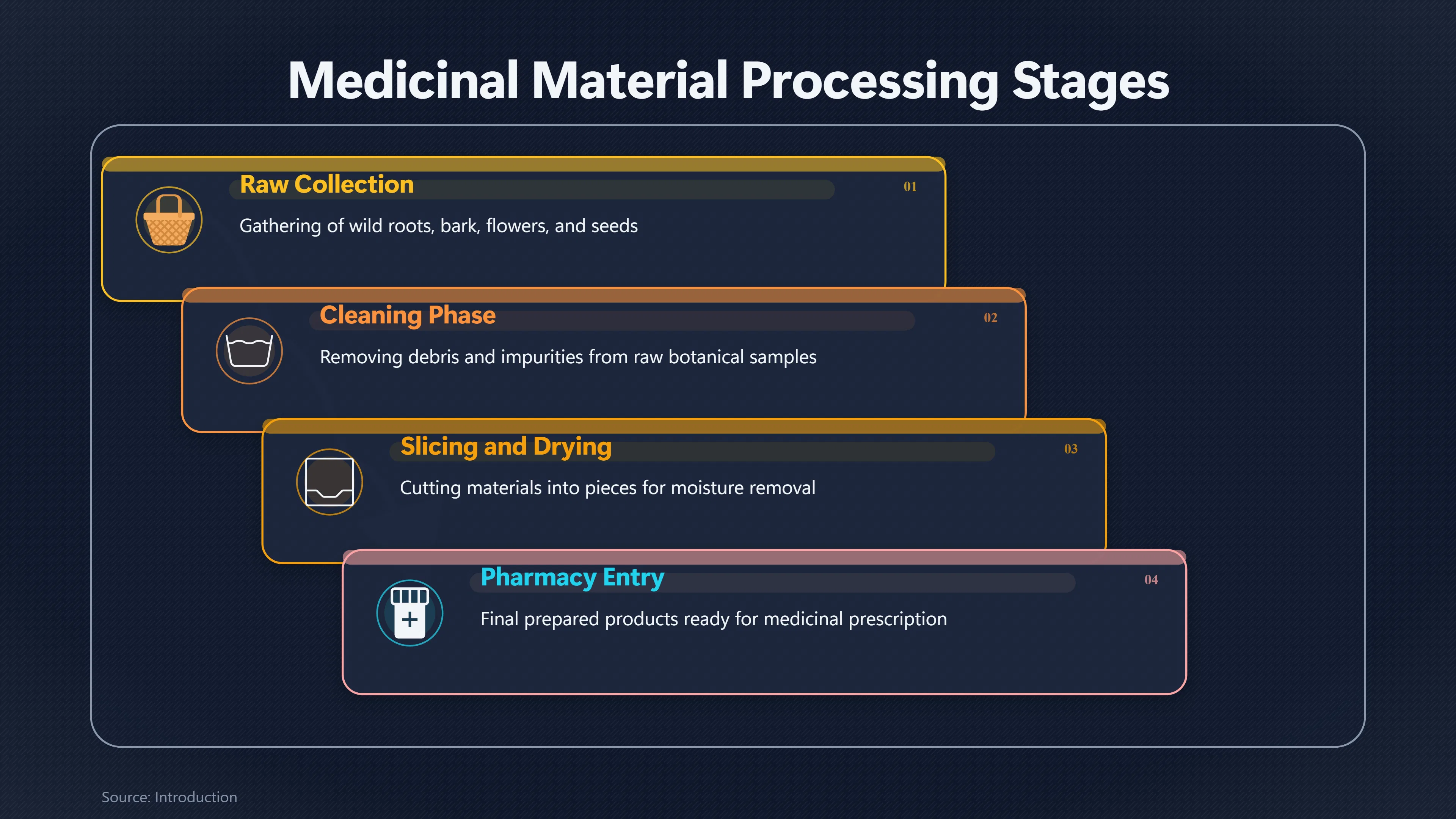
Many museums also exhibit different processing stages, demonstrating how raw materials are cleaned, sliced, dried or otherwise prepared before entering pharmacies. This helps explain why apparently similar specimens may represent entirely different medicinal ingredients after processing.[edu.cn]english.bucm.edu.cnBeijing University of Chinese Medicine The Museum of Chinese MedicineBeijing University of Chinese MedicineThe Museum of Chinese MedicineSeptember 23, 2025…
One feature that often surprises visitors is the presence of taxidermied animals or fluid-preserved specimens. These are generally displayed to aid accurate identification rather than to promote spectacle. Labels usually explain the historical medicinal role of the species alongside modern conservation considerations where appropriate.[Beijing University of Chinese Medicine]english.bucm.edu.cnBeijing University of Chinese Medicine The Museum of Chinese MedicineBeijing University of Chinese MedicineThe Museum of Chinese MedicineSeptember 23, 2025…
How university collections organise medicinal materials
China’s best-known traditional medicine museums are closely linked to teaching institutions, making them more comparable to medical schools than commercial attractions.
The Museum of Chinese Medicine at Beijing University of Chinese Medicine is a good example. Its galleries combine a history of Chinese medicine with a substantial materia medica collection containing thousands of medicinal specimens, including preserved plants and animals, rare medicinal samples, historical books and pharmacy artefacts. The museum also supports university teaching through courses in medicinal zoology, specimen identification and medical history while remaining open to the public at scheduled times.[Beijing University of Chinese Medicine]english.bucm.edu.cnBeijing University of Chinese Medicine The Museum of Chinese MedicineBeijing University of Chinese MedicineThe Museum of Chinese MedicineSeptember 23, 2025…
Rather than arranging exhibits according to rarity, collections typically classify medicinal materials by therapeutic function or botanical relationship. Visitors therefore see:
- reference specimens;
- processed medicinal pieces;
- photographs of living plants;
- preserved whole organisms;
- historical pharmacy equipment;
- manuscripts explaining preparation and use.
This layered presentation demonstrates that accurate identification has long been regarded as essential. Confusing similar-looking species could have serious medical consequences, so museum collections became practical teaching resources rather than simply repositories of unusual objects.[Beijing University of Chinese Medicine]english.bucm.edu.cnBeijing University of Chinese Medicine The Museum of Chinese MedicineBeijing University of Chinese MedicineThe Museum of Chinese MedicineSeptember 23, 2025…

Where curiosity ends and medical interpretation begins
For travellers seeking unusual museums, these collections can initially resemble displays of exotic natural history. However, the interpretive framework changes how the specimens are understood.
Instead of asking, “What is the strangest object here?”, museums encourage visitors to ask:
- How was this material identified?
- Why was it considered medicinal?
- How was it processed before use?
- What historical texts described it?
- Is the ingredient still recognised today, used differently, restricted or primarily of historical interest?
Modern museums increasingly distinguish between historical practice and current regulation. Some ingredients displayed in historical collections come from species now protected by Chinese or international wildlife laws or are no longer used in modern practice. Their presence reflects the history of medicine rather than an endorsement of contemporary use. This distinction has become increasingly important as conservation policy and international wildlife agreements have evolved.[Beijing University of Chinese Medicine]english.bucm.edu.cnBeijing University of Chinese Medicine The Museum of Chinese MedicineBeijing University of Chinese MedicineThe Museum of Chinese MedicineSeptember 23, 2025…
Why preserved animals matter as teaching objects
Animal specimens often attract the most attention, yet they also illustrate one of the central educational goals of these museums: authentication.
Traditional medicine has long depended upon distinguishing authentic medicinal materials from substitutes or adulterated products. Museums therefore preserve complete animals, anatomical examples and processed medicinal forms so students can compare them directly.
The educational emphasis includes:
- recognising diagnostic physical features;
- distinguishing similar species;
- understanding geographical sources;
- identifying processed medicinal forms;
- tracing changes in historical usage.
Research into historic collections has shown how valuable preserved specimens remain. Studies of centuries-old Chinese medicinal materials preserved outside China, including specimens in London’s Natural History Museum, have helped researchers understand historical trade, species identification and changes in medicinal practice over approximately three hundred years.[PubMed]pubmed.ncbi.nlm.nih.govPubMed[Identification of ancient Chinese medicinal specimens preserved at Natural History Museum in London] - PubMed…
A living medical tradition rather than a museum of oddities
Unlike museums devoted solely to historical medicine, China’s traditional medicine museums document a practice that continues today in education, research and healthcare. That continuity shapes the exhibitions.
Digital catalogues, interactive displays, medicinal plant photography and public science programmes increasingly accompany the older specimen cases. Some museums also maintain medicinal gardens where visitors can see living plants before encountering their dried pharmaceutical forms inside the galleries.[Beijing University of Chinese Medicine]english.bucm.edu.cnBeijing University of Chinese Medicine The Museum of Chinese MedicineBeijing University of Chinese MedicineThe Museum of Chinese MedicineSeptember 23, 2025…
This combination of historical artefacts, preserved natural specimens and active medical education makes these museums distinctive within China’s wider landscape of unusual collections. They satisfy the curiosity of visitors drawn to strange objects, but their deeper purpose is explanatory. Every dried root, preserved reptile or labelled mineral is intended to show how generations of physicians classified natural materials into an organised medical system, transforming what might otherwise appear to be a cabinet of curiosities into a working archive of medical knowledge.
Amazon book picks
Further Reading
Books and field guides related to What Is Inside China's Traditional Medicine Museums?. Use these as the next step if you want deeper reading beyond the article.
The Emperor of All Maladies: A Biography of Cancer
First published 2010. Subjects: medical history, social sciences, history, civilization, oncology.
eBay marketplace picks
Marketplace Samples
Live-tested eBay searches with available results related to this page.
Selected frombotanical art print oneBay.co.uk.
Endnotes
1.
Source: english.bucm.edu.cn
Title: Beijing University of Chinese Medicine The Museum of Chinese Medicine
Link:https://english.bucm.edu.cn/2025-09/23/c_8.htm
Source snippet
Beijing University of Chinese MedicineThe Museum of Chinese MedicineSeptember 23, 2025...
Published: September 23, 2025
2.
Source: english.visitbeijing.com.cn
Link:https://english.visitbeijing.com.cn/article/47ONA032cay
3.
Source: cuhk.edu.hk
Title: Chinese University of Hong Kong Institute of Chinese Medicine
Link:https://www.cuhk.edu.hk/icm/resources-museum.html
Source snippet
Chinese University of Hong KongInstitute of Chinese Medicine - Museum...
4.
Source: wwj.beijing.gov.cn
Link:https://wwj.beijing.gov.cn/bjww/wwjzzcslm/1737418/1738088/1742745/545973/index.html
5.
Source: pubmed.ncbi.nlm.nih.gov
Link:https://pubmed.ncbi.nlm.nih.gov/27245044/
Source snippet
PubMed[Identification of ancient Chinese medicinal specimens preserved at Natural History Museum in London] - PubMed...
6.
Source: english.shanghai.gov.cn
Title: [Photo/Chongming district govern
Link:https://english.shanghai.gov.cn/en-ScenicSpots/20250317/7849f51ef88f4f5db89c72fd5b1db7dc.html
Source snippet
TCM Cultural ParkDecember 16, 2025 — SPH TCM CULTURAL PARK english.shanghai.gov.cn Image: SPH TCM Cultural Park.jpg SPH TCM Cultural Par...
Published: December 16, 2025
7.
Source: english.shutcm.edu.cn
Title: shutcm.edu.cn Institute of Chinese Materia Medica (ICMM)
Link:https://english.shutcm.edu.cn/2023/0421/c6946a152604/page.htm
8.
Source: lifumuseum.cmu.edu.tw
Link:https://lifumuseum.cmu.edu.tw/web/en/about.php
9.
Source: beijing.gov.cn
Link:https://www.beijing.gov.cn/renwen/rwzyd/bwg/bjzyydxzyybwg/202301/t20230113_2899072.html
10.
Source: english.pudong.gov.cn
Title: c 84783
Link:https://english.pudong.gov.cn/2017-07/19/c_84783.htm
11.
Source: bwg.shutcm.edu.cn
Link:https://bwg.shutcm.edu.cn/2015/0122/c888a13530/page.htm
12.
Source: bwg.shutcm.edu.cn
Link:https://bwg.shutcm.edu.cn/2008/0313/c894a13273/page.htm
13.
Source: s.visitbeijing.com.cn
Link:https://s.visitbeijing.com.cn/attraction/120402
14.
Source: japanese.beijing.gov.cn
Link:https://japanese.beijing.gov.cn/beijinginfo/culture/culturaltreasures/cityofmuseums/list/202605/t20260509_4643472.html
15.
Source: szbwg.bucm.edu.cn
Link:https://szbwg.bucm.edu.cn/
16.
Source: bowuguan.bucm.edu.cn
Link:https://bowuguan.bucm.edu.cn/bwggk/index.htm
17.
Source: bowuguan.bucm.edu.cn
Link:https://bowuguan.bucm.edu.cn/
18.
Source: bowuguan.bucm.edu.cn
Link:https://bowuguan.bucm.edu.cn/index.htm
19.
Source: bwg.shutcm.edu.cn
Link:https://bwg.shutcm.edu.cn/
20.
Source: bwg.shutcm.edu.cn
Link:https://bwg.shutcm.edu.cn/main.htm
21.
Source: gdcmm.gzucm.edu.cn
Title: gzucm.edu.cn文物鉴赏-广东中医药博物馆中药馆简介 Brief
Link:https://gdcmm.gzucm.edu.cn/zp/wwjs.htm
22.
Source: gdcmm.gzucm.edu.cn
Title: gzucm.edu.cn医史文物-广东中医药博物馆医史馆简介 Brief
Link:https://gdcmm.gzucm.edu.cn/js/ysww.htm
Additional References
23.
Source: chinadaily.com.cn
Title: History of traditional Chinese medicine on display at Shanghai museum
Link:https://www.chinadaily.com.cn/a/202511/29/WS692a8a02a310d6866eb2c10b_3.html
Source snippet
29, 2025 — HISTORY OF TRADITIONAL CHINESE MEDICINE ON DISPLAY AT SHANGHAI MUSEUM By Zhang Kun in Shanghai | chinadaily.com.cn | Updated...
24.
Source: meet-in-shanghai.net
Link:https://www.meet-in-shanghai.net/en/museums/tonghanchuntang-traditional-chinese-medicine-museum-654458/
Source snippet
33 Jiujiaochang Road, Yuyuan Subdistrict, Huangpu District, Shanghai Opening Hours: Introduction: The To...
25.
Source: youtube.com
Title: Beijing Dongbitang Museum of Chinese Medicine
Link:https://www.youtube.com/watch?v=Q2sUEfoxalU
Source snippet
Traditional Chinese Medicine in Hangzhou | Inside the Hu Qingyu Tang Museum...
26.
Source: meet-in-shanghai.net
Link:https://www.meet-in-shanghai.net/en/traditional-chinese-medicine-health-preservation/shanghai-university-of-traditional-chinese-medicine-museum-of-traditional-chinese-medicine-882509/
Source snippet
Shanghai (University of Traditional Chinese Medicine) Museum of Traditional Chinese Medicine-The Official Shanghai China Travel WebsiteOc...
27.
Source: youtube.com
Title: Most Mysterious Traditional Chinese Medicine Museum
Link:https://www.youtube.com/watch?v=3ttov-YaYb0
Source snippet
Traditional Chinese Medicine Museum in Shanghai...
28.
Source: kcl.ac.uk
Link:https://www.kcl.ac.uk/lsm/centre-for-education/museums
29.
Source: tripstoshanghai.com
Link:https://www.tripstoshanghai.com/attractions/show/shanghai-traditional-chinese-medicine-museum.htm
30.
Source: youtube.com
Title: Traditional Chinese Medicine Museum in Shanghai
Link:https://www.youtube.com/watch?v=cDZTP4Q3VwQ
Source snippet
Exploring Beijing University of Chinese Medicine...
31.
Source: youtube.com
Title: Exploring Beijing University of Chinese Medicine
Link:https://www.youtube.com/watch?v=3p2Mvzr0Ph4
Source snippet
Beijing Dongbitang Museum of Chinese Medicine...
32.
Source: china.org.cn
Title: Revamped TCM museum in Beijing opens to public- China.org.cn
Link:https://www.china.org.cn/photos/2024-10/31/content_117518656.htm