Why Does Britain Collect Such Strange Things?
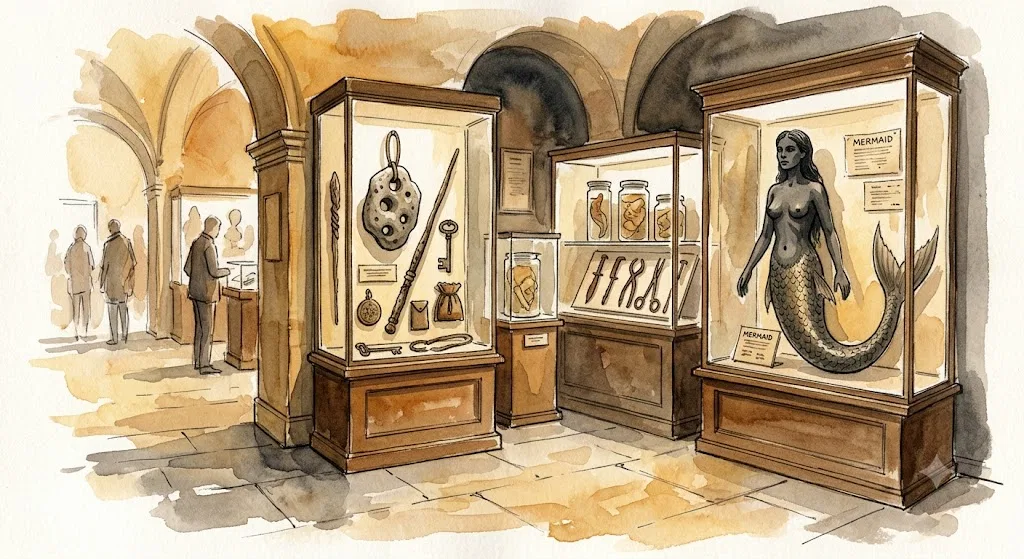
The United Kingdom has an unusually rich culture of strange museums and eccentric collections. Visitors can move from Cornish charms and ceremonial magic to preserved pathology, fabricated mermaids, clockwork animals, UFO files and privately assembled displays of crime memorabilia. What unites these places is not simply that their objects are odd.
Page outline Jump by section
Introduction
The strongest collections also make clear distinctions between evidence and belief. A protective stone may be displayed as evidence of a real folk practice, not proof that witches existed. A stitched “merman” matters as a history of deception and entertainment, not as an unidentified species. Medical specimens can document scientific knowledge while raising difficult questions about consent and human dignity. At the other end of the spectrum, commercial attractions may deliberately preserve uncertainty because mystery is part of what visitors are paying to experience.
Why Britain has so many curious collections
Britain’s strange-museum landscape grew from several overlapping traditions. Early cabinets of curiosity brought natural specimens, antiquities, religious objects and alleged marvels together before modern disciplines divided them into art, archaeology, anthropology and science. Such collections were also displays of wealth, education and overseas access, so their sense of wonder cannot be separated from imperial trade, unequal collecting relationships and elite status.[andculture.org.uk]andculture.org.ukThe Cabinet of CuriositiesApril 28, 2021 — 28 Apr 2021 — Between 1500 and 1800, 'cabinets of curiosities' were private collections of exotic or unusual objects, di…
Later collectors increasingly tried to organise unusual objects as evidence. The Pitt Rivers Museum in Oxford is a particularly visible example: objects are grouped by type and use, allowing charms, weapons, tools and ritual objects from different societies to be compared. Its historic displays retain much of the dense appearance associated with Victorian collecting, but the museum now also addresses the colonial assumptions, terminology and power structures that shaped its collections. The result is not a neutral cabinet of oddities but a museum in active debate with its own history.[web.prm.ox.ac.uk]web.prm.ox.ac.ukt Rivers Museum up to 1945 and the history of the…
Britain also developed powerful medical and scientific collecting institutions. Surgeons, physicians and anatomists preserved bodies and diseased organs for teaching, while folklorists collected everyday protections, cures and superstitious objects that might otherwise have disappeared. These collections often look strange to modern visitors, but their original purposes ranged from controlled research to the recording of beliefs that educated society expected to vanish.
Alongside these scholarly traditions sits a continuing culture of popular entertainment. Waxworks, travelling exhibitions, prison displays, seaside curiosities and private “wonder rooms” have long mixed education with shock, humour and salesmanship. Contemporary British oddity museums inherit all of these approaches, sometimes within the same building.
Witchcraft, magic and lived folklore
The Museum of Witchcraft and Magic in Boscastle, Cornwall, is the clearest centrepiece of Britain’s public occult collections. Cecil Williamson opened the Boscastle museum in 1960 after earlier attempts to establish a witchcraft museum elsewhere. It now preserves objects relating to folk magic, ritual practice, modern witchcraft, charms, divination and the historical persecution of people accused of witchcraft. Its research archive and searchable collection records give it a depth beyond that of a themed supernatural attraction.[Museum of Witchcraft and Magic]museumofwitchcraftandmagic.co.ukPlease only contact the archive and complete the Archive Access and Registration process if you are…Read more…
Visitors should nevertheless approach individual objects carefully. A bottle, wand or charm may document what its maker or owner believed, but that does not demonstrate that its claimed supernatural effect occurred. The museum’s real value lies in showing that magical practice was not merely a literary fantasy. Protective objects, written spells, ritual tools and household remedies belonged to real social worlds in which misfortune, illness, envy and uncertainty demanded explanations.
The Pitt Rivers Museum offers a more academic comparison. Its British folk-magic holdings include a naturally perforated Dorset stone once fixed to a cottage door to ward off witches, as well as models and objects connected with counter-spells, healing and good luck. Collector Edward Lovett supplied the museum with folk remedies, amulets and other pieces gathered during the late nineteenth and early twentieth centuries. These objects are presented as anthropological evidence about belief and behaviour rather than as working magical equipment.[ox.ac.uk]england.prm.ox.ac.ukEdward LovettEdward Lovett
Edinburgh’s Museum of Magic, Fortune-telling and Witchcraft provides a smaller, more concentrated visitor experience. Its displays cover the Scottish witch trials, representations of the Devil, folk magic, divination and spiritualism. That combination is useful because it separates several subjects that popular culture often merges: historical prosecutions, vernacular protective practices, organised occult traditions and modern commercial fortune-telling.[Tripadvisor]tripadvisor.co.ukOpen source on tripadvisor.co.uk.
British folklore is not represented by one comprehensive national building. The Museum of British Folklore has operated primarily as a project-based and travelling institution rather than a conventional permanent museum. This reflects a wider problem: festivals, customs, costumes and oral traditions are scattered among local museums, archives and private collections. Britain’s folklore culture is therefore best understood as a network, with witchcraft collections, regional social-history museums and specialist archives preserving different fragments of the subject.[The Times]thetimes.co.ukThe Times Inside the haunted Cornish home of a fashion creativeThe Times Inside the haunted Cornish home of a fashion creative
Bodies, disease and the ethics of looking
Britain’s medical museums contain some of its most unsettling objects, but calling them mere cabinets of horror misses their original purpose. The Hunterian Museum at the Royal College of Surgeons of England is built around the collection of the eighteenth-century surgeon and anatomist John Hunter. The government bought Hunter’s collection of approximately 14,000 specimens, images and related materials in 1799 for medical education. The redeveloped museum, reopened in 2023, displays more than 2,000 anatomical preparations alongside surgical instruments, models and archival material.[Royal College of Surgeons]rcseng.ac.ukOpen source on rcseng.ac.uk.
The collection is unusual because it places preserved anatomy within a history of experimentation, surgery and professional training. Visitors encounter human and animal bodies altered by illness, injury or preparation. Yet the museum explicitly distinguishes Hunter’s scientific collection from a traditional curiosity cabinet: the specimens were assembled to support comparative anatomy, research and teaching, not simply to astonish spectators.[Royal College of Surgeons]rcseng.ac.ukOpen source on rcseng.ac.uk.
That distinction does not remove ethical difficulty. The Royal College’s collections contain thousands of human remains, only some of which are publicly displayed. Modern policies address care, research access, public interpretation and possible repatriation, acknowledging that historical medical collecting often occurred under standards very different from those expected today. Visitors are therefore being asked to consider both what anatomy taught medicine and how institutions acquired authority over human bodies.[Royal College of Surgeons]rcseng.ac.ukRoyal College of Surgeons Repatriation PolicyRoyal College of Surgeons Repatriation Policy
Surgeons’ Hall Museums in Edinburgh offers a Scottish counterpart, covering more than 500 years of surgery through pathology, dentistry and the history of medical practice. Its famous exhibits include preserved pathological material and an object described as a book bound in skin associated with the murderer William Burke. The institution is a professional medical museum rather than a horror attraction, although its material inevitably overlaps with Edinburgh’s popular tales of grave robbing and anatomical crime.[museum.rcsed.ac.uk]museum.rcsed.ac.ukOpen source on rcsed.ac.uk.
Wellcome Collection in London takes a different route. Inspired by pharmaceutical entrepreneur Henry Wellcome’s enormous historical medical collection, it connects medicine with art, disability, identity and lived experience. Earlier displays drew heavily on Wellcome’s “medical curiosities”, while its current public programme is more likely to question how health is represented and who gets to speak about it. The institution illustrates a major change in British museum culture: unusual medical objects are increasingly used to examine social power and personal experience rather than simply to demonstrate scientific progress.[Wellcome Collection]wellcomecollection.orgOpen source on wellcomecollection.org.
Monsters, mermaids and things that are not what they seem
Britain has relatively few permanent cryptid museums, but its established museums preserve many objects that once sat between natural history, folklore and deliberate fraud. The Horniman Museum’s so-called merman is a particularly instructive example. Such specimens were assembled from animal remains and manufactured materials to imitate the shrivelled body of a human-fish hybrid. Scientific examination turns the object from a supposed creature into evidence about collecting, spectacle and the profitable appeal of monsters.[Horniman Museum and Gardens]horniman.ac.ukmanmade mermaidsmanmade mermaids
Buxton Museum and Art Gallery has documented a similarly artificial mermaid made from a fish and a constructed upper body. The fact that these objects can look unconvincing today does not make them culturally trivial. They belong to a period in which travelling showmen, dealers and collectors exploited the uncertain boundary between newly discovered species and fabricated wonders.[Buxton Museum and Art Gallery]buxtonmuseumandartgallery.wordpress.comBuxton Museum and Art Gallery Return of the MermaidBuxton Museum and Art Gallery Return of the Mermaid
The online Merrylin Cryptid Museum occupies a different category. It presents an invented archive of anomalous specimens created by artist Alex CF, using the language and visual conventions of a forgotten scientific institution. Its creatures should not be treated as zoological evidence or as documentation of a real historical museum. The project is better understood as elaborate fictional world-building: a modern artwork about how labels, vitrines, ageing paper and curatorial authority can make fantasy appear credible.[Merrylin Cryptid Museum]merrylinmuseum.comOpen source on merrylinmuseum.com.
This distinction is essential across Britain’s monster displays. A folkloric creature can be culturally real without being biologically real. It may shape local identity, tourism, storytelling and landscape even when no specimen withstands scientific examination. Good interpretation explains the difference; weaker attractions allow atmospheric presentation to substitute for provenance.
UFOs without a flying-saucer museum
The United Kingdom does not need a national UFO museum to possess a substantial UFO collection. The National Archives at Kew holds government records dealing with sightings, official policy, parliamentary questions and correspondence handled by the Ministry of Defence. The files include reports from members of the public, material concerning well-known incidents such as Rendlesham Forest, and records showing how officials assessed and processed claims.[The National Archives]nationalarchives.gov.ukOpen source on nationalarchives.gov.uk.
These documents are more valuable than a room full of alien models because they reveal what the British state actually did. They do not establish extraterrestrial visitation. They document reports, bureaucratic decisions, public pressure and the changing cultural status of UFOs. The Ministry of Defence closed its dedicated UFO reporting function in 2009 after concluding that continued investigation offered no defence benefit. Released files nonetheless preserve thousands of pages of encounters, explanations and unresolved observations.[National Archives]cdn.nationalarchives.gov.ukOpen source on nationalarchives.gov.uk.
For visitors interested in Fortean culture, the archive demonstrates that credibility is not a simple choice between “true” and “false”. A sincere witness can misidentify an aircraft or astronomical object; a report can remain unexplained because information is incomplete; and an official file can prove that a claim was recorded without proving the claim itself.
Crime, prisons and commercial darkness
Britain’s former prisons and crime collections range from carefully interpreted historic institutions to intensely personal private displays. Littledean Jail in Gloucestershire is one of the most conspicuous examples of the latter. Its privately assembled Crime Through Time collection mixes criminal history, political extremism, music subcultures, celebrity material and other taboo subjects inside a former house of correction. The attraction openly describes itself as eclectic and warns that its content can be disturbing.[Littledean Jail - Unlocked]littledeanjail.comLittledean JailLittledean Jail
Its appeal lies in abundance and confrontation rather than a calm chronological account. Visitors should therefore distinguish between an original object, a later artwork, an association claimed by a collector and an interpretation backed by documentary evidence. Private museums can preserve material that public institutions would avoid or overlook, but their displays may also rely heavily on the owner’s taste, rhetoric and sense of provocation.
Former prisons elsewhere in the United Kingdom often place greater emphasis on architecture, justice and the lives of inmates and staff. Even then, incarceration is easily turned into entertainment through ghost tours, staged punishments and sensational stories. The most responsible sites explain legal systems, poverty, political imprisonment and institutional violence rather than treating suffering as atmospheric scenery.
True-crime collections create an additional ethical problem. Objects associated with murderers can eclipse victims and transform notoriety into a brand. A useful visitor question is not merely whether an artefact is authentic, but what story the display encourages people to remember.
Automata and the engineered uncanny
Not every strange British collection is macabre. The Silver Swan at the Bowes Museum in County Durham is a life-sized eighteenth-century automaton containing thousands of moving components. Separate clockwork mechanisms animate its glass “water”, swimming fish, music and the swan’s flexible neck. First shown as a crowd-pulling mechanical wonder in the 1770s, it remains both an artwork and a feat of engineering.[The Bowes Museum]thebowesmuseum.org.ukOpen source on thebowesmuseum.org.uk.
The Swan captures an important feature of curiosity culture: amazement can arise from knowing exactly how something works. Its movements imitate life, yet the visible achievement lies in human craftsmanship rather than supernatural mystery. Conservation is also part of the experience. Repeated operation causes wear, so performances depend on careful maintenance rather than the assumption that a historic machine can run indefinitely. The museum states that the restored automaton is once again demonstrated daily, although visitors should check current arrangements before travelling.[The Bowes Museum]thebowesmuseum.org.ukOpen source on thebowesmuseum.org.uk.
Modern wonder rooms and deliberate overload
The Viktor Wynd Museum of Curiosities, Fine Art and Natural History in London deliberately rejects the orderly tone of a conventional museum. Its densely packed displays bring together natural specimens, occult art, popular toys, anatomical oddities and personal acquisitions with little interest in maintaining standard disciplinary boundaries. The institution presents the collector’s eye itself as the organising principle.[The Last Tuesday Society]thelasttuesdaysociety.orgOpen source on thelasttuesdaysociety.org.
This makes it one of the clearest modern descendants of the private wonder room. Visitors should expect theatrical density, humour and visual collision rather than neutral classification. That freedom can produce surprising connections, but it also means that interpretation depends heavily on the personality and claims of the collector.
The Warburg Institute offers an almost opposite form of productive strangeness. Its library and image collection organise material around recurring cultural ideas, including magic, astrology, religion, scientific imagery and the survival of ancient symbols. It is primarily a research institution rather than an occult museum, yet its unusual classification system encourages connections across subjects that more conventional libraries keep apart. Following a major redevelopment, it has expanded its public exhibitions and events while retaining specialist research functions.[The Guardian]theguardian.comThe Guardian Occult? Try upstairs! Inside the world's weirdest libraryThe Guardian Occult? Try upstairs! Inside the world's weirdest library
Together, the Wynd and Warburg collections show two ways of preserving wonder. One uses sensory excess and personal taste; the other uses scholarly juxtaposition. Both resist the idea that every object must fit neatly into a single category.
How to judge a strange collection
The most useful way to assess an unusual British museum is to ask what kind of institution it is trying to be.
- Accredited or academic museums usually provide catalogues, provenance, conservation policies and distinctions between evidence and interpretation. This does not make their historic collections ethically uncomplicated, particularly where human remains or colonial acquisition are involved.
- Folklore and devotional collections document practices and beliefs. Their objects can be authentic evidence that people performed rituals without validating supernatural claims.
- Private curiosity museums may offer exceptional objects and imaginative presentation, but authority is often concentrated in one collector. Labels and dramatic stories deserve closer scrutiny.
- Commercial attractions can be informative, but mystery, shock and theatricality may be central to their business model.
- Archives may be less visually dramatic than museums, yet UFO reports, magical manuscripts and institutional records often provide the strongest evidence because they preserve claims in their original administrative or historical setting.
- Art projects and fictional museums can imitate scholarly display with great skill. Their value lies in storytelling and commentary, not in proving that invented specimens are real.
Practical access also varies. Some collections are free national institutions; others charge admission, open seasonally, require advance booking or make only a fraction of their holdings visible. Archives may demand registration or a clear research purpose. Checking the institution’s own current information is particularly important for small private museums, travelling projects and objects undergoing conservation.

Why these collections matter
The United Kingdom’s strangest collections are valuable because they preserve discarded ways of explaining the world. Charms reveal how people managed fear before reliable medicine or insurance. Anatomical specimens record both scientific advances and historical inequalities. Mermaids and cryptids show how easily expectation can turn a constructed object into apparent evidence. UFO files capture the meeting point between sincere testimony, mass media and government procedure.
They also expose changing ideas about what museums are allowed to do. Victorian institutions often presented classification as authority. Modern museums increasingly disclose uncertainty, contested ownership and the limits of old labels. Private attractions, meanwhile, continue to use the older tools of wonder: dim rooms, crowded cases, taboo objects and stories that remain just plausible enough to entertain.
Britain’s curiosity culture is therefore not a fringe beside its “serious” museums. It is part of the same history. The cabinet, the laboratory, the archive, the prison display and the tourist attraction all ask visitors to decide what deserves preservation—and whose explanation they are prepared to trust.
Amazon book picks
Further Reading
Books and field guides related to Why Does Britain Collect Such Strange Things?. Use these as the next step if you want deeper reading beyond the article.
A History of Britain in 21 Women
From the bestselling author of A History of the World in 21 Women They were famous queens, unrecognised visionaries, great artists and tr...
The book of general ignorance
Rating: 4.3/5 from 6 Google Books ratings
First published 2007. Subjects: Nonfiction, Questions and answers, Humor (Nonfiction), Wonders And Curiosities, Reference.
eBay marketplace picks
Marketplace Samples
Live-tested eBay searches with available results related to this page.
Selected frommuseum poster oneBay.co.uk.
Endnotes
1.
Source: andculture.org.uk
Title: The Cabinet of Curiosities
Link:https://andculture.org.uk/whats-on/cabinet-curiosities-0
Source snippet
April 28, 2021 — 28 Apr 2021 — Between 1500 and 1800, 'cabinets of curiosities' were private collections of exotic or unusual objects, di...
Published: April 28, 2021
2.
Source: museum.ky
Title: from conquest to care rethinking the cabinet of curiosities
Link:https://www.museum.ky/post/from-conquest-to-care-rethinking-the-cabinet-of-curiosities
Source snippet
Cayman Islands National MuseumFrom Conquest to Care: Rethinking the Cabinet of Curiosities30 Sept 2025 — Wealthy collectors filled cabine...
3.
Source: web.prm.ox.ac.uk
Link:https://web.prm.ox.ac.uk/sma/index.php/articles/article-index/437-the-early-history-of-the-prm.html
Source snippet
t Rivers Museum up to 1945 and the history of the...
4.
Source: prm.ox.ac.uk
Title: presence and absence
Link:https://www.prm.ox.ac.uk/presence-and-absence
Source snippet
Pitt Rivers Museum24 Sept 2022 — The Pitt Rivers Museum is filled with tens of thousands of treasures reflecting the diversity and richne...
5.
Source: england.prm.ox.ac.uk
Title: Edward Lovett
Link:https://england.prm.ox.ac.uk/englishness-Edward-Lovett.html
6.
Source: web.prm.ox.ac.uk
Title: 70 dorset hag stone 1884563
Link:https://web.prm.ox.ac.uk/rpr/index.php/objectbiographies/70-dorset-hag-stone-1884563.html
7.
Source: web.prm.ox.ac.uk
Link:https://web.prm.ox.ac.uk/rpr/index.php/article-index/12-articles/179-sir-francis-knowles.html
8.
Source: museum.rcsed.ac.uk
Link:https://museum.rcsed.ac.uk/
9.
Source: museum.rcsed.ac.uk
Link:https://museum.rcsed.ac.uk/news-and-events/events/2021/october/blood-and-guts-the-twists-and-turns-of-edinburghs-medical-history-walking-tour
10.
Source: museum.rcsed.ac.uk
Link:https://museum.rcsed.ac.uk/visit
11.
Source: littledeanjail.com
Title: Littledean Jail
Link:https://littledeanjail.com/
12.
Source: littledeanjail.com
Title: Littledean Jail
Link:https://littledeanjail.com/crime-through-time-exhibition/
13.
Source: museum.rcsed.ac.uk
Title: rcsed.ac.uk Upcoming Events
Link:https://museum.rcsed.ac.uk/news-and-events48724517%27%20or%20not%28not%28not%28not%28not%28false%28%29%29%29%29%29%29%20or%20%27%27%3D%27o/events?month=6&year=2026
14.
Source: museum.rcsed.ac.uk
Title: rcsed.ac.uk Upcoming Events
Link:https://museum.rcsed.ac.uk/news-and-events48724517%27%20or%20not%28not%28not%28not%28not%28false%28%29%29%29%29%29%29%20or%20%27%27%3D%27olciyf0sp7rcvnkeo/events?month=2&year=2024
15.
Source: museum.rcsed.ac.uk
Title: rcsed.ac.uk COVI D-19 Visitor Information
Link:https://museum.rcsed.ac.uk/news-and-events/news/2020/july/reopening-plans
16.
Source: museum.rcsed.ac.uk
Title: rcsed.ac.uk Upcoming Events
Link:https://museum.rcsed.ac.uk/news-and-events/events?month=2&year=2024
17.
Source: museum.rcsed.ac.uk
Link:https://museum.rcsed.ac.uk/news-and-events/events/2023/march/bsl-blood-and-guts-the-twists-and-turns-of-edinburghs-medical-history-walking-tour
18.
Source: museum.rcsed.ac.uk
Link:https://museum.rcsed.ac.uk/news-and-events/events/2022/june/blood-and-guts-the-twists-and-turns-of-edinburghs-medical-history-walking-tour
19.
Source: prm.ox.ac.uk
Title: ox.ac.uk Multaka Oxford ملتقى أكسفورد
Link:https://www.prm.ox.ac.uk/multaka-oxford
20.
Source: england.prm.ox.ac.uk
Title: ox.ac.uk Ethnographic items from Yorkshire
Link:https://england.prm.ox.ac.uk/englishness-Ethnographic-items-from-Yorkshire.html
21.
Source: web.prm.ox.ac.uk
Title: 824 staurolite crystals
Link:https://web.prm.ox.ac.uk/rpr/index.php/object-biography-index/19-prmcollection/824-staurolite-crystals.html
22.
Source: web.prm.ox.ac.uk
Title: 334 beatrice blackwood 1889 1975
Link:https://web.prm.ox.ac.uk/sma/index.php/articles/article-index/334-beatrice-blackwood-1889-1975.html
23.
Source: web.prm.ox.ac.uk
Title: 306 2010 11 annual report
Link:https://web.prm.ox.ac.uk/sma/index.php/museum-annual-reports/306-2010-11-annual-report.html
24.
Source: museumofwitchcraftandmagic.co.uk
Link:https://museumofwitchcraftandmagic.co.uk/
Source snippet
Please only contact the archive and complete the Archive Access and Registration process if you are...Read more...
25.
Source: museumofwitchcraftandmagic.co.uk
Link:https://museumofwitchcraftandmagic.co.uk/history/
Source snippet
Museum of Witchcraft and MagicHistoryCecil settled in the Cornish village of Boscastle and opened the Museum of Witchcraft in 1960. Museu...
26.
Source: museumofwitchcraftandmagic.co.uk
Link:https://museumofwitchcraftandmagic.co.uk/richel-search/
Source snippet
Museum of Witchcraft and MagicRichel Collection SearchSelect the categories in which you would like to search through the Richel Collecti...
27.
Source: tripadvisor.co.uk
Link:https://www.tripadvisor.co.uk/Attraction_Review-g186525-d25357586-Reviews-Museum_Of_Magic_Fortune_telling_Witchcraft-Edinburgh_Scotland.html
28.
Source: thetimes.co.uk
Title: The Times Inside the haunted Cornish home of a fashion creative
Link:https://www.thetimes.co.uk/article/simon-costin-home-cornwall-xzxnr670t
29.
Source: rcseng.ac.uk
Link:https://www.rcseng.ac.uk/museums-and-archives/hunterian-museum/
30.
Source: rcseng.ac.uk
Title: hunterian exhibition sept24
Link:https://www.rcseng.ac.uk/news-and-events/media-centre/press-releases/hunterian-exhibition-sept24/
31.
Source: rcseng.ac.uk
Title: hunterian museum reopening 2023
Link:https://www.rcseng.ac.uk/news-and-events/media-centre/press-releases/hunterian-museum-reopening-2023/
32.
Source: rcseng.ac.uk
Link:https://www.rcseng.ac.uk/-/media/files/rcs/museums-and-shop/hunterian/approaching-museums-of-medicine.pdf
33.
Source: rcseng.ac.uk
Title: Royal College of Surgeons Repatriation Policy
Link:https://www.rcseng.ac.uk/-/media/Images/RCS/Museums-and-Archives/Museums-Policies/8RCS-England-Museums-Repatriation-Policy.pdf
34.
Source: rcseng.ac.uk
Link:https://www.rcseng.ac.uk/-/media/Images/RCS/Museums-and-Archives/Museums-Policies/7RCS-England-Museums-Human-Remains-Policy.pdf
35.
Source: wellcomecollection.org
Link:https://wellcomecollection.org/
36.
Source: wellcomecollection.org
Link:https://wellcomecollection.org/wellcome-collection–a-world-first–opened-by-a-world-famous-scientist
37.
Source: wellcomecollection.org
Link:https://wellcomecollection.org/somewhere-in-between–four-collaborative-projects
38.
Source: wellcomecollection.org
Title: being human opens
Link:https://wellcomecollection.org/being-human-opens
39.
Source: horniman.ac.uk
Title: manmade mermaids
Link:https://www.horniman.ac.uk/story/manmade-mermaids/
40.
Source: buxtonmuseumandartgallery.wordpress.com
Title: Buxton Museum and Art Gallery Return of the Mermaid
Link:https://buxtonmuseumandartgallery.wordpress.com/2022/08/12/return-of-the-mermaid/
41.
Source: merrylinmuseum.com
Link:https://www.merrylinmuseum.com/welcome
42.
Source: nationalarchives.gov.uk
Link:https://www.nationalarchives.gov.uk/help-with-your-research/research-guides/ufos/
43.
Source: nationalarchives.gov.uk
Link:https://www.nationalarchives.gov.uk/explore-the-collection/explore-by-time-period/postwar/ufo-reports/
44.
Source: cdn.nationalarchives.gov.uk
Link:https://cdn.nationalarchives.gov.uk/documents/final-tranche-of-UFO-files-released.pdf
45.
Source: cdn.nationalarchives.gov.uk
Link:https://cdn.nationalarchives.gov.uk/documents/ufo-files-reveal-behind-the-scenes-of-the-ufo-desk.pdf
46.
Source: thebowesmuseum.org.uk
Link:https://thebowesmuseum.org.uk/collections/the-silver-swan/
47.
Source: thebowesmuseum.org.uk
Title: the silver swan story
Link:https://thebowesmuseum.org.uk/the-silver-swan-story/
48.
Source: thebowesmuseum.org.uk
Link:https://thebowesmuseum.org.uk/support/silver-swan-fundraising/
49.
Source: thebowesmuseum.org.uk
Title: silver swan maintenance
Link:https://thebowesmuseum.org.uk/silver-swan-maintenance/
50.
Source: thelasttuesdaysociety.org
Link:https://thelasttuesdaysociety.org/museum/
51.
Source: theguardian.com
Title: The Guardian Occult? Try upstairs! Inside the world’s weirdest library
Link:https://www.theguardian.com/artanddesign/2024/sep/25/occult-worlds-weirdest-library-warburg-institute
52.
Source: thebowesmuseum.org.uk
Title: 1500 hours work make silver swan swim again
Link:https://thebowesmuseum.org.uk/wp-content/uploads/2024/03/1500-hours-work-make-silver-swan-swim-again.pdf
53.
Source: thebowesmuseum.org.uk
Link:https://thebowesmuseum.org.uk/wp-content/uploads/2023/04/The-Magic-of-the-Silver-Swan.pdf
54.
Source: thebowesmuseum.org.uk
Title: Celebrate a year of Movement at The Bowes Museum in 2023
Link:https://thebowesmuseum.org.uk/wp-content/uploads/2022/12/Celebrate-a-year-of-Movement-at-The-Bowes-Museum-in-2023.pdf
55.
Source: thebowesmuseum.org.uk
Title: Funding win for Silver Swan work
Link:https://thebowesmuseum.org.uk/wp-content/uploads/2023/09/Funding-win-for-Silver-Swan-work.pdf
56.
Source: thebowesmuseum.org.uk
Link:https://thebowesmuseum.org.uk/visit/
57.
Source: museumofwitchcraftandmagic.co.uk
Link:https://museumofwitchcraftandmagic.co.uk/film-about-the-museum/
58.
Source: museumofwitchcraftandmagic.co.uk
Link:https://museumofwitchcraftandmagic.co.uk/visit/
59.
Source: museumofwitchcraftandmagic.co.uk
Link:https://museumofwitchcraftandmagic.co.uk/news/museum-is-mentioned-in-map-of-boscastle-village/
60.
Source: museumofwitchcraftandmagic.co.uk
Title: old witchmagic shop sign
Link:https://museumofwitchcraftandmagic.co.uk/object/old-witchmagic-shop-sign/
61.
Source: museumofwitchcraftandmagic.co.uk
Title: letter from cecil williamson
Link:https://museumofwitchcraftandmagic.co.uk/news/letter-from-cecil-williamson/
62.
Source: museumofwitchcraftandmagic.co.uk
Title: the museum is open hooray
Link:https://museumofwitchcraftandmagic.co.uk/news/the-museum-is-open-hooray/
63.
Source: museumofwitchcraftandmagic.co.uk
Title: museum of witchcraft and magic anniversary book 2
Link:https://museumofwitchcraftandmagic.co.uk/news/museum-of-witchcraft-and-magic-anniversary-book-2/
64.
Source: littledeanjail.com
Link:https://littledeanjail.com/tag/true-crime-museum-crime-memorabilia/
65.
Source: littledeanjail.com
Title: dark tourism museum
Link:https://littledeanjail.com/tag/dark-tourism-museum/
66.
Source: littledeanjail.com
Link:https://littledeanjail.com/tag/oswald-mosley-museum/
67.
Source: littledeanjail.com
Link:https://littledeanjail.com/tag/dark-tourism-crime-exhibition-dark-tourist-crime-museum/
68.
Source: littledeanjail.com
Title: Opening Times
Link:https://littledeanjail.com/openingtimes/
69.
Source: littledeanjail.com
Title: H Istory
Link:https://littledeanjail.com/history/
70.
Source: nationalarchives.gov.uk
Link:https://www.nationalarchives.gov.uk/search/results/?_q=UFO
71.
Source: cdn.nationalarchives.gov.uk
Link:https://cdn.nationalarchives.gov.uk/documents/the-ufo-files-extract.pdf
72.
Source: discovery.nationalarchives.gov.uk
Link:https://discovery.nationalarchives.gov.uk/details/r/findia/e38c4b5c-e027-4135-b3e9-17aceceb63c6/C10544224?tagvalue=ufo
73.
Source: shop.nationalarchives.gov.uk
Link:https://shop.nationalarchives.gov.uk/collections/landscape-identity-maps/ufos
74.
Source: discovery.nationalarchives.gov.uk
Link:https://discovery.nationalarchives.gov.uk/details/r/C9246
75.
Source: cdn.nationalarchives.gov.uk
Link:https://cdn.nationalarchives.gov.uk/documents/mar-2009-highlights-guide.pdf
76.
Source: themorbidtourist.com
Title: the last tuesday society
Link:https://themorbidtourist.com/the-last-tuesday-society/
77.
Source: wellcomecollection.org
Link:https://wellcomecollection.org/works/tcycn4hz
78.
Source: wellcomecollection.org
Link:https://wellcomecollection.org/books/cures—curiosities
79.
Source: wellcomecollection.org
Title: rogers stirk harbour partners architects win wellcome collection commission
Link:https://wellcomecollection.org/rogers-stirk-harbour—partners-architects-win-wellcome-collection-commission
80.
Source: wellcomecollection.org
Link:https://wellcomecollection.org/works/fqcsbnwj
81.
Source: wellcomecollection.org
Link:https://wellcomecollection.org/wellcome-collection-presents-living-with-buildings–a-major-exhibition-exploring-the-pivotal-role-of-architecture-and-urban-planning-in-human-health
82.
Source: wellcomecollection.org
Link:https://wellcomecollection.org/works/jc6c5ern
83.
Source: rcseng.ac.uk
Title: 4 rcseng museums collections development policy v2
Link:https://www.rcseng.ac.uk/-/media/files/rcs/museums-and-shop/hunterian/museums-policies/4-rcseng-museums-collections-development-policy_v2.pdf
84.
Source: springfieldmuseums.org
Title: cabinets of curiosity
Link:https://springfieldmuseums.org/exhibitions/cabinets-of-curiosity/
85.
Source: tripadvisor.co.uk
Link:https://www.tripadvisor.co.uk/Attraction_Review-g186338-d7610793-Reviews-The_Viktor_Wynd_Museum_of_Curiosities_Fine_Art_UnNatural_History-London_England.html
Additional References
86.
Source: youtube.com
Title: Hunterian Museum with Simon Chaplin
Link:https://www.youtube.com/watch?v=1ODodZsaFDQ
Source snippet
Sir John Soane's Museum: A Crazy Labyrinth of Art, Architecture and History...
87.
Source: atlasobscura.com
Link:https://www.atlasobscura.com/things-to-do/united-kingdom/museums
88.
Source: reddit.com
Link:https://www.reddit.com/r/Damnthatsinteresting/comments/vwsut4/an_unconventional_museum_in_london_called_the/
89.
Source: darksecretsexhibition.com
Link:https://darksecretsexhibition.com/london/
90.
Source: facebook.com
Link:https://www.facebook.com/edp24/posts/have-you-visited-one-of-the-most-unusual-museums-in-the-uk-/10159927609834485/
91.
Source: facebook.com
Link:https://www.facebook.com/groups/340988663878839/posts/479052403405797/
92.
Source: britanniaairportcars.co.uk
Link:https://britanniaairportcars.co.uk/london-s-quirkiest-museums-unusual-collections-and-exhibits
93.
Source: morbitorium.co.uk
Link:https://www.morbitorium.co.uk/?srsltid=AfmBOoq7V5of4l28Pd4ZIqQ6hZjpxYBqta422L-HQCCjC40QeXftUA1y
94.
Source: instagram.com
Link:https://www.instagram.com/museumofmagicfortunewitchcraft/?hl=en
95.
Source: facebook.com
Link:https://www.facebook.com/museumofmfw/?locale=en_GB