Within Curious Andorra
When Sacred Objects Become Museum Treasures
Andorra's religious collections reveal how sacred objects change when they become museum exhibits, replicas or recovered heritage.
On this page
- Reliquaries and liturgical objects in living religious culture
- The removal and return of Santa Coloma's murals
- How museums separate devotion, provenance and proof
Page outline Jump by section
Introduction
Andorra’s most unusual religious heritage is not defined by mysterious relics or hidden shrines, but by objects whose meaning changes depending on where they are seen. A reliquary displayed in a museum remains a devotional object for many believers. A medieval fresco removed from a church becomes both an artwork and evidence in a debate about ownership, conservation and authenticity. The country’s churches and heritage centres therefore ask visitors to consider not only what an object is, but also whether it is being viewed as sacred, historical or reconstructed.
This tension is especially visible at Espai Columba and the nearby Church of Santa Coloma, where original Romanesque paintings that spent decades abroad are reunited with the place they were created, while digital projections restore the appearance of artworks that can no longer safely remain on the church walls. Rather than presenting a simple story of recovery, these sites explore how devotion, conservation and historical evidence coexist.[museus.ad]museus.adSanta ColomaSanta Coloma
Reliquaries and liturgical objects in living religious culture
Unlike many collections of religious art that have become entirely detached from worship, Andorra’s ecclesiastical collections remain closely connected to churches that still function as places of devotion. Many of the objects displayed in museums originated only a short distance away and continue to carry religious significance alongside their historical value.
The Museum of Sacred Art in Encamp illustrates this dual identity. Among its most discussed objects is a sixteenth-century cross presented as containing a relic of the True Cross. For believers, such relics represent a physical connection with Christ’s Passion through centuries of Christian tradition. For historians and museum professionals, however, the emphasis lies on documented provenance, craftsmanship, liturgical use and the history of the object’s veneration rather than on proving the relic’s supernatural origin.
This distinction is important because museums generally authenticate the history of an object’s ownership, manufacture and use, not the theological claims associated with it. A reliquary can therefore be historically authentic while its sacred significance remains a matter of religious belief rather than scientific verification. That balance allows museums to respect devotional traditions without presenting matters of faith as established historical fact.[Visit Andorra]visitandorra.comVisit Andorra Espai ColumbaVisit Andorra Espai Columba
The removal and return of Santa Coloma’s murals
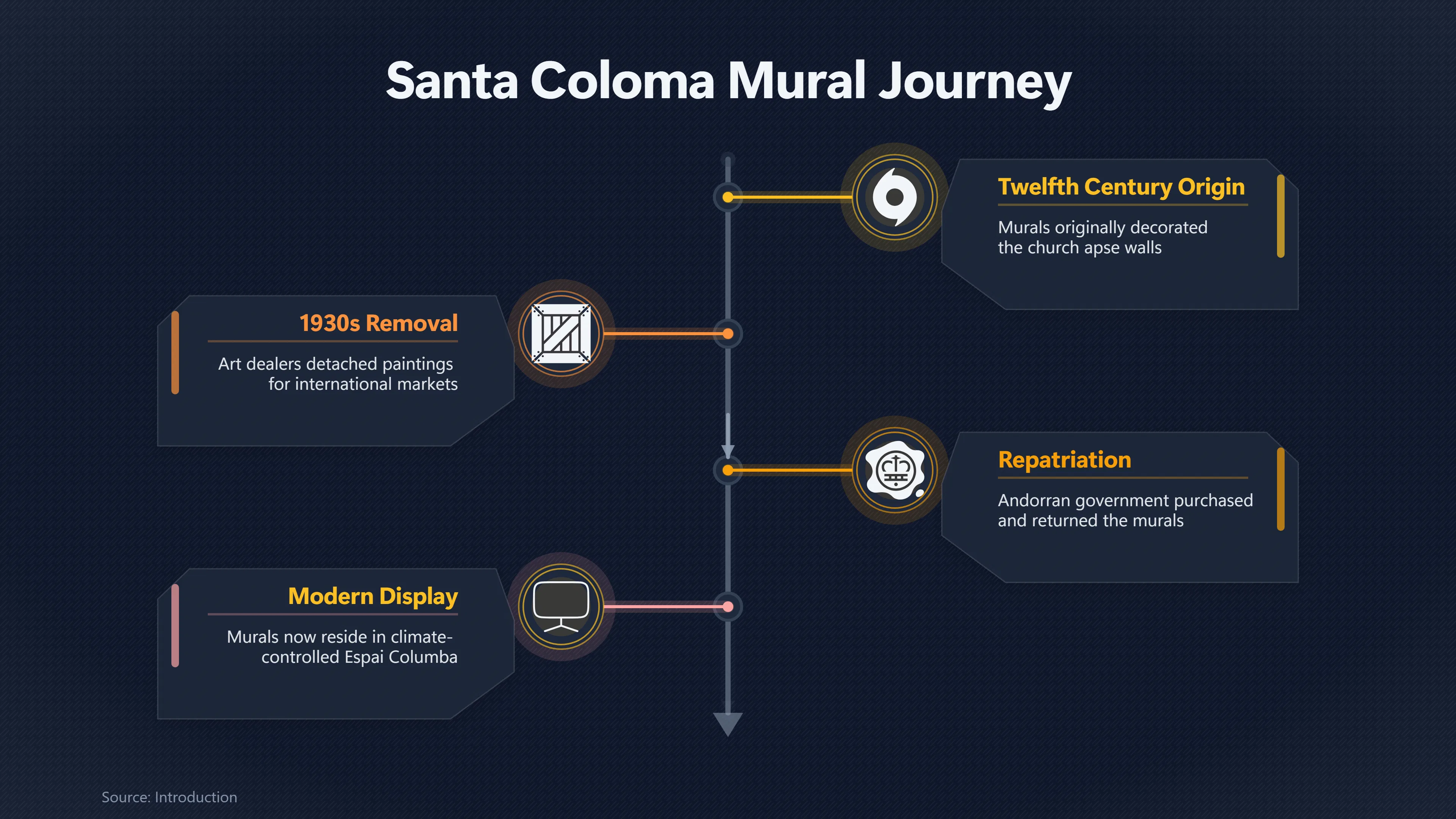
The Romanesque murals from the Church of Santa Coloma provide Andorra’s best-known example of disputed cultural heritage.
The paintings originally decorated the church’s apse during the twelfth century. In the early 1930s they were detached from the walls using techniques commonly employed across the Pyrenees as dealers and collectors sought medieval mural paintings for the international art market. They subsequently passed through private ownership and museums outside Andorra before eventually returning to the Principality in 2007 after lengthy negotiations and purchase by the Andorran government.[govern.ad]govern.add’Andorra Pintures murals romàniques de Santa ColomaGovern d’AndorraPintures murals romàniques de Santa Coloma - Govern d’Andorra…
Their journey raises several overlapping questions.
- Were they legally removed? The transactions reflected the legal and commercial circumstances of their time, but modern attitudes towards cultural heritage place far greater emphasis on preserving artworks within their original historical setting.
- Should they have remained inside the church? Removing murals protected them from environmental damage and possible loss, but separated them from the architecture that gave them much of their meaning.
- What counts as “coming home”? Returning the paintings to Andorra restored an important part of the country’s artistic heritage, yet conservation requirements mean the originals are displayed in Espai Columba rather than being permanently reattached to the medieval church itself.
Instead of reinstalling fragile originals inside an active historic building, Andorra chose a hybrid solution. Espai Columba preserves the authentic paintings in climate-controlled conditions only a short distance from Santa Coloma Church, allowing visitors to experience both the artworks themselves and the architectural space for which they were created.[govern.ad]govern.add’Andorra Les pintures murals de Santa Coloma arriben a l’Espai ColumbaGovern d’AndorraLes pintures murals de Santa Coloma arriben a l’Espai Columba - Govern d’Andorra…
When reconstruction becomes part of the exhibition
One of the most distinctive features of Santa Coloma is that visitors encounter two versions of the same artwork.
Inside Espai Columba they see the original twelfth-century murals, carefully conserved and mounted on structures reproducing the shape of the church’s apse. Inside the church itself they experience a projection-mapped reconstruction showing how the paintings originally covered the walls.
Rather than pretending that the digital reconstruction is authentic, the projection explicitly separates original material from visual interpretation. Visitors can appreciate the surviving medieval paintings while also understanding how the church once appeared as an integrated painted interior. The reconstruction therefore functions as an educational tool rather than a replacement for the originals.[Govern d’Andorra]govern.adGovern d’AndorraEl videomapatge de Santa Coloma recrea les pintures murals al seu lloc original - Govern d’Andorra…
This approach reflects a wider trend in heritage conservation. Increasingly, museums avoid creating misleading physical replicas that could be mistaken for originals. Instead, digital technologies allow damaged or displaced monuments to be interpreted without altering or endangering surviving historic fabric.
How museums separate devotion, provenance and proof
The objects displayed at Espai Columba demonstrate that authenticity is not a single question.
An object may be:
- Materially authentic, meaning the physical artefact genuinely dates from the period claimed.
- Historically authentic, with documented ownership and conservation history.
- Contextually authentic, remaining in—or returning close to—the place for which it was created.
- Devotionally authentic, continuing to hold religious meaning for worshippers regardless of scholarly debate.
These forms of authenticity do not always coincide. A reliquary may possess an unbroken history of veneration while the origin of its relic cannot be independently verified. A fresco may be unquestionably medieval but no longer occupy its original architectural setting. A digital reconstruction is openly modern while offering the most accurate available impression of a lost historical interior.
Recognising these distinctions helps visitors avoid false choices between belief and scepticism. Museums increasingly present provenance, conservation records and historical evidence transparently while allowing religious traditions to speak for themselves.
Why these collections matter within Andorra’s curiosity landscape
For travellers interested in unusual museums, Andorra’s sacred collections are distinctive precisely because they resist becoming simple displays of curiosities.
The fascination lies not in claims of miraculous relics or hidden mysteries, but in watching objects move between different identities. A church becomes partly a museum without ceasing to be a place of worship. A fresco becomes both an artwork and evidence of twentieth-century collecting practices. A digital projection becomes an accepted way of restoring historical experience while making no claim to replace the original.
Recent additions have reinforced this pattern. Espai Columba now also displays returned medieval murals from the Church of Sant Esteve in Andorra la Vella, including The Kiss of Judas and The Flagellation, which rejoined Andorra after more than a century in private ownership. Their return has further strengthened the museum’s role as the country’s principal centre for interpreting displaced Romanesque heritage while continuing the broader conversation about preservation, repatriation and historical authenticity.[visitandorra.com]visitandorra.comVisit Andorra Espai ColumbaVisit Andorra Espai Columba
Amazon book picks
Further Reading
Books and field guides related to When Sacred Objects Become Museum Treasures. Use these as the next step if you want deeper reading beyond the article.
Who Owns Antiquity? Museums and the Battle over Our Ancient H...
Whether antiquities should be returned to the countries where they were found is one of the most urgent and controversial issues in the a...
Strange Beauty: Issues in the Making and Meaning of Reliquari...
"A study of reliquaries as a form of representation in medieval art. Explores how reliquaries stage the importance and meaning of relics...
The Past Is a Foreign Country
A completely updated new edition of David Lowenthal's classic account of how we reshape the past to serve present needs.
eBay marketplace picks
Marketplace Samples
Live-tested eBay searches with available results related to this page.
Selected fromRomanesque art print oneBay.co.uk.
Endnotes
1.
Source: museus.ad
Title: Santa Coloma
Link:https://museus.ad/en/monumentos/santa-coloma
2.
Source: govern.ad
Link:https://www.govern.ad/ca/w/el-videomapatge-de-santa-coloma-recrea-les-pintures-murals-al-seu-lloc-original-1
Source snippet
Govern d’AndorraEl videomapatge de Santa Coloma recrea les pintures murals al seu lloc original - Govern d’Andorra...
3.
Source: govern.ad
Title: d’Andorra Les pintures murals de Santa Coloma arriben a l’Espai Columba
Link:https://www.govern.ad/ca/w/les-pintures-murals-de-santa-coloma-arriben-a-l-espai-columba-1
Source snippet
Govern d’AndorraLes pintures murals de Santa Coloma arriben a l’Espai Columba - Govern d’Andorra...
4.
Source: govern.ad
Title: d’Andorra Pintures murals romàniques de Santa Coloma
Link:https://www.govern.ad/ca/l/4671541
Source snippet
Govern d’AndorraPintures murals romàniques de Santa Coloma - Govern d’Andorra...
5.
Source: govern.ad
Link:https://www.govern.ad/ca/w/les-pintures-murals-de-sant-esteve-registren-prop-de-12-000-visitants-d-enca-que-es-van-recuperar-ara-fa-un-any
Source snippet
Les pintures murals de Sant Esteve registren prop de 12.000 visitants d’ençà que es van recuperar ara fa un any - Govern d’AndorraAugust...
6.
Source: govern.ad
Title: Església de Santa Coloma
Link:https://www.govern.ad/ca/l/4668049
Source snippet
Govern d’AndorraESGLÉSIA DE SANTA COLOMA Image Poble Santa Coloma * * * Adreça carrer Major, s/n * * * Tipus de bé església * * * Parròqu...
7.
Source: visitandorra.com
Title: Visit Andorra Espai Columba
Link:https://visitandorra.com/en/nature–sports/espai-columba.html/
8.
Source: visitandorra.com
Link:https://visitandorra.com/en/nature–sports/espai-columba.html.html.html.html.html.html/
Source snippet
Verge del Remei 19, Santa Coloma - Andorra la Vella Image: 1000x750-espaicolumba-4.jpg Image: espai-columba-simbol-x-web.jpg Image: espai...
Additional References
9.
Source: diariandorra.ad
Title: Les pintures romàniques de Santa Coloma arriben a l’Espai Columba
Link:https://www.diariandorra.ad/cultura/190213/trasllat-les-pintures-romaniques-santa-coloma_49575.html
Source snippet
February 13, 2019 — CULTURA Patrimoni LES PINTURES ROMÀNIQUES DE SANTA COLOMA ARRIBEN A L'ESPAI COLUMBA Els murals quedaran instal·lats d...
Published: February 13, 2019
10.
Source: diariandorra.ad
Title: En tres dies més de 600 persones s’han apropat a l’espai
Link:https://www.diariandorra.ad/nacional/240810/interes-pels-frescos-sant-esteve_156190.html
Source snippet
Interès pels frescos de Sant EsteveAugust 10, 2024 — INTERÈS PELS FRESCOS DE SANT ESTEVE Els recuperats frescos de Sant Esteve es troben...
Published: August 10, 2024
11.
Source: youtube.com
Link:https://www.youtube.com/watch?v=_ja0FnUCyZg
Source snippet
Exploring Andorra la Vella | Sant Esteve, Casa de la Vall & Street Vibes...
12.
Source: elperiodic.ad
Title: El retorn dels frescos
Link:https://elperiodic.ad/cultura/arribada-de-les-pintures-murals-de-santa-coloma-a-lespai-columba/
Source snippet
Image JOAN JOSEP BLASCO * Cultura * Publicat: 13 febrer, 2019 - 20:02 CET EL RETORN DELS FRESCOS LES PINTURES DE SANTA C...
13.
Source: youtube.com
Title: Pal & Santa Coloma
Link:https://www.youtube.com/watch?v=XlaqIi-D9hk
Source snippet
ANDORRA LA VELLA 4K What to see and do in 48 hours in the capital of the Pyrenean country?...
14.
Source: youtube.com
Title: Iglesia de Santa Coloma de Andorra
Link:https://www.youtube.com/watch?v=N9P3BRn688w
Source snippet
Meritxell 'Pheonix' Sanctuary Must See Andorra Sites...
15.
Source: youtube.com
Title: Exploring Andorra la Vella | Sant Esteve, Casa de la Vall & Street Vibes
Link:https://www.youtube.com/watch?v=Lt8IPRmnf3Y
Source snippet
Iglesia de Santa Coloma de Andorra...
16.
Source: youtube.com
Title: Meritxell ‘Pheonix’ Sanctuary Must See Andorra Sites
Link:https://www.youtube.com/watch?v=RGmzAp9s1UM
17.
Source: diariandorra.ad
Title: Tornen a casa un segle després
Link:https://www.diariandorra.ad/nacional/240802/tornen-casa-segle-despres_155792.html