Where Fiji Keeps Its Strangest Stories
Fiji does not have a large circuit of purpose-built “weird museums”. Its curiosity culture is concentrated instead in one major national collection, a small number of local heritage centres, archaeological landscapes and visitor sites where warfare, ritual, conversion, colonialism and seafaring are interpreted.
Page outline Jump by section
Introduction
The most important caution is that Fiji’s stranger heritage has often been filtered through missionary accounts, colonial collecting and tourist sensationalism. Cannibalism was historically practised in some Fijian contexts, and archaeological research supports parts of that history, but individual forks, victim totals and dramatic cave stories vary greatly in evidential quality. Fiji’s unusual collections are therefore most rewarding when treated not as a catalogue of horrors, but as evidence of how power, belief, warfare and colonial storytelling became attached to objects.[nih.gov]pubmed.ncbi.nlm.nih.govFijian cannibalism: osteological evidence from Navatuby D Degusta · 1999 · Cited by 99 — The human burials (for which cannibalism h…
Where to see Fiji’s strangest collections
Fiji Museum: the essential collection
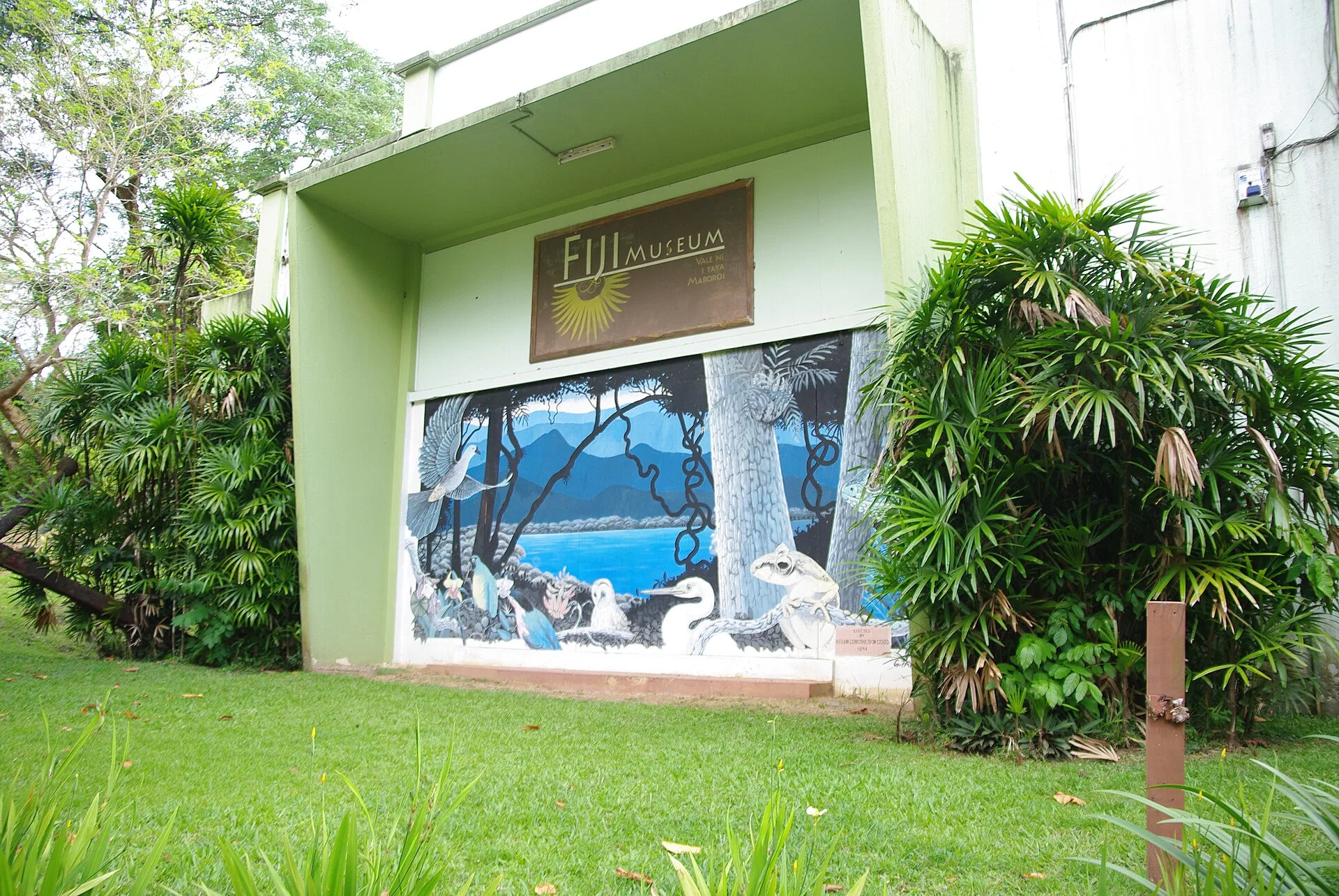
The Fiji Museum, in Suva’s Thurston Gardens, is the country’s principal museum and the clearest public introduction to its unusual material heritage. Its archaeological holdings extend back roughly 3,700 years, covering the settlement and development of Fijian societies alongside later ethnographic, historical, artistic and archival collections. The museum is currently visitor-facing seven days a week, although individual galleries or temporary displays can close during exhibition changes.[Fiji Museum]fijimuseum.org.fjFiji MuseumFiji Museum – 200 years of cultureLocated in the heart of Suva's Thurston Gardens, the Fiji Museum holds a remarkable collecti…
For a visitor interested in curiosities, the attraction lies in the collision of very different object worlds. Ceremonial and combat clubs sit alongside domestic objects, chiefly regalia, barkcloth, pottery and maritime technology. The museum’s best-known large object is Ratu Finau, a surviving double-hulled sailing canoe. The collection also includes the rudder associated with HMS Bounty, linking Fiji’s national story to one of the Pacific’s most persistent maritime legends.[Wikipedia]WikipediaFiji MuseumFiji Museum
The objects most frequently presented as macabre are the wooden feeding forks commonly described as “cannibal forks”. Historical museum catalogues explain that such forks were associated with sacred chiefs or priests who could not touch food directly and therefore had to be fed by attendants. This was not ordinary cutlery, and treating every example as a utensil repeatedly used on human flesh oversimplifies its ritual meaning.[britishmuseum.org]britishmuseum.orgOpen source on britishmuseum.org.
Provenance also matters. Some examples in overseas museums have nineteenth-century collecting histories, but others were produced or acquired long after cannibalism had ended and were probably tourist souvenirs. A Boston museum, for example, concluded that its fork dated from 1939 and was unlikely ever to have been used ceremonially. The lesson applies in Fiji too: object labels, collection histories and local interpretation are more useful than the generic “cannibal fork” name.[The Power of Play]bostonchildrensmuseum.blogThe Power of Play Hidden Object Highlight – Fijian ForkThe Power of PlayHidden Object Highlight – Fijian Fork - The Power of Play1 Aug 2018 — It is likely that this fork was never used to cons…
Weapons offer a similarly complicated mixture of craftsmanship and menace. Fiji’s clubs were shaped for different methods of fighting and could act as prestigious, spiritually charged or commemorative objects as well as weapons. Some surviving examples bear notches, drilled marks or even inset teeth, features interpreted as records of combat achievements. They are unsettling precisely because their decoration, social status and practical violence cannot easily be separated.[Fiji Times]fijitimes.com.fjdiscovering fiji fijis famous war clubs part 2discovering fiji fijis famous war clubs part 2
The Fiji Museum is more than a dark-tourism stop. It is a statutory national institution, a research centre and a guardian of archaeological sites and records. Recent partnerships have focused on digitisation, conservation, community engagement and the interpretation of Fijian collections scattered through overseas museums. UNESCO and the museum strengthened their cooperation in 2025, while an earlier programme linked the institution with four major British museums holding historic Fijian material.[unesco.org]unesco.organd fiji museum strengthen cooperation safeguard pacific cultural heritageand fiji museum strengthen cooperation safeguard pacific cultural heritage
Levuka Museum: relics of an eccentric colonial port
Levuka Museum and Community Centre on Ovalau is less concerned with ritual oddities than with the unusual social world of Fiji’s former capital. Levuka developed as a nineteenth-century port populated by Indigenous Fijians, settlers, missionaries, traders, sailors and officials. The capital later moved to Suva, leaving behind a compact town whose street plan and historic buildings survive with unusual integrity.[Museum of Archaeology and Anthropology]maa.cam.ac.ukOpen source on cam.ac.uk.
The museum contains historical artefacts and local records, with displays on Levuka’s early settlers and colourful colonial population. A public library, crafts centre and community facilities share the site. Its value comes from scale and setting: rather than isolating objects in a grand national narrative, it places them within a town that still resembles the port recorded in nineteenth-century photographs and archives.[Fiji Travel]fiji.travelLevuka Museum and Community CentreThe museum chronicles Levuka's earliest European settlers, There's also historic artefacts and a public…
For curiosity-minded visitors, Levuka is best understood as an open-air historical collection with a small museum at its centre. Old commercial buildings, religious sites, civic structures, narrow lanes and the waterfront collectively preserve the strange hybridity of a Pacific capital created through trade, imperial ambition and migration. UNESCO considers the town’s surviving fabric and documentary record sufficiently authentic to function as a major source for understanding this period.[UNESCO World Heritage Centre]whc.unesco.orgOpen source on unesco.org.
Cannibal caves, graves and tourist storytelling
Naihehe Cave: heritage site or theatrical attraction?
Naihehe Cave, inland from Sigatoka, is Fiji’s most developed visitor attraction associated with cannibalism and pre-Christian warfare. It is a natural cave system that served as a refuge and defensive stronghold for local people during periods of conflict. Guided tours commonly identify a priest’s chamber, ritual platform, living areas and a feature described as an oven, while also presenting the cave’s later connection with resistance and conversion.[travelonline.com]travelonline.comNaihehe Cave | Discover FijiHome to Fiji's Sautabu people during the tribal warfare days, Naihehe Cave was used as a retreat…
The cave’s unusual character is genuine: it is both a geological formation and a preserved cultural landscape, not a fabricated horror display. Its restricted entrances and large inner chambers made it defensible, allowing communities to shelter for extended periods. Local oral traditions associate it with spiritual authority, warfare and people resisting external control during the nineteenth century.[Off Road Safari]offroadfiji.comthe full cave safari guidethe full cave safari guide
The visitor experience, however, is strongly tourism-led. Commercial tours combine four-wheel-drive travel, village hospitality, storytelling and cave exploration. Terms such as “cannibal fortress” and “cannibal oven” are used prominently because they sell an immediately recognisable version of Fiji’s past. These labels may derive from local tradition and historical interpretation, but they should not be mistaken for the sort of fully documented object-by-object evidence expected in an archaeological museum.[Off Road Safari]offroadfiji.comthe full cave safari guidethe full cave safari guide
Naihehe is therefore most credible when approached as a community-interpreted heritage site. The cave itself, its defensive usefulness and its role in nineteenth-century conflict are the firmest elements. Precise accounts of ceremonies, meals or named victims belong more often to oral history and tourism narration. That distinction does not make the stories worthless; it tells visitors what kind of evidence they are hearing.
Udre Udre’s grave: a record built from stones
Near Rakiraki, the grave associated with the chief Udre Udre has become one of Fiji’s starkest roadside curiosities. Its fame rests on claims that he consumed hundreds of people and placed a stone for each victim. Guinness World Records has repeated a total of 872, while other accounts give figures approaching 1,000. The conflicting totals alone are a warning against treating the number as a verified body count.[Wikipedia]WikipediaUdre UdreUdre Udre
The site is not a conventional museum. It is a burial place, memorial landscape and minor tourist stop whose surrounding stones have been turned into supposed physical evidence for an extraordinary claim. Yet the stones cannot independently establish who was eaten, whether each represented one person, or whether the arrangement remained unchanged over time. The grave is therefore more revealing as an example of legend becoming materialised than as a reliable statistical record.
This does not mean the wider history of cannibalism in Fiji was invented. Osteological research has identified human bones bearing patterns consistent with processing in some archaeological contexts, while other burials show little or no such modification. Later interdisciplinary work has combined bone damage, archaeological context and isotope analysis to argue that practices differed by period and place and may have included warfare, punishment or mortuary ritual rather than one uniform custom.[PubMed]pubmed.ncbi.nlm.nih.govFijian cannibalism: osteological evidence from Navatuby D Degusta · 1999 · Cited by 99 — The human burials (for which cannibalism h…
The gap between that careful evidence and the headline claim of “872 victims” is important. Archaeology can support the existence of particular practices without validating every missionary anecdote, tourist label or record-book total.
What the objects reveal about belief and power
Fiji’s most unusual artefacts are often misunderstood because they are classified by their most shocking possible use. A ceremonial fork becomes merely a cannibal fork; a finely engineered club becomes simply a murder weapon; a cave refuge becomes a cannibal lair. These names attract attention but strip objects of their political and religious setting.
Sacred feeding implements, for example, make sense within systems in which high-ranking people could be considered spiritually dangerous or restricted by taboos. Their inability to touch certain food directly expressed status and sacredness. The fork’s strangeness lies not only in what might have been eaten, but in the idea that a chief’s body required ritual mediation.[British Museum]britishmuseum.orgOpen source on britishmuseum.org.
Clubs likewise communicated identity and rank. Their varied forms demonstrate specialised woodworking and knowledge of combat, while decoration could commemorate prestige or violence. Displayed in colonial museums, they were often made to represent a supposedly savage society; interpreted more carefully, they reveal organised warfare, skilled makers and social systems in which weapons could carry ancestry, authority and reputation.[Fiji Times]fijitimes.com.fjdiscovering fiji fijis famous war clubs part 2discovering fiji fijis famous war clubs part 2
Maritime objects provide a useful counterweight to the fixation on violence. Large double-hulled canoes demonstrate navigation, engineering and regional exchange across a sea that connected rather than isolated Pacific communities. Cambridge’s Museum of Archaeology and Anthropology describes its Fijian collections through this “sea of islands” perspective, emphasising movement, exchange and the mixing of cultural traditions.[Museum of Archaeology and Anthropology]maa.cam.ac.ukMuseum of Archaeology and Anthropology Sea of IslandsMuseum of Archaeology and Anthropology Sea of Islands
Fiji’s collections beyond Fiji
A substantial part of Fiji’s material heritage is held outside the country. British, Irish, European, North American and Australasian museums contain clubs, forks, textiles, ornaments, carvings, photographs and human remains gathered during missionary work, colonial administration, naval travel and commercial collecting. Glasgow Museums alone has been documented as holding 184 Fijian items dating mainly from the late nineteenth to mid-twentieth century.[results2021.ref.ac.uk]results2021.ref.ac.ukOpen source on ref.ac.uk.
These dispersed holdings can preserve objects no longer common in Fiji, but they also create problems of context and authority. Older catalogue descriptions frequently depend on statements supplied by collectors who may not have understood an object’s local name or ritual use. Sensational labels were especially likely to survive because they made acquisitions seem exotic. The contradictory histories of purported cannibal forks show why provenance research is essential.[National Museum of Ireland]museum.ieOpen source on museum.ie.
Collaborative research has begun to reconnect these objects with Fijian knowledge. The 2021 partnership discussions between the Fiji Museum and British institutions were intended to improve information about Fijian artefacts in UK collections, drawing on expertise from the country and communities from which the objects came. Cambridge collections have also been used to reconstruct personal histories, including records of women’s tattooing that survive through tools, notebooks and drawings produced during nineteenth-century encounters.[GOV.UK]GOV.UKmajor uk museums to collaborate with fiji museummajor uk museums to collaborate with fiji museum
For the strange-museum visitor, this changes the central question. The most interesting issue is not simply whether an object looks uncanny, violent or magical. It is who named it, who collected it, what information was lost, and whether present-day Fijian researchers and communities can reshape its interpretation.
How credible is Fiji’s curiosity culture?
Fiji’s unusual heritage can be divided into several levels of reliability.
Strongly curated evidence is found at the Fiji Museum and in documented archaeological or archival collections. Objects may still have uncertain provenance, but they are held within an institution capable of comparing records, research and community knowledge. The museum’s national responsibilities, digitisation work and international partnerships make it the most dependable first stop.[fijimuseum.org.fj]fijimuseum.org.fjFiji MuseumFiji Museum – 200 years of cultureLocated in the heart of Suva's Thurston Gardens, the Fiji Museum holds a remarkable collecti…
Community and place-based interpretation characterises Naihehe Cave and Levuka. Here, the physical place is authentic and historically important, while some detailed narratives depend on oral tradition or later retelling. Visitors should distinguish the documented function of a cave, building or port from precise dramatic claims that may be difficult to verify.[UNESCO World Heritage Centre]whc.unesco.orgOpen source on unesco.org.
Legend-led attractions include Udre Udre’s grave and its disputed victim count. The burial place and stone arrangement are real visitor-facing features, but the numerical story is not equivalent to a modern historical record. Its cultural importance lies partly in how repetition by guidebooks, record organisations and travel media has hardened an uncertain tradition into apparent fact.[Wikipedia]WikipediaUdre UdreUdre Udre
Commercial souvenirs and poorly provenanced objects require the greatest caution. An object shaped like a traditional fork may be an authentic old ceremonial implement, a later copy or a souvenir made specifically for outsiders. Date, collector, acquisition history and local terminology matter more than appearance.[National Museum of Ireland]museum.ieOpen source on museum.ie.
Why Fiji’s strange collections matter
Fiji’s unusual collections record more than an exotic past. They show how objects can move between sacred practice, warfare, colonial science, tourism and national heritage. A fork once associated with chiefly restriction can become a sensational museum label. A defensive cave can become a packaged adventure. A group of stones can become a world record. A war club can be displayed either as proof of savagery or as an intricately made object carrying political and spiritual authority.
This makes Fiji especially useful for understanding the ethics of curiosity museums. The country has genuine dark and uncanny history, including archaeological evidence for violence and human consumption, but it has also been subjected to generations of exaggeration. Missionaries, colonial officials, collectors and tour operators all had reasons to emphasise the spectacular. Contemporary museums must now preserve the objects while also correcting inherited descriptions and reconnecting collections with Fijian voices.[nih.gov]pubmed.ncbi.nlm.nih.govFijian cannibalism: osteological evidence from Navatuby D Degusta · 1999 · Cited by 99 — The human burials (for which cannibalism h…
The richest route through Fiji’s strange heritage therefore begins with the national museum, continues through Levuka’s preserved colonial landscape and approaches sites such as Naihehe and Udre Udre’s grave with critical curiosity. The memorable question is rarely just “Did this really happen?” It is also “Who turned this object or place into evidence, and what did they want the visitor to believe?”
Amazon book picks
Further Reading
Books and field guides related to Where Fiji Keeps Its Strangest Stories. Use these as the next step if you want deeper reading beyond the article.
The People of the Sea: Environment, Identity, and History in...
Countering the dominant paradigms of recent Pacific Islands' historiography, which tend to limit understanding of the sea's importance, t...
The Pacific Way: A Memoir
Ratu Sir Kamisese's thoughtful and entertaining memoir of his personal and political life candidly outlines significant events in the dev...
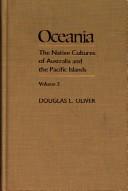
Oceania: The Native Cultures of Australia and the Pacific Isl...
First published 1989. Subjects: Social life and customs, Ethnology, Moeurs et coutumes, Manners and customs, Cultuur.
eBay marketplace picks
Marketplace Samples
Live-tested eBay searches with available results related to this page.
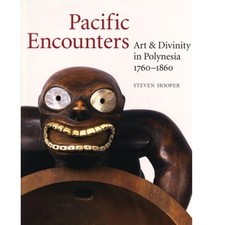
Selected fromPacific art oneBay.co.uk.
Endnotes
1.
Source: fiji.travel
Link:https://www.fiji.travel/places-to-go/outer-islandslomaiviti-lau/places/levuka-museum
Source snippet
Levuka Museum and Community CentreThe museum chronicles Levuka's earliest European settlers, There's also historic artefacts and a public...
2.
Source: travelonline.com
Link:https://www.travelonline.com/fiji/attractions/naihehe-cave
Source snippet
Naihehe Cave | Discover FijiHome to Fiji's Sautabu people during the tribal warfare days, Naihehe Cave was used as a retreat...
3.
Source: Wikipedia
Title: Fiji Museum
Link:https://en.wikipedia.org/wiki/Fiji_Museum
4.
Source: museum.ie
Link:https://www.museum.ie/en-IE/Collections-Research/Collection/Documentation-Discoveries/Artefact/Cannibal%E2%80%99s-Fork-from-Fiji/b7f4d30c-4c64-4924-a7a9-fd84504c2798
5.
Source: unesco.org
Title: and fiji museum strengthen cooperation safeguard pacific cultural heritage
Link:https://www.unesco.org/en/articles/unesco-and-fiji-museum-strengthen-cooperation-safeguard-pacific-cultural-heritage
6.
Source: GOV.UK
Title: major uk museums to collaborate with fiji museum
Link:https://www.gov.uk/government/news/major-uk-museums-to-collaborate-with-fiji-museum
7.
Source: archive-share.america.gov
Link:https://archive-share.america.gov/showcasing-fiji-culture-to-world/index.html
8.
Source: whc.unesco.org
Link:https://whc.unesco.org/en/list/1399/
9.
Source: Wikipedia
Title: Udre Udre
Link:https://en.wikipedia.org/wiki/Udre_Udre
10.
Source: results2021.ref.ac.uk
Link:https://results2021.ref.ac.uk/impact/90099bb8-1b97-4108-81dd-6db045839b14?page=1
11.
Source: Wikipedia
Link:https://en.wikipedia.org/wiki/Veiqia
12.
Source: unesdoc.unesco.org
Link:https://unesdoc.unesco.org/ark%3A/48223/pf0000034181
13.
Source: unesdoc.unesco.org
Link:https://unesdoc.unesco.org/ark%3A/48223/pf0000034208
14.
Source: whc.unesco.org
Link:https://whc.unesco.org/en/
15.
Source: museum.maidstone.gov.uk
Title: fascinating fiji
Link:https://museum.maidstone.gov.uk/fascinating-fiji/
16.
Source: youtube.com
Link:https://www.youtube.com/watch?v=YNvxnYuLGXc
Source snippet
Fiji museum- Unveiling the Rich culture Tapestry...
17.
Source: youtube.com
Title: Fiji museum- Unveiling the Rich culture Tapestry
Link:https://www.youtube.com/watch?v=0Ud55Svgwg4
Source snippet
Naihehe Caves (LegendFM SMEXperience)...
18.
Source: youtube.com
Title: Exploring Levuka: Fiji’s Historical Gem
Link:https://www.youtube.com/watch?v=x0icpzmutUk
Source snippet
Fiji Museum Suva Fiji Museum and Gardens in Suva, Fiji Free Videos...
19.
Source: fijimuseum.org.fj
Link:https://fijimuseum.org.fj/
Source snippet
Fiji MuseumFiji Museum – 200 years of cultureLocated in the heart of Suva's Thurston Gardens, the Fiji Museum holds a remarkable collecti...
20.
Source: pubmed.ncbi.nlm.nih.gov
Link:https://pubmed.ncbi.nlm.nih.gov/10502244/
Source snippet
Fijian cannibalism: osteological evidence from Navatuby D Degusta · 1999 · Cited by 99 — The human burials (for which cannibalism h...
21.
Source: bostonchildrensmuseum.blog
Title: The Power of Play Hidden Object Highlight – Fijian Fork
Link:https://bostonchildrensmuseum.blog/2018/08/01/hidden-object-highlight-fijian-fork/
Source snippet
The Power of PlayHidden Object Highlight – Fijian Fork - The Power of Play1 Aug 2018 — It is likely that this fork was never used to cons...
22.
Source: fijimuseum.org.fj
Link:https://fijimuseum.org.fj/our-exhibitions/
Source snippet
Fiji MuseumOur ExhibitionsThis new and innovative exhibition. Fiji Museum 7 days a week. Open 7 Days A Week! 9:00am–4:30pm (Monday-Sunday...
23.
Source: britishmuseum.org
Link:https://www.britishmuseum.org/collection/object/E_Oc1959
24.
Source: otagomuseum.nz
Title: cannibal forks
Link:https://otagomuseum.nz/blog/cannibal-forks/
25.
Source: fijitimes.com.fj
Title: discovering fiji fijis famous war clubs part 2
Link:https://www.fijitimes.com.fj/discovering-fiji-fijis-famous-war-clubs-part-2/
26.
Source: maa.cam.ac.uk
Link:https://maa.cam.ac.uk/fiji-levuka
27.
Source: fijitimes.com.fj
Title: Fiji Times Secrets of Naihehe Cave
Link:https://www.fijitimes.com.fj/secrets-of-naihele-cave-part-1/
28.
Source: offroadfiji.com
Title: the full cave safari guide
Link:https://offroadfiji.com/the-full-cave-safari-guide
29.
Source: fijitravel.org
Title: cannibalism history fiji
Link:https://fijitravel.org/posts/cannibalism-history-fiji/
30.
Source: maa.cam.ac.uk
Link:https://maa.cam.ac.uk/collections/world-cultures/chiefs-and-governors-art-and-power-fiji/art-and-power-fiji
31.
Source: maa.cam.ac.uk
Title: Museum of Archaeology and Anthropology Sea of Islands
Link:https://maa.cam.ac.uk/sea-islands
32.
Source: facebook.com
Link:https://www.facebook.com/FijiGovernment/photos/head-down-to-the-fijian-museum-located-at-thurston-garden-the-informative-museum/3769665419733032/
33.
Source: facebook.com
Link:https://www.facebook.com/groups/2684750238450264/posts/here-am-i-sniffing-the-warm/4406388329619771/
34.
Source: facebook.com
Title: unesco used international museum day 2026 to praise the fiji museum and its part
Link:https://www.facebook.com/IslandsBusiness/posts/unesco-used-international-museum-day-2026-to-praise-the-fiji-museum-and-its-part/1607456494721172/
35.
Source: facebook.com
Link:https://www.facebook.com/fijimuseum/posts/courtesy-visit-document-handoverthe-fiji-museum-was-honored-to-receive-a-courtes/1283394033823362/
36.
Source: instagram.com
Link:https://www.instagram.com/p/DXdg0dhj4O8/
37.
Source: researchgate.net
Link:https://www.researchgate.net/publication/249014615_Fiji_Museum_Archives_and_Manuscripts_Collection
38.
Source: britishmuseum.org
Link:https://www.britishmuseum.org/collection/term/x40931
39.
Source: fijivillage.com
Link:https://www.fijivillage.com/news/Fiji-Museum-embarks-on-major-restructuring-r58f4x/
40.
Source: itaukeitrustfund.com.fj
Title: fiji museum partneship
Link:https://itaukeitrustfund.com.fj/fiji-museum-partneship/
41.
Source: ifacca.org
Title: unesco and fiji museum strengthen cooperation safe
Link:https://ifacca.org/news/2025/11/28/unesco-and-fiji-museum-strengthen-cooperation-safe/
42.
Source: fijitraveller.com
Title: levuka community centre a tale of old times
Link:https://fijitraveller.com/culture/levuka-community-centre-a-tale-of-old-times/
43.
Source: offroadfiji.com
Link:https://offroadfiji.com/
44.
Source: islandsbusiness.com
Title: unesco hails fiji museums role in protecting pacific heritage
Link:https://islandsbusiness.com/news-break/unesco-hails-fiji-museums-role-in-protecting-pacific-heritage/
45.
Source: unesco.org.uk
Link:https://unesco.org.uk/projects/climate-change-and-unesco-heritage
Additional References
46.
Source: scholarscommons.fgcu.edu
Link:https://scholarscommons.fgcu.edu/esploro/outputs/journalArticle/Kana-Tamata-or-Feasts-of-Men/99383341558706570
Source snippet
le isotopic data, we test for cannibalism in the Lau Group, Fiji and discuss...
47.
Source: facebook.com
Link:https://www.facebook.com/fijionenews/videos/fijionenews-the-protection-of-fijis-cultural-heritage-is-receiving-a-major-boost/969080902500142/
48.
Source: levukafiji.com
Link:https://www.levukafiji.com/activities-levuka-ovalau/
49.
Source: facebook.com
Link:https://www.facebook.com/fijionetelevision/posts/andy-lowe-ceo-of-the-fiji-museum-and-vika-musumoto-collections-officer-continue-/1138783754945030/
50.
Source: facebook.com
Link:https://www.facebook.com/fijionetelevision/videos/breakfastfijione-050525-pt8/977401384213119/
51.
Source: tripadvisor.com
Link:https://www.tripadvisor.com/ShowUserReviews-g294337-d308607-r962298307-Fiji_Museum-Suva_Viti_Levu.html
52.
Source: fijitourtransfers.com
Link:https://fijitourtransfers.com/st_tour/explore-naihehe-cave-tour-sigatoka-fiji/
53.
Source: museumsbund.de
Link:https://www.museumsbund.de/wp-content/uploads/2021/03/mb-leitfaden-en-web.pdf
54.
Source: showcaves.com
Link:https://www.showcaves.com/english/other/caves/Nahehe.html
55.
Source: colonialcollections.nl
Link:https://www.colonialcollections.nl/en/news/