Within Curious Madagascar
How Real Were Madagascar's Giant Lost Animals?
Tsimbazaza's elephant birds and giant lemurs reveal a vanished ecosystem while showing why old museum labels must be checked against modern science.
On this page
- Elephant birds, giant lemurs and the Tsimbazaza displays
- What fossils and eggshells reveal about extinction
- Why museum labels can lag behind scientific consensus
Page outline Jump by section
Introduction
Madagascar’s most extraordinary natural-history displays are not mythical monsters but the remains of animals that genuinely existed until surprisingly recent times. At the Museum of Ethnology and Palaeontology within the Tsimbazaza complex in Antananarivo, visitors encounter skeletons, fossil bones and enormous eggshells from elephant birds alongside the remains of giant lemurs. Together they reveal a lost island ecosystem unlike anywhere else on Earth. They also demonstrate an important lesson about museums: scientific understanding changes, and labels written decades ago may no longer reflect the latest evidence on species, relationships or extinction.
For anyone interested in Madagascar’s unusual collections, these exhibits stand out because they combine spectacular objects with an evolving scientific story. The fossils are real, but the way researchers interpret them continues to change as new techniques such as ancient DNA analysis and isotope chemistry reshape what is known about these vanished giants.[Nature]nature.comMolecular exploration of fossil eggshell uncovers hidden lineage of giant extinct bird | Nature CommunicationsFebruary 28, 2023…
Elephant birds, giant lemurs and the Tsimbazaza displays
The Tsimbazaza museum is the country’s principal public collection for Madagascar’s extinct megafauna. Rather than presenting curiosities for their own sake, it preserves evidence of a world that disappeared only within the past thousand years or so.
The most dramatic exhibits are the elephant birds, enormous flightless birds belonging to the family Aepyornithidae. Some species reached around three metres in height and were among the heaviest birds ever to live. Their eggs remain the largest known from any animal, with shells so thick that even broken fragments are immediately recognisable in museum displays. Fossil skeletons are often incomplete because these birds lived in environments where preservation was uneven, making eggshells almost as important as bones for scientific research.[PMC]pmc.ncbi.nlm.nih.govOpen source on nih.gov.
Nearby displays introduce visitors to Madagascar’s giant lemurs. Unlike today’s relatively small lemurs, several extinct species were comparable in size to modern apes or large monkeys. They occupied ecological roles now absent from the island, including slow-moving leaf eaters and larger-bodied fruit consumers. Seeing their remains beside elephant birds helps visitors appreciate that Madagascar’s famous wildlife once included an entire community of outsized animals rather than a single spectacular species.
The displays also remind visitors that these were not isolated oddities. Giant tortoises, pygmy hippopotamuses and other now-extinct animals once shared Madagascar’s landscapes, making the island’s prehistoric fauna dramatically different from the one tourists encounter today.
What fossils and eggshells reveal about extinction
For many years elephant bird research relied mainly on scattered skeletons, but fossil eggshells have become one of the richest sources of new evidence.
Because eggshell fragments are abundant and can preserve ancient biomolecules remarkably well, researchers have extracted mitochondrial DNA from shells roughly a thousand years old. Combined with measurements of shell thickness, isotope analysis and fossil distribution, these studies have revealed previously hidden genetic lineages and suggested that elephant bird diversity was more complicated than older museum classifications implied.[Nature]nature.comMolecular exploration of fossil eggshell uncovers hidden lineage of giant extinct bird | Nature CommunicationsFebruary 28, 2023…
Stable isotope analysis has also transformed understanding of how these birds lived. Chemical signatures preserved within eggshells indicate differences in diet and habitat use between populations, suggesting that elephant birds occupied varied environments across Madagascar rather than living in a single ecological niche. Some evidence points towards dependence on groundwater-supported wetlands and browsing on woody vegetation, helping explain why environmental change may have affected different populations differently.[Charles Sturt University Research Output]researchoutput.csu.edu.auCharles Sturt University Research OutputThe amino acid and stable isotope biogeochemistry of elephant bird (Aepyornis) eggshells from sou…
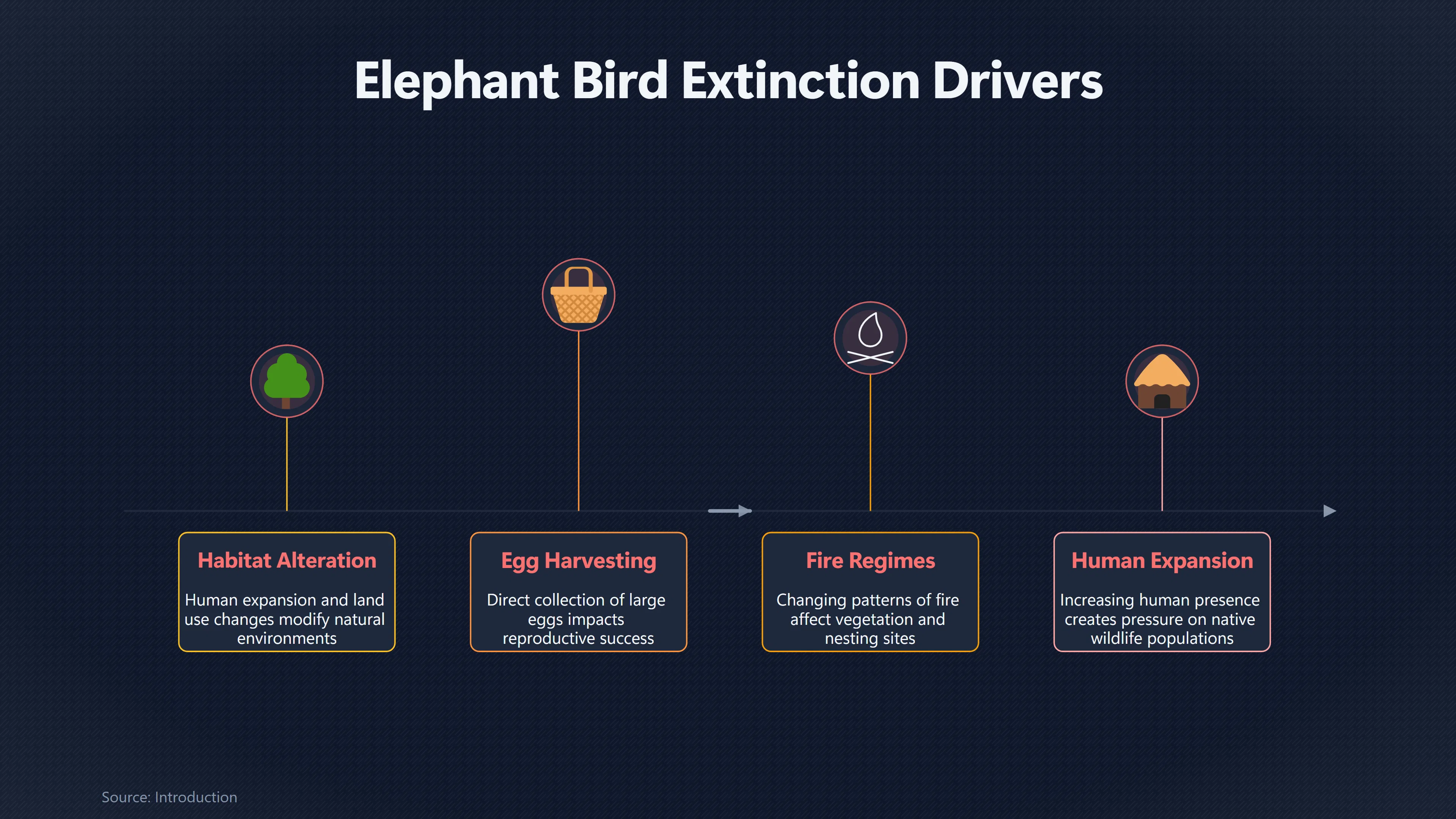
The extinction story has likewise become more nuanced. Earlier explanations often focused on direct hunting alone. Modern research instead favours a combination of pressures including habitat alteration, the harvesting of eggs, changing fire regimes and human expansion across the island. The exact timing and relative importance of each factor remain debated, but few specialists now view a single cause as sufficient.[Nature]nature.comMolecular exploration of fossil eggshell uncovers hidden lineage of giant extinct bird | Nature CommunicationsFebruary 28, 2023…
Why museum labels can lag behind scientific consensus
Natural-history museums face a challenge that visitors rarely notice: taxonomy changes faster than exhibition galleries.
Many museum displays were created before the latest wave of molecular research. Older labels may present more species of elephant bird, different evolutionary relationships or outdated scientific names because those reflected the best available evidence when the cases were designed.
Recent genetic work has questioned long-standing classifications by showing that some supposedly distinct groups are much more closely related than previously believed, while also identifying previously unrecognised lineages through eggshell DNA. Researchers have even argued that the smaller genus Mullerornis deserves placement in its own separate family rather than remaining grouped with the larger elephant birds, illustrating how dramatically classifications can shift.[Nature]nature.comMolecular exploration of fossil eggshell uncovers hidden lineage of giant extinct bird | Nature CommunicationsFebruary 28, 2023…
The same principle applies to reconstructions of body size and diversity. Museum illustrations often present one definitive image of an elephant bird, yet current research increasingly suggests that these birds varied substantially between regions and through time. Some of the extreme gigantism seen in later species appears to have evolved surprisingly recently in geological terms, rather than representing an ancient, unchanging condition.[Nature]nature.comMolecular exploration of fossil eggshell uncovers hidden lineage of giant extinct bird | Nature CommunicationsFebruary 28, 2023…
For visitors, this is not a flaw but part of the attraction. The Tsimbazaza collections preserve the physical evidence itself, while scientific interpretation continues to evolve. A fossil skeleton or giant eggshell may remain unchanged in its display case for decades, yet the story attached to it can become richer as new analytical techniques reveal information that earlier generations of researchers could not detect.
Why these displays matter in Madagascar’s curiosity landscape
Among Madagascar’s unusual collections, the elephant bird and giant lemur exhibits occupy a distinctive place because they blur the boundary between natural history and wonder. Unlike pirate legends or folklore traditions, these giants are supported by tangible physical evidence that visitors can see directly.
Their appeal comes not only from their remarkable size but also from the reminder that extraordinary animals survived into the period of human history. Standing before an elephant bird skeleton or one of its immense eggs helps explain why Madagascar continues to inspire both scientific investigation and popular imagination. At the same time, the evolving interpretations attached to these fossils demonstrate that museums are not static repositories of facts but living institutions whose understanding changes as new evidence emerges.
Amazon book picks
Further Reading
Books and field guides related to How Real Were Madagascar's Giant Lost Animals?. Use these as the next step if you want deeper reading beyond the article.
The Sixth Extinction
"Over the last half billion years, there have been five major mass extinctions, when the diversity of life on Earth suddenly and dramatic...
The Ends of the World
‘A book about one apocalypse – much less five – could have been a daunting read, were it not for the wit, lyricism, and clarity that Pete...
The Rise and Fall of the Dinosaurs
The Times Science Book of the Year. A Sunday Times Bestseller. 66 million years ago the dinosaurs were wiped from the face of the earth....
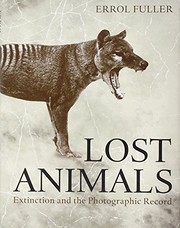
Lost Animals: Extinction and the Photographic Record
First published 2014. Subjects: Photography of birds, Extinct animals, Extinction (Biology), Extinct mammals, Photography of animals.
eBay marketplace picks
Marketplace Samples
Live-tested eBay searches with available results related to this page.
Selected fromnatural history poster oneBay.co.uk.
Endnotes
1.
Source: nature.com
Link:https://www.nature.com/articles/s41467-023-36405-3
Source snippet
Molecular exploration of fossil eggshell uncovers hidden lineage of giant extinct bird | Nature CommunicationsFebruary 28, 2023...
Published: February 28, 2023
2.
Source: pmc.ncbi.nlm.nih.gov
Link:https://pmc.ncbi.nlm.nih.gov/articles/PMC9974994/
3.
Source: researchoutput.csu.edu.au
Link:https://researchoutput.csu.edu.au/en/publications/the-amino-acid-and-stable-isotope-biogeochemistry-of-elephant-bir/
Source snippet
Charles Sturt University Research OutputThe amino acid and stable isotope biogeochemistry of elephant bird (Aepyornis) eggshells from sou...
4.
Source: pubmed.ncbi.nlm.nih.gov
Link:https://pubmed.ncbi.nlm.nih.gov/36854679/
Source snippet
* ^{18} Department of Earth Sciences, University College London, Gower Street, London, WC1E 6BT, UK. * ^{19} R...
5.
Source: unesco.org
Link:https://www.unesco.org/en/memory-world-committees/madagascar?hub=1081
Source snippet
Image: Madagascar Members * Chairman: * Mrs Sahondra Sylvie ANDRIAMIHAMINA RAVONIHAROSON, Directeur des Archives Nationales...
6.
Source: pmc.ncbi.nlm.nih.gov
Link:https://pmc.ncbi.nlm.nih.gov/articles/PMC6235046/
7.
Source: pubmed.ncbi.nlm.nih.gov
Link:https://pubmed.ncbi.nlm.nih.gov/30839722/
8.
Source: pmc.ncbi.nlm.nih.gov
Link:https://pmc.ncbi.nlm.nih.gov/articles/PMC6170582/
9.
Source: pmc.ncbi.nlm.nih.gov
Link:https://pmc.ncbi.nlm.nih.gov/articles/PMC6135541/
10.
Source: research-repository.uwa.edu.au
Link:https://research-repository.uwa.edu.au/en/publications/molecular-exploration-of-fossil-eggshell-uncovers-hidden-lineage-
11.
Source: madagascarbio.org
Link:https://www.madagascarbio.org/about.html
12.
Source: madagascar-island.com
Link:https://www.madagascar-island.com/capitale-antananarivo/antananarivo-parc-tsimbazaza/
Additional References
13.
Source: annuaire.mg
Link:https://annuaire.mg/parc-tsimbazaza/
Source snippet
Parc Tsimbazaza, parc botanique et zoologiqueJuly 13, 2026 — PARC TSIMBAZAZA Image: Parc Tsimbazaza Sponsorisé · Simafri Votre webmaster...
Published: July 13, 2026
14.
Source: new.moov.mg
Title: mg Le squelette du Majungasaurus transféré au Parc Tsimbazaza
Link:https://new.moov.mg/article/117714-patrimoine-scientifique-le-squelette-du-majungasaurus-transfere-au-parc-tsimbazaza
Source snippet
squelette du Majungasaurus transféré au Parc TsimbazazaJune 25, 2026 — Culture PATRIMOINE SCIENTIFIQUE - LE SQUELETTE DU MAJUNGASAURUS TR...
Published: June 25, 2026
15.
Source: iris.unito.it
Title: Here, a molecular analy
Link:https://iris.unito.it/handle/2318/1894972
Source snippet
exploration of fossil eggshell uncovers hidden lineage of giant extinct birdJanuary 1, 2023 —: The systematics of Madagascar's extinct e...
Published: January 1, 2023
16.
Source: youtube.com
Title: The Extinct Aepyornis – Madagascar’s Gigantic Bird
Link:https://www.youtube.com/watch?v=zwrXtJuvo4E
Source snippet
Elephant bird Madagascar extinction Aepyornis The Tale of the Elephant Bird: The Biggest Bird Ever Paleo Analysis...
17.
Source: youtube.com
Title: The Tale of the Elephant Bird: The Biggest Bird Ever
Link:https://www.youtube.com/watch?v=P6ltr2o-hYM
Source snippet
Why did the Ancient Elephant Bird Disappear? | Attenborough and the Giant Egg...
18.
Source: madagascarbio.org
Link:https://www.madagascarbio.org/discovery.html
19.
Source: nhm.ac.uk
Link:https://www.nhm.ac.uk/our-science/research/projects/asian-elephants.html
20.
Source: madagascarbio.org
Link:https://www.madagascarbio.org/
21.
Source: madagascarbio.org
Link:https://www.madagascarbio.org/our-team.html
22.
Source: jacaranda.fr
Link:https://www.jacaranda.fr/en/societe-botanique-outils-de-recherches-qui-representent-de-veritables-patrimoines-les-specimens