Within Strange Canada
Why Canada's Real Institutions Feel Stranger Than Fiction
Canada's Cold War, prison and medical museums are unsettling because their strangest objects come from real systems of fear, control and treatment.
On this page
- Inside the Diefenbunker's nuclear emergency world
- Contraband, restraints and escape tools from prison history
- Medical artefacts and changing ideas about the body
Page outline Jump by section
Introduction
Some of Canada’s most unsettling museums are disturbing precisely because they are not built around horror. Instead, they preserve the material remains of real institutions that once prepared for nuclear war, enforced punishment or attempted to understand and treat disease. Visitors encounter authentic emergency plans, prison-made weapons, restraint devices, early surgical equipment and medical technologies that reveal how fear, authority and scientific knowledge shaped everyday life.

These collections matter because they replace cinematic images with documented history. Rather than inviting visitors to marvel at invented monsters, they ask more difficult questions about how governments planned for catastrophe, how prisons balanced punishment with rehabilitation, and how medicine repeatedly redefined what counted as humane treatment. Together, they form one of the most thought-provoking strands in Canada’s wider landscape of unusual museums.
Why Canada’s real institutions feel stranger than fiction
Many curiosity museums rely on spectacle. Canada’s Cold War, prison and medical collections create unease for a different reason: almost every object once served a practical purpose within a functioning institution.
A restraint chair was not designed to shock museum audiences. A radiation monitor existed because officials genuinely expected radioactive fallout. A homemade prison knife reflects the realities of confinement rather than theatrical imagination. Early surgical instruments, prosthetic limbs and tuberculosis equipment represent periods when medical science was advancing rapidly but often involved painful or invasive treatments by modern standards.
Because these collections preserve documented provenance, they encourage visitors to think about the social systems behind the artefacts instead of treating them as isolated oddities. Museums increasingly interpret these objects within broader conversations about ethics, mental health, reconciliation, public safety and changing standards of care rather than presenting them simply as curiosities.[diefenbunker.ca]diefenbunker.caCanadas Cold War Museum Collections | Diefenbunker: Canadas Cold War MuseumCanadas Cold War MuseumCollections | Diefenbunker: Canadas Cold War Museum…
Inside the Diefenbunker’s nuclear emergency world
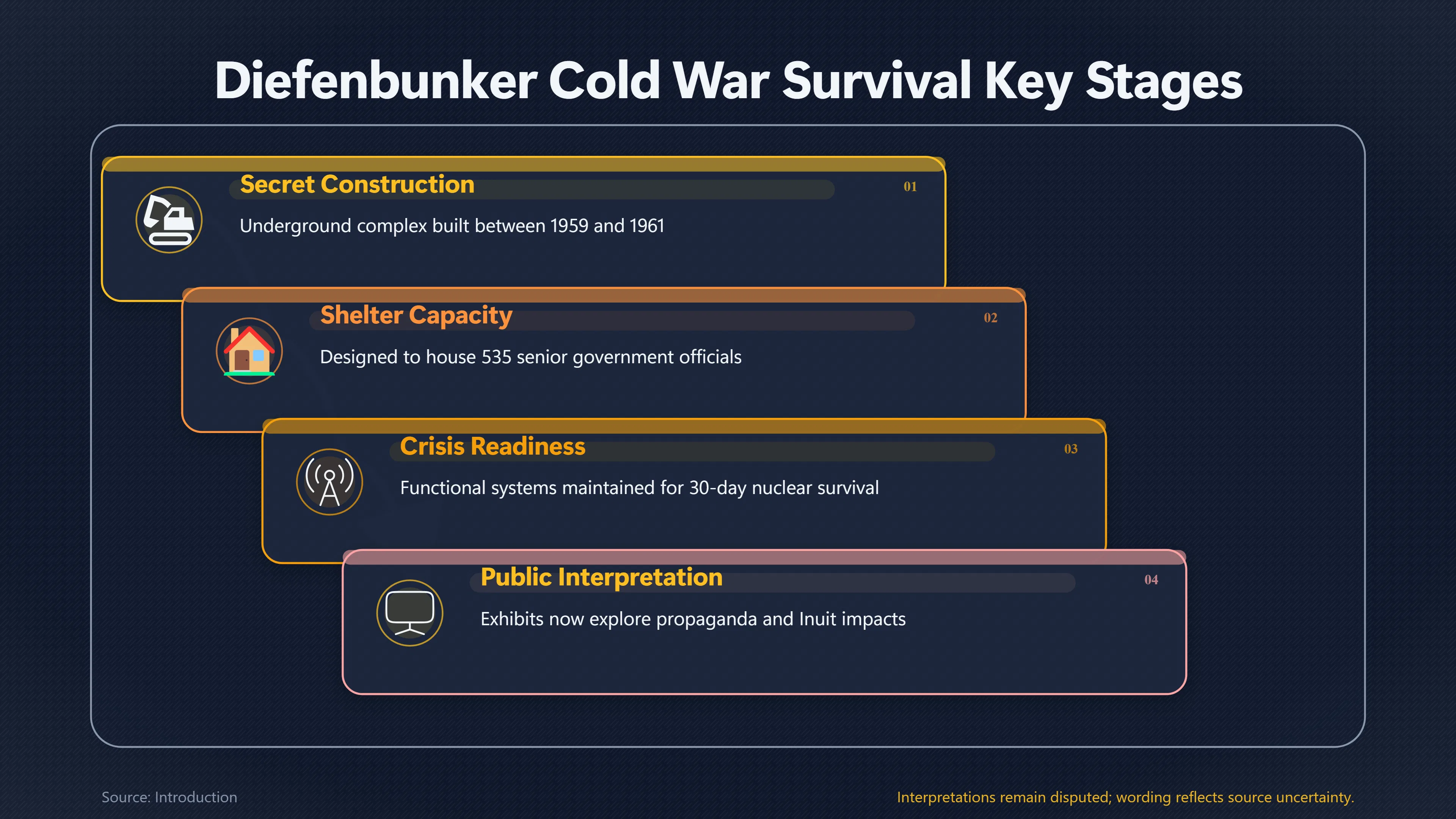
The Diefenbunker near Ottawa remains Canada’s most recognisable Cold War survival structure. Built in secret between 1959 and 1961 as the Central Emergency Government Headquarters, the four-storey underground complex was intended to shelter 535 senior political, military and civil officials for approximately 30 days after a nuclear attack. It was never intended for the wider public, making it a stark reminder that continuity-of-government planning necessarily involved difficult decisions about who would survive and who would not.[Diefenbunker: Canadas Cold War Museum]diefenbunker.caCanadas Cold War MuseumDiefenbunker History | Diefenbunker: Canadas Cold War Museum…
Walking through the preserved bunker is unsettling because almost everything remains recognisably functional. Visitors move through communications centres, decontamination facilities, dormitories, blast doors, filtered air systems and emergency command rooms designed for a crisis that everyone hoped would never occur. Unlike reconstructed attractions, these spaces retain the atmosphere of a workplace that stood on constant readiness for decades.[Diefenbunker: Canadas Cold War Museum]diefenbunker.caCanadas Cold War MuseumDiefenbunker History | Diefenbunker: Canadas Cold War Museum…
The museum has deliberately expanded beyond military technology to examine the broader human experience of the Cold War. Current exhibitions explore subjects including civil defence campaigns, Cold War propaganda, communications systems, the famous “11 Steps to Survival” guidance issued to Canadians, and the impact of Arctic defence projects on Inuit communities. This wider interpretation shifts the museum from nostalgic engineering showcase towards a more critical examination of preparedness, fear, misinformation and the long-term consequences of Cold War policies.[Diefenbunker: Canadas Cold War Museum]diefenbunker.caCanadas Cold War Museum Exhibitions | Diefenbunker: Canadas Cold War MuseumCanadas Cold War MuseumExhibitions | Diefenbunker: Canadas Cold War Museum…
The Diefenbunker’s collections also demonstrate that preservation extends beyond the building itself. Thousands of artefacts and archival documents now record Canada’s wider Cold War experience, including equipment from other bunkers, official records and everyday objects illustrating how nuclear anxiety entered ordinary domestic life.[Diefenbunker: Canadas Cold War Museum]diefenbunker.caCanadas Cold War Museum Collections | Diefenbunker: Canadas Cold War MuseumCanadas Cold War MuseumCollections | Diefenbunker: Canadas Cold War Museum…

Contraband, restraints and escape tools from prison history
Canada’s Penitentiary Museum in Kingston is disturbing because nearly every object reflects a negotiation between institutional control and inmate resistance.
Rather than sensationalising crime, the museum documents how Canadian federal corrections evolved over nearly two centuries. Displays include handmade weapons, escape devices, improvised tools, restraint equipment, official regulations and inmate-produced craftwork. Together they illustrate both the ingenuity of prisoners and the methods correctional authorities used to maintain order.[Canada]canada.caCorrectional Service of Canada MuseumCorrectional Service of Canada Museum - Canada.ca…
Several themes emerge repeatedly:
- Contraband demonstrates how prisoners adapted ordinary materials into weapons, communication devices or escape tools.
- Restraint equipment reveals changing philosophies of discipline, including practices that would now attract significant ethical criticism.
- Inmate crafts complicate simplistic images of prison life by showing rehabilitation, education and creative work alongside punishment.
- Administrative records and photographs place individual objects within wider institutional history rather than presenting them merely as macabre curiosities.[Canada]canada.caCorrectional Service of Canada MuseumCorrectional Service of Canada Museum - Canada.ca…
The museum’s location adds another layer of meaning. It occupies the former official residence of Kingston Penitentiary’s warden, itself constructed by inmate labour during the nineteenth century. Visitors therefore move through a building physically connected to the correctional system it interprets.[Canada]canada.caCorrectional Service of Canada MuseumCorrectional Service of Canada Museum - Canada.ca…
Modern interpretation increasingly avoids celebrating notorious criminals or dramatic escape stories for their own sake. Instead, exhibits encourage reflection on changing correctional philosophies, rehabilitation, institutional authority and the lived experience of incarceration.
Medical artefacts and changing ideas about the body
The Canadian Museum of Health Care in Kingston contains more than 35,000 artefacts spanning roughly three centuries of Canadian medical history. Many visitors find it unsettling not because the objects are intentionally gruesome, but because they reveal how rapidly ideas about disease, pain and the human body have changed.[Canadian Museum of Health Care]museumofhealthcare.caCanadian Museum of Health Care Where Canada's Health History Lives!Canadian Museum of Health Care Where Canada's Health History Lives!
Its collections include surgical instruments, laboratory equipment, prosthetic limbs, diagnostic technologies, nursing equipment, public health materials and everyday clinical objects. Items that once represented cutting-edge treatment can now appear intimidating or primitive, illustrating both the achievements and limitations of earlier medicine.[Canadian Museum of Health Care]museumofhealthcare.caOpen source on museumofhealthcare.ca.
Particularly striking are artefacts connected with infectious disease and long-term disability. Tuberculosis sputum flasks, early prosthetic limbs and historical diagnostic equipment demonstrate how patients adapted to chronic illness while medical professionals worked with the knowledge and technology available at the time. These objects humanise medical history by focusing on lived experience rather than abstract scientific progress.[Canadian Museum of Health Care]museumofhealthcare.caOpen source on museumofhealthcare.ca.
The museum’s interpretation also reflects broader shifts within medical history. Earlier generations often celebrated technological innovation alone; contemporary exhibitions increasingly discuss patient experience, public health, ethics and community care alongside advances in treatment. This approach encourages visitors to question not only how medicine has improved but also how future generations may judge present-day practices.[Canadian Museum of Health Care]museumofhealthcare.caOpen source on museumofhealthcare.ca.
Why these collections matter within Canada’s curiosity landscape
These institutions occupy an unusual position within Canada’s culture of strange museums. They are neither conventional historical museums nor cabinets of bizarre objects assembled for entertainment.
Instead, they preserve evidence of extraordinary circumstances that genuinely shaped Canadian society:
- nuclear planning during the Cold War;
- the realities of incarceration within the federal correctional system;
- evolving medical ideas about disease, disability and treatment.
Their power comes from authenticity. Visitors are confronted with artefacts that once governed real decisions affecting life, liberty and survival. The emotional response therefore arises less from visual shock than from recognising that these systems were not fictional experiments but everyday realities for thousands of Canadians.
Within Canada’s broader landscape of unusual collectionswhich also includes folklore museums, UFO archives and private curiosity cabinetsthese institutional museums provide an important counterbalance. Their most unsettling exhibits are not mysterious because their origins are unknown, but because their history is thoroughly documented. The objects remind visitors that the strangest stories are sometimes those created by ordinary governments, prisons and hospitals responding to the fears and assumptions of their own time.
Amazon book picks
Further Reading
Books and field guides related to Why Canada's Real Institutions Feel Stranger Than Fiction. Use these as the next step if you want deeper reading beyond the article.
Command and Control: Nuclear Weapons, the Damascus Accident,...
From famed investigative journalist Eric Schlosser, author of Fast Food Nation, comes Command and Control a ground-breaking account of th...
The Body: A Guide for Occupants
NATIONAL BESTSELLER NEW YORK TIMES BESTSELLER INTERNATIONAL BESTSELLER A NEW YORK TIMES EDITORS' CHOICE NAMED ONE OF THE BEST BOOKS OF 20...
The History of Medicine: A Very Short Introduction
Against the backdrop of unprecedented concern for the future of health care, this i Very Short Introduction/i surveys the history of medi...
Discipline and Punish: The Birth of the Prison
Beginning with the emergence of Western penal methods in the seventeenth century, the noted French philosopher explores the role of priso...
eBay marketplace picks
Marketplace Samples
Live-tested eBay searches with available results related to this page.
Selected frommilitary history poster oneBay.co.uk.

Endnotes
1.
Source: diefenbunker.ca
Title: Canadas Cold War Museum Collections | Diefenbunker: Canadas Cold War Museum
Link:https://diefenbunker.ca/collections/
Source snippet
Canadas Cold War MuseumCollections | Diefenbunker: Canadas Cold War Museum...
2.
Source: canada.ca
Title: Correctional Service of Canada Museum
Link:https://www.canada.ca/en/correctional-service/corporate/history-csc/correctional-service-canada-museum.html
Source snippet
Correctional Service of Canada Museum - Canada.ca...
3.
Source: diefenbunker.ca
Link:https://diefenbunker.ca/about/
Source snippet
Canadas Cold War MuseumDiefenbunker History | Diefenbunker: Canadas Cold War Museum...
4.
Source: diefenbunker.ca
Title: Canadas Cold War Museum Oral histories | Diefenbunker: Canadas Cold War Museum
Link:https://diefenbunker.ca/oral-histories/
Source snippet
Our collections and research webpages provide resources from the Diefenbunker including: * a search of our collectio...
5.
Source: diefenbunker.ca
Title: Canadas Cold War Museum Exhibitions | Diefenbunker: Canadas Cold War Museum
Link:https://diefenbunker.ca/exhibitions/
Source snippet
Canadas Cold War MuseumExhibitions | Diefenbunker: Canadas Cold War Museum...
6.
Source: diefenbunker.ca
Link:https://diefenbunker.ca/research/
Source snippet
Our collections and research webpages provide resources from the Diefenbunker including: * a search of our collectio...
7.
Source: diefenbunker.ca
Title: Thanks to funding through the Digital Access to Heritage component of Cana
Link:https://diefenbunker.ca/blog/digitizing-our-collections/
Source snippet
Digitizing our collections | Diefenbunker: Canadas Cold War MuseumJanuary 29, 2024 DIGITIZING OUR COLLECTIONS January 29, 2024|Museum...
Published: January 29, 2024
8.
Source: diefenbunker.ca
Link:https://diefenbunker.ca/a-propos/
Source snippet
L'histoire du Diefenbunker | Diefenbunker: Canadas Cold War MuseumL'HISTOIRE DU DIEFENBUNKER Image: Diefenbunker Construction Le Diefenb...
9.
Source: youtube.com
Title: Virtual Tour of the Diefenbunker: Canada’s Cold War Museum
Link:https://www.youtube.com/watch?v=xoI16821M_A
Source snippet
Canada's Penitentiary Museum, Kingston, Ontario...
10.
Source: youtube.com
Title: Canada’s Penitentiary Museum, Kingston, Ontario
Link:https://www.youtube.com/watch?v=KVDLXWwC7xc
Source snippet
An Inside Look Into Underground Cold War Bunker...
11.
Source: museumofhealthcare.ca
Link:https://www.museumofhealthcare.ca/our-museum
12.
Source: museumofhealthcare.ca
Title: Canadian Museum of Health Care Where Canada’s Health History Lives!
Link:https://www.museumofhealthcare.ca/
13.
Source: museumofhealthcare.ca
Link:https://www.museumofhealthcare.ca/collections
14.
Source: nationaltrustcanada.ca
Link:https://nationaltrustcanada.ca/destinations/diefenbunker
Source snippet
The Diefenbunker: Canadas Cold War Museum is a four-storey, 100,000-square-foot underground bunker, built...
Additional References
15.
Source: youtube.com
Title: Torture or Treatment: Electroconvulsive Therapy
Link:https://www.youtube.com/watch?v=G6IVkljYgZs
Source snippet
Tour Kingston Penitentiary: Canada's Most Notorious Prison & Its Dark History...
16.
Source: youtube.com
Title: An Inside Look Into Underground Cold War Bunker
Link:https://www.youtube.com/watch?v=UgHrS28JbDk
Source snippet
Torture or Treatment: Electroconvulsive Therapy...
17.
Source: youtube.com
Title: Tour Kingston Penitentiary: Canada’s Most Notorious Prison & Its Dark History
Link:https://www.youtube.com/watch?v=3z6JpYxM-hA