What Strange History Survives Across the Maldives?
The Maldives does not have a large circuit of purpose-built oddity museums. Its strange-history landscape is smaller, more fragmented and more serious than the phrase “weird museum” might suggest.
Page outline Jump by section
Introduction
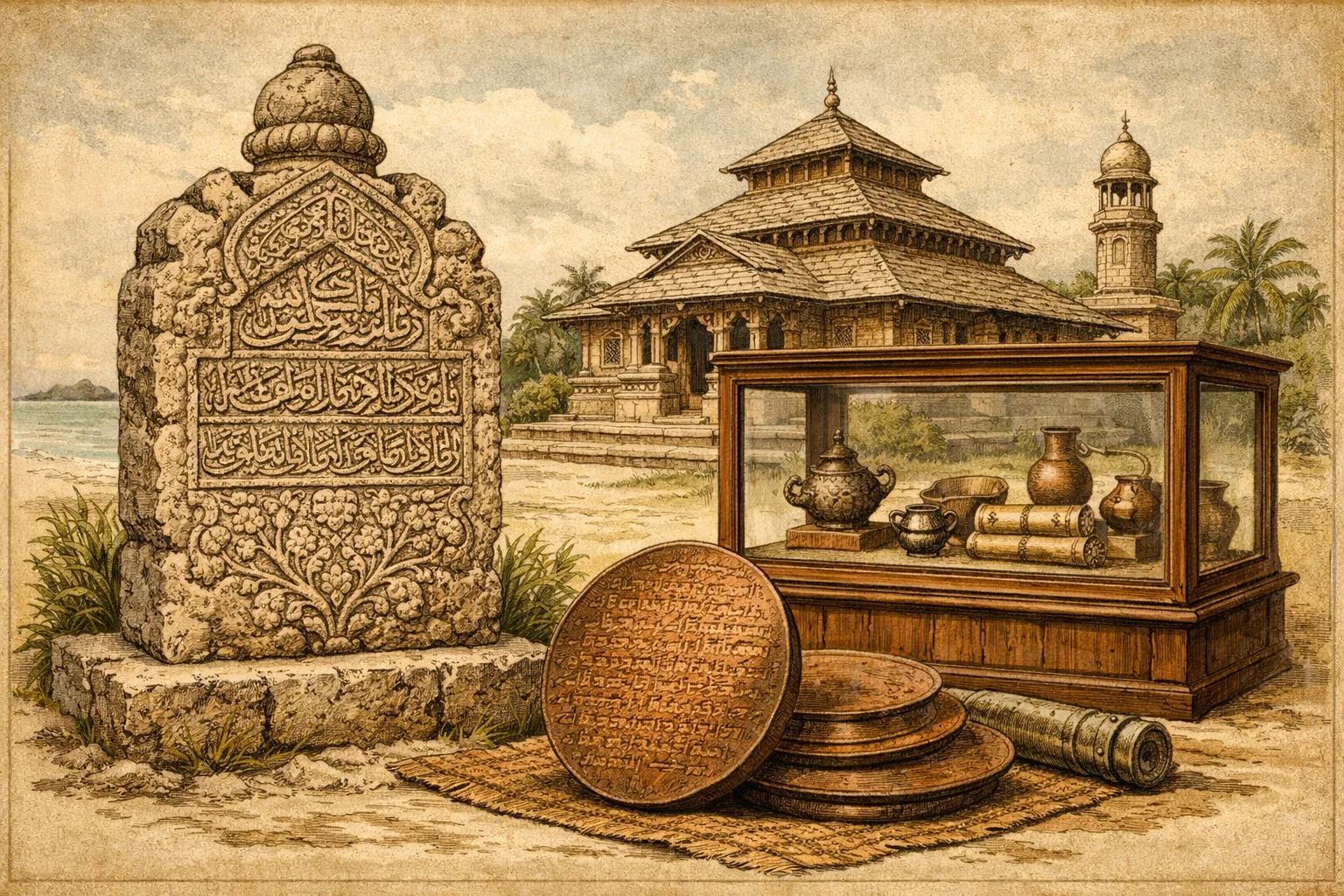
For curious travellers, the central attraction is not a cabinet full of monsters or occult instruments. It is the tension between what survives, what has been destroyed and what remains outside conventional museums. Coral statues, copper-plate records, monumental gravestones, sunken bathing structures and palace objects all complicate the familiar image of the Maldives as a destination concerned only with beaches and reefs.[cambridge.org]cambridge.orgIt contains 1535 carved coral gravestones…Read more…
Where to find the Maldives’ unusual collections
The National Museum is the clearest starting point, but it should not be treated as the country’s only repository of curious heritage. Several of the most memorable collections are better understood as historic places containing objects: a cemetery functioning as an open-air archive, a timber palace arranged as a house museum, or a mosque complex whose carved coral walls preserve layers of religious and artistic history.
The strongest sites fall into four broad groups:
- The National Museum in Malé, where royal belongings, manuscripts, weapons, carved architectural pieces and surviving archaeological material are brought together.
- Archaeological and digital collections, particularly the records created by the Maldives Heritage Survey and the Maritime Asia Heritage Survey.
- Religious and funerary sites, including coral-stone mosques and the vast Koagannu cemetery complex.
- House and resort museums, most notably Utheemu Palace and the historically documented Loama Museum at Maamigili.
This dispersed pattern reflects the geography of the country. Objects have been discovered across distant atolls, while important buildings, burial grounds and ruins cannot simply be transferred to Malé. The result is a curiosity culture spread between formal galleries, living religious sites, archaeological records and vulnerable monuments in the landscape.[cambridge.org]cambridge.orgIt contains 1535 carved coral gravestones…Read more…
Why the National Museum is stranger than it first appears
The National Museum occupies part of the former royal precinct at Sultan Park in Malé. The institution was founded in 1952, while its present main building opened in 2010. Its collection spans royal government, religion, warfare, trade and everyday island life, with objects including thrones, ceremonial furniture, clothing, arms, coins, manuscripts, lacquerwork and carved wooden panels.[wikipedia.org]WikipediaNational Museum (MaldivesNational Museum (Maldives
What makes it relevant to an unusual-museums itinerary is the collision of very different historical worlds. Royal slippers and sunshades sit within the same national story as coral carvings, Buddhist archaeological finds, inscribed copper plates and objects shaped by Indian Ocean trade. The museum’s holdings also include rare manuscripts and copper-plate inscriptions that have been digitally documented by the Maritime Asia Heritage Survey, giving researchers access to material that may not always be prominently displayed.[Maritime Asia Heritage Survey]maritimeasiaheritage.cseas.kyoto-u.ac.jpMaritime Asia Heritage Survey Maldives National MuseumMaritime Asia Heritage SurveyMaldives National Museum - Maritime Asia Heritage SurveyThe National Museum of the Maldives in Male' (MAHS-M…
Visitors should expect a compact national history museum rather than a theatrical cabinet of curiosities. A January 2026 visitor account described English-language labels but found the organisation and interpretation uneven, suggesting that roughly an hour was sufficient for a visit. That assessment is subjective, but it matches the broader impression of a nationally important collection whose presentation can be less developed than the objects themselves deserve.[Tripadvisor]tripadvisor.co.ukTripadvisor National MuseumNational Museum - MaldivesMaldives National Museum recently. Spending an hour is sufficient. Spending an hour is sufficient. R…
Access has recently expanded. In May 2026, the government announced Saturday opening from 10 a.m. to 4 p.m., responding to requests for greater public access. Opening arrangements can still change around religious observances and public holidays, so checking the museum’s current official social-media notices remains sensible.[mmtv.mv]en.mmtv.mvMMNational Museum to open on Saturdays from May 18MMNational Museum to open on Saturdays from May 18
The destroyed Buddhist collection
The most important story attached to the National Museum concerns objects that visitors can no longer see. On 7 February 2012, amid political unrest, a group entered the museum and smashed a substantial part of its pre-Islamic collection. The damaged pieces included Buddhist and other pre-Islamic sculptures made from coral stone, limestone and sandstone, among them a Buddha head and a six-faced coral figure. Museum staff said that many objects had been reduced to fragments or powder.[Reddit]reddit.comOpen source on reddit.com.
The attack matters because physical evidence for the Maldives’ pre-Islamic past was already scarce. Coral and soft stone deteriorate easily, while archaeological remains are distributed across remote islands and have often been disturbed by construction, erosion or earlier reuse. Destroying museum pieces therefore removed not merely decorative statues but some of the most legible evidence that Buddhism had once formed part of the archipelago’s religious history.
The episode also changes how the surviving galleries should be read. Empty spaces, reconstructed fragments and digitally recorded objects are part of the museum’s meaning. The collection is unusual not because curators have manufactured mystery, but because its gaps expose a conflict over which parts of national history can be publicly represented. The 2012 destruction should not be treated as evidence that all Maldivians reject pre-Islamic archaeology; it was an act by a small group during a period of turmoil. It nevertheless demonstrated how vulnerable the country’s ancient material record could be.[Reddit]reddit.comOpen source on reddit.com.
Archaeology beneath the island surface
The Maldives’ archaeological curiosities are often modest in scale but historically disruptive. Ruined ritual complexes, inscribed coral blocks and burial mounds challenge the assumption that small coral islands could not sustain substantial pre-modern religious communities.
The Maldives Heritage Survey has documented sites across the archipelago using photography, mapping and three-dimensional recording. At one major Buddhist site, researchers found that the remains extended well beyond structures recorded during earlier investigations. Survey work also recovered or documented carved coral bearing a monstrous face motif and a Sanskrit Buddhist inscription. Such finds are not supernatural anomalies; their interest lies in how unexpectedly rich the archaeological landscape is beneath settlements and vegetation.[Cambridge University Press & Assessment]cambridge.orgIt contains 1535 carved coral gravestones…Read more…
The National Museum’s digitally recorded holdings complement those field sites. Rare manuscripts, copper plates and carved fragments can connect ruined structures to named rulers, religious foundations or systems of landholding. The digital archive is especially valuable where originals are delicate, poorly displayed or difficult for ordinary visitors to reach.[Maritime Asia Heritage Survey]maritimeasiaheritage.cseas.kyoto-u.ac.jpMaritime Asia Heritage Survey Maldives National MuseumMaritime Asia Heritage SurveyMaldives National Museum - Maritime Asia Heritage SurveyThe National Museum of the Maldives in Male' (MAHS-M…
For travellers, however, archaeology in the Maldives is not always presented through polished visitor centres. Some sites are active religious places, some are unexcavated mounds, and others are vulnerable ruins without extensive interpretation. Claims about “mysterious temples” or lost civilisations should therefore be approached cautiously. The established evidence supports Buddhist settlement, long-distance trade and complex religious architecture; it does not require speculative explanations.
Koagannu: a cemetery that works like an archive
Koagannu, on Hulhumeedhoo in Addu Atoll, is one of the country’s most remarkable open-air collections. It is the Maldives’ largest historic cemetery complex, containing more than 1,500 carved coral grave markers alongside mosques, wells, mausoleums and other funerary structures. The oldest parts are associated with the early Islamic history of the southern atolls.[kyoto-u.ac.jp]maritimeasiaheritage.cseas.kyoto-u.ac.jpkoagannu an endangered heritage site in the maldivesMaritime Asia Heritage SurveyAN ENDANGERED HERITAGE SITE IN THE MALDIVESby MM Jameel — Today the 9800sqm large site (Image 2), just 50m a…
The site resembles an archive made from reef stone. Variations in gravestone shape, scale, carving and inscription encode distinctions of date, gender, rank and religious status. Rather than viewing a line of detached objects in glass cases, visitors encounter a dense historic landscape in which graves, worship and local memory remain connected.
Koagannu is also surrounded by traditions concerning scholars, nobles, saints and the early conversion of the community. These accounts give the cemetery its devotional and folkloric power, but not every identification has been established through documentary or archaeological proof. A responsible reading distinguishes inscriptions and survey evidence from later beliefs about who may be buried beneath particular stones.
Its preservation is a serious concern. The site has suffered erosion, weather exposure, vegetation and vandalism, and it was included in the World Monuments Fund’s 2022 Watch. The fund and heritage researchers have argued that conservation must involve the local community rather than treating the cemetery as a frozen archaeological exhibit.[kyoto-u.ac.jp]maritimeasiaheritage.cseas.kyoto-u.ac.jpkoagannu an endangered heritage site in the maldivesMaritime Asia Heritage SurveyAN ENDANGERED HERITAGE SITE IN THE MALDIVESby MM Jameel — Today the 9800sqm large site (Image 2), just 50m a…
Coral mosques as living cabinets of craftsmanship
The historic coral-stone mosques of the Maldives are unusual collections in architectural form. Their walls were made from blocks cut from living or fossil coral, fitted together and decorated with elaborate carving. Interiors combine timber craftsmanship, calligraphy and painted or carved ornament, producing a style that developed from local materials and connections across the Indian Ocean.[World Monuments Fund]wmf.orgOpen source on wmf.org.
These buildings are not museums in the normal sense. Some remain active places of worship, so access and behaviour are governed by religious practice. Yet each complex preserves a collection of distinct elements: decorated beams, lacquered ceilings, carved panels, wells, tombstones, sundials and funerary monuments. The object cannot easily be separated from the building.
UNESCO’s tentative-list entry describes the mosques as a distinctive fusion of coral-stone construction and regional architectural influences. More than two dozen surviving examples have been documented, although their condition and accessibility vary considerably. In 2026, Maldivian authorities reported submitting a nomination dossier covering a group of major historic mosques, but tentative-list or nomination status is not the same as final World Heritage inscription.[unesco.org]whc.unesco.orgWorld Heritage Centre Coral Stone Mosques of MaldivesSultan Muhammad Ibn Abdullah built the country’s first Friday Mosque soon after his conversion to Islam in 1153 CE, on the exact spot whe…
Their curiosity value comes from material transformation. Reef organisms became sacred architecture; coral surfaces were turned into inscriptions and repeating botanical patterns; and buildings exposed to salt, humidity and rising environmental pressures have survived for centuries. They are best approached as living religious monuments rather than picturesque ruins.

Utheemu Palace and the making of a national hero
Utheemu Palace is a preserved wooden residence associated with Sultan Mohamed Thakurufaanu, the sixteenth-century figure celebrated for resisting Portuguese rule. Unlike the National Museum’s broad chronological collection, Utheemu offers a concentrated house-museum experience: rooms, furnishings and domestic features are used to evoke elite life and the memory of a particular ruling family.[pickyourtrail.com]pickyourtrail.comUtheemu Island in Maldives: Historic & Cultural GetawayUtheemu Island in Maldives: Historic & Cultural Getaway
Its unusual quality lies partly in survival. Timber buildings are highly vulnerable in a humid maritime climate, making an old royal residence exceptional within the Maldivian built environment. Small rooms, low doorways, storage spaces and traditional construction provide a more intimate historical encounter than monumental palace architecture elsewhere in South Asia.
The palace is also a site of national storytelling. Thakurufaanu is remembered not merely as a former ruler but as a liberator and foundational hero. Displays and guided accounts can therefore blend domestic history, patriotic commemoration and popular legend. Visitors should recognise that the building presents both material heritage and an authorised national memory.
Travel information for Utheemu is less consistent than for major attractions in Malé. Published accounts confirm that the residence operates as a heritage attraction, but opening can be affected by holidays, staffing and local arrangements. It is safer to confirm access before making a journey specifically for the palace.[Tripadvisor]tripadvisor.comUtheemu GanduvaruUtheemu Ganduvaru
The former Loama resort museum
The Loama Museum at Maamigili represents one of the Maldives’ most intriguing experiments in commercial heritage. Developed within a luxury resort, it was described as the first museum in a Maldivian hotel to receive a government heritage licence. Its collection combined artefacts recovered on the island, objects connected with trade and everyday livelihoods, Chinese ceramics, contemporary art, an old Maldivian house and ancient bathing structures incorporated into a heritage trail.[hoteliermaldives.com]hoteliermaldives.comHotelier Maldives Loama Resort welcomes guests with Maldivian art, cultureHotelier Maldives Loama Resort welcomes guests with Maldivian art, culture
The bathing structures were among its strangest features. Built from sandstone and partly below ground, they were presented as possible survivals from the pre-Islamic period, although their exact date and original function were not firmly settled. Later use for bathing or ritual washing may have altered how they were understood. Their interpretation illustrates a recurring problem in Maldivian heritage: an unusual structure may be genuinely ancient without every promotional claim about it being archaeologically secure.
Loama was also important because it attempted to make culture part of the resort experience rather than an optional excursion to Malé. Guests encountered archaeology and traditional architecture alongside restaurants, villas and leisure facilities. That model raised useful questions about who controls interpretation, whether excavated objects should remain in a private tourist setting, and whether luxury tourism can finance preservation without turning heritage into décor.
Current public information about the museum is unreliable. The original resort is no longer clearly operating under the Loama identity, while many surviving webpages repeat material written around its 2014–2016 launch. The collection should therefore be regarded as historically documented but of uncertain present accessibility, not as an attraction that travellers can confidently book without direct confirmation.[themaldiveshotels.com]loama-resort-maldives-at-maamigili.themaldiveshotels.comOpen source on themaldiveshotels.com.
Folklore without a folklore museum
Maldivian oral tradition contains stories of spirits, dangerous places, uncanny sea encounters, sorcery and beings associated with isolated islands or the night. Yet there is no well-documented, permanent national museum devoted specifically to monsters, witchcraft or supernatural folklore.
That absence does not mean folklore is culturally unimportant. It means it has generally been preserved through storytelling, written collections, local knowledge and ethnographic research rather than through a visitor-facing display of ritual objects. Folklore also appears indirectly in historic landscapes: saintly tombs attract traditions about conversion and protection, ruins acquire stories explaining their origins, and unusual archaeological remains may be absorbed into local narratives.
Readers looking for an occult cabinet should therefore be wary of tourism copy that labels any old grave, ruin or coral carving “mystical”. The more rewarding approach is to ask how oral traditions interact with physical places. Koagannu, ancient temple mounds and isolated mosques may carry stories that are meaningful to communities even where archaeology cannot confirm every detail. The distinction between folklore and fraud is important: a tradition can be culturally authentic without functioning as literal historical evidence.
How credible is the Maldives’ curiosity landscape?
The Maldives offers substantial strange-history material, but its interpretation varies sharply. The National Museum and academic heritage surveys provide the strongest institutional base. UNESCO documentation and the World Monuments Fund are useful for understanding architecture and conservation risk. Historic houses and religious complexes retain powerful context because objects remain connected to the places where they were used.[cambridge.org]cambridge.orgIt contains 1535 carved coral gravestones…Read more…
Commercial descriptions require more care. Resort histories and tour pages often contain valuable first-hand details, but they may exaggerate certainty, repeat outdated opening information or present tentative archaeological interpretations as established facts. Loama’s bathing structures are a good example: the remains appear genuine, while their precise date and original purpose remain less certain than promotional language sometimes suggests.
Three questions help when assessing an unusual Maldivian attraction:
- Is the object or site professionally documented? Survey records, inscriptions and formal catalogues carry more weight than an unattributed travel claim.
- Is the interpretation clearly labelled? Archaeological findings, community tradition and tourist storytelling should not be presented as interchangeable.
- Is access genuinely current? Remote sites and small institutions may close, change management or operate only through local arrangements.
The country’s most compelling curiosities are credible precisely because they do not need invented mysteries. A shattered Buddhist statue, a field of coral gravestones or an excavated bathing structure is already strange enough when its uncertainty is explained honestly.

Why these collections matter
The Maldives’ unusual heritage changes the scale at which the country is understood. Islands commonly marketed as temporary escapes possess long histories of monarchy, migration, religious change, literacy and trade. Coral was not merely a natural backdrop: it became sculpture, gravestones, mosques and inscriptions. Imported ceramics and coins show the archipelago participating in maritime exchange, while manuscripts and copper plates reveal systems of authority that are easily overlooked in a landscape of small islands.[kyoto-u.ac.jp]maritimeasiaheritage.cseas.kyoto-u.ac.jpMaritime Asia Heritage Survey Maldives National MuseumMaritime Asia Heritage SurveyMaldives National Museum - Maritime Asia Heritage SurveyThe National Museum of the Maldives in Male' (MAHS-M…
The gaps are equally significant. The destruction of pre-Islamic objects, the uncertain future of a resort collection and the endangered condition of Koagannu demonstrate that heritage can vanish through ideology, redevelopment, neglect or environmental exposure. Digital surveys preserve information, but a three-dimensional record cannot fully replace an original sculpture, building or cemetery.
For the strange-travel reader, the Maldives rewards a different kind of curiosity from countries filled with novelty museums. Its most unusual collections are not assembled to shock. They are fragments of a difficult, scattered past: royal objects surviving the end of a sultanate, Buddhist remains in an Islamic nation, reef stone transformed into sacred architecture, and burial grounds that hold centuries of social memory. Their power comes from survival, loss and the uneasy work of deciding what a nation chooses to display.
Amazon book picks
Further Reading
Books and field guides related to What Strange History Survives Across the Maldives?. Use these as the next step if you want deeper reading beyond the article.
The Indian Ocean
In this stimulating and authoritative overview, Michael Pearson reverses the traditional angle of maritime history and looks from the sea...
The Silk Roads
Far more than a history of the Silk Roads, this book is truly a revelatory new history of the world, promising to destabilize notions of...
The Ocean of Churn
Much of human history has played itself out along the rim of the Indian Ocean. In a first-of-its-kind attempt, bestselling author Sanjeev...
eBay marketplace picks
Marketplace Samples
Live-tested eBay searches with available results related to this page.
Selected fromMaldives travel poster oneBay.co.uk.

Current eBay listing
Maldives Retro Classic Travel Poster Print A5, A4, A3, A2, A1
Current eBay listing
Maldives South Asia Travel Poster Wall Art Print Holiday Gift
Endnotes
1.
Source: cambridge.org
Link:https://www.cambridge.org/core/journals/antiquity/article/maldives-heritage-survey/15F61521DF052F7FEA4CA8AEEEA554FC
Source snippet
It contains 1535 carved coral gravestones...Read more...
2.
Source: whc.unesco.org
Title: World Heritage Centre Coral Stone Mosques of Maldives
Link:https://whc.unesco.org/en/tentativelists/5812/
Source snippet
Sultan Muhammad Ibn Abdullah built the country’s first Friday Mosque soon after his conversion to Islam in 1153 CE, on the exact spot whe...
3.
Source: Wikipedia
Title: National Museum (Maldives)
Link:https://en.wikipedia.org/wiki/National_Museum_%28Maldives%29
4.
Source: facebook.com
Title: National Museum MV
Link:https://www.facebook.com/NationalMuseumMV/
5.
Source: reddit.com
Link:https://www.reddit.com/r/MuslimAbuse/comments/1muytqz
6.
Source: see.mv
Link:https://see.mv/73088
7.
Source: pickyourtrail.com
Title: Utheemu Island in Maldives: Historic & Cultural Getaway
Link:https://pickyourtrail.com/blog/utheemu-island-in-the-maldives
8.
Source: tripadvisor.com
Title: Utheemu Ganduvaru
Link:https://www.tripadvisor.com/Attraction_Review-g25354853-d2695336-Reviews-Utheemu_Ganduvaru-Utheemu.html
9.
Source: Wikipedia
Link:https://en.wikipedia.org/wiki/Utheemu
10.
Source: blog.maldivescomplete.com
Title: best of the maldives official museum loama at maamagili
Link:https://blog.maldivescomplete.com/2016/05/18/best-of-the-maldives-official-museum-loama-at-maamagili/
11.
Source: Wikipedia
Title: Maamigili (Raa Atoll)
Link:https://en.wikipedia.org/wiki/Maamigili_%28Raa_Atoll%29
12.
Source: archive.mv
Title: 86xed Z
Link:https://archive.mv/en/articles/86xedZ
13.
Source: whc.unesco.org
Link:https://whc.unesco.org/fr/listesindicatives/5812/
14.
Source: see.mv
Title: Maldives museum reopens minus smashed Hindu images | Sun English Edition
Link:https://see.mv/1396
15.
Source: see.mv
Title: Substantial damage caused to National Museum in unrest | Sun English Edition
Link:https://see.mv/1281
16.
Source: whc.unesco.org
Link:https://whc.unesco.org/en/intassistance/2346
17.
Source: unesdoc.unesco.org
Link:https://unesdoc.unesco.org/ark%3A/48223/pf0000060577
18.
Source: whc.unesco.org
Link:https://whc.unesco.org/en/statesparties/mv
20.
Source: whc.unesco.org
Link:https://whc.unesco.org/en/statesparties/mv/assistance/
21.
Source: Wikipedia
Link:https://en.wikipedia.org/wiki/Maldives
22.
Source: facebook.com
Link:https://www.facebook.com/newspsm/posts/the-museum-the-first-of-its-kind-in-the-maldives-will-use-modern-technology-and-/1382164847288605/
23.
Source: facebook.com
Link:https://www.facebook.com/worldmonuments/posts/koagannu-mosques-and-cemetery-in-maldives-is-on-the-2022-worldmonumentswatch-a-h/10158765474065886/
24.
Source: facebook.com
Title: loama resort maldives at maamigili is the only resort where a museum is located
Link:https://www.facebook.com/100057335723062/photos/loama-resort-maldives-at-maamigili-is-the-only-resort-where-a-museum-is-located-/1110512415632477/
25.
Source: facebook.com
Link:https://www.facebook.com/sunmv/posts/foreign-diplomats-enjoy-tour-of-utheemu-palace-and-other-historical-sites-sunnew/783995900661472/
26.
Source: everything.explained.today
Link:https://everything.explained.today/List_of_mosques_in_the_Maldives/
27.
Source: tripadvisor.com
Title: National Museum
Link:https://www.tripadvisor.com/Attraction_Review-g298571-d1068509-Reviews-National_Museum-Male.html
28.
Source: maritimeasiaheritage.cseas.kyoto-u.ac.jp
Title: Maritime Asia Heritage Survey Maldives National Museum
Link:https://maritimeasiaheritage.cseas.kyoto-u.ac.jp/collection/maldives-national-museum/
Source snippet
Maritime Asia Heritage SurveyMaldives National Museum - Maritime Asia Heritage SurveyThe National Museum of the Maldives in Male' (MAHS-M...
29.
Source: maritimeasiaheritage.cseas.kyoto-u.ac.jp
Title: koagannu an endangered heritage site in the maldives
Link:https://maritimeasiaheritage.cseas.kyoto-u.ac.jp/koagannu-an-endangered-heritage-site-in-the-maldives/
Source snippet
Maritime Asia Heritage SurveyAN ENDANGERED HERITAGE SITE IN THE MALDIVESby MM Jameel — Today the 9800sqm large site (Image 2), just 50m a...
30.
Source: tripadvisor.co.uk
Title: Tripadvisor National Museum
Link:https://www.tripadvisor.co.uk/Attraction_Review-g298571-d1068509-Reviews-National_Museum-Male.html
Source snippet
National Museum - MaldivesMaldives National Museum recently. Spending an hour is sufficient. Spending an hour is sufficient. R...
31.
Source: en.mmtv.mv
Title: MMNational Museum to open on Saturdays from May 18
Link:https://en.mmtv.mv/9620
32.
Source: wmf.org
Link:https://www.wmf.org/monuments/koagannu-mosques-and-cemetery
33.
Source: wmf.org
Link:https://www.wmf.org/monuments/coral-stone-mosques-of-the-maldives
34.
Source: en.mmtv.mv
Link:https://en.mmtv.mv/9619
35.
Source: hoteliermaldives.com
Title: Hotelier Maldives Loama Resort welcomes guests with Maldivian art, culture
Link:https://hoteliermaldives.com/loama-resort-welcomes-guests-with-maldivian-art-culture-and-heritage/
36.
Source: loama-resort-maldives-at-maamigili.themaldiveshotels.com
Link:https://loama-resort-maldives-at-maamigili.themaldiveshotels.com/en/
37.
Source: maldivesisles.com
Link:https://maldivesisles.com/loama-resort-maldives-at-maamigili
38.
Source: maritimeasiaheritage.cseas.kyoto-u.ac.jp
Link:https://maritimeasiaheritage.cseas.kyoto-u.ac.jp/wp-content/uploads/2022/03/Xavier-Romero-Frias-The-Maldive-Islanders-Book.pdf
39.
Source: islamicworld.britishmuseum.org
Link:https://islamicworld.britishmuseum.org/collection/
40.
Source: presidency.gov.mv
Link:https://presidency.gov.mv/Press/Article/29406
41.
Source: thebookingexpert.com
Link:https://thebookingexpert.com/loama-resort-maldives-al-maamigili/
42.
Source: kuoni.co.uk
Link:https://www.kuoni.co.uk/destinations/indian-ocean/maldives/
43.
Source: researchgate.net
Link:https://www.researchgate.net/publication/369900829Koagannu-_an_endangered_heritage_site_in_the_Maldives_httpsmaritimeasiaheritagecseaskyoto-uacjpkoagannu-an-endangered-heritage-site-in-the-maldives
44.
Source: lifeisoutside.com
Link:https://www.lifeisoutside.com/mv/maldives-resorts/loama-resort-maldives-at-maamigili/
45.
Source: bestattravel.co.uk
Link:https://www.bestattravel.co.uk/holidays/maldives
46.
Source: virginatlantic.com
Link:https://www.virginatlantic.com/holidays/destinations/indian-ocean/maldives
Additional References
47.
Source: lonelyplanet.com
Link:https://www.lonelyplanet.com/points-of-interest/national-museum/1039867
Source snippet
Lonely PlanetNational Museum | Male, Maldives | AttractionsItems on display include weaponry, religious paraphernalia and household wares...
48.
Source: nhm.ac.uk
Link:https://www.nhm.ac.uk/visit/weird-objects-in-the-museum.html
49.
Source: viator.com
Link:https://www.viator.com/en-GB/blog/Weird-and-Wonderful-Museums-Around-the-World/l98622
50.
Source: allinclusivebeachresorts.com
Link:https://allinclusivebeachresorts.com/all/maldives/raa-atoll/maamigili-island/loama-museum-and-art-gallery
51.
Source: maxvanberchem.org
Link:https://maxvanberchem.org/fr/activites-scientifiques/projets/archeologie/11-archeologie/171-archaeological-investigations-on-the-coral-stone-mosques-of-the-maldives
52.
Source: maxvanberchem.org
Link:https://maxvanberchem.org/fr/11-archeologie/171-archaeological-investigations-on-the-coral-stone-mosques-of-the-maldives
53.
Source: instagram.com
Link:https://www.instagram.com/bindi_vora/?hl=en
54.
Source: instagram.com
Link:https://www.instagram.com/p/CavR_q3hYXk/
55.
Source: hinduexistence.org
Link:https://hinduexistence.org/2012/02/13/maldives-islamists-storm-national-museum-destroy-entire-collection-of-12th-century-buddhist-statues/
56.
Source: trekgo.in
Link:https://trekgo.in/blog/national-museum-maldives