Where Nigeria Keeps Its Strangest Stories
Nigeria does not have a single, famous “museum of the weird”.
Page outline Jump by section
Introduction
The strongest sites are not simply cabinets of odd objects. They sit where archaeology, spiritual belief, colonial collecting and living tradition overlap. Some are conventional national museums; others are devotional, academic or commemorative spaces. Interpretation and opening arrangements can vary, so visitors should verify access directly. What makes Nigeria distinctive is that many apparently “strange” objects were never intended as curiosities at all. They became unusual through excavation, conversion, warfare, looting or museum display.
Where Nigeria’s strangest collections are found
Nigeria’s National Commission for Museums and Monuments operates a broad network that includes archaeological museums, palace museums, a war museum, colonial-history sites, an architecture museum, a rock-art centre and institutions attached to sacred or historic places. Its current directory lists museums at Esie, Oron, Igbo-Ukwu, Nok, Owo, Lagos and Benin City, alongside the National War Museum in Umuahia and the Museum of Traditional Nigerian Architecture in Jos.[Nat'l Commission for Museums & Monuments]museum.ngNational Museum Jos. P.M.B. 2013, Jos, Plateau State… National Museum Esie. National Museum Esie. Esie Museum road P.M.B. 301, Esie…
The official list, however, gives only part of the picture. Several of the country’s most compelling unusual collections belong to universities, hospitals, religious institutions or living sacred landscapes rather than the national museum system. This fragmentation has practical consequences. Some places have limited web information, irregular public access or poorly publicised collections. Nigerian museum specialists have also documented problems involving funding, storage, documentation, security and public engagement, although conditions vary greatly between institutions.[iccrom.org]iccrom.orgre-org nigeriare-org nigeriaSeptember 25, 2019 — Research on access to collections has linked these problems to existing deficiencies in museum d…
For travellers, that means treating museum hours published by third-party websites as provisional. Direct contact is particularly important outside Lagos and major state capitals.
Esie’s unexplained stone population
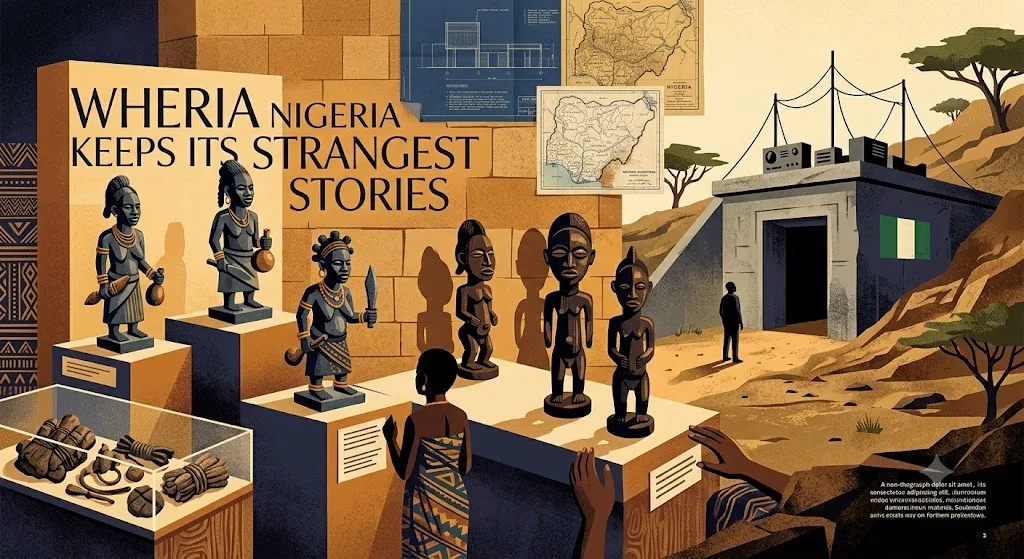
The National Museum at Esie in Kwara State contains Nigeria’s clearest archaeological mystery: a large assemblage of human-shaped soapstone sculptures discovered around the town. Many are seated or kneeling figures with elaborate hairstyles, jewellery, facial marks, weapons or ritual objects. Although commonly grouped together, they vary in appearance and workmanship, suggesting a complex artistic tradition rather than a single batch of crude idols.[The Metropolitan Museum of Art]metmuseum.orgsoapstone sculptures esieThe Metropolitan Museum of ArtThe Soapstone Sculptures of ÈṣìẹOctober 24, 2025 — by AT Adeniji — The Èṣìẹ̀ soapstone figures represent an…
Their makers, date and original function remain debated. Scientific work has investigated possible sources of the soapstone, while archaeological and art-historical interpretation has considered whether the figures represented ancestors, rulers, attendants or members of an unknown community. The Metropolitan Museum of Art describes the group as an unparalleled archaeological assemblage whose precise origins and original use remain unresolved.[The Metropolitan Museum of Art]metmuseum.orgsoapstone sculptures esieThe Metropolitan Museum of ArtThe Soapstone Sculptures of ÈṣìẹOctober 24, 2025 — by AT Adeniji — The Èṣìẹ̀ soapstone figures represent an…
Local oral traditions add another layer. Stories have sometimes presented the stones as people transformed through supernatural punishment. Such accounts are culturally important but should not be confused with archaeological evidence. They reveal how a puzzling group of objects was absorbed into local memory when no written explanation survived.
Esie is unusual because the figures have not become purely archaeological specimens. Community traditions and festivals continue to connect them with place, identity and spiritual history. The museum therefore stands between three modes of interpretation:
- Archaeological: an exceptional sculptural tradition of uncertain authorship.
- Folkloric: a petrified community explained through moral or supernatural narrative.
- Local heritage: a group of objects whose meaning has continued to evolve after their rediscovery.
For a visitor interested in mysteries, Esie offers something better than a manufactured enigma. The uncertainty is genuine, but it has limits: the figures are human-made sculptures, not inexplicable natural formations or proof of a vanished supernatural race.

Charms displayed through a religious lens
One of Nigeria’s most explicitly unusual institutions is the Museum of Charms and Fetish Objects at Madonna University’s main campus and National Pilgrimage Centre in Elele. Academic research describes a collection involving amulets, horns, figures, ritual materials and other objects associated with traditional religious practice.[ResearchGate]researchgate.netResearch Gate Museum of Charms and Fetish Objects in NigeriaMuseum of Charms and Fetish Objects in NigeriaJune 30, 2022 — Research activities were carried out in the Museum of Charms an…
The museum is not a neutral ethnographic display. It exists within a Catholic university and pilgrimage setting associated with the priest and university founder Emmanuel Edeh. That setting shapes how the objects may be classified and explained. Materials regarded by practitioners as protective, medicinal, ancestral or sacred can be reframed as evidence of superstition, fear, witchcraft or spiritual danger.
This matters because words such as “fetish” carry a long colonial history. European traders and writers applied the term broadly to West African sacred objects, often flattening very different belief systems into a single category of irrational magic. The scholarly study of the Elele museum itself notes the complicated history of terms such as “charm” and “fetish” and the difficulty of separating religious, psychological, aesthetic and social meanings.[Hrčak]hrcak.srce.hrOpen source on srce.hr.
Visitors should therefore read the collection on two levels. The first concerns the objects: what they are made from, how they may have been used and what communities believed they could do. The second concerns the institution: why a Catholic university collected them and what argument their display is intended to make.
That tension makes the museum particularly valuable within Nigeria’s strange-collection landscape. It is simultaneously a collection of ritual material, an archive of religious encounter and an example of how one belief system can exhibit the sacred objects of another.
Ancestral figures at Oron
The National Museum at Oron in Akwa Ibom State is associated with carved wooden ancestral figures made by Oron communities. These figures were not originally decorative portraits. They embodied ancestry, social status and collective memory, preserving the identity of prominent male ancestors within family and community life.[Wikipedia]WikipediaEkpu OroEkpu Oro
Their uncanny power comes partly from their original status. They were treated as more than representations of dead people: they helped sustain relationships between the living and the ancestral past. In museum cases, however, ritual presences become classified art objects. The shift is comparable to seeing a reliquary or funerary figure removed from worship and placed under gallery lighting.
The Oron collection was also severely affected by the Nigerian Civil War. Historical accounts indicate that the museum once held hundreds of ancestral carvings, but many were lost, damaged or dispersed during the conflict. Some Oron works subsequently entered foreign collections.[Collecting African Tribal Art]sm76626.wordpress.comOpen source on wordpress.com.
Oron therefore raises questions that recur throughout Nigeria’s museums: is an ancestral image primarily art, religious equipment, family property or national heritage? Who has the authority to interpret it? What happens when an object designed to maintain lineage is separated from the lineage itself?
Bunkers and machines of the civil war
The National War Museum at Umuahia offers a very different form of curiosity: preserved machinery, weapons and underground spaces connected with the Nigerian Civil War of 1967–70. Its collections include military equipment associated with both federal Nigeria and the secessionist Republic of Biafra. The museum site is linked to preserved wartime bunkers, including facilities connected with Biafran broadcasting and command operations.[wikipedia.org]WikipediaNational War Museum, UmuahiaNational War Museum, Umuahia
The most atmospheric elements are the subterranean structures commonly associated with Biafran leader Chukwuemeka Odumegwu Ojukwu and the Voice of Biafra radio service. These are not theatrical reconstructions in the style of a commercial bunker attraction. They are remnants of an improvised wartime state that relied on concealment, local engineering and mobile administration while under military pressure.
The museum’s strangeness lies in the combination of ordinary and improvised technology. Aircraft, armoured vehicles and artillery sit beside objects shaped by blockade and material scarcity. The result is less a celebration of military hardware than a record of how modern war was adapted to local conditions.
Interpretation should remain cautious and humane. The civil war is remembered differently across Nigeria, and its history includes mass starvation, civilian suffering and enduring political sensitivity. A visitor seeking strange machines should not lose sight of the human catastrophe that produced them.
Medical history before the digital hospital
The medical museum at University College Hospital in Ibadan preserves equipment from the development of modern hospital medicine in Nigeria. Reports describe diagnostic apparatus, early hospital equipment, models, statues and other medical artefacts assembled through donations and institutional preservation. The hospital promoted the collection as the first museum of its kind among Nigerian tertiary healthcare institutions and reopened it for wider commercial use in 2024.[facebook.com]facebook.comOpen source on facebook.com.
For many visitors, obsolete medical instruments have the unsettling appeal of machinery whose purpose is recognisable but whose operation is not. Early imaging devices, diagnostic tools and teaching models can resemble props from speculative fiction, especially when compared with compact digital equipment.
The collection is most useful when understood as technological history rather than a gallery of medical horrors. It documents the physical infrastructure required to build teaching hospitals, train specialists and introduce new diagnostic practices. Its unusual objects show how quickly medical technology becomes unfamiliar once it leaves clinical use.
Public information remains limited compared with major international medical museums, so visitors should confirm current access with the hospital rather than assuming unrestricted entry.
A sacred forest that functions like a living museum
The Osun-Osogbo Sacred Grove is not a museum in the conventional sense. It is an active religious landscape around the River Osun and a UNESCO World Heritage Site. Within the forest are shrines, palaces, worship points and large sculptures dedicated to Osun and other Yoruba deities. UNESCO records around forty shrines, sculptures and artworks, as well as sacred places used by priests and worshippers.[UNESCO World Heritage Centre]whc.unesco.orgOpen source on unesco.org.
Many of the monumental forms visible today were created or renewed during the twentieth century through the New Sacred Art movement associated with artist Susanne Wenger and Yoruba collaborators. The grove therefore combines older ritual geography with relatively modern sculpture. Its twisting concrete beings, towering figures and organic architecture can look surreal to visitors unfamiliar with their religious context.[The Metropolitan Museum of Art]metmuseum.orgThe Metropolitan Museum of Art Osun-Osogbo Sacred Grove, NigeriaThe Metropolitan Museum of Art Osun-Osogbo Sacred Grove, Nigeria
Calling the grove an open-air curiosity museum would be misleading. The works are not detached exhibits, and the forest is not simply a sculpture park. Ritual activity continues, particularly around the annual festival. Visitors enter a place where artistic creation, ecology and worship remain connected.
The grove offers an important correction to the museum habit of treating African sacred art as something finished in the past. Here, religious images are still commissioned, inhabited by meaning and incorporated into ceremonies. The “collection” grows from a living tradition rather than from archaeological removal.
Lagos and the return of performative display
Lagos contains several conventional museums, but the John Randle Centre for Yoruba Culture and History represents a more immersive model. Its displays use sound, movement, storytelling and audiovisual interpretation to explore creation narratives, deities, customs and oral tradition. The centre was conceived as a “theatre of living memory” rather than a quiet European-style museum of objects in cases.[The Guardian]theguardian.comOpen source on theguardian.com.
For readers interested in magic, folklore and unusual belief, its value lies in contextualisation. Deities associated with thunder, fertility, rivers, justice and divination are presented as part of a coherent religious and cultural system rather than as an assortment of exotic idols. This makes the centre a useful counterpoint to older museums formed through colonial classifications.
The National Museum Lagos remains important for archaeology, royal art, masks and ritual material, but the Randle Centre demonstrates a newer approach: myths can be animated, oral traditions heard and performance treated as historical evidence. That approach is particularly suitable for masquerade traditions, whose costumes lose much of their meaning when displayed without music, movement or audience participation.
The Benin Bronzes: objects caught between palace and museum
No account of Nigeria’s unusual collections can avoid the Benin Bronzes, a broad category of royal plaques, heads, figures, ivory objects and regalia taken during the British attack on Benin City in 1897. Thousands were dispersed through museums and private collections outside Nigeria. Returns accelerated in the 2020s, including a Dutch agreement involving 119 objects and further transfers by European institutions.[apnews.com]apnews.comOpen source on apnews.com.
These are not “curiosities” in the trivial sense. Many were court records, ancestral objects or elements of royal shrines. Their extraordinary craftsmanship made them famous abroad, but colonial museum display often separated them from the political and spiritual system that produced them.
Their return has not produced a simple happy ending. Nigerian debates have concerned ownership, custody, public access and the authority of the Oba of Benin, the federal government, museums and cultural organisations. A 2023 federal declaration placed ownership and custodianship of returned objects with the Oba, complicating assumptions that restituted works would automatically enter a public national museum.[AP News]apnews.comAP News Protesters in Nigeria disrupt opening of major West African art museumAP News Protesters in Nigeria disrupt opening of major West African art museum
The Museum of West African Art in Benin City was developed with galleries, conservation laboratories, research facilities and spaces for contemporary art. Yet protests and political disputes disrupted its planned opening in November 2025, and the museum advised against visits following the disturbance. Reports stressed that it did not hold the returned royal bronzes and had moved towards a broader West African mission.[theguardian.com]theguardian.comMowaa, funded by France, Germany, and private donors, was expected to exhibit returned artefacts looted during British colonial expeditio…
This dispute is revealing. Restitution is not merely about transporting objects from Europe to Nigeria. It raises a harder question: should a sacred royal object be held by a palace, displayed in a public museum, loaned abroad or placed in a research institution? The answer determines whether visitors can see it and how its meaning is explained.
How to read Nigeria’s unusual collections
Nigeria’s strangest displays are easiest to understand when visitors resist three common mistakes.
Do not assume every ritual object is evidence of witchcraft. Protective medicines, ancestral figures, divination tools and shrine objects belong to different systems of belief. Labels inherited from missionaries or colonial collectors may conceal those distinctions.
Separate genuine uncertainty from supernatural marketing. The origins of the Esie figures are genuinely unresolved, but that does not make every local legend an archaeological conclusion. Good interpretation can preserve mystery without presenting folklore as proof.
Ask who created the display. A national museum, royal palace, Catholic university, hospital and sacred grove have different purposes. One may classify an object as art, another as dangerous spiritual material, another as ancestral property and another as an active focus of worship.
This is why Nigeria rewards slow, evidence-aware curiosity. The country’s most memorable collections are not collections of meaningless oddities. They are places where objects have changed status: gods become sculptures, ancestors become ethnography, weapons become memorials, hospital machines become history and looted palace records become the centre of an international argument about ownership.

Why Nigeria matters in strange-museum culture
Nigeria’s contribution to strange and offbeat heritage lies less in spectacle than in contested meaning. The Esie stones remain archaeologically mysterious. Oron ancestral figures expose the limits of treating sacred objects as art alone. Elele’s charm museum reveals how institutions frame rival belief systems. Umuahia preserves the underground infrastructure of a defeated state. Ibadan turns obsolete medical technology into institutional memory. Osun-Osogbo shows a sacred collection that remains alive, while the Benin Bronzes demonstrate that even world-famous museum objects may still lack an agreed home.
Together, these places show that a cabinet of curiosity is never neutral. Someone chooses what to collect, how to name it and whether to present it as beautiful, dangerous, primitive, holy or historically important. In Nigeria, those choices are unusually visible—and often still being argued over.
Amazon book picks
Further Reading
Books and field guides related to Where Nigeria Keeps Its Strangest Stories. Use these as the next step if you want deeper reading beyond the article.
The Brutish Museums: The Benin Bronzes, Colonial Violence and...
New York Times 'Best Art Books' 2020 'Essential' – Sunday Times 'Brilliantly enraged' - New York Review of Books 'A real game-changer'– E...
The Man-Leopard Murders: History and Society in Colonial Nigeria
This book is an account of murder and politics in Africa, and an historical ethnography of southern Annang communities during the colonia...
Osogbo and the Art of Heritage: Monuments, Deities, and Money
First published 2011. Subjects: Yoruba Art, Culture and globalization, Cultural property, Art and society, Social aspects.
eBay marketplace picks
Marketplace Samples
Live-tested eBay searches with available results related to this page.
Selected fromAfrican collectible oneBay.co.uk.
Endnotes
1.
Source: museum.ng
Link:https://museum.ng/museums/
Source snippet
National Museum Jos. P.M.B. 2013, Jos, Plateau State... National Museum Esie. National Museum Esie. Esie Museum road P.M.B. 301, Esie...
2.
Source: iccrom.org
Title: re-org nigeria
Link:https://www.iccrom.org/sites/default/files/RE-ORG%20Ibadan.pdf
Source snippet
re-org nigeriaSeptember 25, 2019 — Research on access to collections has linked these problems to existing deficiencies in museum d...
Published: September 25, 2019
3.
Source: researchgate.net
Title: 332539780 E Museum of heritage resources The challenges
Link:https://www.researchgate.net/publication/332539780_E-Museum_of_heritage_resources-The_challenges
Source snippet
E-Museum of heritage resources-The challenges20 Apr 2019 — Most of the problems confronting traditional museum collections ca...
4.
Source: researchgate.net
Title: Research Gate Museum of Charms and Fetish Objects in Nigeria
Link:https://www.researchgate.net/publication/362311498_Museum_of_Charms_and_Fetish_Objects_in_Nigeria_Contemplations_about_Imagination_Culture_and_Related_Areas
Source snippet
Museum of Charms and Fetish Objects in NigeriaJune 30, 2022 — Research activities were carried out in the Museum of Charms an...
Published: June 30, 2022
5.
Source: Wikipedia
Title: Ekpu Oro
Link:https://en.wikipedia.org/wiki/Ekpu_Oro
6.
Source: Wikipedia
Title: National War Museum, Umuahia
Link:https://en.wikipedia.org/wiki/National_War_Museum%2C_Umuahia
7.
Source: facebook.com
Link:https://www.facebook.com/UCHIBADAN/posts/breaking-news-uch-medical-museum-opens-for-commercial-usein-a-groundbreaking-dev/906533334838162/
8.
Source: whc.unesco.org
Link:https://whc.unesco.org/en/list/1118/
9.
Source: whc.unesco.org
Link:https://whc.unesco.org/document/224879
10.
Source: facebook.com
Link:https://www.facebook.com/MAACambridge/posts/legal-ownership-of-116-benin-artefacts-cared-for-at-the-museum-of-archaeology-an/1324301609723580/
11.
Source: facebook.com
Link:https://www.facebook.com/HistoricalnigeriaYoruba/photos/the-ojukwu-bunker-is-a-nigerian-civil-war-museum-during-the-civil-war-the-bunker/122237830034076276/
12.
Source: facebook.com
Link:https://www.facebook.com/dayo.adedayo.9/posts/%F0%9D%90%80-%F0%9D%90%89%F0%9D%90%A8%F0%9D%90%AE%F0%9D%90%AB%F0%9D%90%A7%F0%9D%90%9E%F0%9D%90%B2-%F0%9D%90%93%F0%9D%90%A1%F0%9D%90%AB%F0%9D%90%A8%F0%9D%90%AE%F0%9D%90%A0%F0%9D%90%A1-%F0%9D%90%93%F0%9D%90%A2%F0%9D%90%A6%F0%9D%90%9E-%F0%9D%90%83%F0%9D%90%A2%F0%9D%90%AC%F0%9D%90%9C%F0%9D%90%A8%F0%9D%90%AF%F0%9D%90%9E%F0%9D%90%AB%F0%9D%90%A2%F0%9D%90%A7%F0%9D%90%A0-%F0%9D%90%8D%F0%9D%90%A2%F0%9D%90%A0%F0%9D%90%9E%F0%9D%90%AB%F0%9D%90%A2%F0%9D%90%9A-%F0%9D%90%9A%F0%9D%90%AD-%F0%9D%90%AD%F0%9D%90%A1%F0%9D%90%9E-%F0%9D%90%82%F0%9D%90%91%F0%9D%90%88%F0%9D%90%8C%F0%9D%90%8C%F0%9D%90%83-%F0%9D%90%8B%F0%9D%90%A2%F0%9D%90%9B%F0%9D%90%AB%F0%9D%90%9A%F0%9D%90%AB%F0%9D%90%B2-%F0%9D%90%8C%F0%9D%90%AE%F0%9D%90%AC%F0%9D%90%9E%F0%9D%90%AE%F0%9D%90%A6%F0%9D%91%A9%F0%9D%92%9A-%F0%9D%92%85%F0%9D%92%82%F0%9D%92%9A%F0%9D%92%90-%F0%9D%91%A8/10165796304398783/
13.
Source: facebook.com
Title: hidden in the heart of kwara lies a town carved in mystery welcome to esie home
Link:https://www.facebook.com/ibedc.ng/posts/hidden-in-the-heart-of-kwara-lies-a-town-carved-in-mystery-welcome-to-esie-home-/1460152619484002/
14.
Source: facebook.com
Title: university college hospital ibadan nigeriacirca 1959credit eliot elisofon photog
Link:https://www.facebook.com/HistoricalnigeriaYoruba/posts/university-college-hospital-ibadan-nigeriacirca-1959credit-eliot-elisofon-photog/122195221292076276/
15.
Source: facebook.com
Link:https://www.facebook.com/akingbola.folorunso/posts/rev-fr-emmanuel-mathew-paul-edeh-commonly-known-as-father-edeh-is-renowned-for-h/9709876652410651/
16.
Source: facebook.com
Link:https://www.facebook.com/100081637403236/videos/this-is-how-the-life-of-service-of-fr-founder-began-relatable-catholic-nigerian/1292813165760358/
17.
Source: facebook.com
Link:https://www.facebook.com/jideojong/posts/a-trip-inside-the-voice-of-biafra-bunker-at-the-national-war-museum-in-unuahia-j/10163498768522885/
18.
Source: facebook.com
Link:https://www.facebook.com/ASIRIMagazine/posts/inside-view-of-lagos-national-museum-lagos-nigeria-date-august-1959-museum-histo/2582353241796812/
19.
Source: facebook.com
Link:https://www.facebook.com/HistoricalnigeriaYoruba/posts/the-nigerian-national-war-museum-in-umuahia-showcases-the-military-history-of-ni/122290052366076276/
20.
Source: facebook.com
Title: which one of these items do you remember usingthe akwaaba african travel market
Link:https://www.facebook.com/atqnewsmedia/posts/which-one-of-these-items-do-you-remember-usingthe-akwaaba-african-travel-market-/1567529442041246/
21.
Source: facebook.com
Link:https://www.facebook.com/thisiscolossal/posts/a-unesco-world-heritage-site-spanning-190-acres-the-the-%E1%BB%8D%E1%B9%A3un-%C3%B2%E1%B9%A3ogbo-sacred-grove/1469136728588343/
22.
Source: facebook.com
Link:https://www.facebook.com/Uchescolimited/posts/the-national-war-museum-in-umuahia-abia-state-showcases-nigerias-military-histor/4306568716329735/
23.
Source: facebook.com
Link:https://www.facebook.com/100076074825211/videos/discover-the-story-of-the-ekpu-oro-ancient-wooden-figures-carved-from-the-sacred/758939297298731/
24.
Source: facebook.com
Link:https://www.facebook.com/OurGeneticLegacy/posts/our-first-museum-visit-was-to-the-national-museum-lagos-where-the-herstorians-le/998915782275299/
25.
Source: facebook.com
Link:https://www.facebook.com/chioma.chinakachigookwum/posts/it-is-important-to-also-remind-ourselves-that-there-is-no-man-of-god-in-nigeria-/10162125181698353/
26.
Source: facebook.com
Link:https://www.facebook.com/groups/479232809442942/posts/1019427845423433/
27.
Source: Wikipedia
Title: National Commission for Museums and Monuments
Link:https://en.wikipedia.org/wiki/National_Commission_for_Museums_and_Monuments
28.
Source: Wikipedia
Title: Esiẹ Museum
Link:https://en.wikipedia.org/wiki/Esi%E1%BA%B9_Museum
29.
Source: Wikipedia
Title: Nigerian National Museum
Link:https://en.wikipedia.org/wiki/Nigerian_National_Museum
30.
Source: Wikipedia
Title: Center for Research, Information Management and Media Development Museum
Link:https://en.wikipedia.org/wiki/Center_for_Research%2C_Information_Management_and_Media_Development_Museum
31.
Source: researchgate.net
Link:https://www.researchgate.net/publication/372974685_Silent_Heritage_Investigating_Ruxton%27s_Nigeria_Collection_at_the_Horniman_Museum_and_Gardens
32.
Source: researchgate.net
Link:https://www.researchgate.net/publication/369294780_Museums_Monuments_and_the_Reconstruction_of_the_Socio-Cultural_Historiography_of_Nigeria_A_Study_of_the_National_Museum_Lagos
33.
Source: researchgate.net
Link:https://www.researchgate.net/figure/University-College-Hospital-Ibadan-Nigeria-1961-Photograph-reproduced-by-permission_fig1_32886492
34.
Source: researchgate.net
Title: 378858728 The National War Museum Umuahia Insights from an Excursion
Link:https://www.researchgate.net/publication/378858728_The_National_War_Museum_Umuahia_Insights_from_an_Excursion
35.
Source: researchgate.net
Link:https://www.researchgate.net/publication/370440683_Digital_Preservation_of_Nigeria%27s_National_Archives_Opportunities_and_Challenges
36.
Source: metmuseum.org
Title: soapstone sculptures esie
Link:https://www.metmuseum.org/essays/soapstone-sculptures-esie
Source snippet
The Metropolitan Museum of ArtThe Soapstone Sculptures of ÈṣìẹOctober 24, 2025 — by AT Adeniji — The Èṣìẹ̀ soapstone figures represent an...
Published: October 24, 2025
37.
Source: hrcak.srce.hr
Link:https://hrcak.srce.hr/file/407257
38.
Source: hrcak.srce.hr
Link:https://hrcak.srce.hr/en/280918
39.
Source: sm76626.wordpress.com
Link:https://sm76626.wordpress.com/2024/07/01/collecting-african-tribal-art-five-things-to-know-about-oron-ekpu-sculpture/
40.
Source: feathersproject.wordpress.com
Title: FEATHERS PROJECTA Visit to the National War Museum Umuahia
Link:https://feathersproject.wordpress.com/2014/12/19/a-visit-to-the-national-war-museum-umuahia/
41.
Source: thenationonlineng.net
Title: a tour through africas first medical museum
Link:https://thenationonlineng.net/a-tour-through-africas-first-medical-museum/
42.
Source: metmuseum.org
Title: The Metropolitan Museum of Art Osun-Osogbo Sacred Grove, Nigeria
Link:https://www.metmuseum.org/perspectives/osun-osogbo
43.
Source: theguardian.com
Link:https://www.theguardian.com/global-development/2024/apr/30/john-randle-centre-yoruba-culture-lagos-nigeria
44.
Source: apnews.com
Link:https://apnews.com/article/9075dc135bc2a207f9b22e8762e620d1
45.
Source: newyorker.com
Link:https://www.newyorker.com/books/under-review/the-forgotten-movement-to-reclaim-africas-stolen-art
46.
Source: apnews.com
Title: AP News Protesters in Nigeria disrupt opening of major West African art museum
Link:https://apnews.com/article/bbb4dd8e1c04a677aad3ca6397055a5b
47.
Source: theguardian.com
Link:https://www.theguardian.com/news/ng-interactive/2025/oct/12/restitution-row-how-nigerias-new-home-for-the-benin-bronzes-ended-up-with-clay-replicas
Source snippet
These internal disagreements delayed proper restitution, even as European institutions—including Germany and the Netherlands—rushed to re...
48.
Source: theguardian.com
Link:https://www.theguardian.com/world/2025/nov/10/protesters-disrupt-event-at-nigeria-museum-mowaa-embroiled-in-looted-artefacts-row
Source snippet
Mowaa, funded by France, Germany, and private donors, was expected to exhibit returned artefacts looted during British colonial expeditio...
49.
Source: hrcak.srce.hr
Title: hr Museum of Charms and Fetish Objects in Nigeria
Link:https://hrcak.srce.hr/280918
50.
Source: betweenfictionandfact.wordpress.com
Link:https://betweenfictionandfact.wordpress.com/2018/02/26/masquerades/
51.
Source: iwm.org.uk
Link:https://www.iwm.org.uk/collections/item/object/205189824
52.
Source: tripadvisor.com
Title: The National Museum
Link:https://www.tripadvisor.com/Attraction_Review-g304026-d7163242-Reviews-or40-The_National_Museum-Lagos_Lagos_State.html
53.
Source: lagosmuseumarchives.ng
Title: the museum
Link:https://lagosmuseumarchives.ng/about
54.
Source: nigeria.archivingafrica.com
Link:https://www.nigeria.archivingafrica.com/items/show/304
Additional References
55.
Source: townandcountrymag.com
Link:https://www.townandcountrymag.com/leisure/arts-and-culture/a70844099/zurich-museum-benin-bronzes-2026-restitution/
Source snippet
The transfer responds to a formal restitution claim made in July 2024 by Nigeria's National Commission for Museums and Monuments (NCMM)...
Published: July 2024
56.
Source: igwebuikeresearchinstitute.org
Link:https://www.igwebuikeresearchinstitute.org/journal/2.6.3.pdf
Source snippet
y factors, including: poor funding, poor quality museum education officers, bad attitude and lack of commitment of some museum...
57.
Source: ft.com
Title: Financial Times Benin City’s $26mn Museum of West African Art
Link:https://www.ft.com/content/c1f98084-7b6d-40aa-adc1-ad36e11dc1ab
Source snippet
Mowaa, established as an independent charitable trust, stresses it makes no claims to the restituted Benin Bronzes, which are under the O...
58.
Source: youtube.com
Title: Jos Museum and Museum of Traditional Nigerian Architecture
Link:https://www.youtube.com/watch?v=9s8qda1nvdU
Source snippet
The Esie Stone Figures Documentary This video explores Nigeria's first museum and its mysterious collection of soapstone carvings...
59.
Source: instagram.com
Link:https://www.instagram.com/reel/DRKYjFRiDxu/
60.
Source: architecturaldigest.com
Link:https://www.architecturaldigest.com/story/a-bold-new-complex-celebrates-yoruba-culture
61.
Source: cultureartsnetwork.com
Link:https://cultureartsnetwork.com/crimmd-museum-of-nigerian-history/
62.
Source: scribd.com
Link:https://www.scribd.com/document/1001032984/Challenges-and-Prospect-of-Museum-Institutions-in
63.
Source: africanistarchaeology.net
Link:https://www.africanistarchaeology.net/s/Oyinloye.pdf
64.
Source: dma.org
Link:https://dma.org/art/collection/object/4108406