Where Chad Keeps Its Strangest Stories
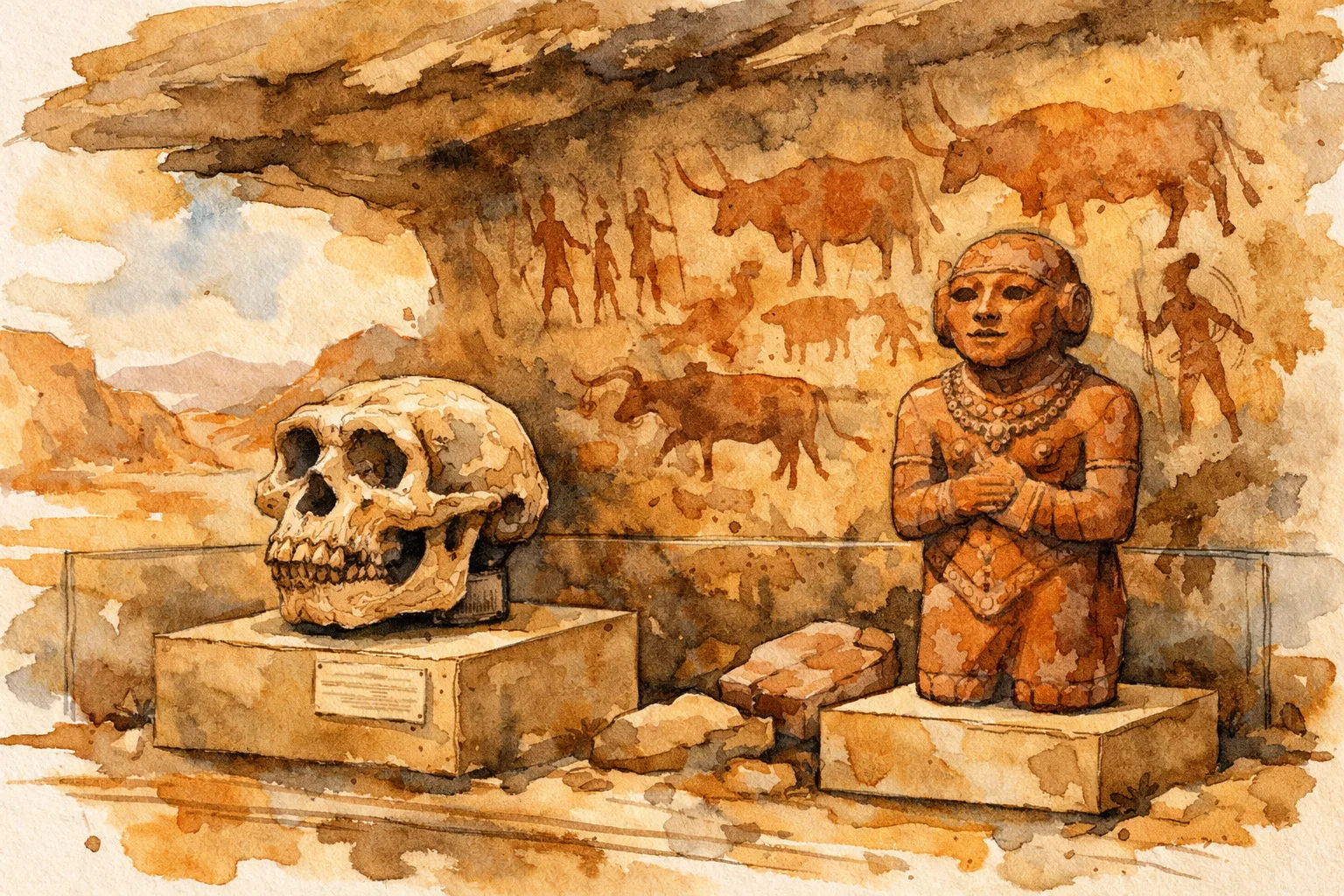
Chad does not have a large circuit of specialist museums devoted to witchcraft, crime, medical oddities or paranormal claims. Its curiosity culture is concentrated instead in a few unusually powerful collections: the National Museum in N’Djamena, the former sultan’s palace at Gaoui, and vast open-air archives of rock art in the Ennedi and Tibesti.
Page outline Jump by section
Introduction
The most useful way to understand Chad’s strange collections is therefore not as a conventional museum trail. It is a landscape of fragments. Some objects sit behind glass; others remain painted or engraved on remote rock shelters. Archaeology and folklore frequently overlap, especially around the ancient Sao peoples. Scientific discoveries such as the Toumaï skull are nationally celebrated but still debated by specialists. Access can also be difficult, and museum schedules are not always reliably published online.
The National Museum’s cabinet of deep time
The National Museum of Chad in N’Djamena is the country’s principal public collection and the clearest starting point for visitors interested in unusual history. Founded in 1962, it was originally organised around prehistory, archaeology, archives, folk arts, crafts and traditions. The national collections later moved into modern premises beside the National Library, with galleries covering subjects including palaeontology, Islamic heritage, popular culture and the archaeological art of the Lake Chad region.[unesco.org]unesdoc.unesco.orgUNESCO DocumentsThe Chad National Museum, Fort-LamyDigital Library · fresruarzh. The Chad National Museum, Fort-Lamy. The Chad National M…
What makes the museum distinctive is the extreme span of time represented within a relatively compact institution. Displays move from stone tools and fossil animals to terracotta sculpture, fishing equipment, musical instruments and objects associated with religious or political authority. It is less an encyclopaedic national history museum than a cabinet of major clues: selected things through which Chad’s immense and unevenly documented past is reconstructed.
Toumaï and the disputed human family tree
The most internationally famous material concerns Chad’s early hominin fossils. The best known is Toumaï, the name given to the skull assigned to Sahelanthropus tchadensis, discovered in the Djurab Desert and dated to roughly seven million years ago. Museum interpretation has presented Toumaï as exceptionally close to the point at which the human lineage separated from that of other apes, making the fossil both a scientific object and a symbol of national importance. The museum displays casts rather than inviting visitors to inspect an unmediated archaeological discovery.[Wikipedia]WikipediaChad National MuseumChad National Museum
The claim should not be treated as a finished certainty. Researchers have long debated whether Toumaï habitually walked on two legs and exactly where the species belongs on the evolutionary tree. A disputed thigh bone, reported years after the skull, became the centre of arguments over access to evidence, scientific interpretation and professional rivalry. Later research supported some form of bipedal movement, but the limited fossil record leaves room for disagreement. The resulting display is unusual not merely because the skull is ancient, but because it represents science in progress rather than a completely settled ancestry story.[The Guardian]theguardian.comThe Guardian The curse of Toumaï: an ancient skull, a disputed femur and a bitter feud over humanity's originsThis assertion challenged prevailing theories that humanity originated in East Africa. Brunet named the species Sahelanthropus tchadensis…
A temporary exhibition opened at the museum in July 2023 under a theme tracing human evolution from Toumaï to Homo sapiens. This illustrates how palaeoanthropology has become part of Chad’s public identity, rather than remaining confined to laboratories and academic journals.[Espace Mendès France]emf.frEspace Mendès FranceLe musée National du Tchad ouvre sa nouvelle expositionL'exposition « De Toumaï le tchadien à Homo sapiens, L'évoluti…
Sao objects: archaeology entangled with giants
The museum’s most atmospheric archaeological material comes from the cultures conventionally grouped under the name Sao. These communities occupied parts of the Lake Chad basin, across areas now divided between Chad, Cameroon and Nigeria. Surviving material includes terracotta heads and figures, pottery and metalwork, although the label “Sao” can cover different periods and sites rather than one simple, uniform civilisation.[International Council of Museums]icom.museumInternational Council of MuseumsSao terracottaSao terracotta and bronzes from the South of Lake Chad. This culture has a foothold in thre…
For visitors drawn to strange history, the fascination lies in the meeting of excavation and legend. Around Gaoui and elsewhere, oral traditions have remembered the Sao as people of extraordinary stature, sometimes described as giants capable of using enormous vessels and objects. Archaeological pots and jars can therefore acquire a second life as supposed evidence of outsized ancestors. The folklore is culturally important, but it is not proof that a race of giants existed. It shows how excavated remains may be absorbed into local explanations of abandoned settlements, unfamiliar artefacts and deep ancestry.
The National Museum has displayed Sao terracottas and bronzes alongside material from sites such as the Bouta-Kabira sanctuary, including masks, bone implements and metal objects. Such pieces can appear uncanny when separated from their archaeological context, but their significance depends on careful documentation: where they were found, what else lay nearby and whether they belonged to domestic, funerary or ceremonial activity.[Around Us]aroundus.comAround Us History and national museum in N'Djamena, ChadAround Us History and national museum in N'Djamena, Chad
Sao objects are also vulnerable commodities. The International Council of Museums includes Sao terracottas and bronzes among categories used to alert customs officials, dealers and collectors to West African cultural material at risk of illicit trafficking. A Red List does not mean that every pictured object has been stolen; it identifies object types for which provenance and export documentation require particular scrutiny.[International Council of Museums]icom.museumOpen source on icom.museum.
This adds an uncomfortable dimension to their appeal. The same strangeness that makes an ancient terracotta head desirable to museums or private collectors can encourage looting and remove the object from the very site that would explain it.
Gaoui: a palace museum inside a pottery village
Gaoui, near N’Djamena, offers a more intimate encounter with the Sao–Kotoko historical landscape. Its museum occupies a former sultan’s palace built in traditional earthen architecture. Collections described in visitor and reference sources include pottery, terracotta figures, fishing gear, clothing, staffs of office, photographs and objects connected with local authority and everyday life.[evendo.com]evendo.comOpen source on evendo.com.
The building matters as much as its contents. Unlike a purpose-built national institution, the palace museum preserves objects inside a former centre of power. Earthen walls, decorated surfaces and domestic-scale rooms make the visit feel closer to a historic house or community collection than to a standard archaeological gallery.
Gaoui is also known for pottery production, which creates a living connection between ancient ceramics and present-day craft. That continuity should not be simplified into the claim that every modern pot directly preserves an unchanged Sao tradition. It is more useful to see the village as a place where pottery remains economically, socially and symbolically visible, allowing archaeological vessels to be understood as made objects rather than mysterious relics.
The most curious exhibits are reportedly the large jars linked in local storytelling to Sao ancestors. Their interest lies precisely in the difference between what archaeology can establish and what folklore makes meaningful. A responsible interpretation preserves both layers: the vessels as historic material culture, and the giant tradition as a story about ancestry, power and the scale of the past.
Reliable current information about Gaoui’s opening arrangements is limited. It is commonly described as a visitor attraction, but travellers should not assume that published hours, guides or full access will always be available.
The desert as an open-air archive
Chad’s largest unusual collection cannot be entered through a museum door. Thousands of paintings and engravings survive in the sandstone landscapes of the Ennedi Plateau and the Tibesti Mountains. They depict wild animals, cattle, camels and human figures, recording environmental and cultural changes across millennia. The oldest known examples are generally placed several thousand years before the present.[African Rock Art]africanrockart.britishmuseum.orgAfrican Rock Art ChadAfrican Rock Art Chad
The images are strange to modern eyes because they contradict the landscape surrounding them. Cattle herds and large wild animals appear on rock faces in regions now associated with extreme aridity. The art is therefore both a cultural archive and indirect evidence of wetter phases in Saharan history. It records hunting, herding, movement and changing relationships between people and animals rather than a single vanished civilisation.[UNESCO Documents]unesdoc.unesco.orgOpen source on unesco.org.
The Ennedi Massif was added to the UNESCO World Heritage List in 2016 as a mixed natural and cultural landscape. UNESCO has reported more than 900 rock-art sites in the massif, with imagery spanning approximately 7,000 years of human history. The precise count varies between surveys because documentation is continuing and because remote shelters are difficult to map systematically.[UNESCO World Heritage Centre]whc.unesco.orgOpen source on unesco.org.
These places are sometimes described as open-air museums, but the phrase can be misleading. They are not curated visitor parks with uniform labels, barriers and marked routes. Many panels exist within living pastoral landscapes and may carry sacred or customary significance for local communities. UNESCO documentation notes that traditional practices have contributed to their protection, including beliefs that certain images and places should be respected.[UNESCO Documents]unesdoc.unesco.orgOpen source on unesco.org.
Modern documentation is gradually creating another kind of collection. Survey teams have photographed and three-dimensionally recorded rock-art sites in Ennedi, Borkou and Tibesti, preserving high-resolution evidence that can assist study if the originals deteriorate or become inaccessible. A 2017 expedition covered nearly 4,000 kilometres while documenting sites across northern Chad.[Factum Foundation]factumfoundation.orgOpen source on factumfoundation.org.
Conservation remains uneven. UNESCO has sought fuller reporting on the state of the Ennedi property and has raised concerns about whether boundaries and buffer zones adequately include all features contributing to its World Heritage value. Training programmes have consequently focused on recording techniques and archaeological-site management.[UNESCO World Heritage Centre]whc.unesco.orgOpen source on unesco.org.
What is missing from Chad’s museum landscape
No well-documented public museum in Chad currently appears to specialise in occult practice, witchcraft trials, UFO claims, cryptids, prisons, medical specimens or deliberate hoaxes. Online lists that imply a broad selection of specialist museums often recycle sparse descriptions or confuse attractions in different places. The evidence supports a small number of significant institutions rather than an extensive national museum network.
That absence is itself revealing. Chad’s strangest heritage has largely been organised around archaeology, human origins, ancestral traditions and monumental landscapes. Objects that might be classified elsewhere as ethnographic curiosities may still have devotional, political or community meaning. Treating them simply as exotic oddities would remove them from the belief systems and histories that made them important.
The country’s museums have also operated through periods of war, political instability and limited cultural funding. Accounts of the National Museum’s history report that objects, including musical instruments, were lost or looted during conflicts in the late twentieth century. This means that present collections reflect not only preservation but interruption: missing records, displaced artefacts and galleries rebuilt around what survived or could be recovered.[Wikipedia]WikipediaChad National MuseumChad National Museum
Visiting with realistic expectations
The National Museum in N’Djamena is described by established travel references as publicly accessible for a modest charge, although detailed official visitor information is difficult to confirm online. Reports indicate that much of the interpretation is in French. Opening hours and temporary exhibitions should therefore be checked locally rather than treated as fixed.[History Hit]historyhit.comHistory Hit Chad National MuseumHistory HitChad National Museum - History and Facts19 Apr 2021 — Chad National Museum was divided into 3 main sections: prehistory, inclu…
Gaoui can be reached from the capital, but access to its palace museum may be informal. A local guide can help distinguish displayed antiquities, modern pottery and stories associated with particular objects.
Ennedi and Tibesti require expedition-level planning rather than an ordinary museum visit. Distances are great, roads may be absent and archaeological panels can be difficult to locate without experienced guides. Visitors should avoid touching rock surfaces, applying water to make faded images clearer, tracing lines or removing fragments.
Security conditions are also essential to any plan. As of May 2026, the UK Foreign, Commonwealth and Development Office advised against all travel to parts of Chad and imposed other regional warnings. Advice can change, so a rock-art journey should never be planned solely from older travel accounts or promotional material.[GOV.UK]GOV.UKChad travel adviceChad travel advice

Why Chad matters to strange-history travellers
Chad’s curiosity culture is compelling because its most unusual material sits on the border between categories. Toumaï is at once a fossil, a national emblem and the centre of an unresolved scientific argument. Sao terracottas are archaeological artworks, vulnerable market objects and prompts for legends about giant ancestors. Gaoui is simultaneously a palace, a community museum and a living pottery centre. Ennedi and Tibesti are landscapes, archives and sacred or historically meaningful places.
The result is not a polished trail of eccentric attractions. It is something rarer: a fragmented national collection in which deep time, oral tradition and modern scientific interpretation remain visibly entangled. Chad rewards the visitor who is willing to ask not only whether a strange story is literally true, but also why particular fossils, vessels, figures and painted animals have become the objects through which people imagine the country’s past.
Amazon book picks
Further Reading
Books and field guides related to Where Chad Keeps Its Strangest Stories. Use these as the next step if you want deeper reading beyond the article.
The Archaeology of Africa: Food, Metals and Towns
Africa has a vibrant past. It emerges from this book as the proud possessor of a vast and highly complicated interweaving of peoples and...
The Sahara: A Cultural History
The Sahara is the quintessence of isolation, epitomizing both remoteness and severity of environment unlike any other place on the face o...
eBay marketplace picks
Marketplace Samples
Live-tested eBay searches with available results related to this page.
Selected fromChad art print oneBay.co.uk.
Current eBay listing
Moundou Chad Coordinates World City Travel Quote Wall Art Print
Current eBay listing
N'Djamena Chad Coordinates World City Travel Quote Wall Art Print
Endnotes
1.
Source: unesdoc.unesco.org
Link:https://unesdoc.unesco.org/ark%3A/48223/pf0000011593
Source snippet
UNESCO DocumentsThe Chad National Museum, Fort-LamyDigital Library · fresruarzh. The Chad National Museum, Fort-Lamy. The Chad National M...
2.
Source: musee-foaa.com
Link:https://www.musee-foaa.com/tchad/
3.
Source: Wikipedia
Title: Chad National Museum
Link:https://en.wikipedia.org/wiki/Chad_National_Museum
4.
Source: evendo.com
Link:https://evendo.com/locations/chad/tandjile/landmark/musee-de-gaoui
5.
Source: travel2unlimited.com
Link:https://travel2unlimited.com/chad-gaoui-sultans-house/
6.
Source: Wikipedia
Title: Musée de Gaoui
Link:https://fr.wikipedia.org/wiki/Mus%C3%A9e_de_Gaoui
7.
Source: unesdoc.unesco.org
Link:https://unesdoc.unesco.org/ark%3A/48223/pf0000246938
8.
Source: whc.unesco.org
Link:https://whc.unesco.org/en/list/1475/
9.
Source: whc.unesco.org
Link:https://whc.unesco.org/fr/actualites/2622
10.
Source: whc.unesco.org
Link:https://whc.unesco.org/en/decisions/8573/
11.
Source: whc.unesco.org
Link:https://whc.unesco.org/en/news/2622
12.
Source: GOV.UK
Title: Chad travel advice
Link:https://www.gov.uk/foreign-travel-advice/chad
13.
Source: whc.unesco.org
Link:https://whc.unesco.org/document/6497
14.
Source: whc.unesco.org
Link:https://whc.unesco.org/en/list/1400/
15.
Source: whc.unesco.org
Link:https://whc.unesco.org/document/152762
16.
Source: whc.unesco.org
Link:https://whc.unesco.org/fr/etatsparties/td
17.
Source: whc.unesco.org
Link:https://whc.unesco.org/en/tentativelists/6812/
18.
Source: whc.unesco.org
Link:https://whc.unesco.org/archive/2016/whc16-40com-inf8B2-en.pdf
19.
Source: whc.unesco.org
Link:https://whc.unesco.org/fr/listesindicatives/6812/
20.
Source: unesdoc.unesco.org
Link:https://unesdoc.unesco.org/ark%3A/48223/pf0000245912
21.
Source: whc.unesco.org
Link:https://whc.unesco.org/en/tentativelists/6921/
22.
Source: whc.unesco.org
Link:https://whc.unesco.org/en/tentativelists/6775/
23.
Source: whc.unesco.org
Link:https://whc.unesco.org/en/list/
24.
Source: whc.unesco.org
Link:https://whc.unesco.org/document/158840
25.
Source: whc.unesco.org
Link:https://whc.unesco.org/en/decisions/7293/
26.
Source: whc.unesco.org
Link:https://whc.unesco.org/en/decisions/8302/
27.
Source: whc.unesco.org
Link:https://whc.unesco.org/en/list/1475/gallery/
28.
Source: whc.unesco.org
Link:https://whc.unesco.org/en/news/1519
29.
Source: unesco.org
Title: UNESC O Design System
Link:https://www.unesco.org/themes/custom/bunesco8/style-guide/list-whc-thelist.html
30.
Source: unesdoc.unesco.org
Link:https://unesdoc.unesco.org/ark%3A/48223/pf0000155917
31.
Source: unesco.org
Title: icom releases red list iraqi artefacts risk being looted and smuggled
Link:https://www.unesco.org/en/articles/icom-releases-red-list-iraqi-artefacts-risk-being-looted-and-smuggled
32.
Source: Wikipedia
Link:https://en.wikipedia.org/wiki/Chad
33.
Source: Wikipedia
Title: Musée national du Tchad
Link:https://fr.wikipedia.org/wiki/Mus%C3%A9e_national_du_Tchad
34.
Source: Wikipedia
Title: Sao civilisation
Link:https://en.wikipedia.org/wiki/Sao_civilisation
35.
Source: historyhit.com
Title: History Hit Chad National Museum
Link:https://www.historyhit.com/locations/chad-national-museum/
Source snippet
History HitChad National Museum - History and Facts19 Apr 2021 — Chad National Museum was divided into 3 main sections: prehistory, inclu...
36.
Source: emf.fr
Link:https://emf.fr/45418/le-musee-national-du-tchad-ouvre-sa-nouvelle-exposition/
Source snippet
Espace Mendès FranceLe musée National du Tchad ouvre sa nouvelle expositionL'exposition « De Toumaï le tchadien à Homo sapiens, L'évoluti...
37.
Source: theguardian.com
Link:https://www.theguardian.com/science/2025/may/27/the-curse-of-[toumai
Source snippet
This assertion challenged prevailing theories that humanity originated in East Africa. Brunet named the species Sahelanthropus tchadensis...
38.
Source: icom.museum
Link:https://icom.museum/en/object/sao-terracotta-2/
Source snippet
International Council of MuseumsSao terracottaSao terracotta and bronzes from the South of Lake Chad. This culture has a foothold in thre...
39.
Source: icom.museum
Link:https://icom.museum/en/object/sao-terracotta/
40.
Source: aroundus.com
Title: Around Us History and national museum in N’Djamena, Chad
Link:https://aroundus.com/p/9598719-chad-national-museum
41.
Source: icom.museum
Link:https://icom.museum/en/resources/red-lists/
42.
Source: africanrockart.britishmuseum.org
Title: African Rock Art Chad
Link:https://africanrockart.britishmuseum.org/country/chad/
43.
Source: africanrockart.org
Link:https://africanrockart.org/chad/
44.
Source: factumfoundation.org
Link:https://www.factumfoundation.org/our-projects/digitisation/tibesti-borkou-mountains-rock-art-survey-and-documentation/
45.
Source: africageographic.com
Title: Rock art
Link:https://africageographic.com/stories/rock-art-a-cultural-treasure-of-ennedi/
46.
Source: britishmuseum.org
Link:https://www.britishmuseum.org/collection/term/x11519
47.
Source: explore-chad.org
Title: The Ennedi Massif
Link:https://explore-chad.org/en/the-ennedi-massif/
48.
Source: africa.com
Link:https://africa.com/museums-of-chad
49.
Source: worldbank.org
Link:https://www.worldbank.org/ext/en/country/chad
50.
Source: theguardian.com
Link:https://www.theguardian.com/world/chad
Additional References
51.
Source: youtube.com
Title: Musee National N’Djamena (National Museum) in N’Djamena, Chad
Link:https://www.youtube.com/watch?v=aUjJBcTilV0
Source snippet
Sao Culture | A Forgotten African Civilization...
52.
Source: tripadvisor.co.uk
Link:https://www.tripadvisor.co.uk/Attraction_Review-g293779-d481167-Reviews-Musee_National_N_Djamena_National_Museum-N_Djamena.html
53.
Source: facebook.com
Link:https://www.facebook.com/onamatchad/videos/%F0%9D%90%82%F0%9D%90%8E%F0%9D%90%8D%F0%9D%90%92%F0%9D%90%84%F0%9D%90%91%F0%9D%90%95%F0%9D%90%80%F0%9D%90%93%F0%9D%90%88%F0%9D%90%8E%F0%9D%90%8D-%F0%9D%90%83%F0%9D%90%94-%F0%9D%90%8F%F0%9D%90%80%F0%9D%90%93%F0%9D%90%91%F0%9D%90%88%F0%9D%90%8C%F0%9D%90%8E%F0%9D%90%88%F0%9D%90%8D%F0%9D%90%84-%F0%9D%90%8D%F0%9D%90%80%F0%9D%90%93%F0%9D%90%88%F0%9D%90%8E%F0%9D%90%8D%F0%9D%90%80%F0%9D%90%8B%F0%9D%90%8B%F0%9D%90%9E-%F0%9D%90%9C%F0%9D%90%AB%F0%9D%90%9A%CC%82%F0%9D%90%A7%F0%9D%90%9E-%F0%9D%90%9D%F0%9D%90%9E-%F0%9D%90%93%F0%9D%90%8E%F0%9D%90%94%F0%9D%90%8C%F0%9D%90%80%F0%9D%90%88%CC%88-%F0%9D%90%9E%F0%9D%90%A7%F0%9D%90%AD%F0%9D%90%AB%F0%9D%90%9E-%F0%9D%90%9D%F0%9D%90%9E-%F0%9D%90%9B%F0%9D%90%A8%F0%9D%90%A7%F0%9D%90%A7%F0%9D%90%9E%F0%9D%90%AC-%F0%9D%90%A6%F0%9D%90%9A%F0%9D%90%A2%F0%9D%90%A7%F0%9D%90%AC/1366641768748961/
54.
Source: adaptation-undp.org
Link:https://www.adaptation-undp.org/explore/africa/chad
55.
Source: radissonhotels.com
Link:https://www.radissonhotels.com/en-us/destination/chad/ndjamena/chad-national-museum
56.
Source: crisisgroup.org
Link:https://www.crisisgroup.org/africa/central-africa/chad
57.
Source: responsibletravel.com
Link:https://www.responsibletravel.com/holidays/chad/travel-guide
58.
Source: africanparks.org
Link:https://www.africanparks.org/ennedi-announcement
59.
Source: facebook.com
Link:https://www.facebook.com/groups/archeologyandcivilizations/posts/7279224958837632/
60.
Source: icom-oesterreich.at
Link:https://icom-oesterreich.at/publikationen/icom-red-list-west-african-cultural-objects-risk