Within Sudan Curiosities
Whose Story Do Khalifa House Relics Tell?
Weapons, banners and personal possessions at Khalifa House reveal how resistance history became both national memory and colonial trophy.
On this page
- The Mahdist state and Khalifa Abdallahi's residence
- Weapons, banners, armour and government objects
- Colonial interpretation, restoration and wartime theft
Page outline Jump by section
Introduction
Khalifa House in Omdurman is one of Sudan’s most historically charged museums because its collection is inseparable from a continuing argument over national memory. The building was the residence and administrative headquarters of Khalifa Abdallahi ibn Muhammad, successor to the Mahdi and ruler of the Mahdist state until its defeat in 1898. Rather than displaying anonymous archaeological finds, the museum preserves weapons, banners, armour, official objects and personal possessions connected to a revolutionary government whose legacy remains deeply contested.[Cambridge University Press & Assessment]cambridge.orgCambridge University Press & AssessmentArchaeology and cultural heritage in wartime: Sudan 2023–2025 | Antiquity | Cambridge CoreOctober…
For visitors interested in unusual collections, Khalifa House stands apart because its artefacts are not simply relics of war. They have repeatedly changed meaning: first as practical objects of a nineteenth-century Sudanese state, then as trophies interpreted through British colonial victory, later as symbols of Sudanese independence and identity, and more recently as vulnerable heritage threatened by civil war. The museum therefore raises a larger question than many military collections: whose version of history do these objects preserve?
The Mahdist state and Khalifa Abdallahi’s residence
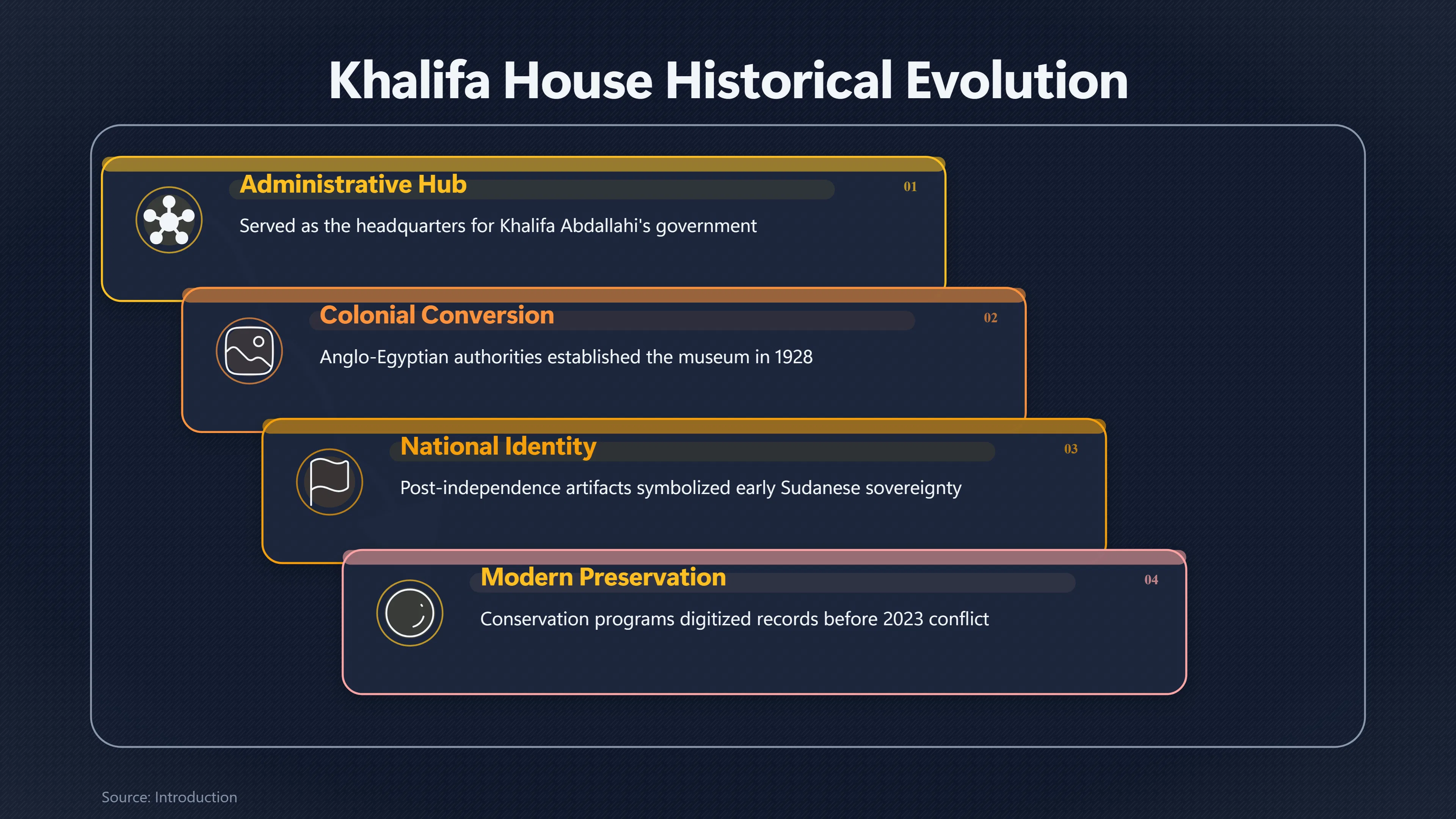
The museum occupies the actual house from which Khalifa Abdallahi governed the Mahdist state after the death of Muhammad Ahmad, the Mahdi. Built in traditional mudbrick with interconnected courtyards and upper rooms added during the late nineteenth century, the house functioned as both a private residence and the administrative centre of an independent Sudanese government. It was converted into a museum in 1928 during the Anglo-Egyptian Condominium, meaning that the colonial authorities themselves decided which aspects of the defeated regime should be preserved and interpreted.[Wikipedia]WikipediaKhalifa House MuseumKhalifa House Museum
This origin shapes the collection’s character. Unlike a reconstructed historic house furnished with replicas, Khalifa House is itself one of the principal artefacts. Visitors encounter the spaces where political decisions were made, alongside objects associated with government, warfare and everyday administration. The museum sits opposite the Mahdi’s tomb, creating a physical landscape where memory, religion, politics and military history remain closely intertwined.[Cambridge University Press & Assessment]cambridge.orgCambridge University Press & AssessmentArchaeology and cultural heritage in wartime: Sudan 2023–2025 | Antiquity | Cambridge CoreOctober…
Weapons, banners, armour and government objects
The museum’s most distinctive exhibits illustrate how the Mahdist state combined religious authority with military organisation.
Among the best-known objects are:
- suits of chain mail and protective armour made or adapted for Mahdist forces;
- swords, spears and firearms associated with the Mahdist armies;
- battle standards and banners used by different military divisions;
- Mahdist coins and administrative objects demonstrating that the movement functioned as a government rather than simply an armed rebellion;
- emergency paper money issued during General Gordon’s defence of Khartoum, preserved alongside Mahdist material to present opposing sides of the conflict;
- personal possessions linked to Khalifa Abdallahi himself.[Wikipedia]WikipediaKhalifa House MuseumKhalifa House Museum
The banners are especially significant. Recent conservation and research projects have treated them not merely as military trophies but as sophisticated textile artefacts carrying religious inscriptions, political symbolism and evidence of local craftsmanship. Specialists from Sudanese institutions and the British Museum documented surviving banners in Khalifa House, examining their materials, manufacture and iconography to better understand how authority was visually expressed during the Mahdist period.[British Museum]britishmuseum.orgBritish Museum NewsletterEgypt and Sudan…
Several rooms also reconstruct the Battle of Omdurman through captured weapons, rifles, Maxim guns, robes and battlefield equipment. The juxtaposition is striking because visitors see both the material culture of the Mahdist state and the technology that ultimately destroyed it.[Wikipedia]WikipediaKhalifa House MuseumKhalifa House Museum
Outside, the courtyards historically displayed additional curiosities, including the surviving cupola from the original Mahdi’s tomb after its destruction in 1898 and what is often described as Sudan’s first motor vehicle, an Arrol-Johnston tractor. These objects broaden the museum beyond military history into an unusual collection of nationally symbolic relics.[Wikipedia]WikipediaKhalifa House MuseumKhalifa House Museum
Why the relics remain politically contested
Few Sudanese museum collections carry such sharply differing interpretations.
During British rule, the Mahdist state was commonly presented as a defeated theocracy whose destruction represented the restoration of order. Objects captured after Omdurman naturally entered that narrative, with weapons and banners functioning as evidence of imperial victory. Similar trophies also entered British museums, where they became part of military collections rather than Sudanese national history.[collection.nam.ac.uk]collection.nam.ac.ukStandard of the Khalifa's Black Flag Division captured at Omdurman, 2 September 1898 | Online Collection | National Army Museum, London…
After Sudanese independence, the emphasis shifted. The same artefacts increasingly came to represent one of the country’s earliest attempts at political independence from foreign domination. Even scholars who criticise aspects of Mahdist rule often recognise its importance in Sudanese state formation. As a result, the museum no longer simply commemorates military defeat but preserves material evidence of a government that many regard as foundational in modern Sudanese history.[Cambridge University Press & Assessment]cambridge.orgCambridge University Press & AssessmentArchaeology and cultural heritage in wartime: Sudan 2023–2025 | Antiquity | Cambridge CoreOctober…
This dual interpretation explains why the collection attracts continuing debate. The relics can simultaneously be viewed as:
- symbols of anti-colonial resistance;
- reminders of an authoritarian religious state;
- evidence of nineteenth-century Sudanese craftsmanship and administration;
- battlefield trophies whose interpretation changed under colonial rule.
The museum does not fully resolve these competing readings. Instead, its collection demonstrates how historical objects accumulate new meanings as political circumstances change.
Colonial interpretation, restoration and wartime theft
The history of Khalifa House did not end with its conversion into a museum. In the late 2010s, an extensive conservation programme supported by Sudanese institutions and international partners restored the historic building, improved collection storage, trained staff in conservation techniques and digitally documented many artefacts. This work proved unexpectedly valuable because detailed photographic records existed before the outbreak of the current conflict.[heritage.arch.cam.ac.uk]heritage.arch.cam.ac.ukOpen source on cam.ac.uk.
Since fighting began in 2023, however, Khalifa House has become another casualty of Sudan’s cultural heritage crisis. UNESCO and heritage specialists have reported partial damage to the museum and widespread looting affecting collections across Khartoum and Omdurman. Reports indicate that historically important Mahdist weapons—including famous swords associated with Osman Digna and Abd al-Rahman al-Nujoumi—were among the missing artefacts after the museum was looted.[unesco.org]core.unesco.orgUNESCO Core Data PortalProject: Supporting Sudan in Preventing and combatting the illicit trafficking of cultural property details | Core…
The wartime losses have transformed the museum’s significance once again. Digital inventories created during recent conservation projects are now essential tools for identifying stolen objects and supporting future recovery efforts. Rather than merely enhancing visitor interpretation, documentation has become part of protecting Sudan’s historical memory itself.[Cambridge University Press & Assessment]cambridge.orgCambridge University Press & AssessmentArchaeology and cultural heritage in wartime: Sudan 2023–2025 | Antiquity | Cambridge CoreOctober…
Why Khalifa House matters within Sudan’s unusual heritage
Khalifa House is unusual not because it preserves bizarre curiosities, but because it demonstrates how museum collections can become participants in political history. Every banner, sword and government document has lived several lives: first as a working object of the Mahdist state, then as evidence collected by colonial administrators, later as part of Sudan’s national heritage, and now as an endangered cultural asset.
For readers exploring Sudan’s more distinctive historic collections, Khalifa House illustrates how museums can preserve contested memory as much as physical artefacts. Its relics ask visitors to think not only about who made or used an object, but also who collected it, who interpreted it, and whose story it tells today.
Amazon book picks
Further Reading
Books and field guides related to Whose Story Do Khalifa House Relics Tell?. Use these as the next step if you want deeper reading beyond the article.
eBay marketplace picks
Marketplace Samples
Live-tested eBay searches with available results related to this page.
Selected fromwhose poster oneBay.co.uk.
Current eBay listing
Whose Life Is It Anyway? (1981) Original US One Sheet Movie Poster

Current eBay listing
Whose Life Is It Anyway? (1981) Original German A1 Movie Poster
Endnotes
1.
Source: cambridge.org
Link:https://www.cambridge.org/core/journals/antiquity/article/archaeology-and-cultural-heritage-in-wartime-sudan-20232025/DF3E9D9EC1C8D76146648B96D49DE131
Source snippet
Cambridge University Press & AssessmentArchaeology and cultural heritage in wartime: Sudan 2023–2025 | Antiquity | Cambridge CoreOctober...
2.
Source: Wikipedia
Title: Khalifa House Museum
Link:https://en.wikipedia.org/wiki/Khalifa_House_Museum
3.
Source: heritage.arch.cam.ac.uk
Link:https://www.heritage.arch.cam.ac.uk/community-museums-western-sudan-omdurman-el-obeid-nyala
4.
Source: collection.nam.ac.uk
Link:https://collection.nam.ac.uk/detail.php?acc=1982
Source snippet
Standard of the Khalifa's Black Flag Division captured at Omdurman, 2 September 1898 | Online Collection | National Army Museum, London...
Published: September 1898
5.
Source: collection.nam.ac.uk
Link:https://collection.nam.ac.uk/detail.php?acc=1973
Source snippet
'The Khalifa's House', Omdurman, September 1898 | Online Collection | National Army Museum, London...
Published: September 1898
6.
Source: core.unesco.org
Link:https://core.unesco.org/en/project/3210523081
Source snippet
UNESCO Core Data PortalProject: Supporting Sudan in Preventing and combatting the illicit trafficking of cultural property details | Core...
7.
Source: unesco.org
Link:https://www.unesco.org/en/articles/sudan-unesco-raises-alarm-reports-illicit-trafficking-cultural-heritage
8.
Source: core.unesco.org
Link:https://core.unesco.org/fr/project/3210523081
9.
Source: collection.nam.ac.uk
Link:https://collection.nam.ac.uk/detail.php?acc=1973
10.
Source: collection.nam.ac.uk
Link:https://collection.nam.ac.uk/detail.php?acc=1973
11.
Source: britishmuseum.org
Title: British Museum Newsletter
Link:https://www.britishmuseum.org/sites/default/files/2020-06/British-Museum_Egypt_Sudan_Newsletter5_2018.pdf
Source snippet
Egypt and Sudan...
12.
Source: flickr.com
Link:https://www.flickr.com/photos/waltercallens/3465622123/
Additional References
13.
Source: sudanow-magazine.net
Link:https://sudanow-magazine.net/page.php?Id=1983&subId=9
Source snippet
April 26, 2026 — DESTRUCTION OF SUDAN'S MEMORY: DAMAGE TO MUSEUMS, HISTORIC BUILDINGS, AND GOVERNMENT RESCUE PLANS 26 April, 2026 Image...
Published: April 26, 2026
14.
Source: apnews.com
Link:https://apnews.com/article/82998ed2a655113e86b938e705656889
Source snippet
The conflict between the Sudanese army and the paramilitary Rapid Support Forces (RSF) led to widespread destruction and looting, with RS...
15.
Source: youtube.com
Link:https://www.youtube.com/watch?v=aPQFROqeNh8
Source snippet
Sudan: The renowned "Khalifa House Museum" in Omdurman has reopened following a monumental repair Bihar Hour · 260 views...
16.
Source: loc.gov
Link:https://www.loc.gov/pictures/collection/matpc/item/mpc2010002857/PP/
17.
Source: youtube.com
Title: The Mahdist War and the Head Britain Took at Khartoum
Link:https://www.youtube.com/watch?v=Uy9PtNAgaI4
Source snippet
What Happened At The Battle of Omdurman, Sudan 1898?...
18.
Source: lorientlejour.com
Link:https://www.lorientlejour.com/article/1454132/au-soudan-pays-des-pharaons-noirs-les-combats-ont-atteint-les-musees-et-sites-du-patrimoine-mondial.html
19.
Source: projectkhthon.com
Link:https://www.projectkhthon.com/research/sudan/culturalgenocide
20.
Source: commons.wikimedia.org
Link:https://commons.wikimedia.org/wiki/File%3ASudan._Omdurman._In_the_Khalifa%27s_house._Collection_of_relics%2C_weapons%2C_etc._LOC_matpc.17361.jpg
21.
Source: cmi.no
Link:https://www.cmi.no/publications/9235-protecting-sudans-cultural-heritage-amidst-war
22.
Source: theguardian.com
Link:https://www.theguardian.com/world/2023/jun/05/sudan-officials-fear-for-historical-artefacts-threatened-by-fighting