Within Strange Hungary
Who Were the Mummies Found in Vác?
Vác's naturally preserved dead can be matched with names, families and records, turning a crypt discovery into unusually intimate social history.
On this page
- How the sealed crypt preserved the bodies
- Names, clothing and family records
- What visitors see and researchers study
Page outline Jump by section
Introduction
The mummies discovered beneath the former Dominican church in Vác are remarkable not simply because their bodies survived, but because many of the people themselves can still be identified. Thanks to coffin inscriptions, parish registers and civic records, researchers have matched numerous mummified individuals with their names, ages, occupations and family relationships. This transforms the collection from an archaeological curiosity into an unusually intimate record of everyday life in an eighteenth- and early nineteenth-century Hungarian town. Rather than presenting anonymous remains, the Memento Mori exhibition allows visitors to encounter identifiable townspeople whose lives, illnesses and family connections can often be reconstructed with surprising precision.[Macquarie University]researchers.mq.edu.auMacquarie UniversityThe Vác mummy project: investigation of 265 eighteenth-century mummified remains from the TB Pandemic Era - Macquarie…
How the sealed crypt preserved the bodies
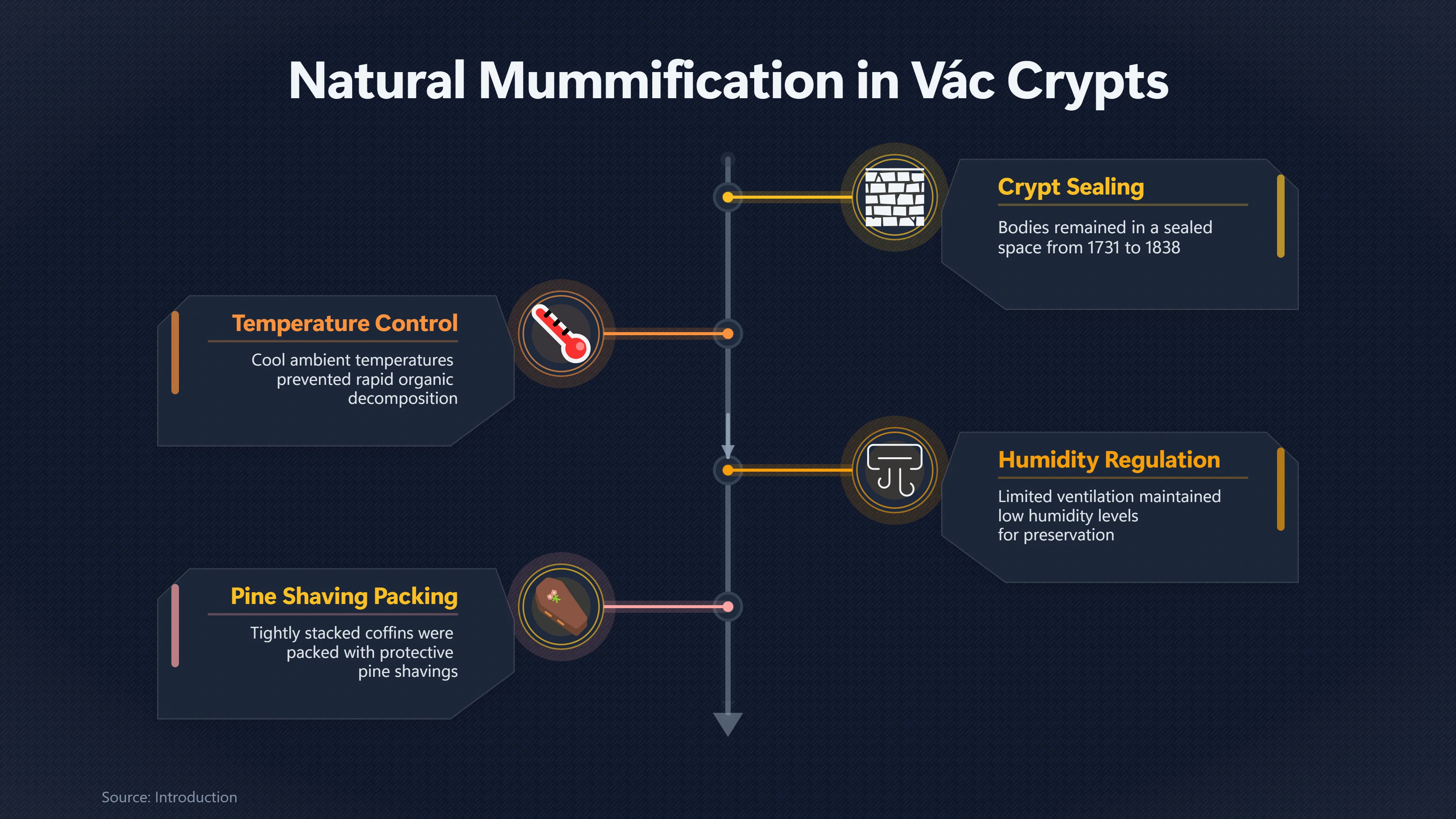
The people displayed in Vác were never intentionally embalmed. Their preservation resulted from the unusual conditions inside a sealed crypt used between 1731 and 1838. Cool temperatures, constant but limited ventilation, low humidity and tightly stacked wooden coffins—many packed with pine shavings—created an environment in which soft tissues dried naturally instead of decomposing. When the crypt was rediscovered in 1994, more than 200 bodies were found, with around 70 per cent preserved either completely or partially through natural mummification.[UCL Discovery]discovery.ucl.ac.ukUCL Discovery Widespread Occurrence of Mycobacterium tuberculosis-DNAUCL Discovery Widespread Occurrence of Mycobacterium tuberculosis-DNA
What makes this discovery exceptional is that the physical remains were accompanied by unusually rich documentary evidence. Painted coffins often carried inscriptions naming the deceased, while church burial registers and civic records recorded deaths, occupations, family members and dates. Instead of relying solely on archaeological interpretation, researchers could compare physical evidence directly with written historical records.[Macquarie University]researchers.mq.edu.auMacquarie UniversityThe Vác mummy project: investigation of 265 eighteenth-century mummified remains from the TB Pandemic Era - Macquarie…
Names, clothing and family records bring the dead back into history
Because many individuals can be identified, the Vác collection functions almost like a preserved community archive rather than a collection of isolated bodies.
Researchers have been able to connect:
- named individuals with their surviving remains;
- husbands, wives, parents and children buried in the same crypt;
- occupations and social status recorded in parish documents;
- original clothing, textiles and personal burial objects with documented people rather than anonymous skeletons.[edu.au]researchers.mq.edu.auMacquarie UniversityThe Vác mummy project: investigation of 265 eighteenth-century mummified remains from the TB Pandemic Era - Macquarie…
This combination allows historians to study everyday life in unusual detail. Clothing demonstrates how middle-class citizens and clergy dressed for burial, while surviving fabrics, caps and decorative coffin paintings reveal local customs that would otherwise survive only in written descriptions. Because the identities are known, these objects become evidence for individual biographies rather than generic examples of eighteenth-century material culture.[Macquarie University]researchers.mq.edu.auMacquarie UniversityThe Vác mummy project: investigation of 265 eighteenth-century mummified remains from the TB Pandemic Era - Macquarie…
Family relationships are especially valuable. Instead of analysing isolated remains, researchers can investigate inherited characteristics, household disease patterns and the effects of shared living conditions across generations. The collection therefore bridges archaeology, genealogy and social history in a way that few European mummy discoveries can match.[PubMed]pubmed.ncbi.nlm.nih.govTwo positive tuberculosis cases in the late Nigrovits family, 18th century, Vác, Hungary - PubMed…
Individual stories behind the scientific research
Several named individuals have become well-documented case studies.
One example is the Nigrovits family. Researchers examined the remains of József Nigrovits, who died aged 55 in 1793, and his son Antal, who died aged 22 in 1803. Historical records confirmed their relationship, allowing scientists to compare physical remains with documented family history. Advanced imaging and laboratory analysis showed that both had tuberculosis infections, even though the father displayed no obvious skeletal signs of the disease. Antal’s dramatic spinal and neck deformity, once suspected to be tuberculosis, instead proved to be a developmental abnormality unrelated to the infection.[PubMed]pubmed.ncbi.nlm.nih.govTwo positive tuberculosis cases in the late Nigrovits family, 18th century, Vác, Hungary - PubMed…
Another closely studied individual is an eighteenth-century midwife whose preserved remains showed evidence of severe illness. Modern ancient DNA analysis recovered tuberculosis genomes from her body and demonstrated that she carried more than one strain of the disease simultaneously. Beyond the medical findings, knowing her occupation places the scientific evidence within the social world of eighteenth-century Vác, illustrating how infectious disease affected ordinary working people before antibiotics.[ScienceDirect]sciencedirect.comMetagenomic analysis reveals mixed Mycobacterium tuberculosis infection in a 18th century Hungarian midwife - ScienceDirect…
These examples illustrate why the collection continues to attract international researchers. The written records make it possible to ask questions that anonymous archaeological finds cannot answer.
What visitors see and what researchers continue to study
The Memento Mori exhibition does not attempt to display every mummy discovered in the crypt. Instead, it presents a carefully selected group of naturally preserved bodies alongside their painted coffins, burial garments and personal artefacts. Interpretation focuses on who these people were rather than treating them as macabre spectacles. Visitors encounter children, adults and elderly townspeople whose names and family histories are often known, making the experience notably more personal than many mummy exhibitions. TRAGOR IGNÁC MÚZEUM • VÁC[muzeumvac.hu]muzeumvac.huTRAGOR IGNÁC MÚZEUM • VÁCFőoldalTRAGOR IGNÁC MÚZEUM • VÁC…
Behind the scenes, the wider collection remains an active scientific resource. CT scanning, radiography, textile analysis, stable historical documentation and increasingly sophisticated ancient DNA techniques continue to reveal information about disease, nutrition, occupations and living conditions. Tuberculosis has received particular attention because the collection preserves both soft tissue and documentary evidence, allowing researchers to compare historical records with molecular analysis in ways rarely possible elsewhere. Studies have confirmed widespread tuberculosis within the community and continue to refine understanding of how the disease spread before modern medicine.[sciencedirect.com]sciencedirect.comVerification of tuberculosis infection among Vác mummies (18th century CE, Hungary) based on lipid biomarker profiling with…

Why the identified lives matter
Many collections of human remains can reveal how people died, but relatively few can also reveal who they were. The Vác mummies stand apart because physical preservation coincides with exceptionally complete historical documentation. Researchers can move from a preserved face to a coffin inscription, then to parish records, family relationships and sometimes even occupation, creating biographies that span both archival history and biological evidence.[Macquarie University]researchers.mq.edu.auMacquarie UniversityThe Vác mummy project: investigation of 265 eighteenth-century mummified remains from the TB Pandemic Era - Macquarie…
Within Hungary’s landscape of unusual museums and collections, this makes the Vác Mummies distinctive. Their importance lies not only in natural mummification but in the rare opportunity to reconnect preserved bodies with identifiable human lives, allowing visitors to encounter eighteenth-century citizens as members of a documented community rather than anonymous archaeological specimens.[Macquarie University]researchers.mq.edu.auMacquarie UniversityThe Vác mummy project: investigation of 265 eighteenth-century mummified remains from the TB Pandemic Era - Macquarie…
Amazon book picks
Further Reading
Books and field guides related to Who Were the Mummies Found in Vác?. Use these as the next step if you want deeper reading beyond the article.
The Scientific Study of Mummies
The fact that bodies decay after death has concerned humans throughout the ages. Many cultures have attempted to arrest this decay, so th...
The Archaeology of Death and Burial
The archaeology of death and burial is central to our attempts to understand vanished societies. Through the remains of funerary rituals...
eBay marketplace picks
Marketplace Samples
Live-tested eBay searches with available results related to this page.
Selected fromhistorical figure model oneBay.co.uk.




Endnotes
1.
Source: sciencedirect.com
Link:https://www.sciencedirect.com/science/article/abs/pii/S1472979215000165
Source snippet
Two positive tuberculosis cases in the late Nigrovits family, 18th century, Vác, Hungary - ScienceDirect...
2.
Source: sciencedirect.com
Link:https://www.sciencedirect.com/science/article/pii/S147297922200018X
Source snippet
Metagenomic analysis reveals mixed Mycobacterium tuberculosis infection in a 18th century Hungarian midwife - ScienceDirect...
3.
Source: sciencedirect.com
Link:https://www.sciencedirect.com/science/article/pii/S1472979220302043
Source snippet
Verification of tuberculosis infection among Vác mummies (18th century CE, Hungary) based on lipid biomarker profiling with...
4.
Source: sciencedirect.com
Title: Memento Mori: Investigating Mummies for Ancient Diseases
Link:https://www.sciencedirect.com/science/article/pii/S1074552113003116
5.
Source: sciencedirect.com
Title: The facial restoration of Antal Simon, a Hungarian priest-teacher of the 19th c
Link:https://www.sciencedirect.com/science/article/abs/pii/S0018442X04000071
6.
Source: researchers.mq.edu.au
Link:https://researchers.mq.edu.au/en/publications/the-v%C3%A1c-mummy-project-investigation-of-265-eighteenth-century-mum/
Source snippet
Macquarie UniversityThe Vác mummy project: investigation of 265 eighteenth-century mummified remains from the TB Pandemic Era - Macquarie...
7.
Source: discovery.ucl.ac.uk
Title: UCL Discovery Widespread Occurrence of Mycobacterium tuberculosis-DNA
Link:https://discovery.ucl.ac.uk/628/1/618.pdf
8.
Source: pubmed.ncbi.nlm.nih.gov
Link:https://pubmed.ncbi.nlm.nih.gov/25814300/
Source snippet
Two positive tuberculosis cases in the late Nigrovits family, 18th century, Vác, Hungary - PubMed...
9.
Source: pubmed.ncbi.nlm.nih.gov
Title: Pub Med Tuberculosis in mummies
Link:https://pubmed.ncbi.nlm.nih.gov/38012931/
Source snippet
2023 Dec:143S:102371. doi: 10.1016/j.tube.2023.102371. Epub 2023 Nov 25. TUBERCULOSIS IN MUMMIES - NEW FINDINGS, PERSPECTIVES AND LIMITAT...
10.
Source: muzeumvac.hu
Title: TRAGOR IGNÁC MÚZEUM • VÁCFőoldal
Link:https://muzeumvac.hu/
Source snippet
TRAGOR IGNÁC MÚZEUM • VÁC...
11.
Source: vac.hu
Title: Bűn és büntetés – börtönséta – Vác.hu
Link:https://www.vac.hu/bun-es-buntetes-bortonseta/
13.
Source: pmc.ncbi.nlm.nih.gov
Link:https://pmc.ncbi.nlm.nih.gov/articles/PMC5578507/
14.
Source: amnh.org
Link:https://www.amnh.org/exhibitions/mummies
15.
Source: ncbi.nlm.nih.gov
Link:https://www.ncbi.nlm.nih.gov/bioproject/PRJEB7454
16.
Source: museum.hu
Link:https://www.museum.hu/exhibition/10624/Enigmas_Fates_Mummies_-_Secrets_of_the_White_Friars_Church_in_Vac
17.
Source: pubmed.ncbi.nlm.nih.gov
Link:https://pubmed.ncbi.nlm.nih.gov/19793751/
18.
Source: pmc.ncbi.nlm.nih.gov
Link:https://pmc.ncbi.nlm.nih.gov/articles/PMC154635/
19.
Source: mnhn.fr
Link:https://www.mnhn.fr/en/exposition-evenement/mummies
20.
Source: muzeumvac.hu
Title: Memento mori
Link:https://muzeumvac.hu/kiallitasok/allando-kiallitasok/memento-mori/
Additional References
21.
Source: youtube.com
Link:https://www.youtube.com/watch?v=n6S0JDzh9Xw
Source snippet
MUMMIES in Hungary!! - Day trip from Budapest to Vác...
22.
Source: youtube.com
Title: The 200-Year-Old Mummy That Could Cure Tuberculosis
Link:https://www.youtube.com/watch?v=5vwREzYMnIc
Source snippet
The 800-Year-Old Mummy That Could Cure Modern Diseases...
23.
Source: researchgate.net
Link:https://www.researchgate.net/publication/371069321_A_vaci_mumiak_koporsoinak_novenyabrazolasai_a_botanika_szemszogebol_The_plant_illustrations_of_the_coffins_of_the_Vac_mummies_from_a_botanical_point_of_view_Hungary
24.
Source: researchgate.net
Link:https://www.researchgate.net/publication/294844717_Anthropological_investigation_of_the_18th-19th_century_ossuary_of_the_Dominican_Church_at_Vac_Hungary_Preliminary_report
25.
Source: researchgate.net
Link:https://www.researchgate.net/publication/308724908_The_mummies_of_the_Hungarian_Natural_History_Museum_in_different_exhibitions_in_Hungary_and_other_countries_A_Magyar_Termeszettudomanyi_Muzeum_mumiai_hazai_es_kulfoldi_kiallitasokon
26.
Source: researchgate.net
Link:https://www.researchgate.net/publication/347977065_Verification_of_tuberculosis_infection_among_Vac_mummies_18th_century_CE_Hungary_based_on_lipid_biomarker_profiling_with_a_new_HPLC-HESI-MS_approach
27.
Source: britishmuseum.org
Link:https://www.britishmuseum.org/research/projects/bioarchaeology-british-museum
28.
Source: britishmuseum.org
Link:https://www.britishmuseum.org/collection/galleries/egyptian-death-and-afterlife-mummies
29.
Source: britishmuseum.org
Link:https://www.britishmuseum.org/our-work/international/international-touring-exhibitions/egyptian-mummies-exploring-ancient-lives
30.
Source: vasw.org.uk
Link:https://vasw.org.uk/whats-on/memento-mori