Within Kenya Curiosities
Kenya's Fossils and the Story of US
Kenya's fossil collections reveal extraordinary stories about human beginnings through real archaeological discoveries.
On this page
- Fossils, tools and ancient discoveries
- How museum collections reveal human origins
- Why these objects matter today
Page outline Jump by section
Introduction
The Nairobi National Museum’s fossil collections are unusual because they do not preserve mysteries in the traditional sense; they preserve evidence of one of the biggest mysteries humans have ever investigated: where we came from. Behind the museum’s displays are fossils, stone tools and research collections connected to some of the most important discoveries in human evolution, especially from Kenya’s Lake Turkana region. The museum’s Human Evolution Gallery presents fossil finds and tools from places such as Koobi Fora, allowing visitors to see how scientists reconstruct the story of early humans from fragments of bone, geology and ancient technology.[National Museums of Kenya]nmk.go.keOpen source on go.ke.
For visitors interested in strange or extraordinary collections, the appeal of these exhibits is that the objects are both ordinary and astonishing. A fossilised tooth, a skull fragment or a stone tool may look small, but each can represent millions of years of environmental change, adaptation and survival. The Nairobi National Museum turns these discoveries into a public record of humanity’s deep past, connecting Kenya’s archaeological heritage with the wider scientific story of human origins.[National Museums of Kenya]nmk.go.keOpen source on go.ke.
Fossils, tools and ancient discoveries
The collection behind the human origins story
The fossil collections at the National Museums of Kenya are among Africa’s most important scientific archives. The institution’s Earth Science Department manages major palaeontology and archaeology collections, including hundreds of thousands of vertebrate fossils and around a thousand early human remains. These collections are not simply displays of ancient bones; they are research resources used to study evolution, extinct environments and human behaviour.[National Museums of Kenya]nmk.go.keOpen source on go.ke.
Much of the human origins story displayed in Nairobi comes from discoveries made in northern Kenya, especially around Lake Turkana. Koobi Fora, on the eastern side of the lake, is one of the world’s best-known fossil landscapes. The sediments there preserve evidence from millions of years of environmental history, including remains linked to early members of the human family tree such as Australopithecus, Homo habilis and Homo erectus.[National Museums of Kenya]nmk.go.keNational Museums of Kenya Koobi Fora UNESCO World HeritageNational Museums of Kenya Koobi Fora UNESCO World Heritage
One of the most famous objects associated with Kenya’s fossil heritage is Turkana Boy, formally known as KNM-WT 15000. Discovered near Nariokotome west of Lake Turkana in 1984, this remarkably complete skeleton belonged to a young member of the early human species commonly classified as Homo erectus or Homo ergaster. Its preservation allowed researchers to study body proportions, growth and walking ability in far greater detail than would have been possible from isolated bones alone.[National Museums of Kenya]nmk.go.keNational Museums of KenyaTurkana Boy: Kenya’s Eternal Ambassador | National Museums Of Kenya (NMK) | Where Heritage Lives OnJanuary 10, 2025…
Other important discoveries reveal that human evolution was not a simple straight line. Fossils such as KNM-ER 732, a partial skull of Paranthropus boisei from Koobi Fora, show that several different human relatives lived in East Africa at overlapping times. These fossils help scientists understand a world where different species adapted in different ways rather than one where one “replacement” followed another in a neat sequence.[Human Origins]humanorigins.si.eduHuman Origins KNM-ER 732 A | The Smithsonian Institution's Human Origins ProgramHuman Origins KNM-ER 732 A | The Smithsonian Institution's Human Origins Program
Stone tools tell a second story
The museum’s human origins displays also include stone tools, because human evolution is not only a story of bodies but also of behaviour. Tools provide clues about problem-solving, food processing and changing relationships with the environment. The National Museums of Kenya highlights stone tools from Koobi Fora and other prehistoric sites as part of the evidence used to understand early human activity.[National Museums of Kenya]nmk.go.keOpen source on go.ke.
These artefacts are especially valuable because they preserve actions rather than just anatomy. A fossil bone can reveal how an early human relative walked or grew, while a shaped stone can suggest choices made by a person or group thousands or millions of years ago. Together, fossils and tools allow researchers to build a more complete picture of ancient life.
How museum collections reveal human origins
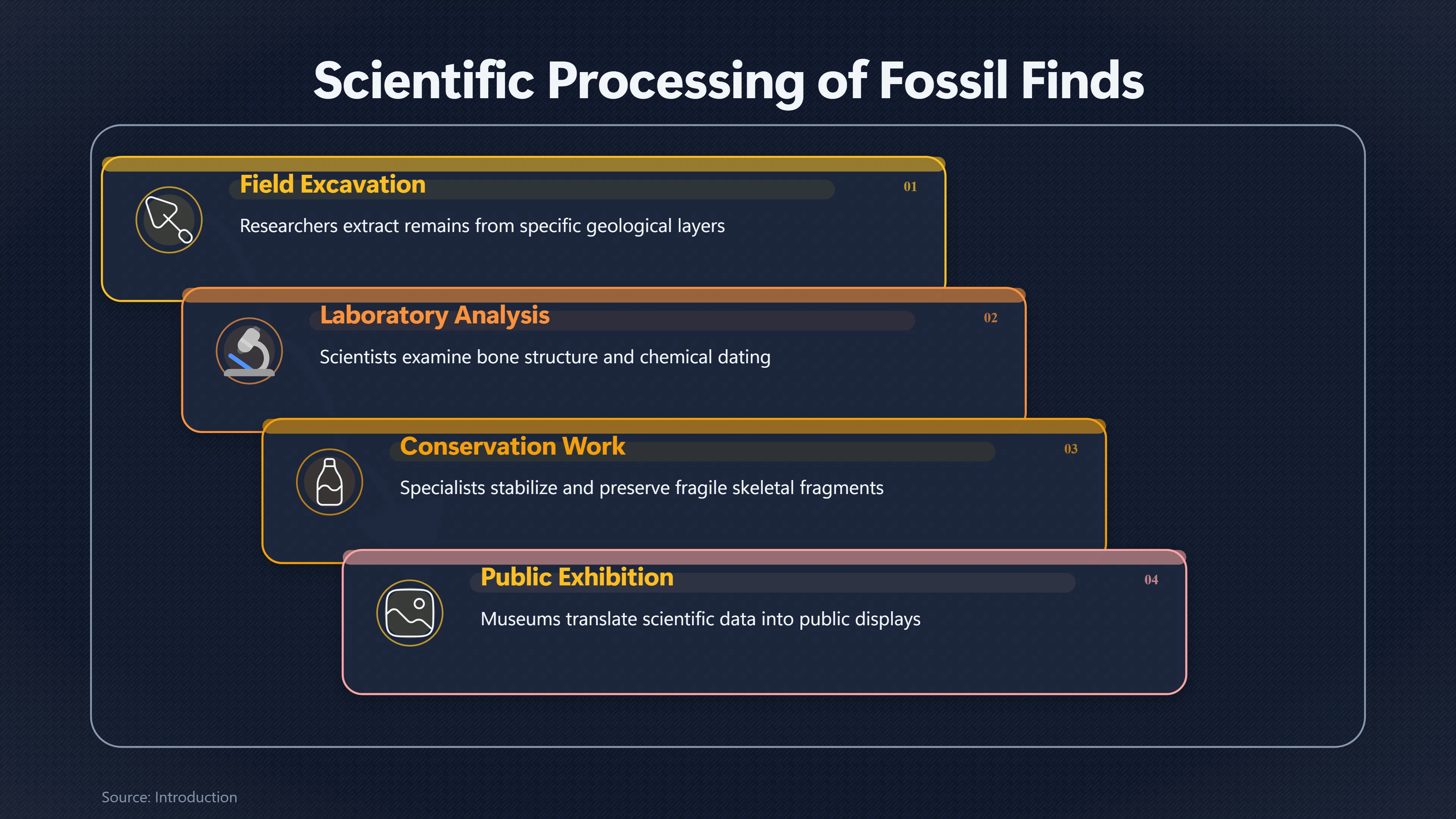
A museum fossil display is the final stage of a much longer scientific process. The objects visitors see have usually passed through excavation, recording, laboratory analysis, conservation and comparison with other discoveries. The value of a fossil does not come only from its age; it comes from the information preserved around it, including the geological layer where it was found and the other remains discovered nearby.[National Museums of Kenya]nmk.go.keOpen source on go.ke.
Scientists use several types of evidence to interpret these collections:
- Anatomy: Fossils reveal changes in skull shape, teeth, limbs and body proportions.
- Dating methods: Geological layers and scientific dating techniques help place discoveries within a timeline.
- Environmental evidence: Fossilised plants, animals and sediments show what landscapes looked like in the past.
- Archaeological evidence: Tools and other traces of activity help explain behaviour.
This combination is what makes Kenya’s collections so important. A single fossil may answer one question, but a collection allows researchers to compare many discoveries across time.
The Nairobi National Museum also represents the transition from field discovery to public understanding. The same institution involved in preserving and researching collections helps translate scientific findings for visitors who may never visit excavation sites such as Koobi Fora.[National Museums of Kenya]nmk.go.keOpen source on go.ke.

Why these objects matter today
Kenya’s fossils are evidence, not legends
Many unusual museum collections attract attention because they involve myths, unexplained objects or dramatic stories. Kenya’s fossil collections are different. Their fascination comes from the opposite: they are carefully studied evidence that has changed scientific understanding of the human past.
The importance of these fossils is not that they prove a single simple story about human beginnings. Instead, they show a complex history involving many species, changing climates and different experiments in survival. Discoveries from places such as Koobi Fora have helped demonstrate that human evolution involved diversity, adaptation and uncertainty rather than a predictable march towards modern humans.[National Museums of Kenya]nmk.go.keNational Museums of Kenya Koobi Fora UNESCO World HeritageNational Museums of Kenya Koobi Fora UNESCO World Heritage
A fragile archive of humanity’s past
The collections also raise questions about preservation. Fossils are irreplaceable because once information is lost through damage or poor documentation, it cannot be recovered. The Nairobi National Museum’s fossil holdings are therefore not only exhibition material but a scientific archive requiring careful conservation and management. Reports have highlighted the challenges involved in protecting such extensive collections, particularly the need for improved storage and resources.[The Wall Street Journal]wsj.comLouise Leakey, descendant of the famous fossil-hunting Leakey family, fears for the preservation of these invaluable prehistoric treasure…
For visitors, this makes the museum experience unusual in a deeper sense. The objects on display are not curiosities collected simply because they are old; they are pieces of evidence that continue to shape research today. A visit to the human origins galleries is effectively a journey through millions of years of investigation, with Kenya’s fossils acting as the surviving clues.[National Museums of Kenya]nmk.go.keOpen source on go.ke.
The Nairobi National Museum’s fossil collections therefore occupy a rare position in Kenya’s curiosity landscape: they are scientifically rigorous, internationally significant and still capable of inspiring the same basic human question that has fascinated people for generations — how did we become who we are?
Amazon book picks
Further Reading
Books and field guides related to Kenya's Fossils and the Story of US. Use these as the next step if you want deeper reading beyond the article.
Sapiens
Rating: 4.5/5 from 12 Google Books ratings
NATIONAL BESTSELLER NEW YORK TIMES BESTSELLER Destined to become a modern classic in the vein of Guns, Germs, and Steel, Sapiens is a liv...
The Fossil Trail
In The Fossil Trail, Ian Tattersall, the head of the Anthropology Department at the American Museum of Natural History, takes us on a swe...
Lucy, the Beginnings of Humankind
Describes the discovery of the oldest, most complete skeleton of any erect walking human ancestor ever found in 1974 in Ethiopia.
eBay marketplace picks
Marketplace Samples
Live-tested eBay searches with available results related to this page.
Selected fromnatural history poster oneBay.co.uk.
Current eBay listing
Museum of Natural History Art Deco Travel Poster: Fine Art Print
Current eBay listing
Natural History Museum Framed Wall Art Poster Canvas Print Picture
Endnotes
1.
Source: nmk.go.ke
Link:https://nmk.go.ke/nairobi-national-museum/
2.
Source: nmk.go.ke
Title: National Museums of Kenya Koobi Fora UNESCO World Heritage
Link:https://nmk.go.ke/koobi-fora/
3.
Source: nmk.go.ke
Link:https://nmk.go.ke/directorate-of-national-repository-and-research/earth-science-department/
4.
Source: museums.or.ke
Title: National Museums of Kenya Earth Science Department – National Museums of Kenya
Link:https://museums.or.ke/earth-science-department/
5.
Source: nmk.go.ke
Link:https://nmk.go.ke/turkana-boy-kenyas-eternal-ambassador/
Source snippet
National Museums of KenyaTurkana Boy: Kenya’s Eternal Ambassador | National Museums Of Kenya (NMK) | Where Heritage Lives OnJanuary 10, 2025...
Published: January 10, 2025
6.
Source: Wikipedia
Title: Turkana Boy
Link:https://en.wikipedia.org/wiki/Turkana_Boy
7.
Source: humanorigins.si.edu
Title: Human Origins KNM-ER 732 A | The Smithsonian Institution’s Human Origins Program
Link:https://humanorigins.si.edu/evidence/human-fossils/fossils/knm-er-732
8.
Source: wsj.com
Link:https://www.wsj.com/world/africa/nairobi-national-museum-natural-history-leakey-832f0262
Source snippet
Louise Leakey, descendant of the famous fossil-hunting Leakey family, fears for the preservation of these invaluable prehistoric treasure...
9.
Source: nmk.go.ke
Link:https://nmk.go.ke/
Source snippet
May 20, 2026 — NATIONAL MUSEUMS OF KENYA WHERE HERITAGE LIVES ON The National Museums of Kenya (NMK), established under the Museums and H...
Published: May 20, 2026
10.
Source: en.wiktionary.org
Title: Turkana Boy
Link:https://en.wiktionary.org/wiki/Turkana_Boy
Source snippet
Boy - Wiktionary, the free dictionaryOctober 31, 2025 — TURKANA BOY ENGLISH [edit] Turkana Boy ALTERNATIVE FORMS [edit] * Turkana boy ETY...
Published: October 31, 2025
11.
Source: nairobipark.org
Title: Nairobi National Museum
Link:https://nairobipark.org/nairobi-national-museum/
12.
Source: nmk.go.ke
Link:https://nmk.go.ke/celebrating-gedis-world-heritage-inscription-and-turkana-boys-anniversary/
13.
Source: si.edu
Title: knm wt 15000a knm wt 15000 turkana boy human fossil:nmnheducation 13109587
Link:https://www.si.edu/object/knm-wt-15000a-knm-wt-15000-turkana-boy-human-fossil%3Anmnheducation_13109587
14.
Source: nmk.go.ke
Link:https://nmk.go.ke/museums-and-heritage-sites/northern-region/
15.
Source: nmk.go.ke
Link:https://nmk.go.ke/museums-and-heritage-sites/world-heritage-sites/
16.
Source: nmk.go.ke
Link:https://nmk.go.ke/samuel-muteti/
17.
Source: nmk.go.ke
Link:https://nmk.go.ke/museums-and-heritage-sites/
18.
Source: nmk.go.ke
Link:https://nmk.go.ke/sitemap/
19.
Source: nmk.go.ke
Link:https://nmk.go.ke/directorate-of-national-repository-and-research/cultural-anthropology/
20.
Source: nmk.go.ke
Link:https://nmk.go.ke/directorate-of-national-repository-and-research/
21.
Source: museums.or.ke
Link:https://museums.or.ke/
22.
Source: humanorigins.si.edu
Title: knm wt 15000
Link:https://humanorigins.si.edu/evidence/human-fossils/fossils/knm-wt-15000
23.
Source: humanorigins.si.edu
Title: knm wt 40000
Link:https://humanorigins.si.edu/evidence/human-fossils/fossils/knm-wt-40000
24.
Source: humanorigins.si.edu
Link:https://humanorigins.si.edu/evidence/human-fossils/fossils
25.
Source: humanorigins.si.edu
Title: knm er 1470
Link:https://humanorigins.si.edu/evidence/human-fossils/fossils/knm-er-1470
26.
Source: humanorigins.si.edu
Title: knm er 406
Link:https://humanorigins.si.edu/evidence/3d-collection/fossils/777/knm-er-406
27.
Source: naturalhistory.si.edu
Link:https://naturalhistory.si.edu/research/paleobiology/about
28.
Source: humanorigins.si.edu
Title: kanam kenya
Link:https://humanorigins.si.edu/research/east-african-research-projects/kanam-kenya
29.
Source: nhm.ac.uk
Link:https://www.nhm.ac.uk/visit/galleries-and-museum-map/human-evolution.html
30.
Source: erosafrica.com
Link:https://www.erosafrica.com/experiences/nairobi-national-museum
Additional References
31.
Source: youtube.com
Title: Turkana Boy: The Nariokotome Homo Erectus Skeleton from Turkana Lake, Kenya
Link:https://www.youtube.com/watch?v=gKSDxPpKZKo
Source snippet
Nairobi National Museum human origins fossil collection Kenya Inside the Race to Save a Museum Home to Some of Humanity's Oldest Bones |...
32.
Source: youtube.com
Title: Kenya: Study Discovers Prehistoric Tools 2.9 Million Years Old
Link:https://www.youtube.com/watch?v=j1tLLBbm5kM
Source snippet
Turkana Boy: The Nariokotome Homo Erectus Skeleton from Turkana Lake, Kenya...
33.
Source: youtube.com
Title: Inside the Race to Save a Museum Home to Some of Humanity’s Oldest Bones
Link:https://www.youtube.com/watch?v=dx9j9m8nz5s
Source snippet
IN SEARCH OF ‘TURKANA BOY’ | 1.6-million-year-old complete skeleton discovered in Turkana County...
34.
Source: youtube.com
Link:https://www.youtube.com/watch?v=FHZ_-yl7vCU
Source snippet
The hidden mysteries inside Kenya's fossil treasury...
35.
Source: youtube.com
Title: The hidden mysteries inside Kenya’s fossil treasury
Link:https://www.youtube.com/watch?v=CG_UFBparHU
Source snippet
Kenya: Study Discovers Prehistoric Tools 2.9 Million Years Old...
36.
Source: nature.com
Title: Early Homo erectus skeleton from west Lake Turkana, Kenya | Nature
Link:https://www.nature.com/articles/316788a0
37.
Source: kahaku.go.jp
Link:https://www.kahaku.go.jp/english/kenkyu/kenkyubu/anthropo-paleontology/
38.
Source: nhm.ac.uk
Link:https://www.nhm.ac.uk/discover/homo-erectus-our-ancient-ancestor.html
39.
Source: nhm.ac.uk
Link:https://www.nhm.ac.uk/our-science/services/collections/palaeontology/human-comparative.html
40.
Source: museums.or.ke
Link:https://museums.or.ke/koobi-fora/