Within Curious Eswatini
Why Was Ochre Mined at Ngwenya?
Ngwenya's red pigment links prehistoric mining, ritual colour and changing claims about one of the world's oldest extraction sites.
On this page
- Lion Cavern and the 48,000 year chronology
- What prehistoric communities used ochre for
- Visitor displays, modern quarrying and UNESCO status
Page outline Jump by section
Introduction
Ngwenya Mine, in north-western Eswatini, is remarkable not because it contains hidden treasure, but because it preserves evidence of one of humanity’s earliest known mining landscapes. At its heart is Lion Cavern, where prehistoric people extracted red ochre – an iron-rich mineral pigment – around 48,000 years ago. Recent archaeological research has strengthened the case that this is the world’s oldest known site of intensive ochre mining, shifting attention away from iron ore and towards the cultural importance of colour itself.[Nature]nature.comOchre communities of practice in Stone Age Eswatini | Nature CommunicationsOchre communities of practice in Stone Age Eswatini | Nature CommunicationsOctober 24, 2024…
For visitors interested in unusual heritage rather than conventional museums, Ngwenya offers a rare combination of archaeology, geology and industrial history. The site connects Middle Stone Age mining, later Iron Age extraction, twentieth-century open-cast mining and modern heritage interpretation within a single landscape. It is one of Eswatini’s most distinctive places for understanding how an apparently ordinary red mineral became a substance linked to identity, ritual, technology and long-distance exchange.[UNESCO World Heritage Centre]whc.unesco.orgWorld Heritage Centre Ngwenya MinesUNESCO World Heritage CentreNgwenya Mines - UNESCO World Heritage CentreDecember 31, 2008…
Why was ochre mined at Ngwenya?
The oldest workings at Ngwenya were not dug for metal production. Instead, prehistoric miners sought high-quality deposits of red haematite and sparkling specularite, both forms of iron oxide that produce vivid mineral pigments. Unlike later industrial mining, these excavations targeted colour rather than metal.
Ochre has been used by human communities across Africa for hundreds of thousands of years. Archaeologists associate it with a remarkable range of activities, including body decoration, ceremonial painting, rock art, hide processing, adhesives for attaching stone tools to wooden handles, and other symbolic or practical purposes. Because ochre appears repeatedly alongside evidence of increasingly complex social behaviour, it has become one of archaeology’s most significant materials for understanding the emergence of symbolic culture.[Nature]nature.comOchre communities of practice in Stone Age Eswatini | Nature CommunicationsOchre communities of practice in Stone Age Eswatini | Nature CommunicationsOctober 24, 2024…
The Ngwenya deposits were especially desirable because of their purity and variety. Recent compositional analysis suggests that people deliberately selected particular pigment sources and transported them over considerable distances, indicating organised procurement rather than casual collection. This implies that ochre carried social value well beyond the immediate vicinity of the mine.[Nature]nature.comOchre communities of practice in Stone Age Eswatini | Nature CommunicationsOchre communities of practice in Stone Age Eswatini | Nature CommunicationsOctober 24, 2024…
Lion Cavern and the 48,000-year chronology
Lion Cavern is the archaeological heart of Ngwenya Mine. It represents the surviving entrance to ancient underground workings cut into the hillside, where miners extracted pigment long before agriculture, metallurgy or permanent settlements appeared in the region.
For decades, Ngwenya was already regarded as one of the world’s oldest mines based largely on radiocarbon dates obtained during excavations in the 1960s and 1970s. Those studies generally suggested mining at least 42,000 to 43,000 years ago. More recent research has refined the chronology using optically stimulated luminescence (OSL), a dating technique that determines when buried sediments were last exposed to sunlight. The new results place intensive mining activity at approximately 48,000 years ago, reinforcing Lion Cavern’s claim as the oldest known intensive ochre mine currently identified anywhere in the world.[Nature]nature.comOchre communities of practice in Stone Age Eswatini | Nature CommunicationsOchre communities of practice in Stone Age Eswatini | Nature CommunicationsOctober 24, 2024…
That distinction deserves careful wording. Archaeologists regularly discover very early evidence for people collecting or using ochre elsewhere in Africa, including much older examples from cave sites. What makes Lion Cavern unusual is not simply the age of ochre use but the evidence for organised extraction from a dedicated mining location rather than opportunistic gathering of naturally exposed pigment.[Nature]nature.comOchre communities of practice in Stone Age Eswatini | Nature CommunicationsOchre communities of practice in Stone Age Eswatini | Nature CommunicationsOctober 24, 2024…
The mine therefore occupies an unusual place within global archaeological history. It demonstrates that tens of thousands of years before large-scale mining for metals became common, humans were already reshaping landscapes to obtain materials that carried cultural and symbolic significance.
What prehistoric communities used ochre for
Exactly how the Ngwenya pigment was used cannot always be demonstrated directly, but archaeology provides a strong picture of its likely importance.
Across southern Africa, ochre appears in contexts associated with:
- Body painting and personal decoration.
- Ceremonial and ritual practices.
- Rock art traditions.
- Processing animal hides.
- Manufacture of compound adhesives used to haft stone tools.
- Symbolic displays connected with identity or social status.[Nature]nature.comOchre communities of practice in Stone Age Eswatini | Nature CommunicationsOchre communities of practice in Stone Age Eswatini | Nature CommunicationsOctober 24, 2024…
Recent research has also revealed surprisingly extensive movement of ochre between archaeological sites in Eswatini. By comparing the chemical composition of pigments from multiple locations, researchers reconstructed networks linking fifteen archaeological sites with particular mineral sources. This suggests that valuable pigments travelled through exchange systems or repeated journeys rather than remaining local commodities.[Nature]nature.comOchre communities of practice in Stone Age Eswatini | Nature CommunicationsOchre communities of practice in Stone Age Eswatini | Nature CommunicationsOctober 24, 2024…
Modern ethnographic observations also show that mineral pigments continue to hold cultural importance in Eswatini. Researchers note ongoing ceremonial uses, including traditional healing practices and aspects of marriage ceremonies, although these living traditions should not be assumed to represent direct continuations of practices from 48,000 years ago. Instead, they illustrate the enduring cultural significance of ochre across very different historical periods.[Senckenberg Naturforschung]senckenberg.deSenckenberg NaturforschungThe Lion’s Den: Use of Ochre 48,000 Years Ago | Press Releases | Senckenberg Nature Research…

A landscape shaped by three eras of mining
One reason Ngwenya stands apart from many archaeological sites is that it preserves evidence from several completely different mining traditions layered within the same landscape.
The sequence includes:
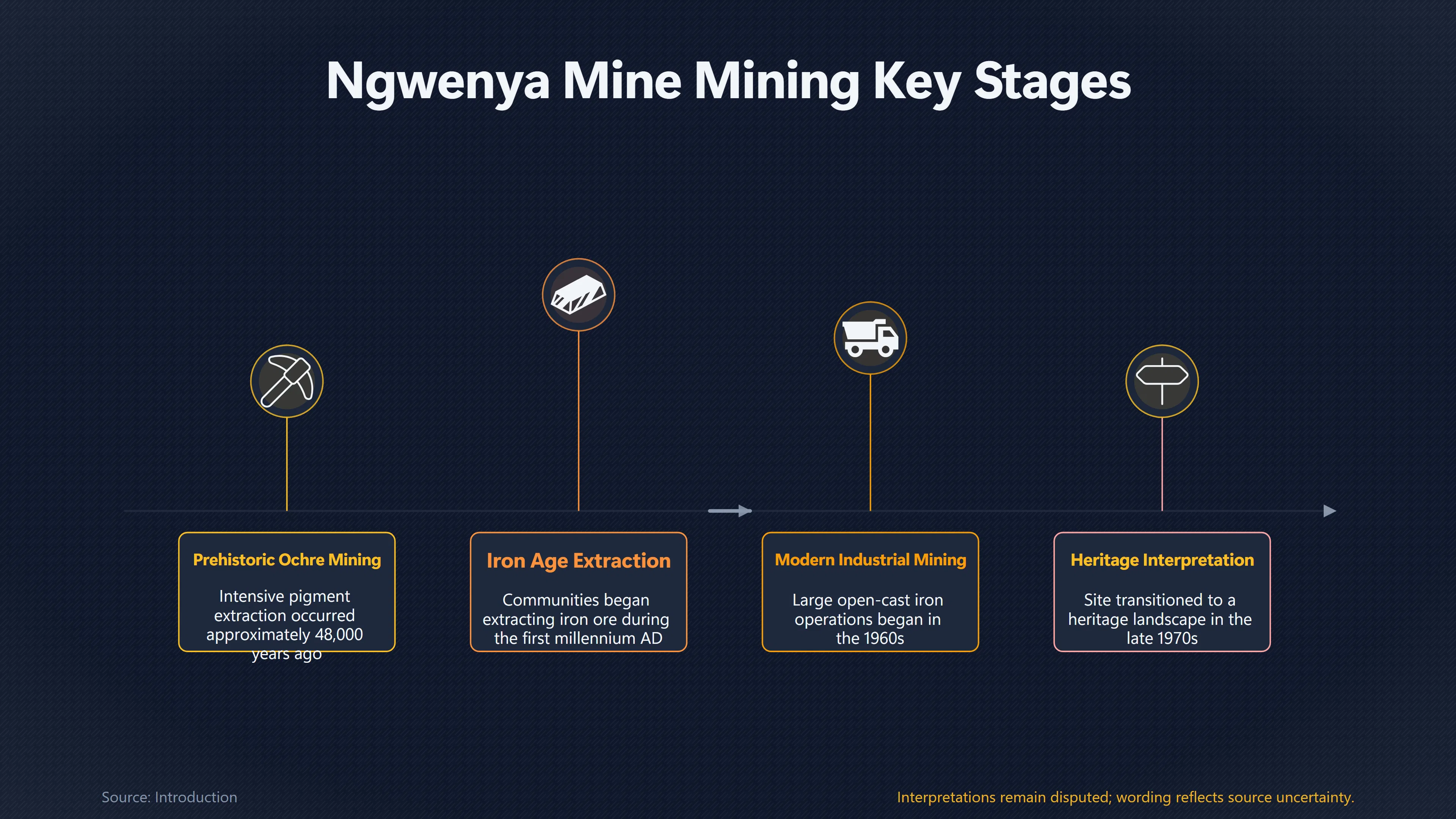
- Middle Stone Age ochre mining, centred on Lion Cavern.
- Iron Age iron ore extraction, beginning roughly during the first millennium AD as iron-smelting communities expanded across the region.
- Modern industrial mining, when a large open-cast iron ore operation began in the 1960s and transformed the surrounding infrastructure before closing in the late 1970s.[UNESCO World Heritage Centre]whc.unesco.orgWorld Heritage Centre Ngwenya MinesUNESCO World Heritage CentreNgwenya Mines - UNESCO World Heritage CentreDecember 31, 2008…
The industrial phase dramatically altered the area. Rail links, electricity infrastructure and wider economic development accompanied the modern mine, leaving visible reminders that Ngwenya is both an archaeological site and an industrial heritage landscape. Unlike many prehistoric mines preserved in isolation, visitors encounter evidence of tens of thousands of years of changing relationships between people and the same mineral-rich hillside.[UNESCO World Heritage Centre]whc.unesco.orgWorld Heritage Centre Ngwenya MinesUNESCO World Heritage CentreNgwenya Mines - UNESCO World Heritage CentreDecember 31, 2008…
What visitors can see today
Ngwenya functions less as a conventional museum than as a heritage site supported by visitor interpretation.
Visitors can normally expect to encounter:
- The Lion Cavern area, reached by a short walk.
- Viewing platforms overlooking the ancient workings.
- Geological exposures showing different iron-rich minerals.
- Interpretation explaining prehistoric ochre mining and later industrial history.
- Displays in the visitor centre presenting mining tools, archaeological discoveries and reconstructions of early mining and smelting traditions.[Wikipedia]WikipediaNgwenya MineNgwenya Mine
Because the archaeological remains themselves are relatively modest, much of the site’s impact comes from understanding what happened there. The cave entrance is not visually spectacular on the scale of famous painted caves or monumental ruins, but its archaeological significance is exceptional precisely because it documents purposeful mining so far back in human history.
The nearby Eswatini National Museum has also hosted exhibitions devoted specifically to Lion Cavern and ongoing archaeological research, helping interpret discoveries that cannot remain permanently on the site itself.[UNESCO World Heritage Centre]whc.unesco.orgUNESCO World Heritage CentreMuseum display at the Eswatini National Museum on Lion Cavern - UNESCO World Heritage CentreJuly 5, 2022…
UNESCO ambitions and the tension with modern mining
Ngwenya has long been recognised as a place of international importance. It appears on Eswatini’s UNESCO Tentative List, reflecting the country’s ambition for eventual World Heritage inscription. The nomination emphasises the site’s exceptional antiquity, the continuity of mining traditions and the survival of archaeological features despite later industrial activity.[UNESCO World Heritage Centre]whc.unesco.orgWorld Heritage Centre Ngwenya MinesUNESCO World Heritage CentreNgwenya Mines - UNESCO World Heritage CentreDecember 31, 2008…
The site’s future has not been entirely straightforward. Periodic proposals to resume commercial mining have raised concerns about protecting the archaeological remains. Heritage specialists have argued that Lion Cavern’s scientific and cultural value offers long-term benefits through conservation and sustainable tourism that would be difficult to recover if the landscape were substantially altered again.[UNESCO World Heritage Centre]whc.unesco.orgUNESCO World Heritage CentreMuseum display at the Eswatini National Museum on Lion Cavern - UNESCO World Heritage CentreJuly 5, 2022…
This debate illustrates an unusual aspect of Ngwenya’s story. The site is not simply a fossilised relic of prehistory but an active heritage landscape where archaeological preservation, economic development and cultural identity continue to intersect.
Why Ngwenya matters in Eswatini’s curiosity landscape
For travellers interested in unusual collections and strange heritage, Ngwenya Mine stands apart because its most extraordinary “object” is not displayed inside a glass case. Instead, the collection is the landscape itself: ancient tunnels, mineral deposits, prehistoric extraction scars and the evidence left behind by people who valued red pigment enough to mine it nearly 50,000 years ago.
Within Eswatini’s broader heritage landscape, the site complements the archaeological collections of the National Museum by preserving the place where many of the country’s most remarkable prehistoric stories began. Rather than presenting curiosities for spectacle, Ngwenya invites visitors to reconsider something as ordinary as coloured earth and recognise it as one of humanity’s earliest mined resources, long before gold, silver or iron reshaped civilisation.
Amazon book picks
Further Reading
Books and field guides related to Why Was Ochre Mined at Ngwenya?. Use these as the next step if you want deeper reading beyond the article.
The Mind in the Cave
The art created in the caves of western Europe in the Ice Age provokes awe and wonder. What do these symbols on the walls of Lascaux and...
After the Ice
"Drawing on the latest research in archaeology, human genetics, and environmental science, After The Life takes the reader on a sweeping...
Sapiens
Rating: 4.5/5 from 12 Google Books ratings
'Interesting and provocative... It gives you a sense of how briefly we've been on this Earth' Barack Obama What makes us brilliant? What...
The Human Past
The most authoritative world prehistory book on the market is now available in a new, thoroughly up-to-date essentials version. Partnerin...
eBay marketplace picks
Marketplace Samples
Live-tested eBay searches with available results related to this page.
Selected fromarchaeology collectible oneBay.co.uk.
Endnotes
1.
Source: nature.com
Title: Ochre communities of practice in Stone Age Eswatini | Nature Communications
Link:https://www.nature.com/articles/s41467-024-53050-6
Source snippet
Ochre communities of practice in Stone Age Eswatini | Nature CommunicationsOctober 24, 2024...
Published: October 24, 2024
2.
Source: senckenberg.de
Link:https://www.senckenberg.de/en/press-releases/the-lions-den-use-of-ochre-48000-years-ago/
Source snippet
Senckenberg NaturforschungThe Lion’s Den: Use of Ochre 48,000 Years Ago | Press Releases | Senckenberg Nature Research...
3.
Source: whc.unesco.org
Title: World Heritage Centre Ngwenya Mines
Link:https://whc.unesco.org/en/tentativelists/5421/
Source snippet
UNESCO World Heritage CentreNgwenya Mines - UNESCO World Heritage CentreDecember 31, 2008...
Published: December 31, 2008
4.
Source: Wikipedia
Title: Ngwenya Mine
Link:https://en.wikipedia.org/wiki/Ngwenya_Mine
5.
Source: whc.unesco.org
Link:https://whc.unesco.org/en/events/1686/
Source snippet
UNESCO World Heritage CentreMuseum display at the Eswatini National Museum on Lion Cavern - UNESCO World Heritage CentreJuly 5, 2022...
Published: July 5, 2022
6.
Source: miragenews.com
Title: Lion’s Den: Use Of Ochre 48,000 Years Ago | Mirage News
Link:https://www.miragenews.com/lions-den-use-of-ochre-48000-years-ago-1347217/
Source snippet
October 30, 2024 — Science 30 Oct 2024 8:12 pm AEDT LION'S DEN: USE OF OCHRE 48,000 YEARS AGO Image: Ascent to the Senckenberg/Bader Asce...
Published: October 30, 2024
Additional References
7.
Source: anthropology.net
Link:https://www.anthropology.net/p/humanitys-oldest-ochre-mine-the-48000
Source snippet
November 7, 2024 — ANTHROPOLOGY.NET HUMANITY’S OLDEST OCHRE MINE: THE 48,000-YEAR LEGACY OF ARTISTRY AND SYMBOLISM IN ESWATINI'S LION CAV...
Published: November 7, 2024
8.
Source: orbit.dtu.dk
Title: dk Ochre communities of practice in Stone Age Eswatini
Link:https://orbit.dtu.dk/en/publications/ochre-communities-of-practice-in-stone-age-eswatini/
Source snippet
MacDonald^{*} *, Elizabeth C. Velliky *, Bob Forrester *, Svenja Riedesel *, Jörg Linstädter *, Alexandra L. Kuo *, Stephan Wood...
9.
Source: uni-tuebingen.de
Link:https://uni-tuebingen.de/en/169584
Source snippet
The site was excavated in the 1960s and 1970s and is considered to be...
10.
Source: pmc.ncbi.nlm.nih.gov
Title: Pub Med Central Ochre communities of practice in Stone Age Eswatini
Link:https://pmc.ncbi.nlm.nih.gov/articles/PMC11502791/
Source snippet
Its preservation and ubiquity within archaeological records across sub-Saha...
11.
Source: uib.no
Title: ochres role early human societies
Link:https://www.uib.no/en/sapience/175426/ochres-role-early-human-societies
Source snippet
Ochre's Role in Early Human Societies | SAPIENCE | UiBJanuary 16, 2025 — Pigments of the Past OCHRE'S ROLE IN EARLY HUMAN SOCIETIES Sapie...
Published: January 16, 2025
12.
Source: pubmed.ncbi.nlm.nih.gov
Link:https://pubmed.ncbi.nlm.nih.gov/39448561/
Source snippet
Nat Commun. 2024. ABSTRACT Our species and other hominins have used earth mineral pigments since at least ~500,000 year...
13.
Source: dainst.org
Link:https://www.dainst.org/newsroom/lion-cavern-ngwenya-the-oldest-ochre-mine-in-the-world/505
Source snippet
DAI - Lion Cavern Ngwenya – The Oldest Ochre Mine in the WorldNovember 14, 2024 — LION CAVERN NGWENYA – THE OLDEST OCHRE MINE IN THE WORL...
Published: November 14, 2024
14.
Source: youtube.com
Link:https://www.youtube.com/watch?v=5zwNA-uXBTY
15.
Source: youtube.com
Link:https://www.youtube.com/watch?v=M7aYMkpKEZ0
16.
Source: youtube.com
Link:https://www.youtube.com/watch?v=NVsgEUHGX0s