Within Tanzania Curiosities
How Tanzanian Museums Handle Ritual and Belief
Tanzanian museums preserve healing, ancestral and ceremonial objects while treating living beliefs as culture rather than supernatural proof.
On this page
- Healing objects and traditional medicines
- Ceremony, music and ancestral practice
- Respectful interpretation versus spectacle
Page outline Jump by section
Introduction
Tanzania does not have dedicated museums of witchcraft or occult practice in the way that some countries do. Instead, ritual objects appear mainly within ethnographic galleries, open-air cultural museums and national collections that document the country’s many communities. Visitors encounter ceremonial items, healing implements, musical instruments and objects associated with ancestral traditions, but these are generally presented as part of living cultural heritage rather than as evidence for supernatural claims. This approach reflects a deliberate choice by Tanzanian museums: to preserve knowledge about belief systems while avoiding sensationalism, respecting communities for whom some traditions remain meaningful, and distinguishing cultural interpretation from religious endorsement.[go.tz]nmt.go.tzNational Museum of Tanzania NMT | Makumbusho na Nyumba ya UtamaduniNational Museum of Tanzania NMT | Makumbusho na Nyumba ya Utamaduni
Healing objects and traditional medicines
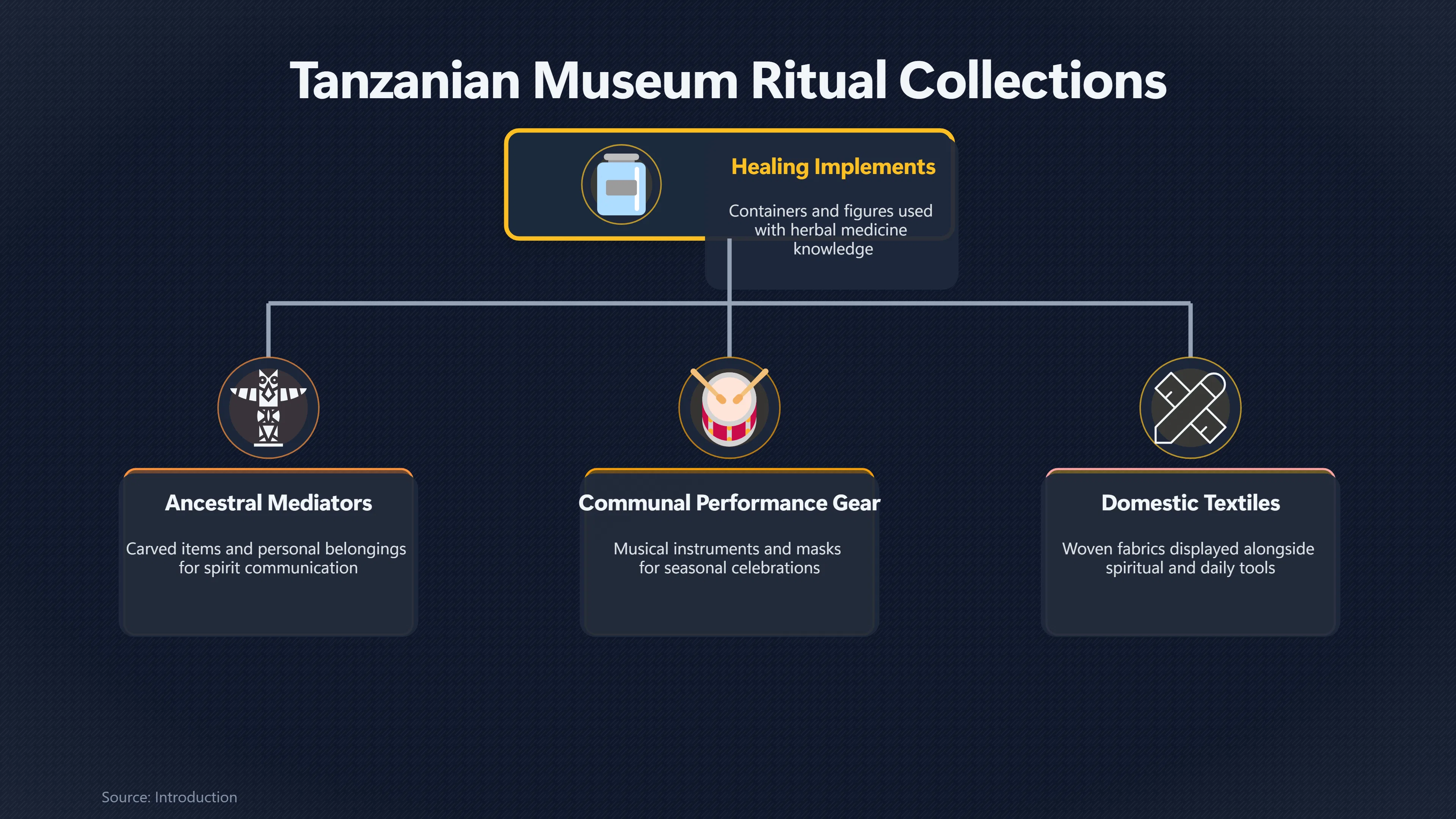
Many of the ritual objects preserved in Tanzanian collections were never intended to be admired as artworks. They were practical items used within systems of healing, protection or communication with ancestors. Once placed inside a museum display case, however, their original purpose inevitably changes.
Ethnographic collections at the National Museum and House of Culture in Dar es Salaam include material representing the diverse cultural traditions of Tanzania, alongside archaeology and history. Rather than isolating ritual items as mysterious curiosities, they are usually displayed with domestic tools, textiles and musical instruments to show how spiritual practice was woven into everyday life.[National Museum of Tanzania]nmt.go.tzNational Museum of Tanzania NMT | Makumbusho na Nyumba ya UtamaduniNational Museum of Tanzania NMT | Makumbusho na Nyumba ya Utamaduni
Research on the Wangoni people illustrates why museum labels can only capture part of an object’s significance. Household possessions, carved objects and personal belongings of deceased relatives could serve as intermediaries in communication with ancestors. Their value depended not only on their physical form but also on relationships, memory and ritual performance. The same carved object displayed behind glass may therefore retain historical importance while losing much of the social and spiritual role that originally gave it meaning.[UDSM Journals]journals.udsm.ac.tzUDSM JournalsArt, Objects and Belief Systems Among the Wangoni of Tanzania | Tanzania Journal for Population studies and DevelopmentSepte…
Objects associated with traditional healing present a similar challenge. Across parts of Tanzania, containers, carved figures and other implements were used alongside herbal knowledge, spoken prayers, music and ritual action. Museums can document the craftsmanship and cultural context of such objects, but they cannot recreate the wider healing ceremony without oversimplifying or turning living traditions into theatrical displays. Comparable collections of Tanzanian healing containers held in international museums emphasise that these objects functioned within broader systems of herbal medicine, community knowledge and ceremonial practice rather than acting as magical objects on their own.[The Art Institute of Chicago]artic.eduThe Art Institute of Chicago Ritual Container | The Art Institute of ChicagoThe Art Institute of Chicago Ritual Container | The Art Institute of Chicago
Ceremony, music and ancestral practice
Many ritual collections are easier to understand when viewed as part of performances rather than isolated artefacts.
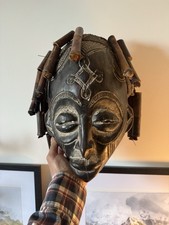
Traditional musical instruments, ceremonial stools, masks, clothing and dance equipment often appear in Tanzanian ethnographic museums because they helped structure important communal events, including initiation ceremonies, leadership rituals, seasonal celebrations and remembrance of ancestors. In an exhibition, these objects become evidence of cultural practice rather than functioning ritual tools.[Visit Tanzania - Land of the Kilimajaro]visittanzania.orgVisit TanzaniaLand of the KilimajaroMuseum and Monuments - Visit Tanzania – Land of the Kilimajaro…
The Village Museum in Dar es Salaam illustrates this approach particularly well. Instead of relying solely on display cases, it combines reconstructed traditional houses with demonstrations of music and dance. While these performances are necessarily adapted for public audiences, they provide visitors with a better sense of how ceremonial objects originally operated within movement, sound and social interaction rather than as isolated museum pieces.[Visit Tanzania - Land of the Kilimajaro]visittanzania.orgVisit TanzaniaLand of the KilimajaroMuseum and Monuments - Visit Tanzania – Land of the Kilimajaro…
Even so, museums generally avoid presenting performances as re-enactments of sacred rituals. Public cultural demonstrations are framed as educational interpretations rather than authentic religious ceremonies, acknowledging that many practices remain culturally sensitive or continue within their own communities.
Respectful interpretation versus spectacle
The greatest challenge for Tanzanian museums is not collecting ritual objects but explaining them responsibly.
Visitors interested in unusual collections may expect stories of magic, curses or supernatural powers. Museum professionals instead tend to emphasise several principles:
- Cultural context over mystery. Ritual objects are interpreted within the history and traditions of the communities that created them rather than being presented as paranormal curiosities.
- Living beliefs deserve respect. Many traditions documented in museums are not extinct. Curators therefore avoid language that ridicules or sensationalises practices still valued by contemporary communities.
- Objects are only part of the story. Songs, oral traditions, specialist knowledge and community participation often mattered as much as the physical artefact itself.
- Multiple perspectives matter. Museums may explain both the traditional understanding of an object and the anthropological interpretation without requiring visitors to accept either as literal truth.[National Museum of Tanzania]nmt.go.tzNational Museum of Tanzania NMT | Kazi za Makumbusho ya TaifaNational Museum of Tanzania NMT | Kazi za Makumbusho ya Taifa
This balanced approach is especially important because ritual objects often occupy an uneasy position between heritage and belief. An ethnographer may describe an object as evidence of social history, while members of the originating community may continue to regard it as spiritually significant. Museums increasingly acknowledge both viewpoints instead of presenting a single authoritative interpretation.[National Museum of Tanzania]nmt.go.tzNational Museum of Tanzania NMT | Kazi za Makumbusho ya TaifaNational Museum of Tanzania NMT | Kazi za Makumbusho ya Taifa
Why museum interpretation has limits
No museum display can fully recreate the circumstances that gave ritual objects their original meaning.
Many ceremonial items were intended to be handled, sung over, danced with or used in private settings. Once removed from those contexts, they become historical evidence rather than active participants in ritual. Labels can explain materials, estimated age and cultural origin, but they cannot fully convey inherited knowledge passed through families, specialist healers or ceremonial leaders.
There are also ethical limits. Museums may deliberately omit details of restricted practices, sacred knowledge or healing methods that communities consider inappropriate for public display. This restraint can frustrate visitors seeking complete explanations, but it reflects an increasingly accepted principle of collaborative museum practice: preserving cultural heritage should not require revealing every aspect of traditions that remain spiritually or socially significant.
For readers interested in Tanzania’s unusual collections, this restraint is itself revealing. Unlike museums that market the occult or the supernatural as entertainment, Tanzanian institutions generally treat ritual objects as windows into cultural history, community identity and the complexity of human belief. Their most distinctive achievement is not proving or disproving spiritual claims, but showing how material objects can illuminate traditions whose deepest meanings ultimately extend beyond what any museum label can fully explain.

Amazon book picks
Further Reading
Books and field guides related to How Tanzanian Museums Handle Ritual and Belief. Use these as the next step if you want deeper reading beyond the article.

African Religions and Philosophy
First published 1970. Subjects: Religion, African Philosophy.

The Story of Africa
"Basil Davidson's Africa is an exciting and compelling history of the peoples who make up Africa today: where they came from, how they de...
The Interpretation Of Cultures
One of the twentieth century's most influential books, this classic work of anthropology offers a groundbreaking exploration of what cult...
The Invention of Africa
"What is the meaning of Africa and being an African? What is and what is not African philosophy? Is philosophy part of Africanism? These...
eBay marketplace picks
Marketplace Samples
Live-tested eBay searches with available results related to this page.
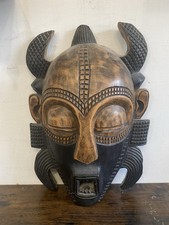
Selected fromAfrican mask decor oneBay.co.uk.

Endnotes
1.
Source: nmt.go.tz
Title: National Museum of Tanzania NMT | Makumbusho na Nyumba ya Utamaduni
Link:https://www.nmt.go.tz/pages/museum-and-house-of-culture
2.
Source: visittanzania.org
Title: Visit Tanzania
Link:https://www.visittanzania.org/experiences-in-tanzania/museum-and-monuments/
Source snippet
Land of the KilimajaroMuseum and Monuments - Visit Tanzania – Land of the Kilimajaro...
3.
Source: nmt.go.tz
Title: National Museum of Tanzania NMT | Kazi za Makumbusho ya Taifa
Link:https://www.nmt.go.tz/pages/functions-of-the-national-museum
4.
Source: journals.udsm.ac.tz
Link:https://journals.udsm.ac.tz/index.php/tjpsd/article/view/5092
Source snippet
UDSM JournalsArt, Objects and Belief Systems Among the Wangoni of Tanzania | Tanzania Journal for Population studies and DevelopmentSepte...
5.
Source: artic.edu
Title: The Art Institute of Chicago Ritual Container | The Art Institute of Chicago
Link:https://www.artic.edu/artworks/185688/ritual-container
6.
Source: nmt.go.tz
Title: NM T | Vituo Vyote vya Makumbusho
Link:https://www.nmt.go.tz/historical-centers/all-museum-centers
Source snippet
Vituo Vyote vya MakumbushoJanuary 29, 2024 — MAKUMBUSHO YA TAIFA LA TANZANIA Vituo Vyote vya Makumbusho Imewekwa: 29 Jan, 2024 Imag...
Published: January 29, 2024
7.
Source: nmt.go.tz
Link:https://www.nmt.go.tz/pages/nmt-history
8.
Source: ethnology.pitt.edu
Link:https://ethnology.pitt.edu/ojs/Ethnology/article/view/6061
Additional References
9.
Source: journals.unesco.go.ke
Link:https://journals.unesco.go.ke/index.php/jknatcom/article/view/66
Source snippet
Illicit Trade in Cultural Objects in Tanzania: An Investigative Report | Journal of the Kenya National Commission for UNESCOJanuary 15, 2...
10.
Source: africa-research.org
Title: National Museum and House of Culture (Dar es Salaam)
Link:https://africa-research.org/national-museum-tanzania/
Source snippet
Africa ResearchMay 3, 2026 — NATIONAL MUSEUM AND HOUSE OF CULTURE (DAR ES SALAAM) Prev Article Next Article Image: National Museum and Ho...
Published: May 3, 2026
11.
Source: youtube.com
Title: Welcome to Dar es Salaam | Fossils, Tribal Villages & Tanzania’s Largest City
Link:https://www.youtube.com/watch?v=cHsVwSA8MWE
Source snippet
TANZANIAN TRIBAL HUTS | MAKUMBUSHO VILLAGE MUSEUM | DAR ES SALAAM...
12.
Source: youtube.com
Title: TANZANIAN TRIBAL HUTS | MAKUMBUSHO VILLAGE MUSEUM | DAR ES SALAAM
Link:https://www.youtube.com/watch?v=UC9xaL00WZY
Source snippet
My Incredible Day at the Bujora Cultural Centre & Sukuma Museum...
13.
Source: youtube.com
Title: My Incredible Day at the Bujora Cultural Centre & Sukuma Museum!
Link:https://www.youtube.com/watch?v=ETRpdov4aQI
Source snippet
3 Things That Surprised Me at the Tanzania National Museum...
14.
Source: anthrosource.onlinelibrary.wiley.com
Link:https://anthrosource.onlinelibrary.wiley.com/doi/abs/10.1111/muan.70002
Source snippet
the things of the spirits: Evidencing unseen presences in missionary collections - Witte - 2025 - Museum Anthropology - Wiley Online Libr...
15.
Source: youtube.com
Title: A tour at Dar es Salam’s Village Museum
Link:https://www.youtube.com/watch?v=ZaZ8S1yjq3c
Source snippet
Welcome to Dar es Salaam | Fossils, Tribal Villages & Tanzania's Largest City...
16.
Source: researchgate.net
Link:https://www.researchgate.net/publication/377736477_Art_Objects_and_Belief_Systems_Among_the_Wangoni_of_Tanzania
17.
Source: smb.museum
Link:https://www.smb.museum/en/museums-institutions/ethnologisches-museum/collection-research/research/collaborative-provenance-research-on-collections-from-tanzania/
18.
Source: cambridge.org
Link:https://www.cambridge.org/core/journals/africa/article/abs/rituals-of-verification-indigenous-and-imported-accountability-in-northern-tanzania/C8931AE5C5D3927F7AC98BD9E93DE810