Within Nauru Curiosities
How Did One Rock Transform Almost All Nauru?
A once-ignored phosphate rock helped trigger an industry that turned much of Nauru's interior into a vast and unresolved industrial heritage site.
On this page
- The phosphate doorstop story and its limits
- Topside's pinnacles, machinery and abandoned infrastructure
- Why the mined landscape remains politically alive
Page outline Jump by section
Introduction
Nauru’s most unusual “museum” has no walls, ticket desk or display cases. Instead, it is the island’s scarred interior, known locally as Topside: a vast expanse of jagged limestone pinnacles, abandoned mining equipment, disused rail alignments and industrial remnants left behind after more than a century of phosphate extraction. What makes this landscape remarkable is that it was never intended as a heritage attraction. It became an accidental open-air museum because the physical evidence of mining was simply too extensive to erase, while the political and environmental consequences remain unresolved. Today, visitors encounter a landscape that is simultaneously an industrial ruin, an environmental warning, a national symbol and an active reminder that the story of phosphate is not finished.[tandfonline.com]tandfonline.comOpen source on tandfonline.com.
How Did One Rock Transform Almost All Nauru?
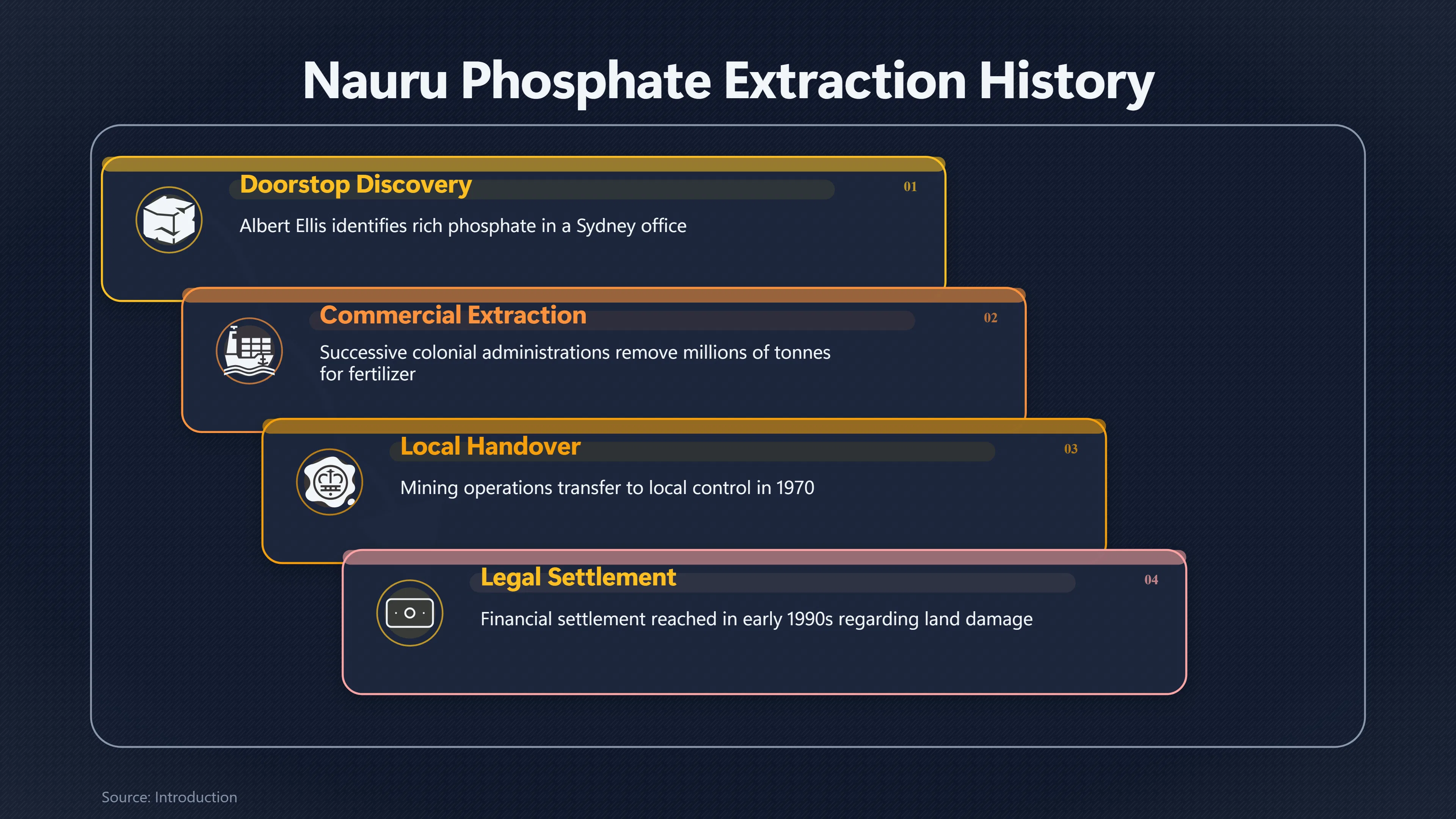
The story often begins with an anecdote that has become part of Nauru’s historical folklore. According to the best-known version, a strange rock was being used as a doorstop in the offices of the Pacific Islands Company in Sydney when the New Zealand geologist and prospector Albert Ellis examined it around 1900. He recognised it as exceptionally rich phosphate rather than an ordinary stone, leading investigators to trace it back to Nauru and nearby Banaba (Ocean Island). The discovery triggered one of the most intensive phosphate industries ever developed on such a small island.[Papers Past]paperspast.natlib.govt.nzPapers PastPapers Past | Magazines and Journals | New Zealand Journal of Agriculture | 20 December 1920 | NAURU AND OCEAN ISLANDS.Decembe…
The famous “doorstop story” is broadly supported by historical accounts, but it is also simplified through repeated retelling. Ellis did not stumble upon an unknown island. Nauru was already charted and inhabited, and geological interest in Pacific phosphates had been growing. The anecdote survives because it vividly illustrates how something apparently insignificant could alter the destiny of an entire nation. Historians generally treat the doorstop as a genuine episode, while cautioning against presenting it as the sole cause of mining or as a miraculous discovery divorced from wider commercial exploration.[Papers Past]paperspast.natlib.govt.nzPapers PastPapers Past | Magazines and Journals | New Zealand Journal of Agriculture | 20 December 1920 | NAURU AND OCEAN ISLANDS.Decembe…
Once commercial extraction began, phosphate rapidly became the island’s defining resource. Over the following decades, successive colonial administrations removed tens of millions of tonnes of phosphate for use mainly as agricultural fertiliser overseas. The wealth generated transformed farming elsewhere, while the extraction progressively stripped away the phosphate layer that had covered much of Nauru’s interior.[Taylor & Francis Online]tandfonline.comOpen source on tandfonline.com.
Walking Through Topside’s Open-Air Industrial Landscape
The most striking feature of Topside is not abandoned machinery but the limestone itself. When miners removed the phosphate, they exposed an ancient landscape of razor-sharp coral limestone pinnacles that had been buried beneath the phosphate deposits for hundreds of thousands of years. The result resembles a natural stone forest, although its appearance is actually the consequence of industrial excavation rather than untouched geology.[Taylor & Francis Online]tandfonline.comOpen source on tandfonline.com.
This creates an unusual experience for visitors. Instead of carefully curated exhibits, the landscape itself acts as the collection:
- Jagged limestone pinnacles rising several metres above the ground.
- Rusting conveyors, loading structures and fragments of mining machinery.
- Abandoned industrial tracks and infrastructure scattered through the interior.
- Artificial clearings where extraction removed nearly all original soil.
- Occasional surviving industrial buildings that illustrate different stages of phosphate production.
Unlike many preserved industrial heritage parks, these remains were not deliberately frozen in time. Some have decayed naturally, others have been reused, while active secondary phosphate mining has continued in parts of the island. Consequently, Topside is not a static archaeological site but a changing industrial landscape where old and new mining coexist.[nauru.gov.nr]nauru.gov.nrNauru celebrates 50 years of phosphate handoverThe Government of the Republic of Nauru…
For travellers interested in unusual heritage, this absence of formal interpretation is part of the site’s character. The island offers comparatively few explanatory signs or reconstructed exhibits. Instead, the evidence is embedded directly in the terrain.
Why the Landscape Looks So Strange
The bizarre appearance of Topside often surprises first-time visitors because it resembles neither an ordinary quarry nor a conventional abandoned mine.
The phosphate itself formed over immense periods as seabird guano accumulated on uplifted coral limestone. Mining removed this relatively soft phosphate blanket while leaving the harder limestone beneath. Rather than flattening the landscape, extraction exposed an older geological surface that had previously been hidden. The extraordinary pinnacles are therefore ancient landforms revealed by modern industry rather than structures created by excavation alone.[Taylor & Francis Online]tandfonline.comOpen source on tandfonline.com.
This geological process also explains why rehabilitation has proved exceptionally difficult. Restoring fertile land requires far more than planting vegetation. Soil must be imported or reconstructed between densely packed limestone spikes, water retention is poor, and large areas remain unsuitable for agriculture without extensive engineering. Researchers have argued that complete restoration is technically and economically challenging, helping explain why much of the interior still resembles an abandoned industrial monument decades after large-scale mining peaked.[Taylor & Francis Online]tandfonline.comOpen source on tandfonline.com.
Why This “Museum” Is Still Politically Alive
Many industrial heritage sites commemorate industries that have long disappeared. Nauru’s phosphate landscape is different because it remains tied to living political debates.
Control of phosphate became central to Nauru’s struggle for economic independence. Although the country achieved political independence in 1968, Nauruans regarded ownership of the phosphate industry as equally important. The transfer of mining operations to local control in 1970 remains a major milestone in national history and is still publicly commemorated by the government.[nauru.gov.nr]nauru.gov.nrNauru celebrates 50 years of phosphate handoverThe Government of the Republic of Nauru…
The damaged landscape also became the basis for international legal action. Nauru argued that the former administering powers—Australia, New Zealand and the United Kingdom—had failed to rehabilitate land extensively mined during the colonial period. A lengthy inquiry examined rehabilitation, and the dispute eventually ended with a financial settlement in the early 1990s rather than comprehensive restoration of the interior itself.[National Library of New Zealand]natlib.govt.nzNational Library of New ZealandCommission of Inquiry into the Rehabi… | Items | National Library of New Zealand | National Library of N…
Because of this history, the pinnacles are not simply geological curiosities. They remain physical evidence in continuing conversations about colonial responsibility, environmental justice, land ownership and national development.

Can the Landscape Ever Be Restored?
Rehabilitation has been discussed almost since mining began, yet progress has been slow.
Government agencies continue to pursue rehabilitation alongside ongoing phosphate operations, and the Nauru Rehabilitation Corporation was established specifically to make mined land economically useful again. Recent national planning also treats restoration of Topside as essential for expanding housing and infrastructure away from the vulnerable coastal strip.[wikipedia.org]WikipediaNauru Rehabilitation CorporationNauru Rehabilitation Corporation
At the same time, some researchers have questioned whether attempting to recreate the former landscape is realistic. They note that the exposed limestone now reveals an ancient geological surface unlike anything visible before mining, making Topside valuable not only as an environmental scar but also as an unexpected geological record. Rather than viewing the interior solely as ruined land, some suggest recognising it as a globally distinctive industrial and geological landscape whose educational value lies precisely in its visible transformation.[Taylor & Francis Online]tandfonline.comOpen source on tandfonline.com.
Why It Matters as a Curiosity Destination
For travellers interested in strange museums and unusual heritage, Nauru’s phosphate landscape stands apart because its exhibits are inseparable from the ground beneath their feet.
There are no reconstructed dioramas explaining industrial history. Instead, the island itself preserves the evidence. Every limestone pinnacle, rusting machine and abandoned excavation demonstrates how one mineral reshaped an entire country economically, politically and physically.
That makes Topside less like a conventional museum than an accidental landscape museum—one created by extraction rather than curation. Its greatest exhibit is not a rare object behind glass but an entire interior transformed into a permanent reminder that industrial success and environmental loss can become the same historical artefact.
Amazon book picks
Further Reading
Books and field guides related to How Did One Rock Transform Almost All Nauru?. Use these as the next step if you want deeper reading beyond the article.

The Phosphateers: A History of the British Phosphate Commissi...
First published 1985. Subjects: British Phosphate Commission, Christmas Island Phosphate Commission, History, Phosphate industry, Phospha...
Nauru: Environmental Damage Under International Trusteeship
Nauru is a small island in the Pacific which was endowed by nature with some of the richest phosphates in the world. Phosphate mining beg...
The Great Derangement: Climate Change and the Unthinkable
Are we deranged? The acclaimed Indian novelist Amitav Ghosh argues that future generations may well think so. How else to explain our ima...
eBay marketplace picks
Marketplace Samples
Live-tested eBay searches with available results related to this page.
Selected frommining sign oneBay.co.uk.
Endnotes
1.
Source: elibrary.imf.org
Title: article A001 en.xml
Link:https://www.elibrary.imf.org/view/journals/002/2020/031/article-A001-en.xml
Source snippet
IMF eLibraryRepublic of Nauru: 2019 Article IV Consultation—Press Release; Staff Report; and Statement by the Executive Director for the...
2.
Source: nauru.gov.nr
Title: Nauru celebrates 50 years of phosphate handover
Link:https://www.nauru.gov.nr/government-information-office/media-release/nauru-celebrates-50-years-of-phosphate-handover.aspx
Source snippet
The Government of the Republic of Nauru...
3.
Source: unfccc.int
Title: Republic of Nauru
Link:https://www.unfccc.int/sites/default/files/2026-01/Nauru%20NDC%203.pdf
Source snippet
Republic of Nauru...
4.
Source: Wikipedia
Title: Nauru Rehabilitation Corporation
Link:https://en.wikipedia.org/wiki/Nauru_Rehabilitation_Corporation
5.
Source: aph.gov.au
Link:https://www.aph.gov.au/Parliamentary_Business/Committees/Senate/Legal_and_Constitutional_Affairs/NauruandManusRPCs/Report/c02
6.
Source: archival.sl.nsw.gov.au
Link:https://archival.sl.nsw.gov.au/Details/archive/110324770
7.
Source: tandfonline.com
Link:https://www.tandfonline.com/doi/abs/10.1080/08120099.2016.1206621
8.
Source: paperspast.natlib.govt.nz
Link:https://paperspast.natlib.govt.nz/periodicals/NZJAG19201220.2.2
Source snippet
Papers PastPapers Past | Magazines and Journals | New Zealand Journal of Agriculture | 20 December 1920 | NAURU AND OCEAN ISLANDS.Decembe...
Published: December 1920
9.
Source: natlib.govt.nz
Link:https://natlib.govt.nz/records/22387957
Source snippet
National Library of New ZealandCommission of Inquiry into the Rehabi... | Items | National Library of New Zealand | National Library of N...
10.
Source: doi.org
Title: The RPCs, like Fairouza and Ishmael’s resettlement accommodation, are
Link:https://doi.org/10.1111/plar.70041
Source snippet
Toxic Entanglements: Asylum and Extraction in the Republic of Nauru - Morris - 2026 - PoLAR: Political and Legal Anthropology Review - Wi...
11.
Source: tandfonline.com
Link:https://www.tandfonline.com/doi/full/10.1080/08120099.2016.1206621
12.
Source: teara.govt.nz
Link:https://teara.govt.nz/en/photograph/15838/nauru-after-phosphate-mining
13.
Source: geognos.com
Link:https://www.geognos.com/en/place/nauru/history
14.
Source: natlib.govt.nz
Link:https://natlib.govt.nz/tapuhi/-159523
15.
Source: natlib.govt.nz
Link:https://natlib.govt.nz/records/34321929
Additional References
16.
Source: anthrosource.onlinelibrary.wiley.com
Title: That’s how they see us. Just like commodities.” Indeed, by the time I ar
Link:https://anthrosource.onlinelibrary.wiley.com/doi/10.1111/plar.70041
Source snippet
Entanglements: Asylum and Extraction in the Republic of Nauru - Morris - 2026 - PoLAR: Political and Legal Anthropology Review - Wiley On...
17.
Source: youtube.com
Link:https://www.youtube.com/watch?v=WbgmsStBkzY
Source snippet
The $600 Dinosaur Tail That Proved Warm-Blooded Dinosaurs...
18.
Source: youtube.com
Title: Illicit Fossils: The Ethical Dilemma in Protecting the World’s Natural History
Link:https://www.youtube.com/watch?v=PnssaLktiXw
Source snippet
A tale of two papers: ethics of Burmese amber...
19.
Source: cambridge.org
Link:https://www.cambridge.org/core/journals/international-law-reports/article/abs/case-concerning-certain-phosphate-lands-in-nauru-nauru-v-australia-preliminary-objections/1AEE6CA86CB1D00752D08050B81D5A08
20.
Source: sciencedirect.com
Link:https://www.sciencedirect.com/org/science/article/abs/pii/S1745010122004052
21.
Source: mendeley.com
Link:https://www.mendeley.com/catalogue/da5201d0-5947-3911-bb6d-8a5ec7332ef4/
22.
Source: youtube.com
Title: Episode 135: Burmese Amber Pt2
Link:https://www.youtube.com/watch?v=ABC736Ron80
Source snippet
Illicit Fossils: The Ethical Dilemma in Protecting the World's Natural History...
23.
Source: theguardian.com
Link:https://www.theguardian.com/world/2018/sep/04/corruption-incompetence-and-a-musical-naurus-riches-to-rags-tale
24.
Source: sciencedirect.com
Title: Lies and misdemeanours: Nauru, phosphate and global geopolitics
Link:https://www.sciencedirect.com/science/article/abs/pii/S2214790X18303095
25.
Source: researchgate.net
Title: (PDF) Nauru Phosphate History and the Resource Curse Narrative
Link:https://www.researchgate.net/publication/272431909_Nauru_Phosphate_History_and_the_Resource_Curse_Narrative