Within Japan Curiosities
When Japanese Monsters Become Public Attractions
Japan's monster attractions show how mysterious creatures become tourism, identity, and entertainment without requiring belief in their reality.
On this page
- Local legends and creature traditions
- How mystery becomes tourism and media
- Separating folklore from claims of proof
Page outline Jump by section
Introduction
Japan’s monster attractions show how imaginary creatures can become public heritage, tourist experiences, and entertainment brands without requiring visitors to believe they are real. From folklore museums and monster-themed streets to manga-inspired exhibitions, these displays preserve stories about strange beings while also adapting them for modern audiences. The result is a distinctive form of cultural tourism: monsters are treated as evidence of human creativity, regional identity, and changing fears rather than as proven supernatural facts.[Miyoshi DMO]miyoshi-dmo.jpMiyoshi Association of Tourism and Town Development Official WebsiteMiyoshi Association of Tourism and Town Development Official WebsiteJ…
The most important examples sit between archive and amusement. A collection of old monster illustrations may be studied as folklore, while the same creatures appear on souvenirs, in games, and as friendly mascots. Japan’s monster culture therefore works by balancing two roles: protecting the memory of legends and keeping those legends alive through entertainment.[jpf.go.jp]jpf.go.jpThe Japan FoundationYokai Parade: Supernatural Monsters from Japan…
Local legends and creature traditions
Monsters preserved as stories rather than evidence
Japanese monster culture is often built around creatures from folklore, especially beings commonly described as mysterious spirits or monsters. These figures developed through oral traditions, illustrated books, religious ideas, local stories, and popular entertainment. Their importance lies less in proving whether they exist and more in showing how communities have explained unusual events, natural dangers, social anxieties, and everyday experiences.[Nippon]nippon.com“Yōkai”: Illuminating the History of Japan’s Imaginary Beasts | Nippon.comNippon“Yōkai”: Illuminating the History of Japan’s Imaginary Beasts | Nippon.com…
This approach changes how visitors understand a monster display. A museum about these creatures is not usually presenting a collection of biological specimens or archaeological discoveries. Instead, it is displaying a history of imagination: paintings, scrolls, prints, toys, stories, and artistic interpretations that show how different generations pictured the unknown.[Miyoshi DMO]miyoshi-dmo.jpMiyoshi Association of Tourism and Town Development Official WebsiteMiyoshi Association of Tourism and Town Development Official WebsiteJ…
A leading example is the Yumoto Koichi Memorial Japan Yokai Museum (Miyoshi Mononoke Museum). Opened around the collection of folklore researcher Koichi Yumoto, it presents thousands of monster-related objects, including picture scrolls, woodblock prints, ceramics, and toys. The museum is particularly associated with the local Edo-period supernatural tale Ino Mononoke Roku, connecting a regional legend with a wider national tradition of monster imagery.[Miyoshi DMO]miyoshi-dmo.jpMiyoshi Association of Tourism and Town Development Official WebsiteMiyoshi Association of Tourism and Town Development Official WebsiteJ…
What makes this type of attraction unusual is the way it treats monsters as cultural documents. A frightening creature from an old story can become a piece of social history, showing what earlier communities feared, joked about, or used to explain the unexplained.
Regional identity built around monsters
Monster culture also allows places to create distinctive identities. Rather than treating folklore as something locked away in books, towns have turned creatures into landmarks, walking routes, exhibitions, and local symbols.
A well-known example is Mizuki Shigeru Road in Sakaiminato, Tottori Prefecture. The street celebrates manga artist Shigeru Mizuki, whose work GeGeGe no Kitarō helped revive public interest in traditional monsters during the modern era. The route features large numbers of monster statues and connects the town’s identity with Mizuki’s fictional world.[水木しげる記念館]mizuki.sakaiminato.net水木しげる記念館水木しげるロード | 水木しげる記念館水木しげる記念館水木しげるロード | 水木しげる記念館
The attraction works because it combines several layers at once. Visitors encounter fictional characters, local pride, manga history, and older folklore traditions in one place. The monsters are not presented simply as ancient beliefs surviving unchanged; they are continually redesigned for new audiences.
How mystery becomes tourism and media
From frightening tales to visitor experiences
Japan’s monster attractions succeed because they convert uncertainty into participation. Instead of asking visitors to decide whether a creature is real, they invite them to explore why people created such stories and why those stories remain appealing.
The Miyoshi Mononoke Museum demonstrates this balance through interactive displays alongside historical material. Its exhibitions include digital experiences and activities that allow visitors to engage with monsters creatively, while the collection itself remains rooted in historical objects and folklore research.[Miyoshi DMO]miyoshi-dmo.jpMiyoshi Association of Tourism and Town Development Official WebsiteMiyoshi Association of Tourism and Town Development Official WebsiteJ…
This combination reflects a wider pattern in Japan’s unusual collections culture: the strange becomes accessible by mixing education with entertainment. Visitors may come because monsters seem fun or unusual, but the attraction can introduce older ideas about art, religion, local storytelling, and social memory.

Manga, games and the modern monster economy
Modern entertainment has been one of the main reasons Japanese monsters remain globally recognisable. Shigeru Mizuki’s GeGeGe no Kitarō, first appearing in the twentieth century and later adapted into animation, transformed many folklore creatures into recurring characters for mass audiences. Scholars and cultural commentators often identify Mizuki’s work as a major reason monster traditions became familiar to modern generations.[Nippon]nippon.com“Yōkai”: Illuminating the History of Japan’s Imaginary Beasts | Nippon.comNippon“Yōkai”: Illuminating the History of Japan’s Imaginary Beasts | Nippon.com…
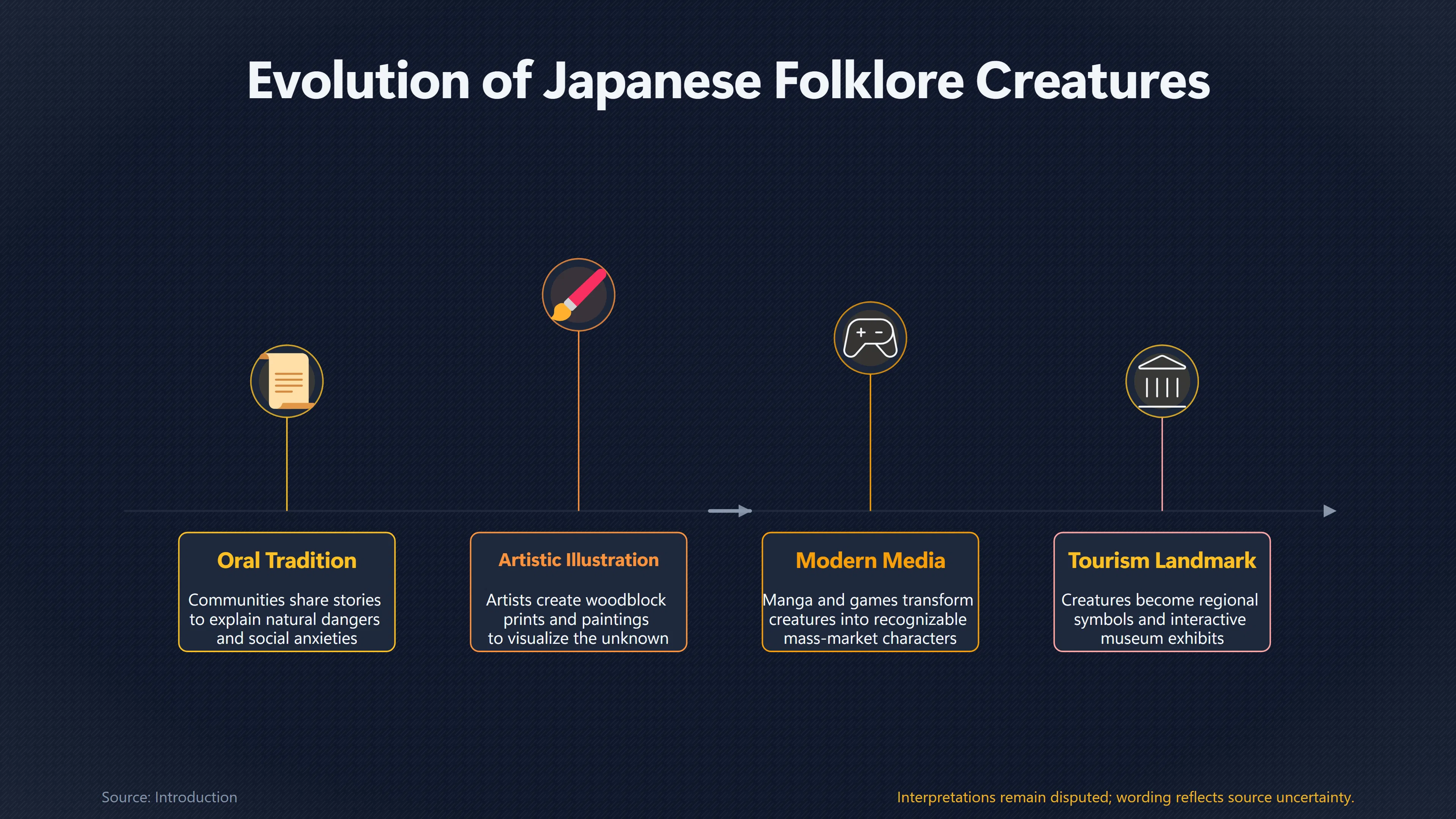
This process does not simply replace folklore with fiction. Instead, entertainment becomes another stage in the life of the legend. A creature may begin as a warning story, become an illustrated character, appear in a television series, and later return as a museum exhibit or tourism mascot.
The same pattern can be seen with other Japanese monster-related media. Games and films often borrow creature designs and ideas from folklore, introducing them to international audiences while reshaping their meanings. A modern audience may encounter a monster first through entertainment and only later discover its connection to older traditions.[Japan Travel]japan.travelGhost stories: What is a 'yokai' and why is it important, with artist Chubei Yagyu | Blog | Travel Japan (Japan National Tourism Organiza…
The appeal of monsters without belief
The popularity of monster attractions does not depend on widespread belief that the creatures are physically real. Their appeal comes from their ability to represent ideas that remain meaningful: fear of the unknown, respect for nature, humour, curiosity, and the fascination of things that sit between ordinary and extraordinary.
The revival of Amabie, a nineteenth-century creature associated in folklore with protection from epidemics, shows how an old supernatural image can take on new cultural roles. During the COVID-19 pandemic, artists and the public reused the creature as a symbol of hope and creativity rather than as a proven medical solution.[The New Yorker]newyorker.comThe New Yorker From Japan, a Mascot for the PandemicAmid the COVID-19 pandemic, Japanese have turned to a 19th-century folklore character, Amabié, a mermaid-like yokai with the power to war…
This example illustrates the wider mechanism behind Japanese monster culture. The creature survives because people continue to reinterpret it. Folklore provides the foundation, but modern society decides what the monster means next.
Separating folklore from claims of proof
Collections preserve belief, not confirmation
Monster displays require careful interpretation because they exist in a space where history, storytelling, tourism, and entertainment overlap. A museum may preserve a centuries-old drawing of a creature without claiming the creature existed. A themed attraction may celebrate a legend without presenting it as a scientific fact.
This distinction is central to understanding Japan’s monster collections. Their value comes from documenting human responses to mystery. The object on display is often not the monster itself, but the artwork, story, performance, or tradition created around it.[Miyoshi DMO]miyoshi-dmo.jpMiyoshi Association of Tourism and Town Development Official WebsiteMiyoshi Association of Tourism and Town Development Official WebsiteJ…
For visitors, this makes these attractions different from exhibitions based on confirmed historical objects or scientific specimens. The question is not “Was this monster real?” but “Why did people imagine this monster, preserve it, and continue telling its story?”
The tension between authenticity and entertainment
Commercial success creates both opportunities and risks. Turning monsters into attractions helps protect folklore and introduces it to wider audiences, but it can also simplify complicated traditions into recognisable characters or tourist products.
The strongest collections avoid this problem by showing multiple layers: older artworks, historical explanations, regional stories, and modern interpretations. The result is not a choice between serious folklore and popular entertainment. Instead, it shows how the two have repeatedly influenced each other.
Japan’s monster attractions are therefore best understood as living archives of imagination. They preserve legends while accepting that legends change. Their unusual quality comes from this balance: a creature can be a subject of research, a symbol of local identity, a character in entertainment, and a reminder of how humans make meaning from mystery.
Amazon book picks
Further Reading
Books and field guides related to When Japanese Monsters Become Public Attractions. Use these as the next step if you want deeper reading beyond the article.
The Book of Yokai: Mysterious Creatures of Japanese Folklore
Monsters, ghosts, fantastic beings, and supernatural phenomena of all sorts haunt the folklore and popular culture of Japan. Broadly labe...
Yokai Attack!: The Japanese Monster Survival Guide
Yokai Attack! is a nightmare-inducing one-stop guide to Japan's traditional monsters and creepy-crawlies. Yokai are ethereal sorts of bei...
Pandemonium and Parade: Japanese Monsters and the Culture of...
Monsters known as yōkai have long haunted the Japanese cultural landscape. This history of the strange and mysterious in Japan seeks out...
The Japanese Mind: Understanding Contemporary Japanese Culture
Offers Westerners an invaluable key to the unique aspects of Japanese culture
eBay marketplace picks
Marketplace Samples
Live-tested eBay searches with available results related to this page.
Selected fromfolklore poster oneBay.co.uk.

Endnotes
1.
Source: miyoshi-dmo.jp
Link:https://www.miyoshi-dmo.jp/en/miyoshi-mononoke-museum/
Source snippet
Miyoshi Association of Tourism and Town Development Official WebsiteMiyoshi Association of Tourism and Town Development Official WebsiteJ...
2.
Source: nippon.com
Title: “Yōkai”: Illuminating the History of Japan’s Imaginary Beasts | Nippon.com
Link:https://www.nippon.com/en/japan-topics/b02504/
Source snippet
Nippon“Yōkai”: Illuminating the History of Japan’s Imaginary Beasts | Nippon.com...
3.
Source: jpf.go.jp
Title: The Japan Foundation
Link:https://www.jpf.go.jp/e/project/culture/exhibit/traveling/yokai_parade.html
Source snippet
Yokai Parade: Supernatural Monsters from Japan...
4.
Source: mizuki.sakaiminato.net
Title: 水木しげる記念館水木しげるロード | 水木しげる記念館
Link:https://mizuki.sakaiminato.net/road/
5.
Source: japan.travel
Link:https://www.japan.travel/en/uk/inspiration/what-is-a-yokai-chubei-yagyu/
Source snippet
Ghost stories: What is a 'yokai' and why is it important, with artist Chubei Yagyu | Blog | Travel Japan (Japan National Tourism Organiza...
6.
Source: miyoshi-dmo.jp
Title: Miyoshi Mononoke Museum: Enter the World of Japanese Monsters and Ancient Lore
Link:https://www.miyoshi-dmo.jp/en/mononoke-museum/
7.
Source: japan.travel
Title: Mt. Mihara | Travel Japan
Link:https://www.japan.travel/en/spot/1724/
8.
Source: japan.travel
Title: Godzilla Rock | Travel Japan
Link:https://www.japan.travel/en/spot/518/
9.
Source: Wikipedia
Title: Shigeru Mizuki
Link:https://en.wikipedia.org/wiki/Shigeru_Mizuki
10.
Source: newyorker.com
Title: The New Yorker From Japan, a Mascot for the Pandemic
Link:https://www.newyorker.com/culture/cultural-comment/from-japan-a-mascot-for-the-pandemic
Source snippet
Amid the COVID-19 pandemic, Japanese have turned to a 19th-century folklore character, Amabié, a mermaid-like yokai with the power to war...
11.
Source: the-kansai-guide.com
Title: Mizuki Shigeru Road | Official Kansai Tourism Information | The KANSAI Guide
Link:https://www.the-kansai-guide.com//en/directory/item/11635/
Source snippet
The Origin of Japan, KANSAIJuly 15, 2026 — Image: Mizuki Shigeru Road MIZUKI SHIGERU ROAD Last update 15 Jul 2026 This page provides offi...
Published: July 15, 2026
12.
Source: etnografiskamuseet.se
Link:https://www.etnografiskamuseet.se/en/exhibitions/yokai2/
13.
Source: ba.jpf.go.jp
Title: jpf.go.jp Traveling exhibition “Yokai Parade: Supernatural Monsters from Japan”
Link:https://ba.jpf.go.jp/en/yokai_parade-2/
14.
Source: gegegenokitaro.fandom.com
Title: Shigeru Mizuki
Link:https://gegegenokitaro.fandom.com/wiki/Shigeru_Mizuki
15.
Source: ny.jpf.go.jp
Title: yokai parade supernatural monsters from japan
Link:https://ny.jpf.go.jp/event/yokai-parade-supernatural-monsters-from-japan/
16.
Source: tottori-tour.jp
Link:https://www.tottori-tour.jp/en/sightseeing/835/
17.
Source: mlit.go.jp
Link:https://www.mlit.go.jp/tagengo-db/en/R2-01660.html
18.
Source: viamichelin.co.uk
Title: Mizuki Shigeru Road
Link:https://www.viamichelin.co.uk/maps/tourist-attractions/poi/sakaiminato-_-d7450105a5cb
Additional References
19.
Source: wired.com
Link:https://www.wired.com/story/ghostwire-tokyo-japanese-folklore-yokai-yurei
Source snippet
Devoted to authentically representing Tokyo's unique blend of modernity and history, the game features a variety of iconic spirits from J...
20.
Source: youtube.com
Link:http://www.youtube.com/watch?v=6P5Gwka0QcA
Source snippet
🇯🇵 Paranormal Borders: Japan's Yokai Culture & Immersive Experience Exhibition...
21.
Source: youtube.com
Title: 🇯🇵 Paranormal Borders: Japan’s Yokai Culture & Immersive Experience Exhibition
Link:http://www.youtube.com/watch?v=amZwn47cpV8
Source snippet
The World of Yōkai − Mysterious Spirit Allies...
22.
Source: youtube.com
Title: Kyoto | Yokai Town
Link:http://www.youtube.com/watch?v=CgD-hrwBv-Y
Source snippet
"Miyoshi Mononoke Museum" OR "Japan Yokai Museum" 広島・三次の「もののけミュージアム」入館者40万人達成 広島市のカップルに記念品 開館5年、妖怪の魅力発信続く RCC NEWS DIG Powered by JNN...
23.
Source: youtube.com
Title: The World of Yōkai − Mysterious Spirit Allies
Link:http://www.youtube.com/watch?v=X9uJWsangXQ
Source snippet
Step Inside the Mizuki Shigeru Museum | Full Walkaround & Tour [HD]...
24.
Source: nijigennomori.com
Link:https://www.nijigennomori.com/en/2026/02/15/godzilla-964/
25.
Source: nakaumi.jp
Link:https://www.nakaumi.jp/sanin-japan/guide/
26.
Source: into-you.jp
Link:https://www.into-you.jp/en/places/6817/
27.
Source: tottori-tour.jp
Link:https://www.tottori-tour.jp/en/sightseeing/837/
28.
Source: tokyoweekender.com
Link:https://www.tokyoweekender.com/location/mizuki-shigeru-road/