Where Djibouti Keeps Its Strangest History
Djibouti does not have a well-documented circuit of witchcraft museums, medical oddity collections or commercial cabinets of curiosity.
Page outline Jump by section
Introduction
Djibouti does not have a well-documented circuit of witchcraft museums, medical oddity collections or commercial cabinets of curiosity. Its stranger heritage is found elsewhere: prehistoric animal carvings spread across black volcanic rock, vast fields of enigmatic stone tombs, archaeological objects only recently brought into national conservation facilities, a memorial devoted to a colonial barrier that once divided the capital, and landscapes so unusual that they function like open-air museums.
For visitors, the crucial distinction is between institutions that clearly exist in law, places that are publicly interpreted, and attractions repeated on travel websites without reliable evidence of opening hours, permanent galleries or professional curation. Djibouti’s unusual collections culture is real, but still developing. It is strongest where archaeology, memory, geology and oral testimony meet, rather than in conventional rooms filled with labelled curiosities.[journalofficiel.dj]journalofficiel.djeJO - Journal Officiel de DjiboutiDécret n° 2021-093/PR/MAMCBW portant organisation et fonctionnement du Musée National de Djibouti (MND)…
Is there a strange museum scene in Djibouti?
There is no strong evidence that Djibouti currently supports a dedicated museum of folklore, magic, monsters, crime, death or unexplained phenomena. Search results sometimes advertise an “Ahmed Nasser Museum”, an ethnographic museum in Ali Sabieh or richly stocked national galleries, but these claims are generally found on automated travel directories and commercial listing sites rather than official museum pages, cultural authority records or detailed first-hand reports. Such listings should not be treated as proof that a dependable visitor attraction exists.
The National Museum of Djibouti is more firmly grounded. A 2021 government decree established it as an autonomous public cultural institution under the ministry responsible for culture. Its duties include protecting collections connected with the country’s arts and civilisations, organising exhibitions and educational activities, and supporting research. The decree also transferred the former Djibouti railway station’s property to the museum and directed that archaeological collections held by the Centre for Studies and Research of Djibouti be transferred to it.[eJO - Journal Officiel de Djibouti]journalofficiel.djeJO - Journal Officiel de DjiboutiDécret n° 2021-093/PR/MAMCBW portant organisation et fonctionnement du Musée National de Djibouti (MND)…
That legal framework is significant, but it is not the same thing as a detailed visitor guide. Reliable public information about permanent displays, admission arrangements, accessibility and regular opening hours remains limited. Travellers should therefore regard the National Museum as an institution in development and confirm access locally rather than relying on generic tourism pages.
This uncertainty is itself part of Djibouti’s museum story. The country possesses substantial archaeological and historical material, yet much of the work still centres on inventory, conservation, research and institution-building. A new national heritage law adopted in 2025 explicitly covers archaeological finds, rare scientific specimens, ethnographic objects, historic photographs, manuscripts, religious material, colonial buildings and even underwater remains. It also provides for a national digital platform to document and publicise cultural heritage.[eJO - Journal Officiel de Djibouti]journalofficiel.djeJO - Journal Officiel de DjiboutiLoi n° 208/AN/25/9ème L relatif au patrimoine culturel national de la République de Djibouti. - eJO…
Abourma: a mountain as a picture archive
The rock art of Abourma is Djibouti’s clearest answer to an open-air collection of strange and arresting images. Located in the Tadjourah region on the Makarrassou massif, it consists of extensive prehistoric engravings cut into basalt surfaces. Djibouti’s submission to UNESCO describes thousands of images extending across roughly three kilometres, including hunters, fighters, livestock and wild animals.[UNESCO World Heritage Centre]whc.unesco.orgWorld Heritage Centre Les Gravures Rupestre d’AbourmaUNESCO World Heritage CentreLes Gravures Rupestre d’Abourma - UNESCO World Heritage Centre…
What makes the site remarkable is the mismatch between the pictures and the present landscape. Elephants, giraffes, hippopotamuses, rhinoceroses and antelope appear on rocks in a country now associated with severe heat, lava fields and arid plains. The carvings are therefore more than early art: they form a visual record of changing climate, animal life and human subsistence. Images of cattle, goats, camels, hunting and conflict also suggest that the surface accumulated scenes over a long period rather than being created as one planned composition.[unesco.org]whc.unesco.orgWorld Heritage Centre Les Gravures Rupestre d’AbourmaUNESCO World Heritage CentreLes Gravures Rupestre d’Abourma - UNESCO World Heritage Centre…
Abourma should not be described as an unexplained archaeological anomaly. The broad scholarly interpretation connects its imagery with prehistoric and pastoral communities of the Horn of Africa. However, dating individual engravings and separating different artistic phases are more difficult than promotional descriptions sometimes imply. Even UNESCO’s tentative-list text is a nomination statement submitted by the state, not a final judgement by the World Heritage Committee.
The site entered Djibouti’s UNESCO tentative list in 2015. More recently, international heritage work identified Abourma as the country’s strongest candidate for a first World Heritage nomination, and preparation of the dossier has continued with technical assistance. Djibouti still had no inscribed World Heritage property at the time of that work, so descriptions calling Abourma an existing World Heritage Site are incorrect.[UNESCO World Heritage Centre]whc.unesco.orgWorld Heritage Centre Les Gravures Rupestre d’AbourmaUNESCO World Heritage CentreLes Gravures Rupestre d’Abourma - UNESCO World Heritage Centre…
Visiting is closer to an archaeological expedition than a museum trip. The carvings are remote, exposed and spread through difficult terrain. There is no reason to expect the infrastructure, guardrails or interpretive panels of a major European rock-art park. A knowledgeable guide is important both for finding the panels and for avoiding damage to an exceptionally vulnerable archive.
The awellos: Djibouti’s fields of stone tombs
Djibouti’s prehistoric burial mounds, commonly known as awellos, supply the country’s most mysterious-looking archaeological landscape. These circular or raised stone monuments occur in large numbers and are sufficiently important to have been placed on Djibouti’s UNESCO tentative list in 2015.[UNESCO World Heritage Centre]whc.unesco.orgWorld Heritage Centre DjiboutiWorld Heritage Centre Djibouti
To an unprepared visitor, the structures can resemble collapsed huts, ritual platforms or deliberately arranged heaps of volcanic stone. Their real interest lies in their funerary function and distribution. Rather than a single royal necropolis, they form a wider tradition of marking the dead across the landscape. Differences in construction, size and setting may reflect chronological, regional or social distinctions, although many individual monuments remain inadequately excavated.
The awellos therefore occupy an appealing but delicate position in Djibouti’s curiosity culture. They are genuinely enigmatic because systematic evidence is incomplete, not because archaeologists have discovered impossible technology or supernatural burials. Claims that confidently assign them to a lost civilisation should be treated with caution unless supported by excavation reports, dating evidence and documented finds.
Objects recovered from burial and settlement sites are increasingly important to Djibouti’s developing national collections. A Franco-Djiboutian research programme has examined the shift from hunting and gathering to herding around the Lake Abbe region, while the national archaeological institute has been building systems for recording, conserving and studying material from excavations.[univ-tlse2.fr]traces.univ-tlse2.frCauliez et X. Gutherz ed. - TRACES: UMR 5608Cet ouvrage est le fruit d’une longue et étroite collaboration entre une équipe française di…
Where the archaeological objects are kept
One of Djibouti’s most important collections is not primarily presented as a tourist spectacle. The Institute of Archaeological and Historical Research, part of the Centre for Studies and Research of Djibouti, was formally created in 2014. It works with national and international researchers on archaeology, environmental history and the region’s early pastoral societies.[journalofficiel.dj]journalofficiel.djOpen source on journalofficiel.dj.
A dedicated conservation and study centre has also received archaeological objects previously held in France. This matters because excavation finds require stable storage, cataloguing and scientific access long before they can appear in a polished public gallery. Ceramics, stone tools, animal remains, ornaments and burial material may seem less dramatic in storage trays than in an “ancient mysteries” display, but their recorded context is what makes them useful.[La Nation]lanation.djOpen source on lanation.dj.
The National Museum decree attempted to bring these holdings into a broader museum structure by transferring Djiboutian excavation collections previously managed by the research centre. The intended model is therefore a national repository linked to education, exhibitions and research, rather than a private cabinet assembled for novelty.[eJO - Journal Officiel de Djibouti]journalofficiel.djeJO - Journal Officiel de DjiboutiDécret n° 2021-093/PR/MAMCBW portant organisation et fonctionnement du Musée National de Djibouti (MND)…
For the curious traveller, this means that Djibouti’s most significant archaeological collection may be easier to understand through research publications and heritage programmes than through a guaranteed walk-in exhibition. It also explains why online travel descriptions often overstate what is currently available: they confuse the existence of important collections with the existence of a fully accessible permanent museum.
A memorial to the barrier that divided a city
The Djibouti Barrier Memorial is the country’s most unusual clearly interpreted historical institution. It is devoted to the fortified barrier erected by the French colonial administration in 1966, when fencing, mines and electrified wire divided the capital. According to the memorial’s account, the system extended for 14.5 kilometres and remained a defining feature of urban life until independence in 1977.[La Nation]lanation.djOpen source on lanation.dj.
This is not an eccentric museum in the playful sense. Its strangeness comes from the object of commemoration: an apparatus of urban separation that survives through photographs, documents, testimony and collective memory rather than as an ordinary collection of decorative artefacts.
The permanent presentation uses archival images, contemporary French press material, audiovisual records and accounts from residents who experienced the divided city. Guided visits and testimony-led interpretation place the barrier within the history of colonial control, resistance and independence. By early 2026, the memorial reported that it had received 1,280 pupils from 44 schools since opening in 2022.[La Nation]lanation.djOpen source on lanation.dj.
In June 2025, it also launched a digital memory platform intended to gather and circulate further testimony, documents and personal narratives. This makes the memorial part museum, part archive and part oral-history project. Its credibility rests on identifiable historical events and documentary collections, although, like many national memorials, it also presents the past through the country’s official commemorative framework.[La Nation]lanation.djOpen source on lanation.dj.
For visitors interested in prisons, borders, bunkers and other institutions of state control, this is Djibouti’s closest equivalent to a specialist museum of difficult history.
Lake Abbe: a geological cabinet of monsters
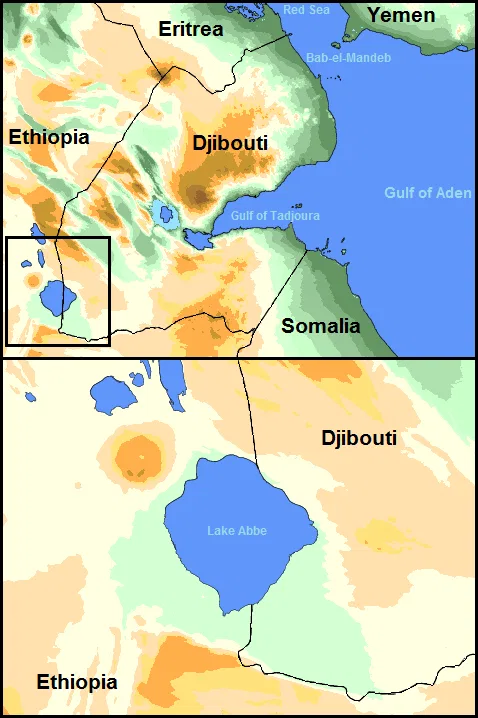
Lake Abbe is not a museum, yet it is probably Djibouti’s most famous collection of natural curiosities. Its forest of carbonate chimneys rises from an intensely hot, saline landscape near the Ethiopian border. Steam, mineral deposits, sulphurous smells and flamingos combine to create scenery often compared with a different planet.[youfoundsarah.com]youfoundsarah.comYou Found Sarah Visiting the Moonscape of Lake AbbeYou Found Sarah Visiting the Moonscape of Lake Abbe
The chimneys are not petrified creatures, ruins or artificial towers. They formed through interactions between geothermal fluids and lake water in an active rift environment. Some vents continue to release steam, giving the formations an animated appearance that has encouraged science-fiction comparisons and exaggerated “alien landscape” marketing.[Wikipedia]WikipediaLake AbbeLake Abbe
Its connection with curiosity culture lies in the experience of moving through a natural collection without cases or labels. Each tower has an irregular form: clustered spires, eroded cones, hollow openings and mineral-crusted channels. The landscape displays geological processes at monumental scale, but interpretation on the ground is limited. Visitors depend heavily on guides, and the absence of boardwalks or controlled routes means that hot ground and vents require care.[YouFoundSarah]youfoundsarah.comYou Found Sarah Visiting the Moonscape of Lake AbbeYou Found Sarah Visiting the Moonscape of Lake Abbe
Lake Abbe is frequently packaged with Lake Assal and volcanic sites on guided four-wheel-drive trips. This commercialisation can make it sound like a theme-park moonscape, but its scientific value and physical hazards are real. The best interpretation avoids both mystical invention and sterile geology: the site matters because an active landscape has produced forms that genuinely look sculpted, architectural and uncanny.
Living heritage rather than glass cases
Djibouti’s unusual collections cannot be understood entirely through objects. Oral poetry, family history, food customs, craft knowledge and ceremonial practices remain important forms of transmission. The country’s heritage legislation explicitly recognises oral traditions, rituals, knowledge of nature, traditional subsistence, craft skills and “living human treasures” as part of the national patrimony.[eJO - Journal Officiel de Djibouti]journalofficiel.djeJO - Journal Officiel de DjiboutiLoi n° 208/AN/25/9ème L relatif au patrimoine culturel national de la République de Djibouti. - eJO…
A prominent example is the wedding-related practice inscribed by UNESCO in 2023 as Djibouti’s first element on the Representative List of the Intangible Cultural Heritage of Humanity. It centres on a decorated container prepared by the bride’s mother and filled with foods and gifts associated with marriage, hospitality and family relationships. The significance lies not merely in the container as an attractive object, but in the knowledge, social obligations and performance surrounding its preparation and presentation.[UNESCO]unesco.orgOpen source on unesco.org.
This offers a useful warning for anyone looking for “tribal curiosities”. Removing an object from its ceremony and presenting it as an exotic artefact can flatten its meaning. Djibouti’s emerging museum system increasingly treats songs, testimony, craftsmanship and food practices as heritage that must be documented alongside physical objects.
Small displays of baskets, wooden vessels, mats, leatherwork and other Somali or Afar material culture do exist, including privately hosted selections. One digital heritage project, for example, documents Djiboutian objects displayed inside a luxury hotel. Such a display may be publicly viewable in practice, but it is neither equivalent to a national museum nor necessarily curated with the provenance, conservation standards and interpretation expected of a research institution.[hornheritage.org]hornheritage.orgDjibouti ArtifactsDjibouti Artifacts
What a curious visitor can realistically expect
Djibouti rewards travellers who are comfortable with heritage that is dispersed, lightly interpreted and sometimes difficult to access. The strongest possibilities are:
- For prehistoric imagery: Abourma, with a specialist guide and realistic expectations about terrain.
- For archaeological mystery: awello burial landscapes, approached as protected funerary archaeology rather than treasure sites.
- For difficult modern history: the Djibouti Barrier Memorial and its documentary and oral-history collections.
- For natural oddities: Lake Abbe’s geothermal chimneys, normally reached by an organised four-wheel-drive journey.
- For formal collections: the National Museum and national archaeological institutions, but only after confirming current public access directly.
- For living traditions: cultural programmes and community events that retain the connection between objects, skills and ceremony.
Visitors should be cautious of pages that provide confident descriptions of unnamed galleries, extensive collections or precise visitor facilities without identifying an official operator. The safest evidence is an institutional decree, ministry announcement, UNESCO record, research programme or detailed report from the organisation itself.
Djibouti’s strange-history landscape is not built around sensational relics. Its appeal comes from more substantial tensions: prehistoric animals carved into a now-arid landscape, tombs whose chronology is still being assembled, artefacts moving from foreign research stores into national custody, personal memories becoming public archives, and geological towers marketed as fantasy while remaining products of measurable natural processes.
The result is a curiosity culture that feels unfinished but not empty. Djibouti is gradually turning landscapes, excavation archives, testimony and living traditions into a national system of preservation. For the offbeat traveller, the most memorable “museum” may therefore be a mountain face, a field of stone graves, a former line of colonial division or a steaming tower beside a salt lake.

Amazon book picks
Further Reading
Books and field guides related to Where Djibouti Keeps Its Strangest History. Use these as the next step if you want deeper reading beyond the article.
African Archaeology: A Critical Introduction
A landmark introduction to the archaeology of Africa that challenges misconceptions & claims about Africa’s past and teaches students how...
The Archaeology of Africa: Food, Metals and Towns
Africa has a vibrant past. It emerges from this book as the proud possessor of a vast and highly complicated interweaving of peoples and...
A History of Archaeological Thought
First published 1989. Subjects: Archaeology, History, Philosophy, Methodologie, Archeologie.
eBay marketplace picks
Marketplace Samples
Live-tested eBay searches with available results related to this page.
Selected fromDjibouti map print oneBay.co.uk.
Endnotes
1.
Source: whc.unesco.org
Link:https://whc.unesco.org/en/news/2815
Source snippet
The workshop built on earlier technical studies conducted with ICOMOS and IUCN, which had identified the Rock Art of Abourma as the count...
2.
Source: whc.unesco.org
Title: World Heritage Centre Les Gravures Rupestre d’Abourma
Link:https://whc.unesco.org/en/tentativelists/5957/
Source snippet
UNESCO World Heritage CentreLes Gravures Rupestre d’Abourma - UNESCO World Heritage Centre...
3.
Source: whc.unesco.org
Title: World Heritage Centre Djibouti
Link:https://whc.unesco.org/en/statesparties/dj/
4.
Source: unesco.org
Link:https://www.unesco.org/en/articles/djibouti-receives-support-preparation-first-world-heritage-nomination-file
5.
Source: youfoundsarah.com
Title: You Found Sarah Visiting the Moonscape of Lake Abbe
Link:https://youfoundsarah.com/lake-abbe-djibouti/
6.
Source: Wikipedia
Title: Lake Abbe
Link:https://en.wikipedia.org/wiki/Lake_Abbe
7.
Source: unesco.org
Link:https://www.unesco.org/en/articles/xeedho-first-intangible-cultural-heritage-treasure-djibouti-be-inscribed-unescos-world-heritage-list
8.
Source: hornheritage.org
Title: Djibouti Artifacts
Link:https://www.hornheritage.org/djibouti-artifacts/
9.
Source: unesco.org
Title: djibouti considers nominating abourma rock art site unesco world heritage list
Link:https://www.unesco.org/en/articles/djibouti-considers-nominating-abourma-rock-art-site-unesco-world-heritage-list
10.
Source: whc.unesco.org
Link:https://whc.unesco.org/fr/listesindicatives/5957
11.
Source: whc.unesco.org
Link:https://whc.unesco.org/en/tentativelists/action%3Dlisttentative%26order%3Dstates%26state%3Ddj
12.
Source: whc.unesco.org
Link:https://whc.unesco.org/fr/listesindicatives/%3F%26%26%26%26action%3Dlisttentative%26state%3Ddj%26
13.
Source: whc.unesco.org
Link:https://whc.unesco.org/en/tentativelists/5956/
14.
Source: unesco.org
Title: djibouti reviews its potential world heritage sites
Link:https://www.unesco.org/en/articles/djibouti-reviews-its-potential-world-heritage-sites
15.
Source: whc.unesco.org
Link:https://whc.unesco.org/fr/etatsparties/dj/
18.
Source: Wikipedia
Title: Djibouti Museum
Link:https://en.wikipedia.org/wiki/Djibouti_Museum
19.
Source: museum.ie
Title: African Collections
Link:https://www.museum.ie/collections/collections-and-research/ethnographic/collections/africa/
20.
Source: african.business
Title: a tourism gem in the rough awaiting polishing
Link:https://african.business/2025/04/long-reads/a-tourism-gem-in-the-rough-awaiting-polishing
21.
Source: djibouti.ch
Title: AMBASSAD E DE LA REPUBLIQUE DE DJIBOUTI
Link:https://djibouti.ch/ambassade/index.php/Tourisme/AliSabieh
22.
Source: djibouti.ch
Title: AMBASSAD E DE LA REPUBLIQUE DE DJIBOUTI
Link:https://www.djibouti.ch/ambassade/index.php/Ambassade/Ambassade
23.
Source: djibouti.ch
Title: AMBASSAD E DE LA REPUBLIQUE DE DJIBOUTI
Link:https://www.djibouti.ch/ambassade/index.php/Ambassade/Consulat
24.
Source: journalofficiel.dj
Link:https://www.journalofficiel.dj/arabe/texte-juridique/decret-n2021-093-pr-mamcbw-portant-organisation-et-fonctionnement-du-musee-national-de-djibouti-mnd/
Source snippet
eJO - Journal Officiel de DjiboutiDécret n° 2021-093/PR/MAMCBW portant organisation et fonctionnement du Musée National de Djibouti (MND)...
25.
Source: lanation.dj
Link:https://www.lanation.dj/un-lieu-une-histoire-le-memorial-du-barrage-de-djibouti-eega-gardien-de-la-memoire-nationale-et-passeur-dhistoire/
26.
Source: journalofficiel.dj
Link:https://www.journalofficiel.dj/arabe/texte-juridique/loi-n208-an-25-9eme-l-relatif-au-patrimoine-culturel-national-de-la-republique-de-djibouti/
Source snippet
eJO - Journal Officiel de DjiboutiLoi n° 208/AN/25/9ème L relatif au patrimoine culturel national de la République de Djibouti. - eJO...
27.
Source: traces.univ-tlse2.fr
Link:https://traces.univ-tlse2.fr/accueil/agenda-traces/djibouti-des-paysages-et-des-hommes-regards-sur-le-patrimoine-archeologique-du-lac-abhe-j-cauliez-et-x-gutherz-ed
Source snippet
Cauliez et X. Gutherz ed. - TRACES: UMR 5608Cet ouvrage est le fruit d’une longue et étroite collaboration entre une équipe française di...
28.
Source: archeologie.culture.gouv.fr
Link:https://archeologie.culture.gouv.fr/monde/fr/djibouti-des-derniers-chasseurs-cueilleurs-aux-premiers-eleveurs
Source snippet
ArchéologieDjibouti: des derniers chasseurs-cueilleurs aux premiers éleveurs | Archéologie française dans le mondeLe programme constitue...
29.
Source: archeologie.culture.gouv.fr
Link:https://archeologie.culture.gouv.fr/fr/la-mission-premieres-societes-de-production-dans-la-corne-de-lafrique
30.
Source: lanation.dj
Link:https://www.lanation.dj/cerd-institut-de-recherches-archeologiques-et-historiques-atelier-sur-la-methodologie-et-gestion-des-donnees-en-archeologie-et-ethnohistoirecerd-institut-de-recherches-archeologiques-et-historiq/
31.
Source: journalofficiel.dj
Link:https://www.journalofficiel.dj/arabe/texte-juridique/decret-n2014-272-pr-mensur-portant-creation-de-linstitut-de-recherches-archeologiques-et-historiques-au-centre-detudes-et-de-recherche-de-djibouti/
32.
Source: lanation.dj
Link:https://www.lanation.dj/un-centre-de-conservation-et-detudes-des-collections-archeologiques-pour-sauvegarder-le-patrimoine-national-du-pays/
33.
Source: newafricanmagazine.com
Title: the seven wonders of djibouti
Link:https://newafricanmagazine.com/society/the-seven-wonders-of-djibouti/
34.
Source: lanation.dj
Title: ali sabieh cinquieme edition de la foire regionale
Link:https://www.lanation.dj/ali-sabieh-cinquieme-edition-de-la-foire-regionale/
35.
Source: lanation.dj
Link:https://www.lanation.dj/atelier-dinventaire-pilote-participatif-du-patrimoine-culturel-immateriel-de-la-communaute-somalie-a-ali-sabieh/
36.
Source: journalofficiel.dj
Title: Loi n° 81/AN/00/4ème L portant création du Musée de Djibouti
Link:https://www.journalofficiel.dj/arabe/texte-juridique/loi-n81-an-00-4eme-l-portant-creation-du-musee-de-djibouti/
37.
Source: lanation.dj
Link:https://www.lanation.dj/inauguration-du-grand-musee-degypte-le-president-ismail-omar-guelleh-au-caire-pour-valoriser-lheritage-millenaire-de-lhumanite/
38.
Source: doseeafrica.com
Link:https://doseeafrica.com/tabs/?country=null&dkWqrd=15&type=country
39.
Source: sammlungen.ub.uni-frankfurt.de
Title: de Djibouti
Link:https://sammlungen.ub.uni-frankfurt.de/kolonialesbildarchiv/nav/cloud/place?query=Djibouti
40.
Source: peabody.harvard.edu
Link:https://peabody.harvard.edu/africa
Additional References
41.
Source: youtube.com
Title: Stories on stones: The hidden rock engravings of Abourma in Djibouti
Link:https://www.youtube.com/watch?v=7cWp3t-g3T8
Source snippet
How did 3,600 African objects arrive in France? The Dakar-Djibouti Mission...
42.
Source: arxiv.org
Link:https://arxiv.org/abs/2406.16451
43.
Source: youtube.com
Title: How did 3,600 African objects arrive in France? The Dakar-Djibouti Mission
Link:https://www.youtube.com/watch?v=wIrHlGg78uI
Source snippet
Exploring the Mystical Beauty of Lake Abhe...
44.
Source: macrobians.com
Link:https://macrobians.com/tour-packages/2-days-lake-abbe-lake-assal-private-tour/
45.
Source: evendo.com
Link:https://evendo.com/locations/djibouti/arta-region/landmark/ahmed-nasser
46.
Source: evendo.com
Link:https://evendo.com/locations/djibouti/djibouti-region/landmark/ahmed-nasser
47.
Source: iziko.org.za
Link:https://www.iziko.org.za/collection/ancient-and-classical-cultures/
48.
Source: archiqoo.com
Link:https://archiqoo.com/sites/djibouti.php
49.
Source: cerd.dj
Link:https://www.cerd.dj/confirah.html
50.
Source: opulentroutes.com
Link:https://www.opulentroutes.com/services/cultural-heritage-tourism-in-djibouti/