Within Strange Morocco
When Moroccan Jewellery Was More Than Decoration
Moroccan jewellery can signal identity, status and marriage while also serving as a spiritual safeguard worn close to the body.
On this page
- Hands, Pendants and Protective Forms
- How Clothing and Placement Changed Meaning
- Reading Amulets Without Reducing Them to Superstition
Page outline Jump by section
Introduction
Moroccan jewellery has long been admired for its bold silverwork, colourful enamel and striking geometric forms, but many historic pieces were designed to do far more than decorate the body. Across different regions, jewellery communicated family background, marital status, wealth and community identity while also serving as a form of spiritual protection worn close to the skin. Modern museum displays increasingly present these objects as works of craftsmanship, yet their original wearers often understood them as practical safeguards against envy, misfortune and unseen danger as well as markers of belonging. Ethnographic collections, especially the National Jewellery Museum in Rabat, now face the challenge of presenting these multiple layers of meaning without reducing them either to simple fashion or to exotic tales of “magic”.[Wikipedia]WikipediaNational Jewellery Museum (MoroccoNational Jewellery Museum (Morocco

Hands, Pendants and Protective Forms
Protective jewellery in Morocco rarely relied on a single universal symbol. Instead, different communities combined shape, material, colour and placement to create layered meanings that varied across regions.
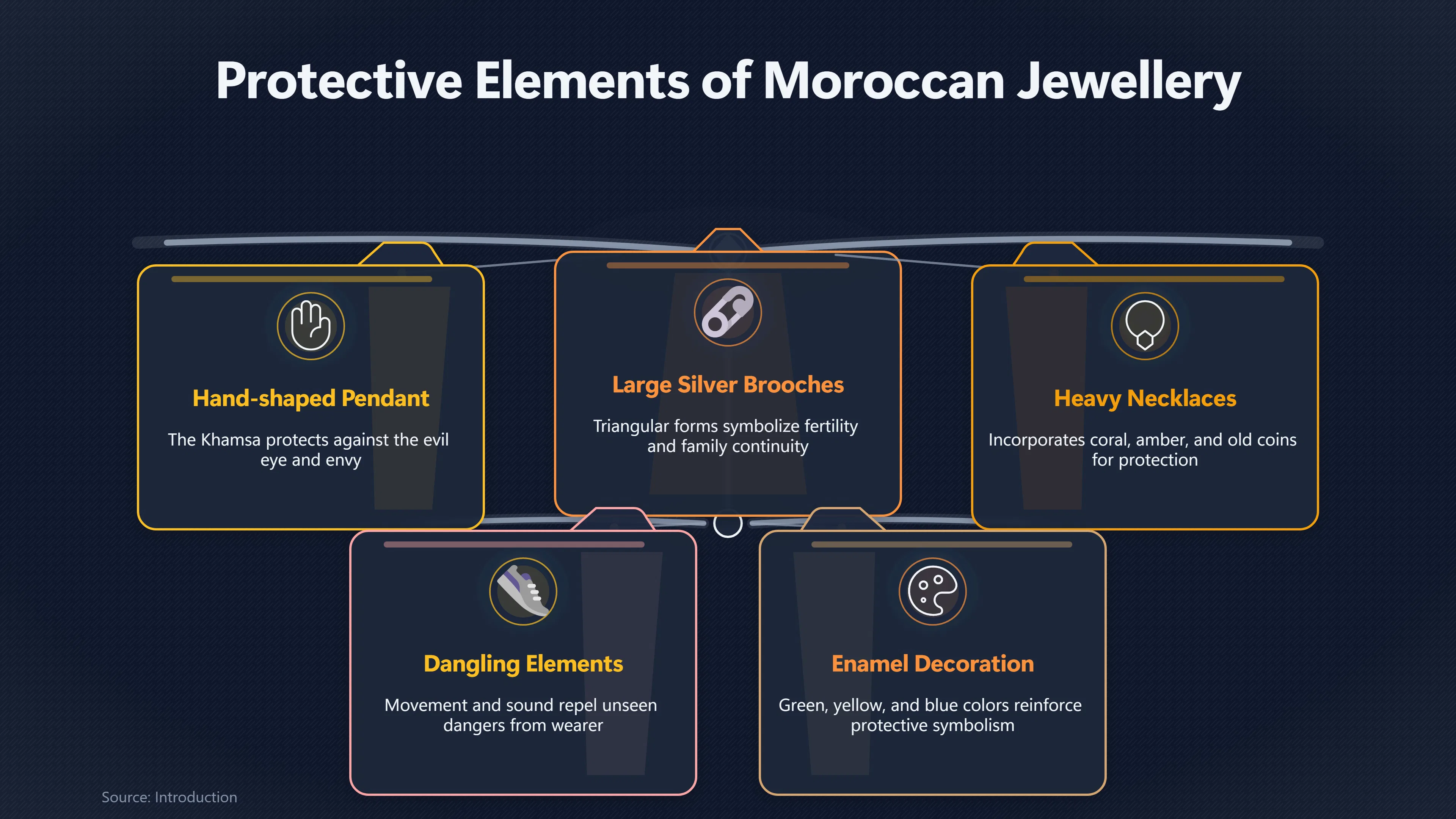
One of the best-known examples is the hand-shaped pendant commonly known as the Hand of Fatima or khamsa. Examples made in Morocco during the late nineteenth century survive in museum collections, where curators explain that the open hand was widely believed to protect against the “evil eye” or harmful envy. Rather than belonging exclusively to one religion, hand amulets were used across Muslim and Jewish communities in North Africa, illustrating how protective traditions often crossed religious boundaries.[British Museum]britishmuseum.orgBritish Museumpendant; amulet | British MuseumBritish Museumpendant; amulet | British Museum
Equally significant were large silver brooches used to fasten women’s garments. These were not merely functional clasps. Their triangular or diamond forms became associated with fertility, continuity of family lines and protection. A pair of brooches linked by chains across the chest could simultaneously secure clothing, display family wealth and act as an amulet believed to repel harmful influences.[Zevira]zevira.netBerber and Moroccan jewellery: silver and the symbols of…
Other recurring protective features included:
- Heavy silver necklaces incorporating coral, amber or old coins.
- Crescent or geometric pendants associated with regional identity.
- Enamel decoration in green, yellow or blue, colours that could reinforce protective symbolism alongside aesthetic appeal.
- Small dangling elements whose movement and sound were sometimes believed to distract or repel unseen dangers.[Zevira]zevira.netBerber and Moroccan jewellery: silver and the symbols of…
These pieces rarely had just one meaning. A necklace could function as family savings, bridal property, visible proof of status and a protective object at the same time.
How Clothing and Placement Changed Meaning
The power of traditional Moroccan jewellery depended not only on its design but also on where it was worn. Removing an object from its original clothing, as often happens in museum displays, can separate it from the system that originally gave it meaning.
Large shoulder brooches secured woven garments while visibly framing the upper body. Their position announced regional identity before a wearer spoke. Neck ornaments rested close to the chest, an area frequently associated with safeguarding the individual. Bracelets surrounded the wrists, while rings and earrings completed an arrangement in which protection was distributed across the body rather than concentrated in a single object.[Zevira]zevira.netBerber and Moroccan jewellery: silver and the symbols of…
Museum visitors sometimes assume these objects were selected individually like modern jewellery. In practice, many formed part of coordinated ensembles associated with particular life stages such as marriage, motherhood or ceremonial occasions. The complete arrangement communicated information that becomes harder to recognise once individual pieces are displayed in separate cases.
Material also mattered. In many Amazigh communities, silver enjoyed greater prestige than gold for ceremonial jewellery. Beyond economic considerations, silver was widely regarded as a purer and more protective material, while jewellery itself often represented a woman’s personal wealth that could be sold or exchanged if necessary. The distinction therefore reflected practical security as much as symbolic belief.[Zevira]zevira.netBerber and Moroccan jewellery: silver and the symbols of…

Reading Amulets Without Reducing Them to Superstition
Modern audiences often encounter protective jewellery through labels describing “charms” or “amulets”. While technically accurate, these descriptions can oversimplify objects that sat within complex social and religious worlds.
Many protective forms operated through shared cultural understandings rather than formal religious doctrine. Belief in protection from envy, misfortune or harmful intentions existed alongside everyday religious practice instead of replacing it. A hand-shaped pendant, for example, might be appreciated simultaneously as family heritage, regional craft, beautiful ornament and a reminder of divine protection. Museum interpretation increasingly reflects this complexity rather than presenting such objects simply as examples of folk superstition.[British Museum]britishmuseum.orgBritish Museumpendant; amulet | British MuseumBritish Museumpendant; amulet | British Museum
Scholars also caution against assigning fixed meanings to every geometric motif. Similar triangles, diamonds or crosses could carry different associations depending on locality, family tradition or historical period. Symbols that appear identical in museum cases may once have communicated different ideas to different communities.[Zevira]zevira.netBerber and Moroccan jewellery: silver and the symbols of…
This is especially important when interpreting ethnographic collections assembled during the colonial period. Early collectors often focused on visual style while recording only limited information about how individual families understood particular pieces. Contemporary curators increasingly place jewellery alongside photographs, clothing and oral histories to restore some of that missing context.[Wikipedia]WikipediaNational Jewellery Museum (MoroccoNational Jewellery Museum (Morocco
Why These Meanings Matter in Morocco’s Curiosity Landscape
Morocco’s unusual collections are distinctive because the extraordinary often hides within ordinary-looking objects. Protective jewellery illustrates this particularly well. A silver pendant displayed as decorative art may once have functioned simultaneously as inherited wealth, everyday clothing hardware, regional identity marker and spiritual safeguard.
For visitors interested in Morocco’s more curious heritage, jewellery collections reward slow observation rather than the search for spectacular relics. They reveal how ideas about protection, identity and community became embedded in everyday possessions, making seemingly familiar objects among the country’s most revealing cultural artefacts.
Seen in this light, Moroccan protective jewellery belongs naturally within the country’s wider landscape of unusual collections. Its fascination lies not in claims of supernatural power but in the way beautifully crafted objects carried multiple hidden meanings that only become visible once decoration, belief and daily life are understood together.
Amazon book picks
Further Reading
Books and field guides related to When Moroccan Jewellery Was More Than Decoration. Use these as the next step if you want deeper reading beyond the article.
Islamic Art and Spirituality
With remarkable breadth of vision, Seyyed Hossein Nasr reveals for both Western and Muslim readers how each art form in the islamic tradi...

Morocco: Courtyards and Gardens
First published 2007. Subjects: Courtyard gardens, Courtyards, Gardens, africa, Landscape gardening.
A History of Islamic Societies
Rating: 4.0/5 from 8 Google Books ratings
Ira Lapidus' classic history of the origins and evolution of Muslim societies, revised and updated for this second edition, first publish...
eBay marketplace picks
Marketplace Samples
Live-tested eBay searches with available results related to this page.
Selected fromMoroccan fashion accessories oneBay.co.uk.
Endnotes
1.
Source: Wikipedia
Title: National Jewellery Museum (Morocco)
Link:https://en.wikipedia.org/wiki/National_Jewellery_Museum_%28Morocco%29
2.
Source: zevira.net
Link:https://www.zevira.net/en/information/articles/berber-and-moroccan-jewellery-silver-and-the-symbols-of
Source snippet
Berber and Moroccan jewellery: silver and the symbols of...
3.
Source: zevira.net
Title: hamsa hand of fatima meaning guide
Link:https://www.zevira.net/en/information/articles/hamsa-hand-of-fatima-meaning-guide
4.
Source: britishmuseum.org
Title: British Museumpendant; amulet | British Museum
Link:https://www.britishmuseum.org/collection/object/W
5.
Source: britishmuseum.org
Title: British Museumpendant; amulet | British Museum
Link:https://www.britishmuseum.org/collection/object/W
6.
Source: islamicworld.britishmuseum.org
Title: Pendant, amulet
Link:https://islamicworld.britishmuseum.org/collection/RRM46563/
Source snippet
The British Museum: Islamic Gallery...
7.
Source: britishmuseum.org
Link:https://www.britishmuseum.org/collection/object/W_As1966
8.
Source: artgallery.yale.edu
Link:https://artgallery.yale.edu/collections/objects/122429
Additional References
9.
Source: azrarmarrakech.com
Link:https://azrarmarrakech.com/the-history-of-amazigh-jewelry-in-morocco-silver-symbols-heritage/
Source snippet
February 18, 2026 — THE HISTORY OF AMAZIGH JEWELRY IN MOROCCO – SILVER, SYMBOLS & HERITAGE Posted by Image: author-avatar azrarmarrakech...
Published: February 18, 2026
10.
Source: iwziwn.com
Title: Moroccan Jewelry: 11 Sacred True Meanings Behind Moroccan Silver Art
Link:https://www.iwziwn.com/moroccan-jewelry-silver-symbolism-heritage/
Source snippet
March 5, 2026 — MOROCCAN AMAZIGH JEWELRY – A LIVING CRAFT OF SILVER AND SYMBOLISM Byⵉⵡⵣⵉⵡⵏ iwziwn إوزيون September 4, 2025March 5, 2026 I...
Published: March 5, 2026
11.
Source: iwziwn.com
Title: The Hidden Meaning of Berber Symbols in Moroccan Art
Link:https://www.iwziwn.com/meaning-of-berber-symbols-moroccan-art/
Source snippet
October 19, 2025 — * * * JEWELRY: SILVER, SHAPE, AND SOCIAL GRAMMAR Image: amazigh berber jewelry symbolsamazigh berber jewelry symbols S...
Published: October 19, 2025
12.
Source: theheritagehandmade.com
Title: Why Are Amazigh (Berber) Symbols So Misunderstood?
Link:https://www.theheritagehandmade.com/es/blogs/moroccan-crafts/why-are-amazigh-berber-symbols-so-misunderstood-7-meanings-finally-explained
Source snippet
7 Meanings Explained – Heritage HandmadeSeptember 9, 2025 — Image: Authentic Amazigh Berber silver fibula jewelry with tribal symbols and...
Published: September 9, 2025
13.
Source: youtube.com
Title: What Is the Hamsa? History, Meaning, and Symbolism Explained!
Link:https://www.youtube.com/watch?v=noDrH8G-P8o
Source snippet
The silver crosses -Tuareg people New Atlantis TRIBES · 16K views...
14.
Source: youtube.com
Title: Jewish silversmiths: Amazigh (Berber) jewelry from North Africa
Link:https://www.youtube.com/watch?v=GgNbLEnX5MQ
Source snippet
Morocco museum shows stunning traditional jewelry...
15.
Source: youtube.com
Title: Morocco museum shows stunning traditional jewelry
Link:https://www.youtube.com/watch?v=ZO4T5pETGzA
Source snippet
Morocco museum showcases stunning traditional jewelry...
16.
Source: ucm.es
Link:https://ucm.es/bdiconografiamedieval/mano-de-fatima
17.
Source: skyjems.ca
Link:https://skyjems.ca/pages/encyclopedia-berber-jewellery
18.
Source: packagemorocco.com
Link:https://packagemorocco.com/hand-of-fatima/