Within Uncanny Belgium
Who Decided What Counted as Normal?
Brussels and Ghent use anomalous bodies, psychiatric records and outsider art to question who defined normality and who controlled the display.
On this page
- Anatomical models, hybrids and medical teaching
- Psychiatric institutions and the making of outsider art
- Consent, dignity and the ethics of display
Page outline Jump by section
Introduction
Belgium’s most thought-provoking unusual collections are often not the most sensational. Instead of inviting visitors simply to marvel at preserved bodies or strange artworks, institutions in Brussels and Ghent ask a more difficult question: who decided what counted as normal? Medical museums, psychiatric collections and outsider-art exhibitions preserve objects that once served diagnosis, teaching or institutional control, but they are now increasingly interpreted as evidence of changing ideas about illness, disability, creativity and human dignity.
This shift is especially visible in two complementary institutions. Brussels’ medical collections explain how doctors studied the human body through anatomical models, pathological specimens and teaching devices. Ghent’s Museum Dr. Guislain, housed within Belgium’s oldest purpose-built psychiatric asylum, examines how psychiatry classified, photographed and treated patients while also celebrating artistic work created beyond the conventional art world. Together they show that Belgium’s curiosity culture is not only about unusual objects but also about the changing values that shaped their collection and display.[Brussels Museums]brusselsmuseums.beBrussels Museums ULBBrussels MuseumsULB - Museum of medicine | Brussels Museums…
Who Decided What Counted as Normal?
The history of medicine and psychiatry is full of objects that were created to explain, categorise or control bodies that appeared different from accepted norms. In Belgium, these collections have largely survived because universities, hospitals and psychiatric institutions preserved them as teaching material rather than as entertainment.
Today the emphasis has changed. Visitors are encouraged to ask why particular bodies, behaviours or artworks were once labelled abnormal, and how scientific authority has evolved. Rather than presenting nineteenth-century classifications as timeless truths, museums increasingly place them within their historical context, showing how medical knowledge was shaped by the assumptions and limitations of its own era.[De Gentse musea]degentsemusea.beOpen source on degentsemusea.be.
Anatomical Models, Hybrids and Medical Teaching
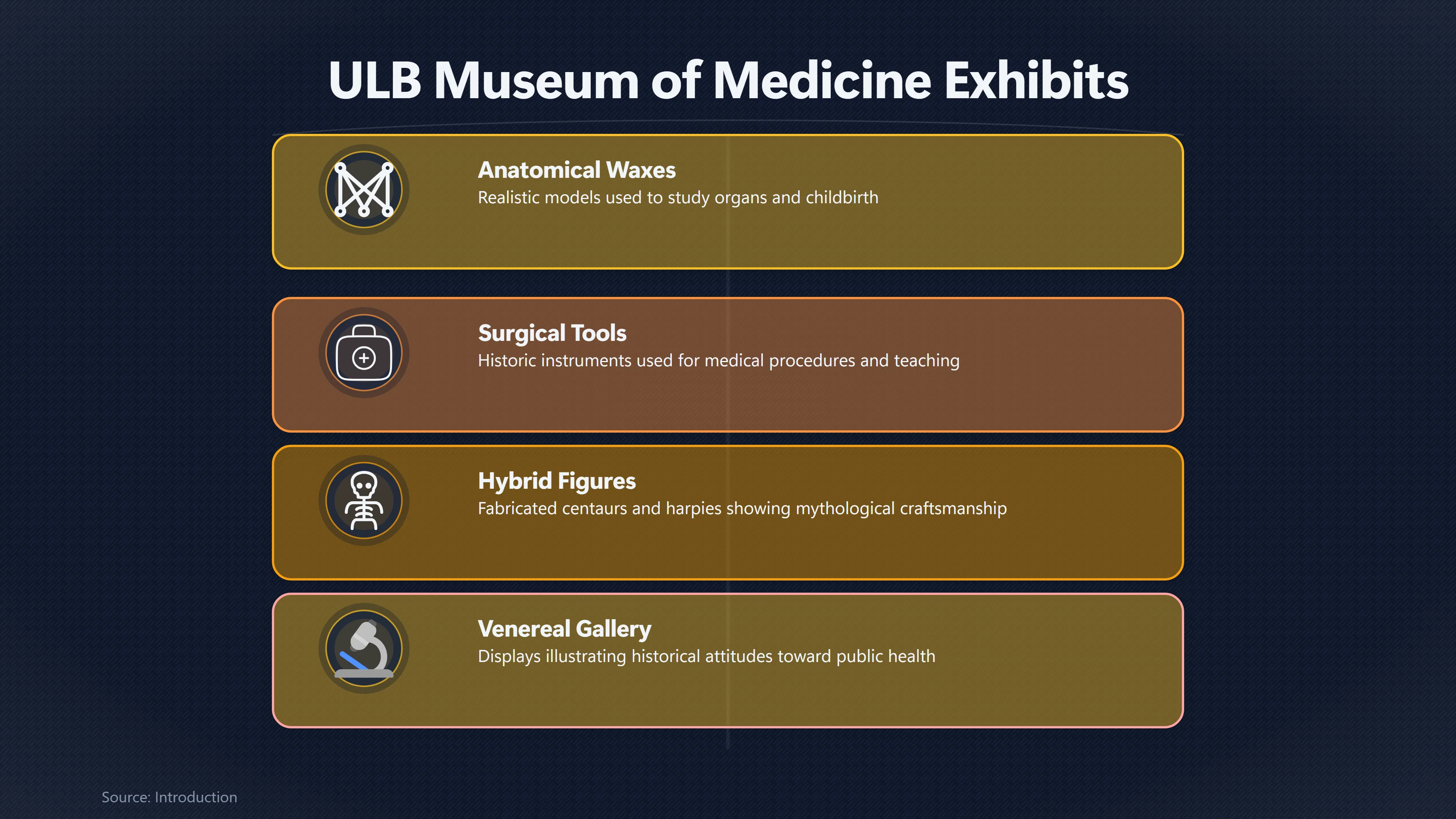
Brussels’ ULB Museum of Medicine provides one of Belgium’s clearest examples of how unusual medical collections can be interpreted responsibly. Its galleries combine archaeological artefacts, historic surgical instruments, anatomical wax models and teaching displays covering medicine from antiquity to the modern period.[Brussels Museums]brusselsmuseums.beBrussels Museums ULBBrussels MuseumsULB - Museum of medicine | Brussels Museums…
Among the exhibits are remarkably realistic anatomical waxes produced before modern medical imaging became available. These models allowed generations of students to study organs, childbirth, infectious diseases and surgical anatomy without relying solely on human dissection. Many are visually striking because they were designed to reproduce disease with exceptional accuracy rather than artistic beauty.[Brussels Museums]brusselsmuseums.beBrussels Museums ULBBrussels MuseumsULB - Museum of medicine | Brussels Museums…
The museum also contains deliberately fabricated anatomical curiosities, including displays such as a centaur skeleton, a harpy and other hybrid figures. These are not presented as genuine discoveries but as examples of how imagination, mythology and anatomical craftsmanship have intersected throughout medical history. Their inclusion reminds visitors that museums have historically mixed scientific demonstration with visual spectacle, while modern interpretation distinguishes clearly between authentic teaching material and constructed curiosities.[Medicine Museum]medicine.museumMuseum of Medicine of Brussels - Museum of Medicine…
One gallery devoted to venereal disease illustrates another important aspect of historical medical collections. Objects that once shocked or warned medical students are now interpreted through changing attitudes towards public health, sexuality and disease rather than moral judgement.[Brussels Museums]brusselsmuseums.beBrussels Museums ULBBrussels MuseumsULB - Museum of medicine | Brussels Museums…
Psychiatric Institutions and the Making of Outsider Art
Ghent’s Museum Dr. Guislain approaches unusual collections from a very different direction. Located within the former nineteenth-century asylum established under the reforming physician Joseph Guislain, the museum combines the history of psychiatry with one of Belgium’s most important collections of outsider art.[Museum Dr. Guislain]museumdrguislain.beMuseum Dr. Guislain Building — Museum Dr. GuislainMuseum Dr. Guislain Building — Museum Dr. Guislain
The medical collection traces successive approaches to mental illness, from pre-psychiatric beliefs through early scientific theories to twentieth-century biological psychiatry. Hospital equipment, institutional records, photographs and nursing materials reveal how psychiatric care changed over time, but also how strongly patients’ lives were shaped by institutional authority. Historic photographs are particularly revealing because nineteenth-century psychiatrists increasingly believed photography offered an objective way to classify mental illness, even though modern historians recognise that these images reflected contemporary assumptions as much as medical reality.[Museum Dr. Guislain]museumdrguislain.beMuseum Dr. Guislain Collection — Museum Dr. GuislainMuseum Dr. Guislain Collection — Museum Dr. Guislain
Alongside this history sits the museum’s outsider-art collection. Rather than treating works by psychiatric patients or socially marginalised creators as medical evidence, the museum presents them as significant artistic achievements in their own right. The collection includes works by internationally recognised outsider artists alongside contemporary artists whose practice engages with mental healthcare, deliberately encouraging dialogue between art and psychiatry rather than reducing creativity to diagnosis.[Museum Dr. Guislain]museumdrguislain.beMuseum Dr. Guislain Collection — Museum Dr. GuislainMuseum Dr. Guislain Collection — Museum Dr. Guislain
This reflects a broader change in interpretation. Earlier psychiatric institutions often collected patients’ drawings and sculptures as clinical documents illustrating illness. Contemporary curators increasingly emphasise artistic agency, individual expression and the limits of medical labelling. The question shifts from “What illness produced this?” to “What does this work communicate?”[Museum Dr. Guislain]museumdrguislain.beMuseum Dr. Guislain Collection — Museum Dr. GuislainMuseum Dr. Guislain Collection — Museum Dr. Guislain
Consent, Dignity and the Ethics of Display
Medical and psychiatric collections inevitably raise ethical questions that differ from those surrounding folklore or curiosity museums.
Human remains, pathological specimens, patient photographs and institutional records were frequently created in periods when informed consent operated very differently from today, or did not exist in a modern sense. Contemporary Belgian museums therefore place increasing emphasis on explanation, historical context and respect for the individuals represented, avoiding displays that encourage voyeurism.[De Gentse musea]degentsemusea.beOpen source on degentsemusea.be.
The Museum Dr. Guislain explicitly frames itself not simply as a museum about psychiatry but as a place where visitors can question assumptions about mental illness and normality. Temporary exhibitions frequently connect historical collections with contemporary debates about stigma, diagnosis and mental wellbeing rather than presenting psychiatric history as a closed chapter.[De Gentse musea]degentsemusea.beOpen source on degentsemusea.be.
Similarly, the ULB Museum of Medicine interprets anatomical collections primarily as educational material. Even visually dramatic waxes and pathological models are embedded within the history of medical teaching, reducing the risk that unusual specimens become mere spectacles.[Brussels Museums]brusselsmuseums.beBrussels Museums ULBBrussels MuseumsULB - Museum of medicine | Brussels Museums…
Why These Collections Matter in Belgium’s Strange-History Landscape
Belgium’s medical and psychiatric collections occupy a distinctive place within the country’s wider landscape of unusual museums. Unlike collections built around monsters, occult traditions or folklore, these institutions demonstrate that ideas of the strange can emerge from ordinary scientific practice.
Their most memorable exhibits are often unusual not because they are supernatural or mysterious, but because they reveal how confidently earlier generations defined normality, illness and difference. Anatomical waxes, psychiatric photographs and outsider art each preserve evidence of changing ways of seeing the human body and mind.
For visitors interested in Belgium’s more unusual heritage, these museums therefore offer something deeper than curiosity alone. They show how collections that once reinforced medical authority are increasingly being reinterpreted to encourage empathy, critical thinking and respect for the people whose bodies, experiences and creativity became part of the historical record.
Amazon book picks
Further Reading
Books and field guides related to Who Decided What Counted as Normal?. Use these as the next step if you want deeper reading beyond the article.
The Birth of the Clinic
In this remarkable book Michel Foucault, one of the most influential thinkers of recent times, calls us to look critically at specific hi...
Madness and Civilization
Rating: 4.0/5 from 15 Google Books ratings
This text is a classic of French post-structuralist scholarship and is widely recommended on humanities courses across a variety of disci...
The Man Who Mistook His Wife for a Hat
With an introduction by Will SelfA classic work of psychology, this international bestseller provides a groundbreaking insight into the h...
The Disability Studies Reader
The Fourth Edition of the Disability Studies Reader breaks new ground by emphasizing the global, transgender, homonational, and posthuman...
eBay marketplace picks
Marketplace Samples
Live-tested eBay searches with available results related to this page.
Selected frommedical collectible oneBay.co.uk.
Endnotes
1.
Source: brusselsmuseums.be
Title: Brussels Museums ULB
Link:https://www.brusselsmuseums.be/en/museums/ulb-museum-of-medicine
Source snippet
Brussels MuseumsULB - Museum of medicine | Brussels Museums...
2.
Source: museumdrguislain.be
Title: Museum Dr. Guislain Collection — Museum Dr. Guislain
Link:https://www.museumdrguislain.be/en/collection
3.
Source: degentsemusea.be
Link:https://degentsemusea.be/en/museums/museumdrguislain
4.
Source: medicine.museum
Link:https://medicine.museum/museum/14-Brussels-Museum-Medicine
Source snippet
Museum of Medicine of Brussels - Museum of Medicine...
5.
Source: museumdrguislain.be
Title: Museum Dr. Guislain Building — Museum Dr. Guislain
Link:https://www.museumdrguislain.be/en/building
6.
Source: museumdrguislain.be
Title: Museum Dr. Guislain Collectie — Museum Dr. Guislain
Link:https://www.museumdrguislain.be/nl/vaste-collectie
7.
Source: museumdrguislain.squarespace.com
Title: Museum Dr. Guislain Our library — Museum Dr. Guislain
Link:https://museumdrguislain.squarespace.com/en/library
8.
Source: visit.gent.be
Title: be Museum Dr
Link:https://visit.gent.be/nl/zien-doen/museum-dr-guislain
Source snippet
Guislain | Visit GentMUSEUM DR. GUISLAIN Musea CityCard voordeel Image: ©VisitGent ©VisitGent GESCHIEDENIS VAN DE PSYCHIATRIE Een museu...
9.
Source: museumdrguislain.be
Link:https://www.museumdrguislain.be/fr/collections
10.
Source: museumdrguislain.be
Link:https://www.museumdrguislain.be/nl/collectie
11.
Source: museumdrguislain.be
Link:https://www.museumdrguislain.be/en/ourmission
12.
Source: degentsemusea.be
Link:https://degentsemusea.be/fr/musees/museumdrguislain
13.
Source: okv.be
Title: museum dr guislain
Link:https://www.okv.be/museum/museum-dr-guislain
Additional References
14.
Source: visit.gent.be
Title: Visit Gent Dr Guislain Museum | Visit Gent
Link:https://visit.gent.be/en/see-do/dr-guislain-museum
Source snippet
Guislain Museum | Visit GentVisit Gent DR GUISLAIN MUSEUM Museums CityCard benefit Image: ©VisitGent ©VisitGent HISTORY OF PSYCHIATRY The...
15.
Source: youtube.com
Title: Musée de la médecine: Quand la Médecine apprit du Corps #museum
Link:https://www.youtube.com/watch?v=VK4hYKshulE
Source snippet
Au cœur de l'Histoire: Visite du Musée de la Médecine et d'Anatomie...
16.
Source: youtube.com
Title: Jan Rosseel over zijn werkwijze en Back-up in Museum Dr. Guislain
Link:https://www.youtube.com/watch?v=jo5i9834Gs4
Source snippet
Musée de la médecine: Quand la Médecine apprit du Corps #museum...
17.
Source: visit.gent.be
Title: Today it
Link:https://visit.gent.be/en/see-do/dr-guislain-museum?context=tourist&from_category=3888
Source snippet
Guislain Museum | Visit GentDR GUISLAIN MUSEUM Museums CityCard benefit Image: ©VisitGent ©VisitGent HISTORY OF PSYCHIATRY The oldest men...
18.
Source: youtube.com
Link:https://www.youtube.com/watch?v=sJXN0UCIwGE
Source snippet
Tentoonstelling Museum Dr. Guislain...
19.
Source: visit.gent.be
Link:https://visit.gent.be/fr/voir-et-faire/le-musee-dr-guislain
20.
Source: youtube.com
Title: Tentoonstelling Museum Dr. Guislain
Link:https://www.youtube.com/watch?v=82Wobgvolgg
Source snippet
Jan Rosseel over zijn werkwijze en Back-up in Museum Dr. Guislain...
21.
Source: research.monash.edu
Title: imagining madness the conceptualisation of mental illness in psyc
Link:https://research.monash.edu/en/publications/imagining-madness-the-conceptualisation-of-mental-illness-in-psyc/
22.
Source: culture.uliege.be
Title: be Musée Dr Guislain (Gand): une histoire de fous!
Link:https://culture.uliege.be/jcms/c_1582803/en/musee-dr-guislain-gand-une-histoire-de-fous
23.
Source: youtube.com
Title: Au cœur de l’Histoire: Visite du Musée de la Médecine et d’Anatomie
Link:https://www.youtube.com/watch?v=qohh7yrAn9A