Within Curious Guinea
How Did Baga Masks Become Guinea's Emblems?
Guinea's giant Baga shoulder masks reveal how sacred performances became museum objects, state folklore and national emblems.
On this page
- How the monumental masks were worn and performed
- Fertility, farming, motherhood and changing interpretations
- Suppression, collecting and national cultural branding
Page outline Jump by section
Introduction
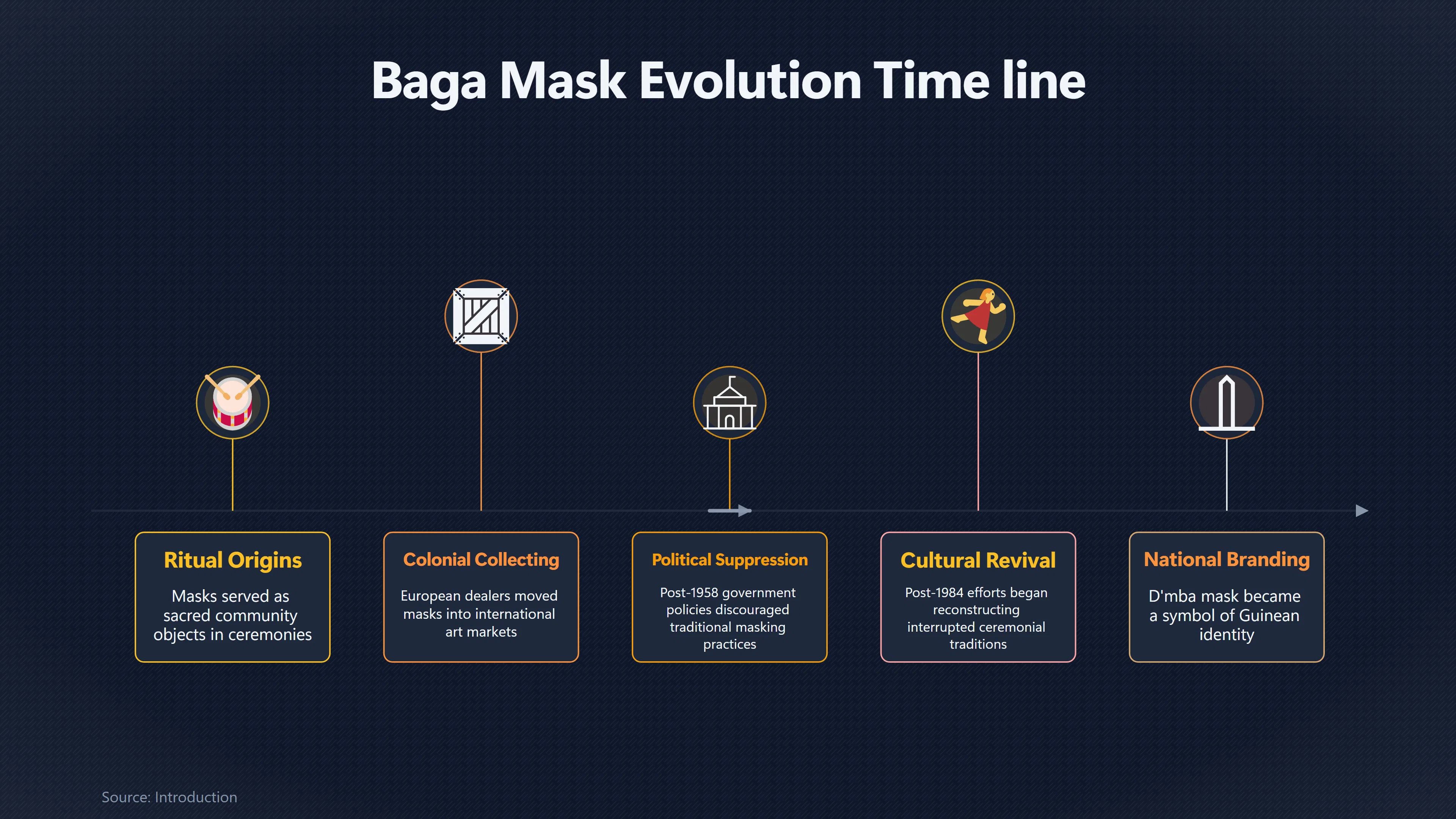
The monumental Baga shoulder masks of coastal Guinea are among the most recognisable ritual sculptures in Africa. Once carried in carefully controlled ceremonial performances, they have travelled an extraordinary path: from sacred community objects to prized museum pieces, symbols of Guinea’s cultural identity and enduring icons of African art. That transformation was neither simple nor peaceful. Colonial collecting, religious change, political campaigns against traditional practices and the international art market all reshaped how these masks were understood. Today, the same object may be viewed simultaneously as a sacred heirloom, an ethnographic artefact, a masterpiece of sculpture and a national emblem. Understanding that journey reveals far more than the history of a famous mask—it explains how ritual power can be translated into heritage, tourism and state symbolism without entirely losing its original cultural meaning.[britishmuseum.org]britishmuseum.orgBritish Museummask | British MuseumBritish Museummask | British Museum
How were the monumental masks worn and performed?
The best-known Baga shoulder mask is often called D’mba or Nimba, although scholars note that local names and meanings have varied between Baga communities. Unlike face masks that conceal only the head, these monumental carvings were balanced across a performer’s shoulders beneath a full costume of raffia and cloth. The dancer looked through an opening carved between the figure’s breasts, allowing the towering sculpture to appear as a living presence moving above the crowd.[British Museum]britishmuseum.orgBritish Museummask | British MuseumBritish Museummask | British Museum
The sheer scale of the masks made their appearance dramatic. Many examples stand well over a metre tall and can weigh more than 35 kilograms. Some were carved with four supporting legs beneath the torso to stabilise the sculpture while it rested on the performer’s shoulders. The visual effect depended as much on movement, music and costume as on the carving itself. A museum display can preserve the wood, but it cannot recreate the sound of drums, the hidden performer or the communal knowledge that once surrounded each appearance.[British Museum]britishmuseum.orgBritish Museummask | British MuseumBritish Museummask | British Museum
Performances were not random entertainments. D’mba figures appeared during important moments in community life, including planting and harvest celebrations, weddings, ceremonies honouring respected visitors and events connected with ancestors and social continuity. Rather than representing an individual spirit, the figure embodied an ideal of maturity, dignity and abundance expressed through public performance.[National Museum of African Art]africa.si.eduNational Museum of African Art Shoulder mask | National Museum of African ArtNational Museum of African Art Shoulder mask | National Museum of African Art
Fertility, farming, motherhood and changing interpretations
The large breasts, elaborate hairstyle and calm facial expression have often led outsiders to describe the masks simply as fertility figures. That description is only partly accurate.
The female body certainly symbolises motherhood, nourishment and the ability to sustain future generations. Yet many specialists argue that the emphasis falls less on human reproduction alone than on the broader idea of prosperity. Agricultural success, healthy families, social harmony and the continuity of the community were understood as interconnected rather than separate concerns. The mask therefore represented an ideal woman whose qualities promoted collective well-being instead of functioning as a straightforward fertility goddess.[si.edu]africa.si.eduNational Museum of African Art Shoulder mask | National Museum of African ArtNational Museum of African Art Shoulder mask | National Museum of African Art
The carved details reinforce these ideas. Carefully incised hairstyles, scarification patterns and balanced proportions express maturity, discipline and beauty according to Baga cultural ideals rather than naturalistic portraiture. The exaggerated scale transforms an admired human form into a powerful symbolic presence visible across a large gathering.[World history museum]worldhistorymuseum.orgWorld history museum D’mba (Nimba) Shoulder Mask | World history museumWorld history museum D’mba (Nimba) Shoulder Mask | World history museum
Modern interpretations have become more cautious than older museum labels. Earlier collectors sometimes described the masks through simplified ideas about “fertility cults” or “mother goddesses”. Contemporary scholarship instead places them within a broader system of ceremonial performance, agriculture, initiation and social values, recognising that meanings differed across Baga communities and changed over time.[menil.org]menil.orgD’MBA: Beauty, Desire, and Collecting an African MaskD’MBA: Beauty, Desire, and Collecting an African Mask

Why did sacred masks become museum objects?
The journey from ritual object to museum collection accelerated during the twentieth century.
European dealers, collectors and museums increasingly sought monumental Baga masks because of their striking appearance. By the late 1950s they had become highly desirable in international collections, with major museums in Europe and North America acquiring examples through dealers and private collectors. Their sculptural qualities appealed to audiences who often appreciated them primarily as works of art, detached from the ceremonies that had originally given them authority.[menil.org]menil.orgD’MBA: Beauty, Desire, and Collecting an African MaskD’MBA: Beauty, Desire, and Collecting an African Mask
At the same time, profound changes were affecting Baga society itself. Colonial rule, expanding Islamic influence and political transformation altered many traditional ceremonial practices. Some masks ceased to be used regularly, while others entered museum collections or the art market under very different circumstances. Because documentation is often incomplete, the histories of individual objects are not always fully known, making questions of provenance and cultural ownership especially important today.[menil.org]menil.orgD’MBA: Beauty, Desire, and Collecting an African MaskD’MBA: Beauty, Desire, and Collecting an African Mask
This shift illustrates a broader pattern across West Africa: objects once activated through performance became static exhibits. Visitors can admire their craftsmanship in museums, but much of their original significance depended on movement, restricted knowledge and community participation that cannot be fully transferred into a gallery.
Suppression, cultural revival and national branding
Perhaps the most remarkable stage in the masks’ history came after Guinea achieved independence in 1958.
The government of President Ahmed Sékou Touré promoted a new national culture while also discouraging many traditional religious practices that it regarded as incompatible with its political and ideological goals. In several regions, ceremonial masking declined sharply, and aspects of Baga ritual life were suppressed. Many researchers describe this period as one in which traditional masking nearly disappeared from regular public practice.[Mask Museum]maskmuseum.orgMask Museum Baga Ancestor Mask – Second FaceMask Museum Baga Ancestor Mask – Second Face
Following political change after 1984, some ceremonial traditions were revived, although not always in their earlier form. Knowledge had been interrupted, communities had changed and many historic masks had already entered foreign collections. Revival therefore involved both cultural continuity and cultural reconstruction.[Mask Museum]maskmuseum.orgMask Museum Baga Ancestor Mask – Second FaceMask Museum Baga Ancestor Mask – Second Face
Ironically, while ritual performances declined, the image of the D’mba mask grew increasingly prominent as a national symbol. Its distinctive silhouette appeared in cultural festivals, tourism promotion and representations of Guinean identity because it was instantly recognisable and visually powerful. Museums and cultural institutions came to present the mask not simply as a Baga object but as one of the country’s defining artistic achievements.[National Museum of African Art]africa.si.eduNational Museum of African Art Shoulder mask | National Museum of African ArtNational Museum of African Art Shoulder mask | National Museum of African Art
What visitors encounter today
Travellers interested in Guinea’s unusual cultural heritage are more likely to encounter Baga masks in museum displays than in traditional ceremonial settings.
Within Guinea, collections such as the National Museum in Conakry preserve examples alongside other regional cultural objects, although displays and accessibility have varied over time. Internationally, important examples are held in institutions including the British Museum and the Smithsonian National Museum of African Art, where detailed interpretation explains both their ceremonial origins and their later role in shaping global appreciation of African sculpture.[British Museum]britishmuseum.orgBritish Museummask | British MuseumBritish Museummask | British Museum
For visitors, the masks represent more than remarkable carvings. They illustrate how sacred performance, colonial collecting, religious change, political ideology and national heritage can all become layered within a single object. Few artefacts better demonstrate how something created for ritual power can eventually become a museum masterpiece and, at the same time, one of the enduring visual emblems of Guinea itself.[si.edu]africa.si.eduNational Museum of African Art Shoulder mask | National Museum of African ArtNational Museum of African Art Shoulder mask | National Museum of African Art
Amazon book picks
Further Reading
Books and field guides related to How Did Baga Masks Become Guinea's Emblems?. Use these as the next step if you want deeper reading beyond the article.

The Predicament of Culture
The Predicament of Culture is a critical ethnography of the West in its changing relations with other societies. Analyzing cultural pract...
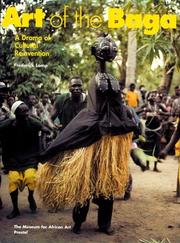
The Art of the Baga: The Nalu and Their Neighbors
First published 1996. Subjects: Arts, Baga, Arts, Black, Baga (African people), Baga Arts, Black Arts.
Museums and the Interpretation of Visual Culture
This is a multi-disciplinary study that adopts an innovative and original approach to a highly topical question, that of meaning-making i...
eBay marketplace picks
Marketplace Samples
Live-tested eBay searches with available results related to this page.
Selected fromtribal art collectible oneBay.co.uk.
Endnotes
1.
Source: britishmuseum.org
Title: British Museummask | British Museum
Link:https://www.britishmuseum.org/collection/object/E_Af1957-07-1-a-b
2.
Source: africa.si.edu
Title: National Museum of African Art Shoulder mask | National Museum of African Art
Link:https://africa.si.edu/collection/object/nmafa
3.
Source: menil.org
Title: D’MBA: Beauty, Desire, and Collecting an African Mask
Link:https://www.menil.org/exhibition/d-mba-beauty-desire-and-collecting-an-african-mask
4.
Source: worldhistorymuseum.org
Title: World history museum D’mba (Nimba) Shoulder Mask | World history museum
Link:https://www.worldhistorymuseum.org/portfolio-collections/my-portfolio/d%E2%80%99mba-nimba-shoulder-mask
5.
Source: rct.uk
Title: nimba or dmba shoulder helmet mask
Link:https://www.rct.uk/collection/stories/grand-vestibule-the-british-monarchy-and-the-world/nimba-or-dmba-shoulder-helmet-mask
Source snippet
Royal Collection TrustRCIN 95893 - Nimba (or D’mba) (Shoulder helmet mask)...
6.
Source: maskmuseum.org
Title: Mask Museum Baga Ancestor Mask – Second Face
Link:https://www.maskmuseum.org/mask/baga-1/
7.
Source: britishmuseum.org
Link:https://www.britishmuseum.org/collection/object/E_Af1979
Source snippet
mask | British MuseumMASK Object Type mask Museum number Af1979,01.2947 Description Mask carved of wood in form of crocodile with two lon...
8.
Source: britishmuseum.org
Link:https://www.britishmuseum.org/collection/object/E_Af1989
Source snippet
mask | British MuseumMASK Object Type mask Museum number Af1989,05.177 Description Large, wooden dance mask, "nimba", in the form of a wo...
9.
Source: britishmuseum.org
Link:https://www.britishmuseum.org/collection/object/E_Af1904
Source snippet
mask | British MuseumMASK Object Type mask Museum number Af1904,1122.1 Description Mask made of wood, pigment, fibre (vegetable)...
10.
Source: britishmuseum.org
Title: Production ethnic group Made by: Bamileke Made by: Bamenda Product
Link:https://www.britishmuseum.org/collection/object/E_Af1954
Source snippet
mask | British MuseumMASK Object Type mask Museum number Af1954.3445 Description Elephant mask; made of European cotton cloth and cowrie...
11.
Source: britishmuseum.org
Link:https://www.britishmuseum.org/collection/object/E_Af1956
12.
Source: britishmuseum.org
Link:https://www.britishmuseum.org/collection/object/E_Af1942-01-1-a-b
13.
Source: britishmuseum.org
Link:https://www.britishmuseum.org/collection/object/E_Af1889-1201-1-a
14.
Source: africa.si.edu
Link:https://africa.si.edu/collection/object/nmafa
Additional References
15.
Source: youtube.com
Title: Cultural Capital: African Art, Repatriation, and Restitution
Link:https://www.youtube.com/watch?v=U7JibvB0fo4
Source snippet
Traditional Dance for D'mba, the Nimba mask. The Baga people of Guinea Conakry...
16.
Source: youtube.com
Title: Traditional Dance for D’mba, the Nimba mask. The Baga people of Guinea Conakry
Link:https://www.youtube.com/watch?v=pggvZ6n46BU
Source snippet
The legendary Nimba mask of Guinea Conakry...
17.
Source: youtube.com
Title: The legendary Nimba mask of Guinea Conakry
Link:https://www.youtube.com/watch?v=SYmcOosBlt0
Source snippet
West African Tribal Dances (Guinea, Sierra Leone, Liberia, Cote-d-Ivoire, Ghana)...
18.
Source: christies.com
Link:https://www.christies.com/en/lot/lot-6469519
19.
Source: youtube.com
Title: D’mba mask (Baga peoples)
Link:https://www.youtube.com/watch?v=U9nskX7TlYI
Source snippet
Cultural Capital: African Art, Repatriation, and Restitution...
20.
Source: kreegermuseum.org
Link:https://www.kreegermuseum.org/about-us/collection/african-collection/Baga-artist_Dance-Mask-Dmba/
21.
Source: youtube.com
Title: West African Tribal Dances (Guinea, Sierra Leone, Liberia, Cote-d-Ivoire, Ghana)
Link:https://www.youtube.com/watch?v=lR9TtgZHmMM
22.
Source: slam.org
Title: Shoulder Mask (D’mba)
Link:https://www.slam.org/collection/objects/5739/
23.
Source: portail.museedesconfluences.fr
Title: fr Masque
Link:https://portail.museedesconfluences.fr/notice122425417139416811?lang=fr