Within Curious Gabon
What Was Removed From Gabon's Reliquary Guardians?
Fang and Kota guardians become incomplete museum objects when separated from the bones, baskets and ceremonies they once protected.
On this page
- How Fang and Kota reliquaries worked
- Why guardians were separated from ancestral remains
- Provenance, collecting and the modern art market
Page outline Jump by section
Introduction
Many of Gabon’s most celebrated ancestor reliquary sculptures entered museums without the very elements that gave them meaning. The famous Fang wooden guardian figures and Kota metal-covered guardians were not originally independent works of art. They formed only one part of a sacred ensemble that also included baskets or bark containers holding carefully preserved ancestral bones, ritual substances and family relics. Once these assemblages were dismantled for collectors, museums typically acquired the sculpted guardians while the human remains were retained, reburied, destroyed, hidden or simply disappeared from the historical record.[The Metropolitan Museum of Art]metmuseum.orgThe Metropolitan Museum of Art Okak-Fang artistThe Metropolitan Museum of ArtOkak-Fang artist - Eyema byeri (reliquary guardian figure) - Okak-Fang peoples - The Metropolitan Museum of…
Understanding what was removed is essential to understanding the objects themselves. A reliquary guardian displayed alone in a gallery represents only the visible fragment of a much larger religious system centred on lineage, memory and continuing relationships between the living and the dead.
How Fang and Kota reliquaries worked
Among several communities in what is now Gabon, ancestor reliquaries were family treasures rather than public monuments. Their purpose was not to commemorate the dead in an abstract sense but to maintain an active connection between generations.
For the Fang, a carved wooden figure or head sat atop a cylindrical bark container known as a reliquary. Inside were selected skulls and other important bones of respected ancestors together with valued objects and powerful ritual materials. The complete ensemble was known as a byeri. Family elders consulted these ancestral relics before major decisions including marriages, journeys, political negotiations and hunting expeditions. The guardian figure announced the sacred nature of the contents while symbolically protecting them from both physical theft and improper viewing.[metmuseum.org]metmuseum.orgThe Metropolitan Museum of Art Okak-Fang artistThe Metropolitan Museum of ArtOkak-Fang artist - Eyema byeri (reliquary guardian figure) - Okak-Fang peoples - The Metropolitan Museum of…
Kota communities used a different visual language but a similar principle. Their distinctive guardians, covered with copper and brass sheets, were attached to or placed above baskets containing ancestral bones. Because many Kota groups moved settlements periodically as agricultural land changed, portable reliquaries allowed ancestors to travel with the living community rather than remaining in fixed burial places.[Smarthistory]smarthistory.org– Kota reliquary (mbulu nguluSmarthistory – Kota reliquary (mbulu ngulu)…
Seen in isolation, these sculptures can appear highly abstract or decorative. In their original setting, however, they functioned as visible markers directing attention towards the hidden ancestral remains beneath them.
Why guardians were separated from ancestral remains
The separation happened for several different reasons, not all of them identical.
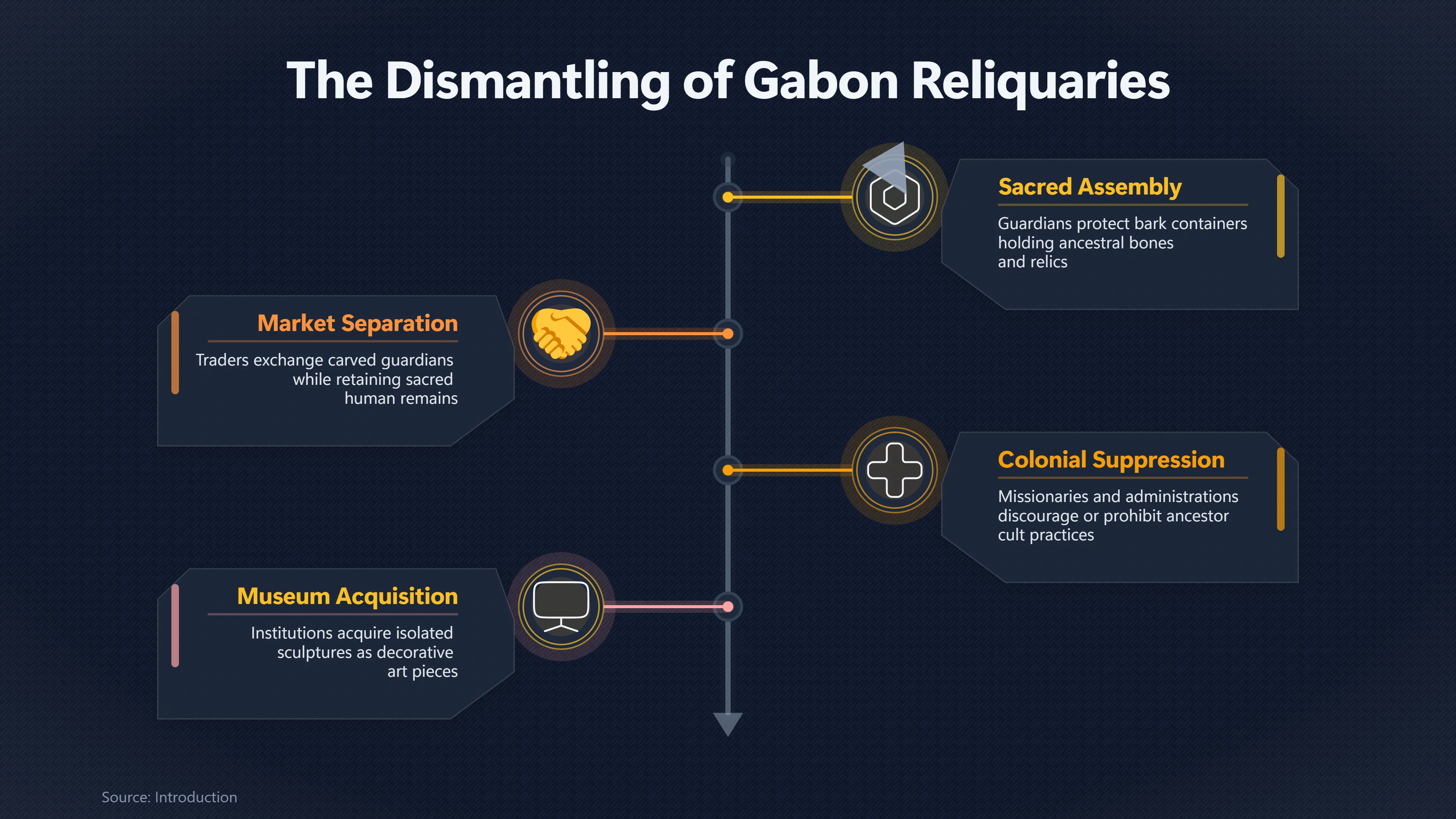
Some Fang communities regarded the relics themselves as the truly irreplaceable sacred element. Early European traders and collectors often found that carved guardians could be exchanged more readily than the ancestral bones they protected. In other cases, missionaries and colonial administrations actively discouraged or prohibited ancestor cults during the early twentieth century, leading to the abandonment, destruction or concealment of complete reliquaries. Sculptures survived because they appealed to collectors, while baskets and human remains often did not.[digitalprojects.carlos.emory.edu]digitalprojects.carlos.emory.eduByeri Guardian Figure · Michael C. Carlos Museum Collections OnlineByeri Guardian Figure · Michael C. Carlos Museum Collections Online
Museum collections therefore frequently preserve:
- the carved guardian;
- little or none of the original bark container or basket;
- no ancestral bones;
- minimal information about the family’s ritual practices.
This dramatically altered how the objects were understood. A religious assemblage became an individual sculpture.
The Metropolitan Museum of Art explicitly notes that Fang guardian figures were “invariably separated” from their reliquary containers before leaving Africa. That observation reflects a wider collecting pattern seen across European and North American museum collections.[The Metropolitan Museum of Art]metmuseum.orgThe Metropolitan Museum of Art Okak-Fang artistThe Metropolitan Museum of ArtOkak-Fang artist - Eyema byeri (reliquary guardian figure) - The Metropolitan Museum of Art…
What happened to the missing human remains?
There is no single answer because individual histories differ.
Some ancestral bones remained with descendant families even after guardians entered the art market. Others appear to have been reburied when communities abandoned earlier religious practices or converted to Christianity. In many documented cases, the archaeological trail simply ends because collectors recorded only the sculpture and ignored the rest of the assemblage.[digitalprojects.carlos.emory.edu]digitalprojects.carlos.emory.eduByeri Guardian Figure · Michael C. Carlos Museum Collections OnlineByeri Guardian Figure · Michael C. Carlos Museum Collections Online
This creates an important interpretive problem. Visitors naturally ask where the bones went, but museums often cannot answer with certainty because acquisition records from the colonial period rarely documented the fate of the associated human remains.
The absence therefore reflects both historical collecting practices and incomplete documentation rather than a single, universal sequence of events.
Provenance, collecting and the modern art market
The removal of guardians transformed them into highly desirable works of modern art.
From the early twentieth century onwards, Fang and Kota sculptures attracted artists, dealers and collectors who admired their striking forms. Their influence on European modernism is well documented, yet the qualities celebrated by collectors—bold abstraction, simplified anatomy and expressive geometry—were originally inseparable from their ritual role as guardians of ancestral relics.[Smithsonian Institution]si.eduSmithsonian Institution Reliquary guardian figure | Smithsonian InstitutionSmithsonian Institution Reliquary guardian figure | Smithsonian Institution
This shift also changed the questions museums ask. Instead of asking:
- Which ancestors did this reliquary protect?
- Which family commissioned it?
- What ceremonies surrounded it?
catalogues often focused on:
- stylistic schools;
- carving techniques;
- attributed artists;
- auction history;
- aesthetic innovation.
As provenance research has become more sophisticated, museums increasingly acknowledge that these sculptures entered collections as fragments of larger sacred assemblages rather than complete artworks. Labels now more commonly explain that the guardian originally crowned a reliquary containing ancestral remains instead of presenting it as an isolated carving.[The Metropolitan Museum of Art]metmuseum.orgThe Metropolitan Museum of Art Okak-Fang artistThe Metropolitan Museum of ArtOkak-Fang artist - Eyema byeri (reliquary guardian figure) - Okak-Fang peoples - The Metropolitan Museum of…

Why the missing remains matter today
The absence of the bones changes how these objects are experienced.
In a museum gallery, visitors encounter an elegant sculpture illuminated in a display case. Originally, initiated family members encountered a guardian whose importance depended entirely upon what lay beneath it. The power of the object resided not simply in the carving but in the continuing relationship between ancestors, descendants and sacred relics.
This distinction also shapes current debates about provenance and interpretation. Even when no human remains survive in museum collections, curators increasingly recognise that displaying only the guardian risks presenting a devotional object as a purely aesthetic masterpiece. Explaining the missing basket, the absent bones and the disrupted ritual context helps restore part of the meaning that was lost when the reliquary was dismantled.
Within Gabon’s landscape of unusual collections, these incomplete reliquary guardians are therefore unusual not because they are mysterious objects, but because what is missing is as historically significant as what remains on display.
Amazon book picks
Further Reading
Books and field guides related to What Was Removed From Gabon's Reliquary Guardians?. Use these as the next step if you want deeper reading beyond the article.
The forest of symbols
First published 1967. Subjects: Ndembu (African tribe), Ndembu (African people), Ndembu, Rites and ceremonies, Ethnology.


The Social Life of Things
First published 1986. Subjects: Social aspects, Commerce, Economic anthropology, History, Commodity exchanges.
The Anthropology of Art
An authoritative introduction to art forms in the non-Western world addresses the problem of cross-cultural aesthetic appreciation in soc...
eBay marketplace picks
Marketplace Samples
Live-tested eBay searches with available results related to this page.
Selected fromAfrican art collectible oneBay.co.uk.
Endnotes
1.
Source: smarthistory.org
Title: – Kota reliquary (mbulu ngulu)
Link:https://smarthistory.org/kota-mfa/
Source snippet
Smarthistory – Kota reliquary (mbulu ngulu)...
2.
Source: smarthistory.org
Title: – Male Reliquary Guardian Figure (Fang peoples)
Link:https://smarthistory.org/fang-reliquary-figure/
Source snippet
Smarthistory – Male Reliquary Guardian Figure (Fang peoples)...
3.
Source: digitalprojects.carlos.emory.edu
Title: Byeri Guardian Figure · Michael C. Carlos Museum Collections Online
Link:https://digitalprojects.carlos.emory.edu/items/show/9009
4.
Source: smarthistory.org
Title: – Female Figure from a Reliquary Ensemble (Fang peoples)
Link:https://smarthistory.org/seated-female-reliquary/
5.
Source: metmuseum.org
Title: The Metropolitan Museum of Art Okak-Fang artist
Link:https://www.metmuseum.org/art/collection/search/310870
Source snippet
The Metropolitan Museum of ArtOkak-Fang artist - Eyema byeri (reliquary guardian figure) - Okak-Fang peoples - The Metropolitan Museum of...
6.
Source: si.edu
Title: Smithsonian Institution Reliquary guardian figure | Smithsonian Institution
Link:https://www.si.edu/object/nmafa
7.
Source: metmuseum.org
Title: The Metropolitan Museum of Art Okak-Fang artist
Link:https://www.metmuseum.org/pt/art/collection/search/310870
Source snippet
The Metropolitan Museum of ArtOkak-Fang artist - Eyema byeri (reliquary guardian figure) - The Metropolitan Museum of Art...
8.
Source: metmuseum.org
Title: The Metropolitan Museum of Art Betsi-Fang artist
Link:https://www.metmuseum.org/art/collection/search/312429?amp=&sortBy=Relevance
Source snippet
The Metropolitan Museum of ArtBetsi-Fang artist - Nlô byeri (reliquary guardian head) - Betsi-Fang peoples - The Metropolitan Museum of Art...
9.
Source: metmuseum.org
Title: Kota artist
Link:https://www.metmuseum.org/art/collection/search/312169
10.
Source: metmuseum.org
Title: Figure from a Reliquary Element: Seated Male (Nlo Bieri)
Link:https://www.metmuseum.org/art/collection/search/310984
11.
Source: si.edu
Link:https://www.si.edu/object/reliquary-guardian-figure%3Anmafa
Additional References
12.
Source: youtube.com
Link:http://www.youtube.com/watch?v=qzdmjzfPnkU
Source snippet
Eyema byeri reliquary guardian, Gabon, Fang (70.2017.66.24) - Najwa Borro...
13.
Source: digitalcommons.pvamu.edu
Title: african sculptures and masks
Link:https://digitalcommons.pvamu.edu/african-sculptures-and-masks/37/
Source snippet
pvamu.edu"FANG Culture Of Arts in Gabon and adjoining regions in Cameroon and Eq" by Prairie View A&M UniversityJuly 7, 2022 — AFRICAN SC...
Published: July 7, 2022
14.
Source: youtube.com
Title: My Kota Guardian Figures From Gabon
Link:http://www.youtube.com/watch?v=A4uSnRs1sSk
Source snippet
Fang byeri reliquary guardian sculpture Fang Reliquary Guardian Figurines Art History 101...
15.
Source: youtube.com
Title: Fang Reliquary Guardian Figurines
Link:http://www.youtube.com/watch?v=650oYNa3Ad8
Source snippet
Eyema byeri reliquary guardian, Gabon, Fang (70.2017.66.24) - Christiane Falgayrettes-Leveau...
16.
Source: sothebys.com
Link:https://www.sothebys.com/en/auctions/ecatalogue/2014/1000-ways-seeing-l14313/lot.198.html
17.
Source: brooklynmuseum.org
Link:https://www.brooklynmuseum.org/en-GB/objects/4755
18.
Source: khanacademy.org
Link:https://www.khanacademy.org/v/fang-reliquary
19.
Source: worldhistorymuseum.org
Link:https://www.worldhistorymuseum.org/portfolio-collections/my-portfolio/fang-mabea-reliquary-figure
20.
Source: dorotheum.com
Link:https://www.dorotheum.com/en/l/1722283/
21.
Source: dorotheum.com
Link:https://www.dorotheum.com/en/l/1180516/