Within Dutch Curiosities
When Does Anatomy Become an Ethical Problem?
Dutch anatomy museums reveal how preserved bodies became teaching tools and why institutions now reconsider consent, dignity and restitution.
On this page
- What visitors see at Museum Vrolik
- Anatomical theatres, punishment and public spectacle
- Consent, racial science and the return of remains
Page outline Jump by section
Introduction
The Netherlands is home to some of Europe’s most important anatomical collections, but today they are valued as much for the ethical questions they raise as for their scientific importance. Museums in Amsterdam and Leiden preserve human remains that were collected over centuries for medical teaching, anatomical research and, at times, racial science. Modern visitors therefore encounter two stories at once: the history of anatomy and the changing understanding of consent, dignity and human rights. Rather than presenting preserved bodies simply as medical curiosities, Dutch institutions increasingly explain who collected them, why they were acquired, whose voices were ignored and how museums now address restitution, provenance research and respectful display.
When Does Anatomy Become an Ethical Problem?
The ethical debate begins with a simple question: when does a scientific specimen stop being an educational object and remain, above all, a person?
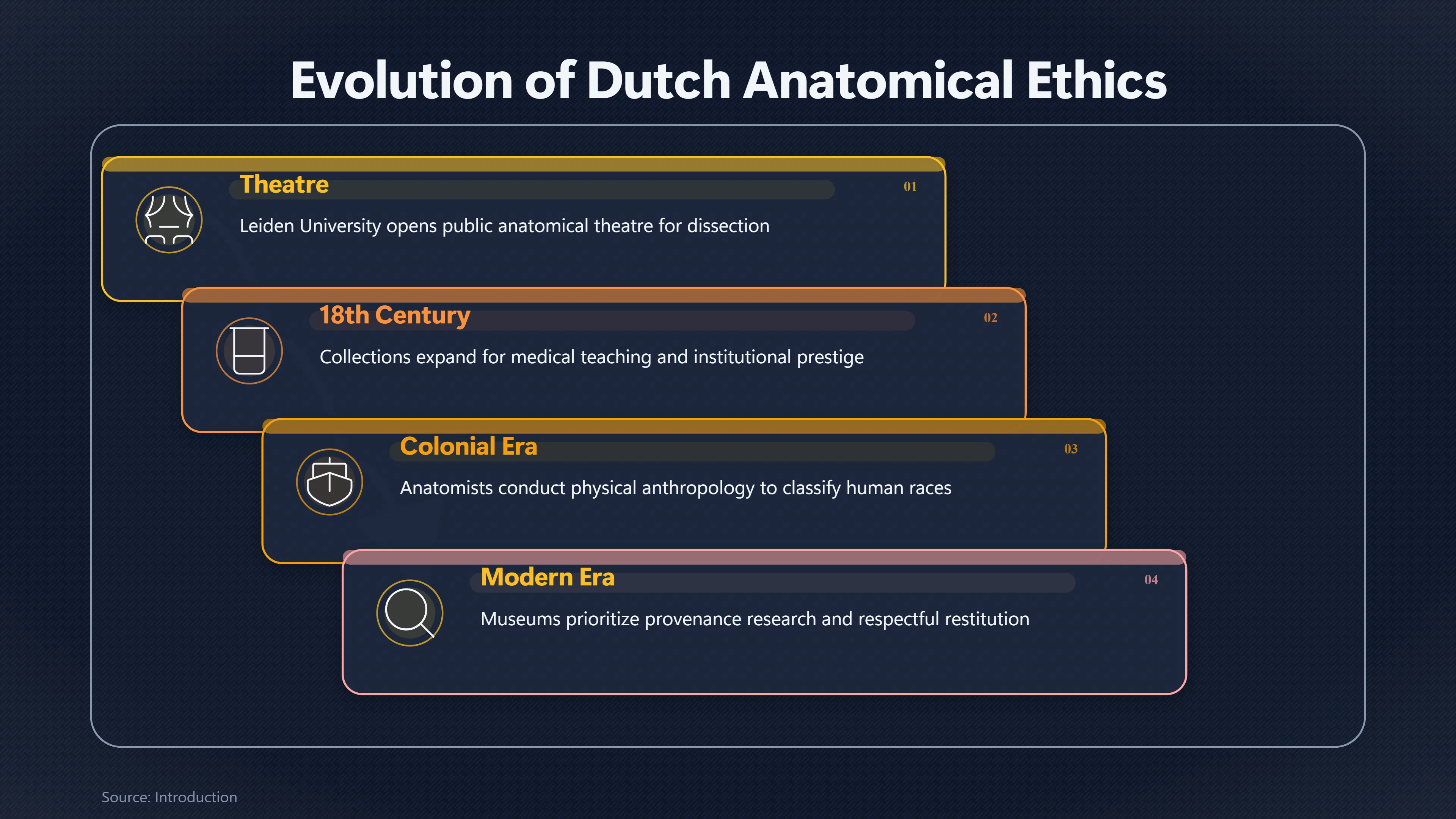
For much of European medical history, anatomy depended on a limited supply of bodies. Universities often dissected the remains of executed criminals, while hospitals and medical schools acquired unclaimed bodies or anatomical specimens under legal and social systems that would not meet modern standards of informed consent. Collections expanded because they were useful for teaching, but they also became symbols of prestige for professors and institutions.[Museum Vrolik]museumvrolik.nlMuseum Vrolik Human remainsMuseum VrolikHuman remains - Museum VrolikMarch 16, 2026…
Today, Dutch museums generally frame these collections differently. Human remains are displayed only where they serve a clear educational purpose, and institutions increasingly explain how older collecting practices reflected unequal power, colonial expansion and changing scientific beliefs rather than timeless medical necessity.[Rijksmuseum van Oudheden]rmo.nlRijksmuseum van Oudheden Human Remains | Rijksmuseum van OudhedenRijksmuseum van OudhedenHuman Remains | Rijksmuseum van OudhedenMarch 2, 2023…
What Visitors See at Museum Vrolik
Museum Vrolik in Amsterdam is perhaps the Netherlands’ most direct encounter with the ethics of anatomical collecting. Its collection contains around 25,000 anatomical preparations, including preserved organs, skeletons, embryos, foetal specimens and pathological material assembled largely between the eighteenth and twentieth centuries. Many visitors come because the displays are visually extraordinary, but the museum deliberately encourages them to think beyond shock or curiosity.[Museum Vrolik]museumvrolik.nlMuseum Vrolik HomeMuseum VrolikHome - Museum Vrolik…
Roughly half of the collection consists of human remains. The museum explains that these were collected for medical education and research, although nineteenth-century anatomists also gained professional status through building such collections. Rather than hiding this history, Museum Vrolik openly discusses how scientific ambition, collecting culture and social inequality became intertwined.[Museum Vrolik]museumvrolik.nlMuseum Vrolik Human remainsMuseum VrolikHuman remains - Museum VrolikMarch 16, 2026…
Several visitor policies reflect this approach:
- Visitors are warned in advance that recognisable human remains are displayed.[museumvrolik.nl]museumvrolik.nlMuseum Vrolik Human remainsMuseum VrolikHuman remains - Museum VrolikMarch 16, 2026…
- Photography is prohibited out of respect for the deceased and to discourage decontextualised sharing on social media.
- Human remains are presented within medical and historical interpretation rather than as entertainment or spectacle.[Museum Vrolik]museumvrolik.nlMuseum Vrolik Human remainsMuseum VrolikHuman remains - Museum VrolikMarch 16, 2026…
These policies illustrate a broader shift in museum practice. The remains are treated as individuals who continue to contribute to medical knowledge, not simply as unusual objects.
Anatomical Theatres, Punishment and Public Spectacle
The Netherlands also preserves the memory of an earlier culture in which anatomy was public performance as well as scientific investigation.
Rijksmuseum Boerhaave in Leiden contains a reconstruction of the famous anatomical theatre established by Leiden University in 1594. In the original theatre, the bodies of executed criminals were dissected before audiences that included students, surgeons and members of the public who purchased admission. Winter dissections became educational events as well as civic spectacles, while cabinets of curiosities surrounded the theatre during the rest of the year.[rijksmuseumboerhaave.nl]rijksmuseumboerhaave.nlAnatomical TheatreRijksmuseum Boerhaave…
Modern interpretation places these events in historical context rather than celebrating them. Executed criminals were among the few legally available bodies, making punishment part of medical education. The theatre therefore illustrates how criminal justice, scientific progress and public entertainment once overlapped in ways that would now appear ethically troubling.[rijksmuseumboerhaave.nl]rijksmuseumboerhaave.nlAnatomical TheatreRijksmuseum Boerhaave…
For visitors, the reconstructed theatre demonstrates that ethical standards have changed dramatically. What seventeenth-century audiences regarded as legitimate public instruction is now interpreted through questions of dignity, coercion and unequal treatment after death.
Consent, Racial Science and the Return of Remains
The most difficult ethical questions no longer concern anatomy alone but the origins of many museum collections.
Museum Vrolik acknowledges that, for many individuals represented in its collections, it is impossible to determine whether they or their families ever consented to their remains being collected. The museum therefore treats provenance research—the investigation of where remains came from and how they were acquired—as an ongoing responsibility rather than a completed historical exercise.[Museum Vrolik]museumvrolik.nlMuseum Vrolik Human remainsMuseum VrolikHuman remains - Museum VrolikMarch 16, 2026…
Particular attention has focused on remains gathered during the colonial period. Some of the museum’s nineteenth- and early twentieth-century anatomists conducted physical anthropology intended to classify human populations into supposedly distinct “races”. Although these researchers reflected ideas common in their era, the museum explicitly recognises that such work also helped reinforce racist and colonial ideologies whose effects continue today.[Museum Vrolik]museumvrolik.nlMuseum Vrolik Human remainsMuseum VrolikHuman remains - Museum VrolikMarch 16, 2026…
This acknowledgement has practical consequences. Museum Vrolik has undertaken dedicated provenance research into colonial-era human remains while working with descendant communities to determine appropriate futures for those collections. Where justified, restitution and reburial are recognised as legitimate outcomes rather than losses to science.[Museum Vrolik]museumvrolik.nlMuseum Vrolik Human remainsMuseum VrolikHuman remains - Museum VrolikMarch 16, 2026…
Its recent exhibition Imagine: The Future of Human Remains from Colonial Contexts makes this ethical shift visible. Instead of celebrating historical collecting, the exhibition deliberately includes empty display supports representing remains that have been or may eventually be returned. The absence itself becomes part of the interpretation, reminding visitors that museums can acknowledge historical injustice without erasing its history.[Museum Vrolik]museumvrolik.nlMuseum Vrolik Exhibition: ImagineMuseum VrolikExhibition: Imagine - Museum Vrolik…
A Wider Dutch Approach to Human Remains
Museum Vrolik is not the only Dutch institution to formalise ethical policies.[museumvrolik.nl]museumvrolik.nlMuseum Vrolik Human remainsMuseum VrolikHuman remains - Museum VrolikMarch 16, 2026…
The National Museum of Antiquities in Leiden states that human remains should only be displayed when they provide genuine scientific or educational value and that sensationalism should be avoided. The museum also commits itself to investigating provenance, distancing itself from colonial and racial ideologies, and cooperating with countries of origin if uncertain provenance raises the possibility of reburial or repatriation.[Rijksmuseum van Oudheden]rmo.nlRijksmuseum van Oudheden Human Remains | Rijksmuseum van OudhedenRijksmuseum van OudhedenHuman Remains | Rijksmuseum van OudhedenMarch 2, 2023…
Although archaeological museums deal with much older remains than medical collections, the underlying principles increasingly converge:
- respect for human dignity;
- transparency about provenance;[rmo.nl]rmo.nlProvenance | Rijksmuseum van OudhedenProvenance | Rijksmuseum van Oudheden
- educational rather than sensational display;
- continuing research into historical acquisition;
- openness to restitution where appropriate.[Rijksmuseum van Oudheden]rmo.nlRijksmuseum van Oudheden Human Remains | Rijksmuseum van OudhedenRijksmuseum van OudhedenHuman Remains | Rijksmuseum van OudhedenMarch 2, 2023…
These policies reflect broader international museum ethics while responding to the Netherlands’ own history of medicine, colonial expansion and scientific collecting.
Why These Collections Still Matter
The Dutch anatomy collections remain internationally important because they preserve material that transformed medical education and the understanding of disease and human development. Removing every human remain from public view would also erase evidence of how medicine developed and how scientific institutions sometimes contributed to unequal treatment.
Instead, Dutch museums increasingly invite visitors to examine both achievements and failures together. A preserved specimen can simultaneously demonstrate anatomical knowledge, reveal nineteenth-century collecting practices, expose the influence of racial science and prompt discussion about consent and restitution.
Within the Netherlands’ wider landscape of unusual museums and curiosity collections, anatomy museums therefore stand apart. Their displays are striking not simply because they contain preserved human bodies, but because they ask visitors to consider how scientific knowledge was created, who paid the human cost and how museums can present difficult collections with honesty, dignity and accountability.
Amazon book picks
Further Reading
Books and field guides related to When Does Anatomy Become an Ethical Problem?. Use these as the next step if you want deeper reading beyond the article.
Body of Work: Meditations on Mortality from the Human Anatomy...
A "gleaming, humane" (The New York Times Book Review) memoir of the relationship between a cadaver named Eve and a first-year medical stu...
The Butchering Art
DAILY MAIL, GUARDIAN AND OBSERVER BOOKS OF THE YEAR 2017 Winner of the 2018 PEN/E.O. Wilson Prize for Literary Science Writing Shortliste...
The Immortal Life of Henrietta Lacks
Her name was Henrietta Lacks, but scientists know her as HeLa. She was a poor black tobacco farmer who worked the same land as her slave...
Medical Apartheid
Examines the history of medical experimentation on African Americans, from the colonial era to the present day, revealing the exploitatio...
eBay marketplace picks
Marketplace Samples
Live-tested eBay searches with available results related to this page.
Selected fromanatomy poster oneBay.co.uk.
Endnotes
1.
Source: rijksmuseumboerhaave.nl
Title: Anatomical Theatre
Link:https://www.rijksmuseumboerhaave.nl/en/our-worlds/anatomical-theatre
Source snippet
Rijksmuseum Boerhaave...
2.
Source: rijksmuseumboerhaave.nl
Title: Anatomisch Theater
Link:https://www.rijksmuseumboerhaave.nl/onze-werelden/anatomisch-theater
3.
Source: museumvrolik.nl
Title: Museum Vrolik Human remains
Link:https://www.museumvrolik.nl/en/about-the-museum/human-remains/
Source snippet
Museum VrolikHuman remains - Museum VrolikMarch 16, 2026...
Published: March 16, 2026
4.
Source: rmo.nl
Title: Rijksmuseum van Oudheden Human Remains | Rijksmuseum van Oudheden
Link:https://www.rmo.nl/en/collection/provenance/human-remains/
Source snippet
Rijksmuseum van OudhedenHuman Remains | Rijksmuseum van OudhedenMarch 2, 2023...
Published: March 2, 2023
5.
Source: museumvrolik.nl
Title: Museum Vrolik Home
Link:https://www.museumvrolik.nl/en/
Source snippet
Museum VrolikHome - Museum Vrolik...
6.
Source: museumvrolik.nl
Title: Museum Vrolik Exhibition: Imagine
Link:https://www.museumvrolik.nl/en/visit-the-museum/exhibition-imagine/
Source snippet
Museum VrolikExhibition: Imagine - Museum Vrolik...
7.
Source: museumvrolik.nl
Title: Museum Vrolik Exhibition: Imagine
Link:https://www.museumvrolik.nl/en/bericht/exhibition-imagine/
Source snippet
Exhibition: Imagine - Museum VrolikMarch 13, 2026 — EXHIBITION: IMAGINE News ImageImagine – the future of human remains from colonial con...
Published: March 13, 2026
8.
Source: rmo.nl
Title: Provenance | Rijksmuseum van Oudheden
Link:https://www.rmo.nl/en/collection/provenance/
9.
Source: museumvrolik.nl
Title: Menselijke resten
Link:https://www.museumvrolik.nl/over-ons/menselijke-resten-fotografiebeleid/
10.
Source: museumvrolik.nl
Title: Tentoonstelling: Verbeeld je
Link:https://www.museumvrolik.nl/bezoek-ons/tentoonstelling-verbeeld-je/
11.
Source: museumvrolik.nl
Title: About the museum
Link:https://www.museumvrolik.nl/en/about-the-museum/
12.
Source: museumvrolik.nl
Link:https://www.museumvrolik.nl/en/about-the-museum/faq/
13.
Source: rmo.nl
Link:https://www.rmo.nl/uw-bezoek/activiteiten/museum-meets-university/
14.
Source: visitleiden.nl
Title: rijksmuseum boerhaave
Link:https://www.visitleiden.nl/en/locations/2070439264/rijksmuseum-boerhaave
Additional References
15.
Source: pure.amsterdamumc.nl
Link:https://pure.amsterdamumc.nl/en/publications/toestemming-en-tentoonstelling-over-menselijke-resten-benutten-co/
Source snippet
and exhibition: On utilizing, conserving and exhibiting human remains at Museum Vrolik - Amsterdam UMCAugust 1, 2025 — TOESTEMMING EN TEN...
Published: August 1, 2025
16.
Source: student.universiteitleiden.nl
Title: nl Human remains in museums and collections
Link:https://www.student.universiteitleiden.nl/agenda/2026/05/human-remains-in-museums-and-collections
Source snippet
remains in museums and collections - Universiteit LeidenMay 21, 2026 — Lezing | Museum meets University HUMAN REMAINS IN MUSEUMS AND COLL...
Published: May 21, 2026
17.
Source: folia.nl
Title: Should Museum Vrolik change its name?
Link:https://www.folia.nl/en/actueel/173806/should-museum-vrolik-change-its-name
Source snippet
April 28, 2026 — * * Image: Display case with 46 skull stands Foto: Romain Beker actueel SHOULD MUSEUM VROLIK CHANGE ITS NAME? Jip K...
Published: April 28, 2026
18.
Source: youtube.com
Link:https://www.youtube.com/watch?v=WbgmsStBkzY
Source snippet
The $600 Dinosaur Tail That Proved Warm-Blooded Dinosaurs...
19.
Source: youtube.com
Title: Illicit Fossils: The Ethical Dilemma in Protecting the World’s Natural History
Link:https://www.youtube.com/watch?v=PnssaLktiXw
Source snippet
A tale of two papers: ethics of Burmese amber...
20.
Source: pure.amsterdamumc.nl
Link:https://pure.amsterdamumc.nl/en/publications/toestemming-en-tentoonstelling-over-het-benutten-conserveren-en-t/
21.
Source: youtube.com
Title: Episode 135: Burmese Amber Pt2
Link:https://www.youtube.com/watch?v=ABC736Ron80
Source snippet
Illicit Fossils: The Ethical Dilemma in Protecting the World's Natural History...
22.
Source: pure.amsterdamumc.nl
Title: nl Imagine: The Future of Human Remains from Colonial Contexts
Link:https://pure.amsterdamumc.nl/en/publications/imagine-the-future-of-human-remains-from-colonial-contexts/
23.
Source: youtube.com
Title: The $600 Dinosaur Tail That Proved Warm-Blooded Dinosaurs
Link:https://www.youtube.com/watch?v=Dr1mnTX3DP8
Source snippet
Episode 135: Burmese Amber Pt2...
24.
Source: youtube.com
Title: A tale of two papers: ethics of Burmese amber
Link:https://www.youtube.com/watch?v=0LxHpvgflBw
Source snippet
You stopped this response...