Within Curious Armenia
What Makes Armenia's Ancient Finds So Strange?
Armenia's strangest archaeological finds are compelling because their age and context are documented even when their exact meanings remain debated.
On this page
- The Areni cave shoe and its survival
- Dragon stones in high mountain landscapes
- What archaeology can and cannot explain
Page outline Jump by section
Introduction
Armenia’s most intriguing archaeological curiosities are unusual not because they depend on mystery or myth, but because they combine remarkable physical preservation with unanswered historical questions. A 5,500-year-old leather shoe, towering prehistoric stone monuments known as dragon stones, and enigmatic ritual deposits from mountain landscapes all demonstrate how archaeology can reveal extraordinary objects while leaving their deeper meanings open to debate. These discoveries are grounded in careful excavation, radiocarbon dating and ongoing research rather than speculation, making them among the country’s most compelling examples of evidence-based historical mystery.

Unlike folklore attractions or legendary relics, these finds invite visitors to appreciate both what archaeologists know with confidence and what remains uncertain. Their fascination lies in the balance between solid scientific evidence and the limits of interpretation.
The Areni cave shoe and its remarkable survival
The best-known archaeological curiosity in Armenia is the leather shoe discovered in 2008 at Areni-1 Cave in the Vayots Dzor region. Radiocarbon dating placed it between about 3627 and 3377 BC, making it around 5,500 years old. It remains one of the oldest directly dated leather shoes ever found and is among the best-preserved examples of prehistoric footwear anywhere in Eurasia.[plos.org]journals.plos.orgFirst Direct Evidence of Chalcolithic Footwear from the Near Eastern Highlands | PLOS OneJune 9, 2010…
The shoe immediately stands out because it looks surprisingly familiar. It was made from a single piece of cowhide wrapped around the foot and stitched with leather thongs, measuring about 24.5 centimetres long—roughly equivalent to a modern European size 37. Grass was found stuffed inside it, although archaeologists cannot say with certainty whether this served as insulation, helped preserve its shape while stored, or had another practical purpose.[PLOS]journals.plos.orgFirst Direct Evidence of Chalcolithic Footwear from the Near Eastern Highlands | PLOS OneJune 9, 2010…
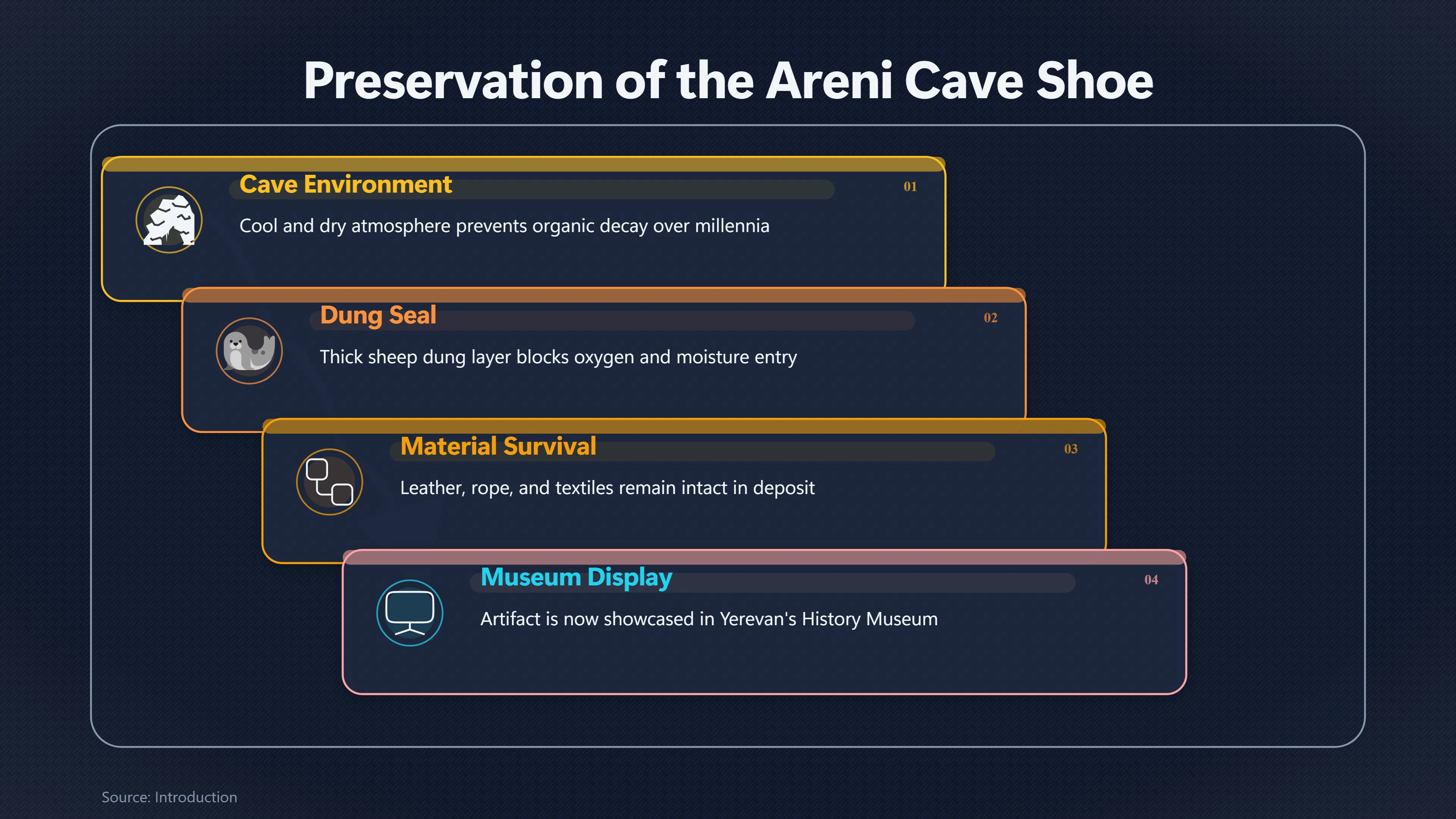
Its preservation was largely a matter of exceptional environmental conditions rather than luck alone. The cave’s cool, dry atmosphere, combined with a thick layer of sheep dung that sealed the deposit from moisture and oxygen, prevented the leather from decaying. Organic materials that almost always disappear elsewhere—including rope, basketry, textiles, seeds and wooden objects—also survived in the cave.[PLOS]journals.plos.orgFirst Direct Evidence of Chalcolithic Footwear from the Near Eastern Highlands | PLOS OneJune 9, 2010…
The shoe was not discovered in isolation. It lay beneath an overturned ceramic vessel inside a prepared pit, alongside other Copper Age material. The same cave complex later produced evidence of one of the world’s earliest known wine-making installations, illustrating that Areni-1 preserves an unusually complete picture of everyday and ritual life during the Chalcolithic period rather than a single spectacular artefact.[UNESCO World Heritage Centre]whc.unesco.orgUNESCO World Heritage CentreAreni-1 (Birds’) Cave: Prehistoric Life and Winemaking in the Arpa River Gorge - UNESCO World Heritage Centre…
Today the original shoe is displayed at the History Museum of Armenia in Yerevan, where it has become one of the country’s signature archaeological exhibits.[History Museum of Armenia]historymuseum.am5500 year old leather shoeHistory Museum of Armenia5500 -YEAR-OLD LEATHER SHOE – HMA…
Why Armenia’s dragon stones remain mysterious
If the Areni shoe represents extraordinary preservation, Armenia’s prehistoric dragon stones represent extraordinary interpretation.
Known in English as dragon stones, these large carved standing stones are found mainly in high mountain landscapes near springs, lakes and alpine pastures. Many are over two metres tall, with some weighing several tonnes. They are carved with images of fish, cattle hides or other symbolic forms, yet they contain no written explanation of their purpose.
Their nickname can be misleading. Archaeologists do not believe they depict dragons in the modern fantasy sense. Instead, the traditional name reflects later folklore, while researchers generally treat them as prehistoric ritual monuments dating to around the fourth or third millennium BC, although precise dating remains difficult because many were reused or moved over thousands of years.[arXiv]arxiv.orgVishap stelae as cult dedicated prehistoric monuments of Armenian Highlands: data analysis and interpretationAugust 15, 2025…
Several characteristics make them especially intriguing:
- They are concentrated in high-altitude landscapes rather than settlements.
- Many stand close to natural water sources.
- Their carvings follow recurring patterns rather than random decoration.
- Some appear to have been deliberately repositioned or incorporated into later archaeological contexts.
Because there are no accompanying texts, archaeologists must reconstruct their significance from landscape, carving style and excavation evidence rather than written records.

Water cults or territorial markers?
The biggest debate concerns what dragon stones actually represented.
One long-standing interpretation links them with prehistoric water cults. Their repeated association with mountain springs and seasonal water sources suggests they may have marked places where water held practical and religious importance for early pastoral communities. Recent statistical analyses have strengthened this hypothesis by showing consistent patterns in the stones’ elevation and location relative to water systems, although these studies remain part of an active scholarly discussion rather than a settled conclusion.[arXiv]arxiv.orgVishap stelae as cult dedicated prehistoric monuments of Armenian Highlands: data analysis and interpretationAugust 15, 2025…
Other researchers have proposed broader possibilities, including:
- ritual monuments connected with seasonal pastoral movement;
- territorial markers for communities using high mountain grazing grounds;
- memorial or ceremonial monuments;
- symbols associated with fertility or livestock.
None of these explanations has been conclusively proven. Unlike monuments bearing inscriptions, the dragon stones preserve the physical evidence but not the beliefs that originally gave them meaning.
What archaeology can and cannot explain
These discoveries demonstrate an important principle of archaeology: spectacular finds do not automatically produce complete answers.
The Areni shoe illustrates this well. Archaeologists know its approximate age through multiple radiocarbon measurements, understand how it was constructed, and can explain why it survived. They cannot, however, identify its owner, determine whether it belonged to a man or woman, or say exactly why it was deposited where it was found. Even the grass inside the shoe remains open to more than one reasonable interpretation.[PLOS]journals.plos.orgFirst Direct Evidence of Chalcolithic Footwear from the Near Eastern Highlands | PLOS OneJune 9, 2010…
The dragon stones present the opposite problem. Researchers know the monuments were deliberately carved and placed in significant mountain locations, but without written records they cannot confidently reconstruct the ceremonies, myths or social systems associated with them. Archaeology can reveal patterns, dates and landscapes, yet some aspects of prehistoric belief remain beyond direct recovery.
This distinction matters because it separates genuine archaeological mystery from unsupported speculation. Uncertainty is not evidence of lost civilisations or supernatural activity; it is often the natural consequence of interpreting societies that left few written records.

Why these ancient oddities matter
Armenia’s archaeological curiosities occupy an unusual place within the country’s broader landscape of strange collections. Unlike miraculous relics or folkloric objects preserved because people believe in them, the Areni shoe and the dragon stones are valued because they preserve tangible evidence of prehistoric life while reminding us how incomplete that evidence can be.
For visitors interested in unusual heritage, they offer something rarer than sensational mystery. The leather shoe demonstrates how exceptional preservation can bring everyday objects across five and a half millennia almost intact. The dragon stones show how enormous public monuments can survive long after the ideas that inspired them have vanished.
Together they illustrate why Armenia’s ancient oddities continue to attract archaeologists as much as curious travellers: not because they promise impossible secrets, but because they reveal just enough of the distant past to make its remaining gaps all the more fascinating.
Amazon book picks
Further Reading
Books and field guides related to What Makes Armenia's Ancient Finds So Strange?. Use these as the next step if you want deeper reading beyond the article.
The Art of Armenia
Though immediately recognizable in public discourse as a modern state in a political "hot zone," Armenia has a material history and visua...
Archaeology: Theories, Methods and Practice
The most authoritative and up-to-date archaeology textbook, revised and updated, and now in full color.
A Concise History of the Armenian People
The first part of the study discusses the origins of the Armenians, the Urartian Kingdom, Armenia and the Achaemenid, Seleucid, Parthian,...
The Human Past
The most authoritative world prehistory book on the market is now available in a new, thoroughly up-to-date essentials version. Partnerin...
eBay marketplace picks
Marketplace Samples
Example marketplace items related to this page. Use the search link to explore similar finds on eBay.
Selected fromancient artifact replica oneBay.co.uk.


Endnotes
1.
Source: journals.plos.org
Link:https://journals.plos.org/plosone/article?id=10.1371%2Fjournal.pone.0010984
Source snippet
First Direct Evidence of Chalcolithic Footwear from the Near Eastern Highlands | PLOS OneJune 9, 2010...
Published: June 9, 2010
2.
Source: whc.unesco.org
Link:https://whc.unesco.org/en/tentativelists/6967/
Source snippet
UNESCO World Heritage CentreAreni-1 (Birds’) Cave: Prehistoric Life and Winemaking in the Arpa River Gorge - UNESCO World Heritage Centre...
3.
Source: arxiv.org
Link:https://arxiv.org/abs/2508.11324
Source snippet
Vishap stelae as cult dedicated prehistoric monuments of Armenian Highlands: data analysis and interpretationAugust 15, 2025...
Published: August 15, 2025
4.
Source: arxiv.org
Link:https://arxiv.org/abs/2605.02991
Source snippet
Vishap epoch unitary society in Armenian Highlands, c. 4000 BC: data analysis consequences...
5.
Source: ora.ox.ac.uk
Link:https://ora.ox.ac.uk/objects/uuid%3A2fbfed35-ca01-4e3c-aa26-66edb57d2830
Source snippet
direct evidence of Chalcolithic footwear from the Near Eastern Highlands - ORA - Oxford University Research ArchiveJune 9, 2010 — Image...
Published: June 9, 2010
6.
Source: historymuseum.am
Title: 5500 year old leather shoe
Link:https://historymuseum.am/en/collections_type/5500-year-old-leather-shoe/
Source snippet
History Museum of Armenia5500 -YEAR-OLD LEATHER SHOE – HMA...
Additional References
7.
Source: arenicave.am
Link:https://www.arenicave.am/en/publication/
Source snippet
Areni CaveARENI-1 CAVE Image: Areni-1 Cave PUBLICATIONS First direct evidence of Chalcolithic footwear from the Near Eastern Highlands 09...
8.
Source: guinnessworldrecords.com
Link:https://www.guinnessworldrecords.com/world-records/first-leather-shoe
Source snippet
First leather shoe | Guinness World RecordsFIRST LEATHER SHOE Image: First leather shoe Who a 5,500-years-old leather shoe What First Whe...
9.
Source: cris.haifa.ac.il
Link:https://cris.haifa.ac.il/en/publications/first-direct-evidence-of-chalcolithic-footwear-from-the-near-east/
Source snippet
direct evidence of chalcolithic footwear from the near eastern highlands - University of HaifaFIRST DIRECT EVIDENCE OF CHALCOLITHIC FOOTW...
10.
Source: arenicave.am
Title: Areni Cave THE OLDEST FOOTWEAR IN EURASIA Olga Brileva, Science and Life, No
Link:https://www.arenicave.am/en/publication/the-oldest-footwear-in-eurasia/8/
Source snippet
3, 2011 Download Areni-1 Cave is located in Armenia not far from the Nakhchivan Autonomous Republic. The ancient shoe was found in...
11.
Source: arenicave.am
Title: Areni Cave ABOUT TWO TYPES OF ANCIENT SHOES FROM ARMENIA D
Link:https://www.arenicave.am/en/publication/about-two-types-of-ancient-shoes-from-armenia/13/
Source snippet
Zardaryan, B. Gasparyan Download In 2008, during excavations of the Areni-1 cave (Vayots Dzor region, Republic of Armenia), a complete sh...
12.
Source: armenian-tour.ru
Title: Areni-1 Cave — Oldest Shoe & Winery in Armenia
Link:https://armenian-tour.ru/en/areni-1-cave/
Source snippet
June 22, 2026 — ARENI-1 CAVE Image: Entrance to Areni-1 Cave (Bird Cave) near Areni village in Vayots Dzor, Armenia This cave near the vi...
Published: June 22, 2026
13.
Source: youtube.com
Title: Exploring Areni-1 Cave & Khor Virap & Noravank | My Armenia Travel Vlog
Link:https://www.youtube.com/watch?v=AUvxq4ucATI
Source snippet
The Mystery of the Mountaintop Fish Megaliths...
14.
Source: pmc.ncbi.nlm.nih.gov
Link:https://pmc.ncbi.nlm.nih.gov/articles/PMC2882957/
15.
Source: youtube.com
Title: The Mystery of the Mountaintop Fish Megaliths
Link:https://www.youtube.com/watch?v=-t_tAlVTkjs
Source snippet
The Vishapakar Stones: Armenia's Strangest Megalithic Mystery...
16.
Source: youtube.com
Title: When Did Humans Start Wearing Shoes?
Link:https://www.youtube.com/watch?v=K8Ff2mRjWWo
Source snippet
Treasures of Areni -1 Cave - presented by Ani Adigyozalyan...