Within Samoa Curiosities
Can Samoa's Ancient Tools Be Made Again?
Pottery sherds, basalt adzes and working heritage projects reveal how Samoa preserves and relearns its earliest technologies.
On this page
- The submerged Lapita settlement at Mulifanua
- What stone adzes reveal about Samoan life
- Tiapapata and the revival of traditional making
Page outline Jump by section
Introduction
Samoa’s earliest surviving artefacts are modest in appearance but extraordinary in importance. Broken pottery fragments, basalt adzes and the evidence of ancient craft techniques provide the clearest physical record of how the islands were first settled and how people built houses, carved canoes and established communities nearly 3,000 years ago. Unlike countries with vast archaeological museums, Samoa’s prehistoric collections are relatively small, making each object unusually significant.
Today, the story extends beyond museum display cases. Archaeologists continue to study the artefacts from the submerged Lapita site at Mulifanua, while heritage organisations are experimenting with recreating ancient technologies through practical workshops. The result is an unusual form of living archaeology in which ancient craftsmanship is not simply preserved but actively relearned.
The submerged Lapita settlement at Mulifanua
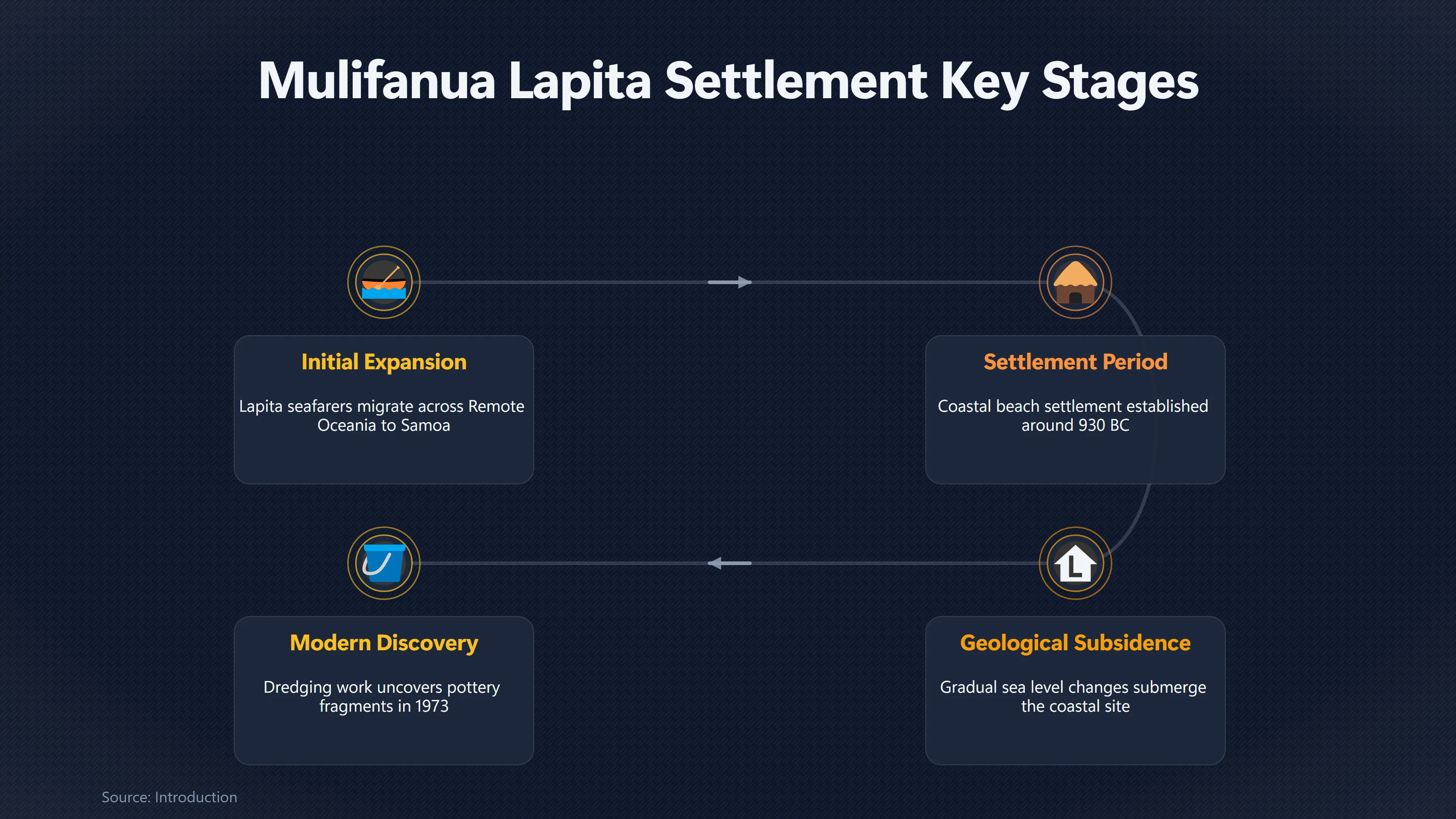
The single most important archaeological discovery in Samoa emerged almost by accident. During expansion work at the Mulifanua ferry berth on Upolu in 1973, dredging uncovered thousands of pottery fragments buried beneath the lagoon floor. Later geological work showed that the settlement had originally stood on a coastal beach before gradual subsidence and changing sea levels left it underwater.[Cambridge University Press & Assessment]cambridge.orgCambridge University Press & AssessmentRadiocarbon Determinations from the Mulifanua Lapita Site, Upolu, Western Samoa | Radiocarbon | Ca…
Mulifanua remains exceptional because it is the only confirmed Samoan site to have produced decorated dentate-stamped Lapita pottery. More than 4,000 pottery sherds were recovered together with two stone adzes, making the site the easternmost confirmed occurrence of classic Lapita ceramics in the Pacific. Radiocarbon dating places occupation at roughly 2880–2750 years before present (around 930–800 BC), firmly linking Samoa to the great expansion of Lapita seafarers across Remote Oceania.[cambridge.org]cambridge.orgCambridge University Press & AssessmentRadiocarbon Determinations from the Mulifanua Lapita Site, Upolu, Western Samoa | Radiocarbon | Ca…
The collection is unusual partly because so little survives. Rather than complete pots, archaeologists work with broken fragments whose stamped patterns, clay composition and manufacturing techniques reveal migration routes, trade connections and technological knowledge. Every sherd therefore contributes to reconstructing an otherwise largely invisible prehistoric society.
The site also illustrates the limits of archaeological certainty. Because the artefacts were recovered during dredging rather than a planned excavation, parts of the original context were disturbed before researchers could document them fully. This has led to decades of debate over precise dating, settlement duration and the relationship between decorated Lapita pottery and the later undecorated ceramics found elsewhere in Samoa.[sciencedirect.com]sciencedirect.comRefining the chronology for west polynesian colonization: New data from the Samoan archipelago - ScienceDirect…
What stone adzes reveal about Samoan life
If Lapita pottery tells archaeologists who first reached Samoa, stone adzes reveal how those communities actually lived.
A basalt adze was one of the most valuable tools in prehistoric Samoa. Before metal, these carefully shaped cutting tools made it possible to fell trees, hollow canoe hulls, construct houses and produce ceremonial carvings. Their quality directly affected the efficiency of daily life.
Archaeologists study adzes in several ways:
- Stone source: Geochemical analysis can identify where the basalt originated, revealing exchange networks between islands.
- Manufacturing style: Grinding marks, polishing and hammer dressing show how different communities shaped their tools.
- Wear patterns: Damage to cutting edges indicates whether an adze was mainly used for woodworking, heavy construction or finer carving.
The two adzes from Mulifanua are especially informative because they differ in form. One displays hammer dressing more commonly associated with eastern Lapita traditions elsewhere in the Pacific, suggesting technological connections beyond Samoa itself, while the other resembles forms that later became characteristic of Samoan stone-working traditions.[sadil.ws]sadil.wsArchaeology in Samoa – the Pulemelei InvestigationsNovember 2, 2025…
Later archaeological collections across Samoa contain many more plain stone adzes than decorated pottery. This imbalance reflects a broader cultural transition. Decorated ceramics disappear relatively early from the archaeological record, whereas expertly made stone tools continued to evolve for many centuries. Consequently, stone artefacts often provide the strongest evidence for understanding changing craft traditions after the Lapita period.[ScienceDirect]sciencedirect.comRefining the chronology for west polynesian colonization: New data from the Samoan archipelago - ScienceDirect…
For museum visitors these objects can seem surprisingly plain. Their importance lies less in visual spectacle than in the information they preserve about technology, resource use and everyday work in prehistoric Polynesia.
Tiapapata and the revival of traditional making
Ancient technologies are increasingly being treated as practical skills rather than purely archaeological subjects.
The Tiapapata Art Centre has developed heritage programmes that reconnect modern Samoans with traditional forms of making, including stone-tool production, pottery inspired by Lapita traditions, fibre work and other historic crafts. Rather than claiming uninterrupted continuity with prehistoric methods, the centre presents these activities as cultural revival informed by archaeological research, experimentation and collaboration with artists and communities.[Reviving Samoan Cultural Heritage]heritage.creativesamoa.comReviving Samoan Cultural Heritage Crafts | Reviving Samoan Cultural HeritageReviving Samoan Cultural Heritage Crafts | Reviving Samoan Cultural Heritage
This approach changes the role of archaeological collections. Instead of serving only as museum specimens, ancient artefacts become teaching resources that help answer practical questions:
- How were stone adzes shaped without metal?[creativesamoa.com]creativesamoa.comSource details in endnotes.
- Which local materials produce workable clay?
- How were pottery vessels formed and fired?
- Which traditional techniques remain useful for contemporary crafts?
Experimental reconstruction cannot prove every detail of ancient manufacture, but it allows researchers and craftspeople to test archaeological interpretations against real materials. Failed experiments can be just as informative as successful ones, revealing which techniques are unlikely to have been used in the past.
For visitors, workshops also make prehistoric technology more accessible. A polished basalt adze or reconstructed pottery vessel is easier to understand after watching the labour required to reproduce it.
Why these collections matter
Samoa’s archaeological collections differ from many famous museum treasures because their value lies in interpretation rather than rarity alone.
The Mulifanua pottery fragments anchor Samoa within one of humanity’s great episodes of oceanic exploration. Stone adzes demonstrate how those first settlers transformed forests into villages and voyaging canoes. Modern heritage projects then complete the story by asking whether ancient knowledge can still be practised rather than merely displayed.
Together, these artefacts illustrate a distinctive feature of Samoa’s curiosity culture. The country’s most remarkable collections are not cabinets of mysterious relics but carefully studied fragments of ordinary tools and pottery whose significance grows through research, reconstruction and living craftsmanship. They show that some of the most compelling archaeological objects are not the most spectacular to look at, but the ones that continue to teach new generations how an ancient society actually worked.
Amazon book picks
Further Reading
Books and field guides related to Can Samoa's Ancient Tools Be Made Again?. Use these as the next step if you want deeper reading beyond the article.
Tales of the Tikongs
In this lively satire of contemporary South Pacific life, we meet a familiar cast of characters: multinational experts, religious fanatic...
The Lapita Peoples
This is the first account of the Lapita peoples, the common ancestor of the Polynesians, Micronesians, and Austronesian-speaking Melanesi...
On the Road of the Winds
The Pacific Ocean covers one-third of the earth's surface and encompasses many thousands of islands, the home to numerous human societies...
The Human Past: World Prehistory and the Development of Human...
First published 2005. Subjects: Social life and customs, Prehistoric peoples, Economic conditions, Human evolution, Hunting and gathering...
eBay marketplace picks
Marketplace Samples
Example marketplace items related to this page. Use the search link to explore similar finds on eBay.
Selected fromancient artifact replica oneBay.co.uk.
Endnotes
1.
Source: cambridge.org
Link:https://www.cambridge.org/core/journals/radiocarbon/article/radiocarbon-determinations-from-the-mulifanua-lapita-site-upolu-western-samoa/8B9D5F36E62589F5B3C26C870F1C90AE
Source snippet
Cambridge University Press & AssessmentRadiocarbon Determinations from the Mulifanua Lapita Site, Upolu, Western Samoa | Radiocarbon | Ca...
2.
Source: sadil.ws
Link:https://sadil.ws/handle/123456789/1091
3.
Source: sciencedirect.com
Link:https://www.sciencedirect.com/science/article/pii/S2352409X16300463
Source snippet
Refining the chronology for west polynesian colonization: New data from the Samoan archipelago - ScienceDirect...
4.
Source: pmc.ncbi.nlm.nih.gov
Link:https://pmc.ncbi.nlm.nih.gov/articles/PMC6728074/
Source snippet
MAP OF THE CENTRAL SUBTROPICAL GYRE WATERS AND ASSOCIATED ISLAND GROUPS. Open in a new tab Insert: Sāmoan Archipelago showing sites menti...
5.
Source: sadil.ws
Title: Archaeology in Samoa – the Pulemelei Investigations
Link:https://www.sadil.ws/bitstream/handle/123456789/4598/Archaeology_in_Samoa_The_Pulemelei_Inves.pdf?sequence=1
Source snippet
November 2, 2025...
Published: November 2, 2025
6.
Source: samoa.travel
Link:https://www.samoa.travel/discover/our-history/early-samoa/
7.
Source: sciencedirect.com
Link:https://www.sciencedirect.com/science/article/abs/pii/S2352409X16300463
8.
Source: heritage.creativesamoa.com
Title: Reviving Samoan Cultural Heritage Crafts | Reviving Samoan Cultural Heritage
Link:https://heritage.creativesamoa.com/crafts
9.
Source: creativesamoa.com
Link:https://www.creativesamoa.com/stone-adzes
Additional References
10.
Source: thearchaeologist.org
Title: Samoa’s Mulifanua: 3,500-Year Lapita Potsherds
Link:https://www.thearchaeologist.org/blog/samoas-mulifanua-3500-year-lapita-potsherds
Source snippet
July 14, 2026 — Image SAMOA'S MULIFANUA: 3,500-YEAR LAPITA POTSHERDS July 14, 2026 INTRODUCTION Discovered accidentally during the expans...
Published: July 14, 2026
11.
Source: youtube.com
Title: Samoan method for making coconut sennit string
Link:https://www.youtube.com/watch?v=6xi-nWbC-bo
Source snippet
Alatina Avamua Matamua carves a wood handle for a Samoan stone adze...
12.
Source: docslib.org
Link:https://docslib.org/doc/3662828/geoarchaeological-context-of-holocene-subsidence-at-the-ferry-berth-lapita-site-mulifanua-upolu-samoa
13.
Source: researchgate.net
Link:https://www.researchgate.net/publication/41799106_Radiocarbon_determinations_from_the_Mulifanua_Lapita_site_Upolu_Western_Samoa
14.
Source: youtube.com
Title: Samoan method of lashing a stone adze to a handle
Link:https://www.youtube.com/watch?v=woQ5B6RpEbo
Source snippet
Grating coconut with a stone tool, Samoa...
15.
Source: youtube.com
Title: Reviving the Sound of the Fagufagu in Samoa
Link:https://www.youtube.com/watch?v=Z_sJmBln2es
Source snippet
Samoan method for making coconut sennit string...
16.
Source: onlinelibrary.wiley.com
Link:https://onlinelibrary.wiley.com/doi/10.1002/arco.5099
Source snippet
Dickinson, as part of his wide study of the geological history of the Pacific islands, has linked the unique...
17.
Source: youtube.com
Title: Grating coconut with a stone tool, Samoa
Link:https://www.youtube.com/watch?v=IOidOQyhQyQ
Source snippet
Reviving the Sound of the Fagufagu in Samoa...
18.
Source: youtube.com
Title: Alatina Avamua Matamua carves a wood handle for a Samoan stone adze
Link:https://www.youtube.com/watch?v=eDpIUzbYR1U
19.
Source: Wikipedia
Title: Archaeology of Samoa
Link:https://en.wikipedia.org/wiki/Archaeology_of_Samoa