Within Unusual Ethiopia
Why Lucy Still Defines Ethiopia's Strangest Museum
Lucy's replica and Ethiopia's other hominin fossils turn fragmentary bones into a public encounter with millions of years of human ancestry.
On this page
- What visitors actually see in the fossil galleries
- What Lucy revealed about early upright walking
- Why originals, replicas and travelling fossils matter
Page outline Jump by section
Introduction
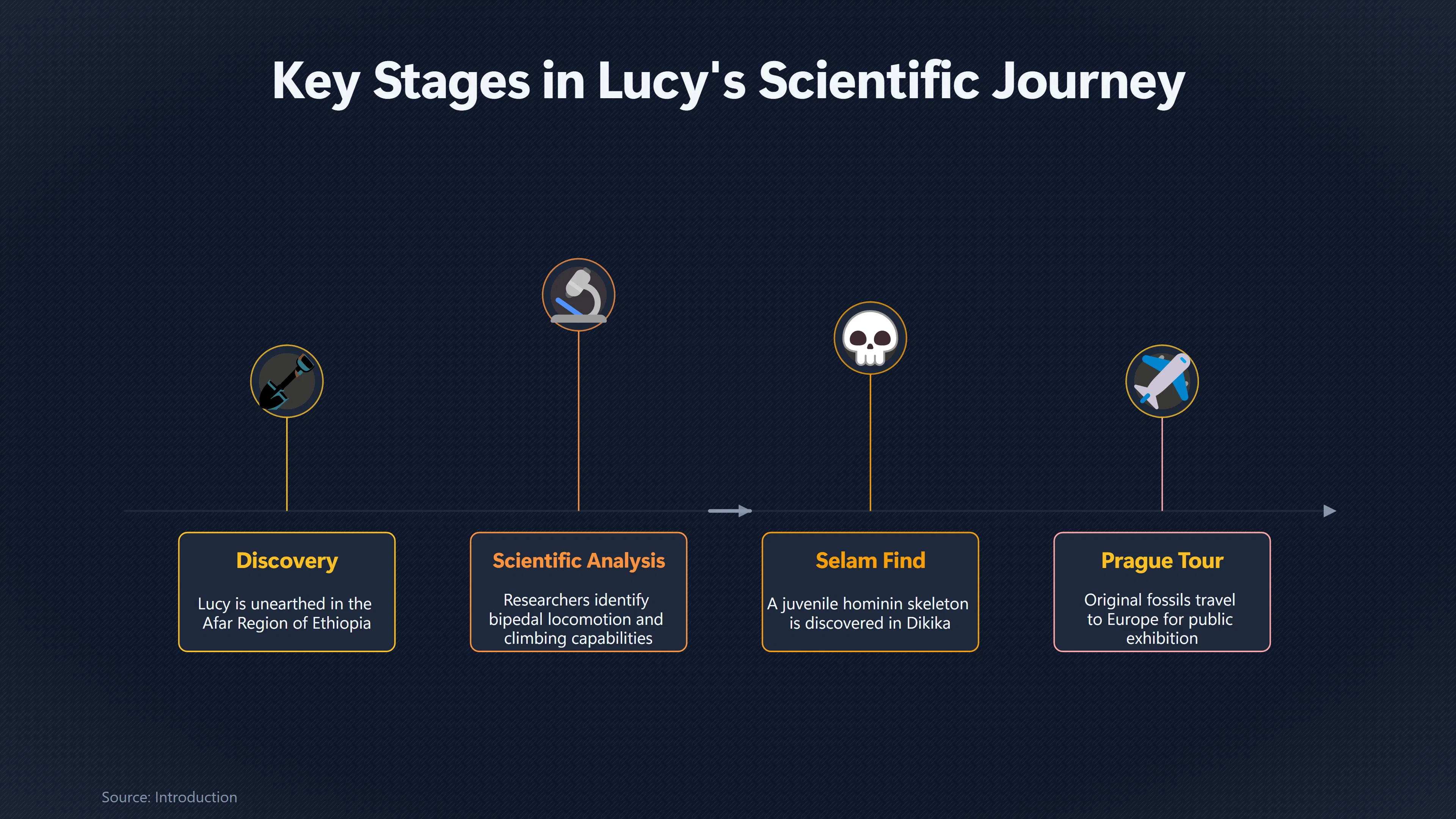
The most remarkable gallery in Ethiopia is not filled with mysterious relics or legendary monsters. Instead, it displays fragmentary fossil bones that have transformed how humanity understands its own origins. At the centre is Lucy, the 3.2-million-year-old partial skeleton of Australopithecus afarensis, discovered in Ethiopia’s Afar Region in 1974. Although visitors to the National Museum in Addis Ababa usually see a meticulously made replica rather than the original fossil, the experience remains one of the world’s most unusual museum encounters: a meeting with an ancestor whose remains helped redefine the story of human evolution.[Human Origins]humanorigins.si.eduHuman Origins AL 288-1 | The Smithsonian Institution's Human Origins ProgramHuman Origins AL 288-1 | The Smithsonian Institution's Human Origins Program

Within Ethiopia’s landscape of unusual collections, Lucy occupies a distinctive place. She is neither an archaeological treasure displayed for artistic beauty nor a religious relic preserved for devotion. Instead, her fossil fragments are scientific evidence presented almost like a secular relic, inviting visitors to contemplate millions of years of human history through a surprisingly small collection of bones.
What visitors actually see in the fossil galleries
The National Museum’s human origins galleries focus on some of the most significant hominin discoveries ever made. The centrepiece is Lucy (catalogue number AL 288-1), but the display also introduces visitors to other Ethiopian fossil discoveries that together illustrate an exceptionally deep record of early human evolution.[Human Origins]humanorigins.si.eduHuman Origins AL 288-1 | The Smithsonian Institution's Human Origins ProgramHuman Origins AL 288-1 | The Smithsonian Institution's Human Origins Program
One detail often surprises first-time visitors: the skeleton on public display is normally a replica. The genuine fossil consists of hundreds of fragile pieces preserved under carefully controlled conditions and kept in secure storage to minimise the risks posed by light, vibration, humidity and accidental damage. The cast allows the museum to present Lucy’s anatomy while protecting an irreplaceable scientific specimen.[AP News]apnews.comAP News Ethiopian fossil Lucy leaves for her first exhibition in EuropeDiscovered in 1974 in Ethiopia, Lucy belongs to the species Australopithecus afarensis and is more than 3 million years old. Her skeleton…
The gallery combines reconstructed skeletons, fossil casts, explanatory panels and geological context rather than presenting Lucy as an isolated curiosity. This approach helps visitors understand that no single fossil explains human evolution. Instead, Lucy forms part of a growing body of evidence recovered from Ethiopia’s Rift Valley over decades of palaeoanthropological research.[Human Origins]humanorigins.si.eduOpen source on si.edu.
Unlike many archaeological museums that celebrate kings, monuments or civilisations, these galleries present individuals who lived millions of years before recorded history. That perspective gives the museum an unusual atmosphere: visitors are not looking into the history of a nation but into the much older history of humanity itself.
What Lucy revealed about early upright walking
Lucy became famous not because she was the oldest human ancestor ever discovered, but because her skeleton was unusually complete. Roughly 40 per cent of her skeleton survived, providing researchers with enough anatomical evidence to examine how an early hominin moved through its environment.[Human Origins]humanorigins.si.eduHuman Origins AL 288-1 | The Smithsonian Institution's Human Origins ProgramHuman Origins AL 288-1 | The Smithsonian Institution's Human Origins Program
Her bones revealed an intriguing combination of features.
- Her pelvis and angled thigh bones clearly supported efficient upright walking.
- Her feet were adapted to bearing body weight while walking on two legs.
- At the same time, her long arms, curved fingers and powerful upper body suggest she still climbed trees regularly.
- Rather than representing a modern human body plan, Lucy demonstrated an evolutionary transition that combined terrestrial walking with substantial climbing ability.[Human Origins]humanorigins.si.eduHuman Origins AL 288-1 | The Smithsonian Institution's Human Origins ProgramHuman Origins AL 288-1 | The Smithsonian Institution's Human Origins Program
This combination challenged earlier assumptions that upright walking evolved only after humans had developed much larger brains. Lucy showed instead that bipedal locomotion emerged considerably earlier, fundamentally changing scientific thinking about the sequence of human evolution.[Human Origins]humanorigins.si.eduHuman Origins AL 288-1 | The Smithsonian Institution's Human Origins ProgramHuman Origins AL 288-1 | The Smithsonian Institution's Human Origins Program
Even details that appear insignificant—such as the angle of a knee joint or the shape of the pelvis—became critical pieces of evidence. In the fossil gallery, these ordinary-looking fragments demonstrate how anatomical interpretation depends on careful comparison rather than dramatic discoveries.
Beyond Lucy: Ethiopia’s wider fossil record
Lucy’s fame can overshadow the broader significance of Ethiopia’s fossil record. The museum’s displays increasingly place her alongside other discoveries that deepen and sometimes complicate the story she first told.
One of the most important is Selam (DIK-1-1), an exceptionally preserved child of the same species discovered in Dikika in 2000. Although popularly nicknamed “Lucy’s baby”, Selam was not Lucy’s offspring and actually lived around 100,000 years earlier. The fossil preserves much of the skull, torso and limbs, making it one of the most complete juvenile early hominin skeletons ever found.[Human Origins]humanorigins.si.eduHuman Origins DIK-1-1 | The Smithsonian Institution's Human Origins ProgramHuman Origins DIK-1-1 | The Smithsonian Institution's Human Origins Program
Selam allowed researchers to investigate childhood growth in Australopithecus afarensis. Her teeth suggest a growth pattern resembling that of young chimpanzees, while aspects of her developing brain hint at evolutionary changes moving towards later human development. Her skeleton also reinforces the picture of a species capable of both habitual upright walking and effective tree climbing.[Human Origins]humanorigins.si.eduHuman Origins DIK-1-1 | The Smithsonian Institution's Human Origins ProgramHuman Origins DIK-1-1 | The Smithsonian Institution's Human Origins Program
Seen together, Lucy and Selam transform isolated fossil finds into a population rather than a single famous individual. Visitors begin to appreciate that Ethiopia preserves not merely one iconic skeleton but an extensive archive documenting several stages of early human evolution.
Why originals, replicas and travelling fossils matter
The distinction between an original fossil and a museum replica is especially important in palaeoanthropology because the evidence itself is irreplaceable. Every crack, mineral deposit and microscopic surface feature may contain information valuable for future research. Conservation therefore often takes priority over public display.[AP News]apnews.comAP News Ethiopian fossil Lucy leaves for her first exhibition in EuropeDiscovered in 1974 in Ethiopia, Lucy belongs to the species Australopithecus afarensis and is more than 3 million years old. Her skeleton…
That makes the occasional international loan highly significant. In 2025, the original Lucy and Selam fossils travelled to Prague for a temporary exhibition—the first time Lucy had been displayed in Europe and only the second occasion on which she had left Ethiopia. The exhibition highlighted both Ethiopia’s willingness to share its scientific heritage and the continuing debate over whether such fragile specimens should travel at all. Supporters argued that the fossils belong to humanity’s shared story, while critics worried about transport risks and questioned whether such national treasures should leave the country.[AP News]apnews.comAP News Ethiopian fossil Lucy leaves for her first exhibition in EuropeDiscovered in 1974 in Ethiopia, Lucy belongs to the species Australopithecus afarensis and is more than 3 million years old. Her skeleton…
For most visitors to Addis Ababa, however, the replica remains the more meaningful encounter. The scientific importance of Lucy does not depend on touching the original bones. The reconstruction faithfully communicates the anatomical relationships that transformed understanding of early human evolution while allowing the authentic fossil to survive for future generations of researchers.

Why Lucy remains Ethiopia’s strangest museum experience
Among Ethiopia’s remarkable collections, Lucy stands apart because she overturns expectations of what a museum curiosity can be. There is no mystery about her authenticity, no folklore surrounding supernatural powers and no elaborate treasure narrative. Her fascination comes from evidence.
A relatively small collection of fossil fragments enables visitors to visualise a creature that walked through East Africa more than three million years ago and whose anatomy still informs debates about how humans evolved. Few museum objects compress such immense spans of time into a single display.
That combination of scientific certainty, extraordinary age and public accessibility makes the National Museum’s fossil gallery unlike almost any other attraction in Ethiopia. Rather than presenting something strange because it is inexplicable, it presents something astonishing because painstaking scientific work has made the seemingly impossible understandable.
Amazon book picks
Further Reading
Books and field guides related to Why Lucy Still Defines Ethiopia's Strangest Museum. Use these as the next step if you want deeper reading beyond the article.
The Last Human: A Guide to Twenty-Two Species of Extinct Humans
Creates three-dimensional scientific reconstructions for twenty-two species of extinct humans, providing information for each one on its...

The Human Story: Our Evolution from Prehistoric Ancestors to...
First published 2004. Subjects: History, Nonfiction, Reference, World history, Civilization, history.

Lucy: The Beginnings of Humankind
First published 1981. Subjects: Fossil hominids, Australopithecus afarensis, Fossil man, Prehistoric peoples, africa, Human beings, origin.
Lucy, the beginnings of humankind
Describes the discovery of the oldest, most complete skeleton of any erect walking human ancestor ever found in 1974 in Ethiopia.
eBay marketplace picks
Marketplace Samples
Live-tested eBay searches with available results related to this page.
Selected fromscience collectible oneBay.co.uk.


Endnotes
1.
Source: humanorigins.si.edu
Title: Human Origins AL 288-1 | The Smithsonian Institution’s Human Origins Program
Link:https://humanorigins.si.edu/evidence/human-fossils/fossils/al
2.
Source: humanorigins.si.edu
Link:https://humanorigins.si.edu/evidence/human-fossils/species/australopithecus-afarensis
3.
Source: apnews.com
Title: AP News Ethiopian fossil Lucy leaves for her first exhibition in Europe
Link:https://apnews.com/article/8ba1e84b3ff1cc774264fa441f3057ff
Source snippet
Discovered in 1974 in Ethiopia, Lucy belongs to the species Australopithecus afarensis and is more than 3 million years old. Her skeleton...
4.
Source: humanorigins.si.edu
Title: Human Origins DIK-1-1 | The Smithsonian Institution’s Human Origins Program
Link:https://humanorigins.si.edu/evidence/human-fossils/fossils/dik
5.
Source: australian.museum
Title: Australopithecus afarensis
Link:https://australian.museum/learn/science/human-evolution/australopithecus-afarensis/
Source snippet
The Australian MuseumMay 14, 2021 — AUSTRALOPITHECUS AFARENSIS * Author(s) Fran Dorey * Updated 14/05/21 * Read time 2 minutes * * * Imag...
Published: May 14, 2021
6.
Source: humanorigins.si.edu
Title: reconstructions early humans
Link:https://humanorigins.si.edu/exhibit/reconstructions-early-humans
Source snippet
of Early Humans | The Smithsonian Institution's Human Origins ProgramRECONSTRUCTIONS OF EARLY HUMANS * Exhibit Floorplan * Exhibit Floorp...
Additional References
7.
Source: nhm.ac.uk
Link:https://www.nhm.ac.uk/discover/australopithecus-afarensis-lucy-species.html
Source snippet
Australopithecus afarensis, Lucy's species | Natural History MuseumImage: Two Australopithecus afarensis reconstructions Facial reconstru...
8.
Source: smithsonianmag.com
Link:https://www.smithsonianmag.com/science-nature/meeting-lucy-how-a-world-first-european-exhibition-brought-visitors-face-to-face-with-the-fossil-that-shrinks-time-180987690/
Source snippet
November 14, 2025 — Science | November 14, 2025 MEETING LUCY: HOW A WORLD-FIRST EUROPEAN EXHIBITION BROUGHT VISITORS FACE TO FACE WITH TH...
Published: November 14, 2025
9.
Source: smithsonianmag.com
Link:https://www.smithsonianmag.com/smithsonian-institution/what-lucy-one-of-the-worlds-most-important-fossils-has-taught-scientists-in-the-50-years-since-her-discovery-180985541/
Source snippet
November 26, 2024 — WHAT ‘LUCY,’ ONE OF THE WORLD’S MOST IMPORTANT FOSSILS, HAS TAUGHT SCIENTISTS IN THE 50 YEARS SINCE HER DISCOVERY THE...
Published: November 26, 2024
10.
Source: nm.cz
Link:https://www.nm.cz/en/about-us/news/the-original-fossils-of-lucy-and-selam-are-on-display-for-the-first-time-in-europe-in-the-exhibition-people-and-their-ancestors-at-the-national-museum-of-the-czech-republic
Source snippet
tional Museum of the Czech Republic - National museumAugust 25, 2025 — * The original fossils of Lucy and Selam are on display for the fi...
Published: August 25, 2025
11.
Source: publikace.nm.cz
Link:https://publikace.nm.cz/o-nas/novinky/originaly-fosilii-lucy-a-selam-poprve-vevrope-v-expozici-lide-a-jejich-predci-v-narodnim-muzeu
Source snippet
8. 2025 ORIGINÁLY FOSILIÍ LUCY A SELAM POPRVÉ V EVROPĚ V EXPOZICI LIDÉ A JEJICH PŘEDCI V NÁRODNÍ...
12.
Source: youtube.com
Title: Obama meets Lucy, a 3.2 million-year-old human ancestor | Mashable
Link:https://www.youtube.com/watch?v=M8tQRfTWbF4
Source snippet
"Lucy fossil" "National Museum of Ethiopia" 2 million year old human fossil-Lucy in the national museum of Ethiopia,Addis Ababa Traveling...
13.
Source: nm.cz
Title: Národní muzeum People and Their Ancestors
Link:https://www.nm.cz/en/program/long-term-exhibitions/people-and-their-ancestors
Source snippet
People and Their Ancestors - National museumPEOPLE AND THEIR ANCESTORS Immerse yourself in the history of humankind, from the first steps...
14.
Source: smithsonianmag.com
Title: And her fossils are still yie
Link:https://www.smithsonianmag.com/blogs/national-museum-of-natural-history/2024/11/29/after-50-years-scientists-still-love-lucy/
Source snippet
After 50 Years, Scientists Still Love Lucy | Smithsonian Voices | National Museum of Natural History Smithsonian MagazineNovember 22, 202...
15.
Source: youtube.com
Title: What Lucy Taught Us About Ourselves | NOVA | PBS
Link:https://www.youtube.com/watch?v=sPyb2Z5LXBs
Source snippet
Donald Johanson: Unearthing Lucy changed my life and the world...
16.
Source: youtube.com
Title: The Face of Lucy’s Ancestor Revealed
Link:https://www.youtube.com/watch?v=JltrBmtMUM0
Source snippet
Obama meets Lucy, a 3.2 million-year-old human ancestor | Mashable...