Within Central African Curiosities
Are These Objects Really Witchcraft Curiosities?
Masks and protective objects reveal systems of healing and authority, but sensational labels often erase their origins and uses.
On this page
- What ritual objects may have meant
- How sensational labels distort interpretation
- Provenance, authority and responsible display
Page outline Jump by section
Introduction
Visitors looking for “witchcraft objects” in the Central African Republic are likely to be disappointed if they expect shelves of cursed relics or occult curiosities. The country’s surviving ritual collections instead reveal something far more interesting: objects created for healing, protection, initiation, conflict resolution and spiritual authority that have often been misunderstood through colonial descriptions or sensational modern labels. The surviving collections at the Barthélémy Boganda National Museum, together with comparable Central African ethnographic material, show that masks, carved figures, ceremonial instruments and protective objects formed part of living social systems rather than isolated magical curiosities. Understanding these objects requires asking what communities believed they did, who was entitled to use them and how museums can present them without reducing them to stereotypes.[Aliph Foundation]aliph-foundation.orgAliph FoundationProtecting Heritage at the Barthélémy Boganda Museum | Aliph Foundation - Protecting heritage to build peace…

Are these objects really witchcraft curiosities?
In the Central African Republic, ritual objects were traditionally embedded within everyday community life rather than separated into a category equivalent to “the occult”. An object could be used during an initiation ceremony, serve as a symbol of legitimate authority, accompany healing practices or help regulate relationships between families and communities. Its meaning depended on trained specialists, recognised social roles and accepted ceremonial contexts.
Many surviving museum pieces therefore lose much of their original significance when displayed behind glass. A carved mask, for example, was often intended to be seen in movement, accompanied by music, costume and performance. A carved figure might only become meaningful during a specific ritual carried out by authorised individuals. Without those surrounding practices, the object alone tells only part of the story.
The Barthélémy Boganda National Museum reflects this broader understanding. Its ethnographic collections combine ritual objects with musical instruments, hunting equipment, domestic tools and archaeological finds, illustrating that ceremonial life was intertwined with ordinary social and economic life rather than existing as a separate world of “magic”.[Wikipedia]WikipediaBoganda National MuseumBoganda National Museum
What ritual objects may have meant
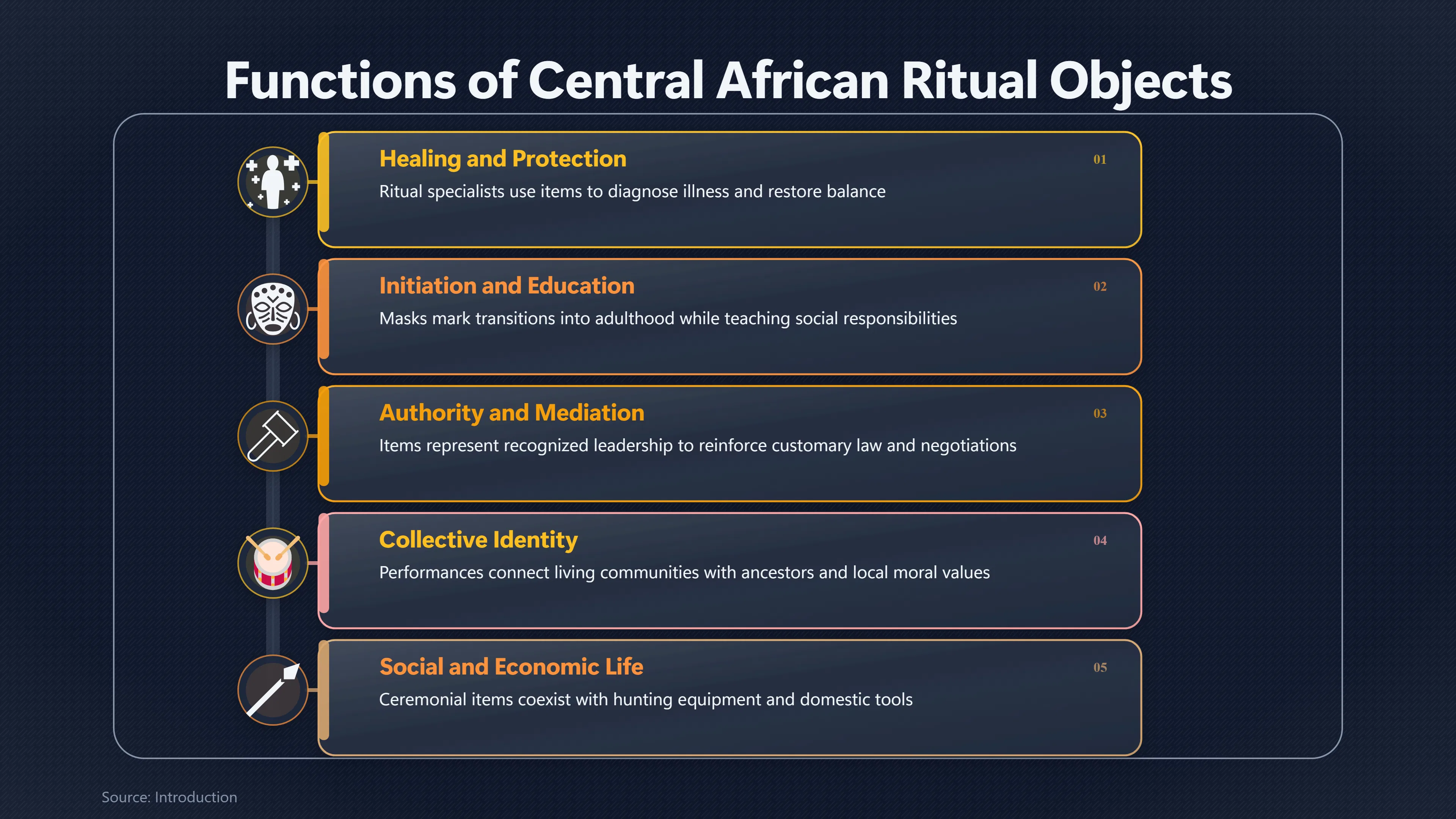
The surviving evidence from Central African collections points towards several overlapping functions rather than a single category of “witchcraft”.
- Healing and protection. Certain objects were associated with recognised ritual specialists who sought to diagnose illness, restore balance or provide spiritual protection. Such practices were often understood locally as responses to misfortune rather than attempts to cause harm.
- Initiation and education. Masks and ceremonial objects frequently appeared during initiation ceremonies that marked the transition into adulthood, teaching social responsibilities, history and accepted behaviour.
- Authority and mediation. Some ritual items represented recognised authority within a community. Their use could reinforce customary law, confirm leadership or accompany negotiations and reconciliation.
- Collective identity. Ceremonial performances involving masks, music and regalia strengthened shared identity by connecting living communities with ancestors, historical traditions and local moral values.
These functions often overlapped. A single object could simultaneously possess artistic value, ceremonial importance, historical significance and practical social purpose.
How sensational labels distort interpretation
The label “witchcraft object” became common in many colonial catalogues because European collectors frequently interpreted unfamiliar religious practices through their own assumptions about superstition or sorcery. As a result, highly diverse ceremonial traditions were compressed into one dramatic category.
This simplification creates several problems.
First, it treats every ritual object as though it were intended for harmful supernatural activity, despite many being associated with protection, healing or education.
Second, it separates objects from the performances, songs, costumes and social relationships that originally gave them meaning.
Third, it encourages visitors to judge artefacts by appearance alone. A carved wooden mask may seem frightening when displayed in isolation, yet its original purpose may have been to welcome initiates, represent respected ancestors or symbolise moral authority rather than terror.
Museums increasingly acknowledge these problems by describing the communities that created objects, explaining ceremonial contexts and avoiding language that presents African religious traditions simply as collections of mysterious or dangerous artefacts. Comparable Central African collections elsewhere similarly interpret ritual masks through initiation, healing or community governance instead of relying solely on the language of witchcraft.[si.edu]africa.si.eduNational Museum of African Art Cap mask | National Museum of African ArtNational Museum of African Art Cap mask | National Museum of African Art
Provenance matters as much as the objects themselves
For the Central African Republic, questions of provenance have become especially important because conflict has threatened both the collections and the documentation that explains them.
The Barthélémy Boganda National Museum suffered severe looting and damage during the civil war beginning in 2013. Conservation projects now focus not only on preserving physical artefacts but also on stabilising storage conditions, improving documentation and strengthening professional collections management. That work helps reconnect objects with information about where they came from, which communities used them and how they entered the museum.[Aliph Foundation]aliph-foundation.orgAliph FoundationProtecting Heritage at the Barthélémy Boganda Museum | Aliph Foundation - Protecting heritage to build peace…
Without reliable provenance, visitors may know that an object is old but remain unable to understand:
- which community created it;
- whether it was collected with permission;
- whether it served ceremonial, political or domestic purposes;
- how representative it is of wider traditions.
These questions are particularly important because many Central African ceremonial traditions were transmitted through practice rather than extensive written records.
Responsible display after conflict
The Central African Republic presents a different challenge from countries that have built commercial museums around occult tourism. Here, the priority is preserving vulnerable cultural heritage rather than creating dramatic visitor experiences.
Responsible interpretation therefore means presenting ritual objects as cultural evidence rather than supernatural attractions. Good displays explain:
- the object’s known cultural context;
- the limits of current knowledge;
- the difference between local belief and sensational myth;
- how conflict has affected preservation and documentation.
Where documentation is incomplete, museums increasingly acknowledge uncertainty instead of inventing dramatic stories. This approach is especially important for collections disrupted by war, displacement and loss of archival records.[Aliph Foundation]aliph-foundation.orgAliph FoundationProtecting Heritage at the Barthélémy Boganda Museum | Aliph Foundation - Protecting heritage to build peace…

Why this perspective matters
For anyone exploring the Central African Republic’s unusual heritage, the most valuable insight is that ritual objects become less mysterious—and far more interesting—when understood within the societies that created them.
Rather than representing a hidden world of exotic “witchcraft”, surviving ceremonial objects demonstrate how communities expressed authority, preserved knowledge, marked life transitions and responded to illness, uncertainty and social conflict. Their significance lies not in supernatural spectacle but in the ways they connected art, belief, memory and community life.
Seen in that light, the country’s ritual collections belong within a broader history of cultural heritage and ethnography, reminding visitors that the most revealing questions are often not whether an object was believed to possess spiritual power, but who used it, for what purpose and how responsibly its story is told today.
Amazon book picks
Further Reading
Books and field guides related to Are These Objects Really Witchcraft Curiosities?. Use these as the next step if you want deeper reading beyond the article.
Magic, Witchcraft and Religion: An Anthropological Study of t...
This comparative reader takes an anthropological approach to the study of religious beliefs, both strange and familiar. The engaging arti...
The Interpretation Of Cultures
One of the twentieth century's most influential books, this classic work of anthropology offers a groundbreaking exploration of what cult...
The Anthropology of Religion: An Introduction
Now available in a revised second edition, this popular introduction to the anthropology of religion combines discussion of the origin an...
eBay marketplace picks
Marketplace Samples
Live-tested eBay searches with available results related to this page.
Selected fromAfrican mask decor oneBay.co.uk.

Endnotes
1.
Source: aliph-foundation.org
Link:https://www.aliph-foundation.org/en/projects/protecting-heritage-at-the-barthelemy-boganda-museum
Source snippet
Aliph FoundationProtecting Heritage at the Barthélémy Boganda Museum | Aliph Foundation - Protecting heritage to build peace...
2.
Source: Wikipedia
Title: Boganda National Museum
Link:https://en.wikipedia.org/wiki/Boganda_National_Museum
3.
Source: aliph-foundation.org
Title: Protéger le patrimoine au Musée Barthélémy-Boganda | Aliph Foundation
Link:https://www.aliph-foundation.org/fr/nos-actions/protecting-heritage-at-the-barthelemy-boganda-museum
4.
Source: africa.si.edu
Title: National Museum of African Art Cap mask | National Museum of African Art
Link:https://africa.si.edu/collection/object/nmafa
5.
Source: allenartcollection.oberlin.edu
Title: Allen Memorial Art Museum Diviner’s Mask – Works – Allen Memorial Art Museum
Link:https://allenartcollection.oberlin.edu/objects/36174/diviners-mask
6.
Source: africacommons.net
Title: Boganda National Museum | Africa Commons
Link:https://africacommons.net/collections/33455/boganda-national-museum/
7.
Source: artmuseum.princeton.edu
Link:https://artmuseum.princeton.edu/art/collections/objects/102729
8.
Source: wepa.unima.org
Title: central african republic
Link:https://wepa.unima.org/en/central-african-republic/
9.
Source: collections.lacma.org
Link:https://collections.lacma.org/object/282166
10.
Source: si.edu
Title: cap mask:nmafa 70 34 3
Link:https://www.si.edu/object/cap-mask%3Anmafa
11.
Source: africa.si.edu
Link:https://africa.si.edu/collection/object/nmafa
12.
Source: si.edu
Title: cap mask:nmafa 86 6 2
Link:https://www.si.edu/object/cap-mask%3Anmafa
13.
Source: si.edu
Title: cap mask:nmafa 73 7 700
Link:https://www.si.edu/object/cap-mask%3Anmafa
14.
Source: africa.si.edu
Link:https://africa.si.edu/collection/object/nmafa
15.
Source: africa.si.edu
Link:https://africa.si.edu/collection/object/nmafa
16.
Source: africa.com
Link:https://africa.com/museums-of-central-african-republic
Additional References
17.
Source: researchgate.net
Link:https://www.researchgate.net/publication/399952777_L%27art_plastique_chez_les_anciens_Bulu_du_sud-Cameroun_perspective_ethno-_anthropologique_sur_les_statues_et_les_masques
Source snippet
December 1, 2025 — Article PDF Available L'ART PLASTIQUE CHEZ LES ANCIENS BULU DU SUD-CAMEROUN: PERSPECTIVE ETHNO- ANTHROPOLOGIQUE SUR L...
Published: December 1, 2025
18.
Source: ora.ox.ac.uk
Link:https://ora.ox.ac.uk/objects/uuid%3A9b4b62b6-66bf-42df-a1a3-8847d0d0f853
Source snippet
ox.ac.ukL’art plastique chez les anciens Bulu du sud-Cameroun: perspective ethno-anthropologique sur les statues et les masques - ORA - O...
19.
Source: fatshimetrie.org
Link:https://fatshimetrie.org/en/international/2024/06/07/treasures-found-the-captivating-story-of-fatshimetrie-at-the-national-museum-of-the-central-african-republic/
Source snippet
June 7, 2024 — TREASURES FOUND: THE CAPTIVATING STORY OF FATSHIMETRIE AT THE NATIONAL MUSEUM OF THE CENTRAL AFRICAN REPUBLIC...
Published: June 7, 2024
20.
Source: youtube.com
Link:https://www.youtube.com/watch?v=qZJaBuigPmU
Source snippet
The 13 Sacred Objects That Built Ancient Africa...
21.
Source: link.springer.com
Link:https://link.springer.com/article/10.1007/s10745-024-00484-7
Source snippet
Versus Cattle: The Ecology of an African Art Form | Human Ecology | Springer Nature LinkApril 15, 2024 — MASKS VERSUS CATTLE: THE ECOLOGY...
Published: April 15, 2024
22.
Source: youtube.com
Title: Powerful AFRICAN ART MASTERPIECES at the Smithsonian Museum
Link:https://www.youtube.com/watch?v=VzC80WE8wJA
Source snippet
West And Central African Art - Art And Design Senior Three...
23.
Source: youtube.com
Title: The 13 Sacred Objects That Built Ancient Africa!
Link:https://www.youtube.com/watch?v=VrWx3rqOJRE
Source snippet
Powerful AFRICAN ART MASTERPIECES at the Smithsonian Museum...
24.
Source: researchgate.net
Link:https://www.researchgate.net/publication/348873900_Agonie_perte_ou_renouveau_d%27une_esthetique_oubanguienne_A_propos_de_certains_artefacts_anciens_et_de_leurs_avatars_recents_en_Centrafrique
25.
Source: africanarchive.org
Link:https://africanarchive.org/en/staemme/bulu
26.
Source: youtube.com
Title: West And Central African Art
Link:https://www.youtube.com/watch?v=Mg48fqqwI8g
Source snippet
African Arts and It's Symbolism...