Within Strange Egypt
Why Did Egypt Mummify Sacred Animals?
Egypt's animal mummies reveal how dangerous creatures, divine presence, pilgrimage and temple economies became closely connected.
On this page
- Crocodiles, cats and other sacred species
- How temples produced and buried animal offerings
- What scans reveal inside mummy bundles
Page outline Jump by section
Introduction
Ancient Egypt did not mummify animals simply because they were considered sacred. Instead, animal mummies formed part of a sophisticated religious system in which living creatures represented divine powers, temples organised their care and burial, and pilgrims purchased mummified offerings as acts of devotion. The result was one of the largest ritual industries of the ancient world, producing millions of animal mummies over many centuries. Modern museum displays, particularly at Kom Ombo, Luxor and in collections around the world, preserve these remarkable remains because they reveal how religion, pilgrimage, economics and animal management became closely intertwined. Scientific research is also transforming what these bundles can tell us, showing that appearances can be deceptive and that each mummy reflects different religious practices rather than a single standard ritual.[British Museum]britishmuseum.orgOpen source on britishmuseum.org.
Why did Egypt mummify sacred animals?
Animal mummification reached its greatest scale during the first millennium BC, especially in the Late and Ptolemaic periods. Different species were associated with particular deities: crocodiles with Sobek, cats with Bastet, ibises with Thoth, falcons with Horus, bulls with Apis and other sacred cattle cults, and many smaller creatures including fish, snakes and shrews with regional gods. Rather than worshipping every individual animal as a god, Egyptians recognised several distinct categories of sacred animals.
A small number of living animals were regarded as unique manifestations of a deity and lived within temple precincts, receiving elaborate care before being mummified at death. Far more common were votive animals. These were bred or obtained so that worshippers could dedicate them to a god, much as later pilgrims might light candles or leave offerings at a shrine. The mummy became a permanent prayer placed within the deity’s sacred landscape. Archaeological discoveries of vast catacombs filled with animal mummies demonstrate how widespread this practice became across Egypt.[British Museum]britishmuseum.orgOpen source on britishmuseum.org.
For visitors exploring Egypt’s unusual heritage, this helps explain why displays of hundreds of similar mummies are not evidence of bizarre mass worship. They represent organised pilgrimage supported by temple institutions, making them archaeological records of religious behaviour rather than collections of curiosities alone.
Crocodiles, cats and other sacred species
Different temples specialised in different animals according to the deity honoured there, creating distinctive local traditions.
- Crocodiles: At Kom Ombo and other centres devoted to Sobek, crocodiles symbolised both danger and protection. Some were carefully raised within temple precincts, while others may have been captured from the wild depending on period and location. Large mummified crocodiles, sometimes containing smaller crocodiles attached to or placed within the wrapping, survive as striking examples of temple ritual.[British Museum]britishmuseum.orgBritish Museumanimal mummy | British MuseumBritish Museumanimal mummy | British Museum
- Cats: Closely associated with Bastet, cats became among the most numerous votive animals. Cat cemeteries, especially around Saqqara and Bubastis, have yielded enormous numbers of mummies ranging from carefully embalmed individuals to simpler offerings. Decorative bronze or wooden cat coffins emphasised the connection with the goddess rather than the value of any individual animal.[British Museum]britishmuseum.orgBritish Museumanimal mummy; mummy-wrapping; mummy-case | British MuseumBritish Museumanimal mummy; mummy-wrapping; mummy-case | British Museum
- Ibises: Sacred to Thoth, the ibis became another major votive species. Wrapped in distinctive linen patterns and sometimes decorated with images of deities, ibis mummies filled extensive underground galleries near important temple complexes.[British Museum]britishmuseum.orgBritish Museumanimal mummy; mummy-wrapping | British MuseumBritish Museumanimal mummy; mummy-wrapping | British Museum
These animal cults also varied by region. A traveller moving between temple centres would have encountered different sacred creatures, rituals and cemeteries, reflecting the local identity of each religious community rather than a single nationwide practice.
How temples produced and buried animal offerings
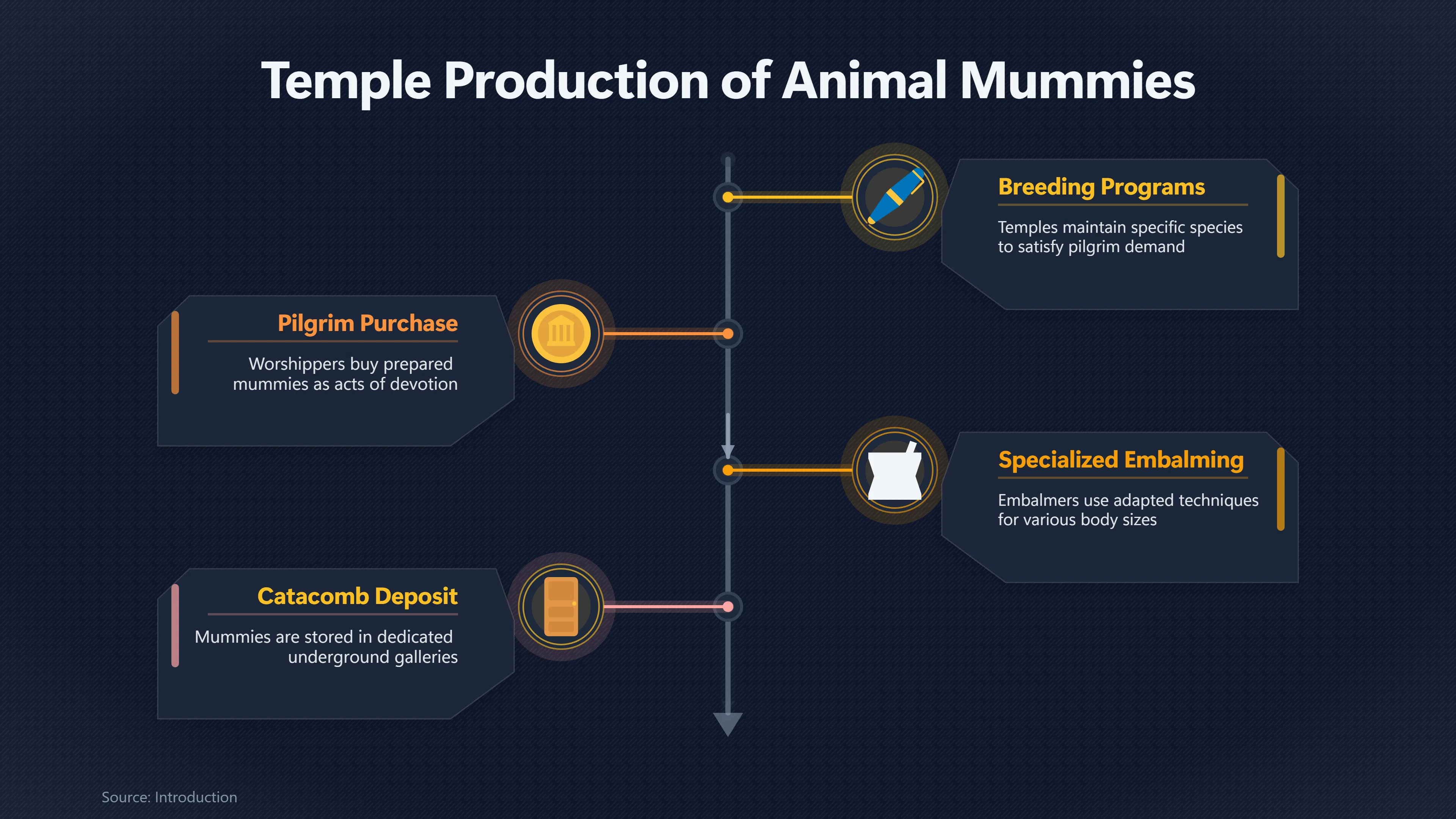
The sheer quantity of surviving animal mummies shows that temple cults required substantial organisation. Pilgrims visiting a sanctuary could purchase a prepared mummy as an offering, with proceeds helping support temple activities. This linked religious devotion directly to a functioning economic system.
Evidence suggests that temples and associated communities maintained breeding programmes or organised the collection of particular species to satisfy demand. Embalmers developed specialised methods for preserving animals, sometimes using techniques similar to those applied to humans but adapted for different body sizes and purposes. Linen wrapping styles, resins and decorative features varied between regions and periods, allowing archaeologists to identify changing traditions over time.[British Museum]britishmuseum.orgOpen source on britishmuseum.org.
Once prepared, the mummies were deposited in dedicated galleries or catacombs near temples rather than in ordinary cemeteries. These underground complexes accumulated over generations, producing the extraordinary archaeological deposits that modern excavations continue to study.
This mechanism helps explain why so many museums display groups of similar animal mummies. They were originally intended to remain together within sacred burial spaces, preserving the collective devotional activity of thousands of worshippers.
What scans reveal inside mummy bundles
Modern imaging has fundamentally changed the study of animal mummies because researchers no longer need to unwrap fragile specimens. CT scanning, X-rays and other non-invasive techniques can reveal bones, soft tissues, wrapping methods and even stomach contents while leaving the mummy intact.[British Museum]britishmuseum.orgOpen source on britishmuseum.org.
The results have overturned several long-held assumptions.
Some beautifully wrapped bundles do indeed contain complete animals preserved with considerable care. Others contain only partial skeletons, feathers, eggshells or selected bones. In some cases, the wrapping itself formed the symbolic offering, even though little or no complete animal remained inside. These discoveries suggest that ritual significance sometimes mattered more than anatomical completeness.[British Museum]britishmuseum.orgOpen source on britishmuseum.org.
Scanning has also revealed details of animal life before mummification. Researchers have identified growth stages, injuries, diet and methods of preservation, helping distinguish animals raised in temple environments from those that may have been captured elsewhere. A large crocodile examined with modern imaging even retained stones used naturally for digestion together with the foreleg of a cow, offering clues about its final meals and possible life within a temple setting.[The Times]thetimes.co.ukWith around 400 such mummies, the museum will unveil its findings in a major exhibition in autumn 2026. The research utilizes X-rays and…
Rather than exposing fraud, these findings show that ancient Egyptian religious practice was more varied than once assumed. Different temples, species and periods employed different approaches, reflecting changing ritual priorities over centuries.
Why animal mummies remain one of Egypt’s most unusual collections
Few archaeological collections combine religion, zoology and mass ritual as dramatically as Egypt’s animal mummies. They preserve evidence of living temple communities, pilgrimage, economic organisation and beliefs about divine presence in physical form.
For visitors, displays such as the crocodiles at Kom Ombo or animal mummies exhibited in major Egyptian and international museums are memorable because they unite natural history with sacred practice. The preserved animals are visually striking, yet their greatest importance lies in explaining how dangerous predators, familiar domestic animals and wild birds all became participants in a sophisticated religious system.
Ongoing scientific projects continue to refine this picture. Radiocarbon dating, isotope analysis, molecular techniques and increasingly detailed CT imaging are helping researchers establish when particular traditions developed, how animals were obtained, how embalming methods changed and how temple cults influenced both Egyptian society and the surrounding environment.[British Museum]britishmuseum.orgOpen source on britishmuseum.org.
Amazon book picks
Further Reading
Books and field guides related to Why Did Egypt Mummify Sacred Animals?. Use these as the next step if you want deeper reading beyond the article.
Divine Creatures: Animal Mummies in Ancient Egypt
The invention of mummification enabled the ancient Egyptians to preserve the bodies not only of humans but also of animals, so that they...
Mummies, magic and medicine in ancient Egypt
This volume, published in honour of Egyptologist Professor Rosalie David OBE, presents the latest research on three of the most important...
The British Museum Book of Ancient Egypt
"This thoughtful and highly readable book covers every aspect of Egyptian culture, from early prehistory, through the three millenia of p...
eBay marketplace picks
Marketplace Samples
Live-tested eBay searches with available results related to this page.
Selected fromEgyptian decor oneBay.co.uk.
Endnotes
1.
Source: britishmuseum.org
Link:https://www.britishmuseum.org/research/projects/divine-creatures-animal-mummies-ancient-egypt
2.
Source: thetimes.co.uk
Link:https://www.thetimes.co.uk/article/british-museum-unwraps-egypts-mysterious-animal-cults-x6kzb55wj
Source snippet
With around 400 such mummies, the museum will unveil its findings in a major exhibition in autumn 2026. The research utilizes X-rays and...
3.
Source: britishmuseum.org
Title: British Museumanimal mummy | British Museum
Link:https://www.britishmuseum.org/collection/object/Y_EA38562
4.
Source: britishmuseum.org
Title: British Museumanimal mummy; mummy-wrapping; mummy-case | British Museum
Link:https://www.britishmuseum.org/collection/object/Y_EA22540
5.
Source: britishmuseum.org
Title: British Museummummy-case; animal mummy; mummy-wrapping | British Museum
Link:https://www.britishmuseum.org/collection/object/Y_EA11483
Source snippet
mummy-case; animal mummy; mummy-wrapping | British MuseumMUMMY-CASE; ANIMAL MUMMY; MUMMY-WRAPPING Object Type mummy-case animal mummy mum...
6.
Source: britishmuseum.org
Title: British Museumanimal mummy; mummy-wrapping | British Museum
Link:https://www.britishmuseum.org/collection/object/Y_EA67149
7.
Source: thenationalnews.com
Link:https://www.thenationalnews.com/news/uk/2025/01/01/british-museum-to-unwrap-the-secrets-of-its-animal-mummies-using-scans//
Source snippet
British Museum unwraps secrets of Egyptian animal mummies using scans | The NationalJanuary 1, 2025 — Image: The British Museum's extensi...
Published: January 1, 2025
8.
Source: britishmuseum.org
Link:https://www.britishmuseum.org/collection/object/Y_EA37347
Source snippet
animal mummy; mummy-case; mummy-wrapping | British MuseumANIMAL MUMMY; MUMMY-CASE; MUMMY-WRAPPING Object Type animal mummy mummy-case mum...
9.
Source: britishmuseum.org
Title: Y EA6759
Link:https://www.britishmuseum.org/collection/object/Y_EA6759
Source snippet
coffin; animal mummy (?) | British MuseumCOFFIN; ANIMAL MUMMY(?) Object Type coffin animal mummy (?) Museum number EA6759 Description Ani...
10.
Source: britishmuseum.org
Title: Y EA6753
Link:https://www.britishmuseum.org/collection/object/Y_EA6753?selectedImageId=225733001
Source snippet
animal mummy; mummy-wrapping | British MuseumANIMAL MUMMY; MUMMY-WRAPPING Object Type animal mummy mummy-wrapping Museum number EA6753 De...
Additional References
11.
Source: ucl.ac.uk
Link:https://www.ucl.ac.uk/museums-static/digitalegypt/saqqara/temple/catacombs.html
Source snippet
Saqqara: animal catacombsSaqqara: The Sacred Animal Necropolis: the catacombs Mummies of animals and birds were placed as votive offering...
12.
Source: doi.org
Title: Imaging of Ancient Egyptian Animal Mummies | Radio Graphics
Link:https://doi.org/10.1148/rg.2015140309
Source snippet
McKnight, PhD lidija.mcknight@manchester.ac.uk, Stephanie D. Atherton-Woolham, PhD, and Judith E. Adams, MDAuthors Info & A...
13.
Source: youtube.com
Title: Fake Animals Mummified for Profit?: Inside Egypt’s Biggest Fraud
Link:https://www.youtube.com/watch?v=7zfh1AfGMUg
Source snippet
When Egyptian Gods Walked Among Humans...
14.
Source: youtube.com
Title: Cats in Ancient Egypt
Link:https://www.youtube.com/watch?v=oRSnV3fq7R0
Source snippet
Wrapped in Eternity: Animal Mummies in Ancient Egypt...
15.
Source: rvc.ac.uk
Link:https://www.rvc.ac.uk/static/newsletter/eclipse/2015-aut-flipped/files/basic-html/page5.html
Source snippet
5 `5 How do you scan a four metre-long crocodile mummy? This was the dif cult quest...
16.
Source: youtube.com
Title: When Egyptian Gods Walked Among Humans
Link:https://www.youtube.com/watch?v=wRDZh_AkDrQ
Source snippet
Egypt, the Kingdom of Animal Mummies...
17.
Source: youtube.com
Title: Wrapped in Eternity: Animal Mummies in Ancient Egypt
Link:https://www.youtube.com/watch?v=SvBiX8SA3Mg
18.
Source: youtube.com
Title: Egypt, the Kingdom of Animal Mummies
Link:https://www.youtube.com/watch?v=ufVHAZlcU6w
Source snippet
Cats in Ancient Egypt...