Where Algeria Keeps Its Strangest Histories
Algeria does not appear to have a well-documented, visitor-facing museum devoted specifically to witchcraft, UFOs, cryptids or theatrical horror.
Page outline Jump by section
Introduction
The most rewarding places are therefore not conventional “weird museums”. They are serious archaeological, ethnographic and historical institutions whose collections acquire an uncanny quality through age, disputed interpretation or the circumstances in which they were gathered. Tassili n’Ajjer is the outstanding example: a vast open-air archive whose strange figures have inspired scholarship, psychedelic mythology and ancient-astronaut speculation. In Algiers, the Bardo museum, the Museum of Popular Arts and Traditions and the National Museum of Antiquities provide the clearest indoor route into Algeria’s unusual collections.[unesco.org]whc.unesco.orgUNESCO World Heritage CentreTassili n'AjjerLocated in a strange lunar landscape of great geological interest, this site has one of the mo…

Tassili n’Ajjer: Algeria’s vast open-air cabinet of mysteries
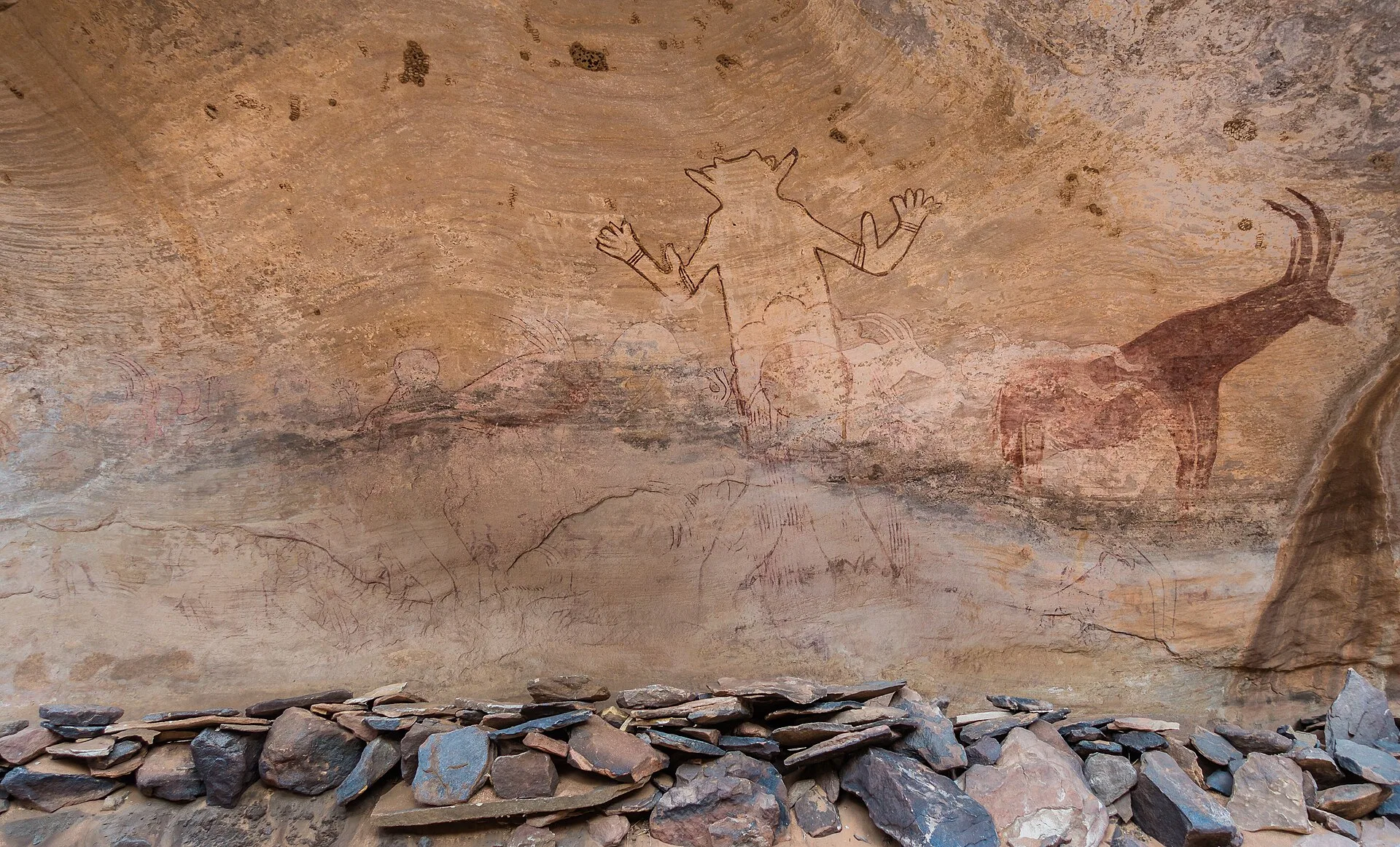
Tassili n’Ajjer, in south-eastern Algeria, is less a museum building than an immense protected landscape filled with prehistoric imagery. UNESCO records more than 15,000 paintings and engravings, covering changing climates, animal migrations and human life from roughly 6000 BC into the early centuries of the present era. The art appears among eroded sandstone formations described as “forests of rock”, making the setting itself feel like part gallery, part geological fantasy.[UNESCO World Heritage Centre]whc.unesco.orgUNESCO World Heritage CentreTassili n'AjjerLocated in a strange lunar landscape of great geological interest, this site has one of the mo…
The most memorable scenes include vanished Saharan wildlife, cattle-herding communities, hunters, dancers and large round-headed human figures. These images matter because they preserve evidence that today’s desert once supported very different environments and ways of life. They are not simply illustrations of a lost world, however. Their meanings are difficult to recover, and attempts to name every figure as a god, spirit, priest or monster can reveal as much about modern expectations as about prehistoric belief.
Tassili became especially vulnerable to extravagant interpretation during the twentieth century. Archaeological populariser Henri Lhote helped make the paintings internationally famous but also used dramatic labels for some round-headed figures, encouraging later writers to imagine astronauts, supernatural visitors or forgotten advanced cultures. Such language survives in tourism and popular mystery literature even though the pictures offer no reliable evidence of extraterrestrial contact.[Wikipedia]WikipediaTassili Mushroom FigureTassili Mushroom Figure
The disputed “mushroom” figures
A small group of Tassili images has been repeatedly described as depicting mushrooms and trance ceremonies. Some ethnobotanical writers have proposed that masked or dancing figures are holding psychoactive fungi, potentially making the paintings early evidence of ritual mushroom use. The idea entered wider popular culture through psychedelic writing in the late twentieth century and now circulates heavily online.[Atlas Obscura]atlasobscura.comAtlas Obscura In Algeria, Ancient Cave Art May Show PsychedelicAtlas ObscuraIn Algeria, Ancient Cave Art May Show Psychedelic…June 2, 2022 — 2 Jun 2022 — The mushrooms depicted in the Tassili caves…
The evidence is much less settled than the familiar story suggests. The supposed mushrooms have also been interpreted as flowers, implements, arrows or simply abstract forms. One influential modern illustration was reconstructed from a published photograph rather than copied directly at the site, with damaged areas visually completed by the artist. Recent discussion of “ancient psychedelics” has consequently stressed how easily ambiguous images become proof of whatever modern visitors already hope to find.[Wikipedia]WikipediaTassili Mushroom FigureTassili Mushroom Figure
For curiosity-minded travellers, this dispute is part of Tassili’s appeal. The site contains genuinely mysterious pictures, but mystery should not be confused with confirmation. Its strongest interpretation is archaeological and environmental; the mushroom, shaman and alien narratives are later hypotheses or cultural afterlives rather than established facts.
Visiting is also very different from entering an urban museum. The important art lies across a remote protected region, and access generally depends on local arrangements, guides, transport and suitable physical preparation. Anyone planning a trip should confirm current permits, routes and conservation restrictions rather than relying on old travel accounts.
The Bardo: burials, fossils and the legend of Tin Hinan
The Bardo National Museum of Prehistory and Ethnography in Algiers is Algeria’s clearest conventional museum for visitors interested in ancient human remains, fossils, rock art and reconstructed prehistoric life. It occupies an elaborate historic residence and combines archaeological collections with ethnographic displays. Visitor descriptions consistently identify fossils, prehistoric pottery and rock-art material among its principal attractions.[Lonely Planet]lonelyplanet.comOpen source on lonelyplanet.com.
Its most unusual association is with Tin Hinan, a woman traditionally remembered as an ancestral queen or founding mother among Tuareg communities. A monumental tomb at Abalessa in the Hoggar region was excavated in the 1920s, producing a skeleton, jewellery and other grave material. The Bardo has displayed material and a reconstruction connected with the burial, turning a remote Saharan tomb into one of Algeria’s most powerful museum encounters with legend, archaeology and national identity.[jinhaagency.com]jinhaagency.comexhibition of queen tin hinan in algeria 8232exhibition of queen tin hinan in algeria 8232
Tin Hinan illustrates the difference between a culturally meaningful tradition and a fully documented biography. The burial is real, and the remains were identified as those of an adult woman of high status. The familiar image of a named fourth-century queen, however, depends partly on later oral tradition and interpretation. Visitors should therefore understand the display on two levels: as archaeological evidence of an elite Saharan burial and as the material focus of a living ancestral narrative.
That layered presentation is what makes the Bardo more than a general prehistory museum. Fossils and tools establish a long human past, while reconstructed burials and ethnographic rooms show how physical objects become attached to stories of origin, status and belonging. The museum is academic and state-run rather than sensational, although English-language visitor information may be less extensive than at major European institutions.
Everyday objects with magical and devotional lives
The National Museum of Popular Arts and Traditions, housed in the historic Dar Khadaoudj El Amia in the Casbah of Algiers, is the best place to look beyond monumental archaeology towards the intimate strangeness of domestic life. Its collections include carpets, jewellery, pottery, ceramics, clothing, mirrors, musical instruments, household fittings and a large photographic archive.[Algeria Tourism & Craft Ministry]alger.mta.gov.dzOpen source on mta.gov.dz.
These objects are not presented as a witchcraft collection, and visitors should not expect rooms of spell books or occult theatre. Their relevance to curiosity culture comes from the way ordinary craft can overlap with protection, identity, ceremony and devotion. Jewellery may function as adornment while also carrying protective associations; textiles and costumes can mark life stages or community membership; and carefully preserved household objects can reveal beliefs rarely recorded in formal histories.
The museum’s setting strengthens this effect. The palace is itself an exhibit, with enclosed rooms, decorated surfaces and layers of domestic and civic history. Rather than isolating “magic” as a separate subject, it places meaningful objects within the wider material culture from which protective customs and ritual practices emerged.
This distinction matters in Algeria, where popular beliefs are more likely to survive within ethnography, religious practice, oral tradition and family objects than in a commercial “museum of the paranormal”. Labels may emphasise craftsmanship, region and use rather than invisible powers. Readers interested in folklore should therefore pay attention to object histories and symbolism rather than search only for exhibits explicitly classified as supernatural.
Antiquities, votive objects and uncertain meanings
The National Museum of Antiquities and Islamic Art in Algiers offers another route into unusual material. Its holdings developed from a collection established during the early French occupation and include archaeological objects spanning ancient North African, classical and later Islamic periods. Museum With No Frontiers describes it as Algeria’s oldest museum collection, assembled from 1835 and opened to visitors in the following years.[museumwnf.org]museumwnf.orgOpen source on museumwnf.org.
For the curiosity traveller, the most interesting pieces are often objects created for graves, sanctuaries, protection or private devotion. Archaeological museums contain many things that modern visitors may instinctively call mysterious: funerary inscriptions, small figurines, amuletic forms, ritual vessels and fragmentary images of deities. Yet their strangeness usually results from lost context, not deliberate secrecy.
The museum also raises questions about how Algeria’s ancient past was collected and classified under colonial rule. Research into nineteenth-century museum-building in Algeria shows that archaeology developed alongside military occupation and the colonial management of Roman ruins. This does not make every object illegitimate, but it means that the history of the collection is inseparable from decisions about excavation, ownership and whose version of the past received institutional authority.[Livrepository]livrepository.liverpool.ac.ukEffros museum building in algeria (Open AccessEffros museum building in algeria (Open Access
Its appeal is therefore double. Visitors encounter objects once used in worship, burial and daily life, while also seeing the results of an older museum system that separated those objects from their landscapes. The collection is credible and scholarly, but its institutional history deserves as much attention as its most enigmatic artefacts.
Prisons as museums of national memory
Algeria’s darkest museum landscape is built around colonial imprisonment and the war of independence. Former prisons and commemorative institutions preserve cells, execution sites, photographs, documents and testimony connected with detention, resistance and state violence. These are not entertainment-led “crime museums”. Their purpose is national remembrance.
Serkadji Prison in Algiers, formerly known as Barberousse Prison, is the most prominent example. Built during French colonial rule, it became closely associated with the imprisonment and execution of Algerian nationalists. It continued functioning after independence and was finally closed in 2014, after which plans were announced to convert it into a museum of national memory.[Wikipedia]WikipediaSerkadji PrisonSerkadji Prison
The building’s later history complicates any simple memorial narrative. It was not frozen at independence: it remained an operating prison and was the scene of a deadly disturbance in 1995. Researchers examining Algerian prison heritage have consequently asked how buildings created by a colonial state are reinterpreted when they also contain difficult post-independence histories.[NomadIT]nomadit.co.ukOpen source on nomadit.co.uk.
Public access should not be assumed merely because maps or travel platforms label Serkadji as a museum. Information about conversion plans, museum status and ordinary visiting arrangements is inconsistent. Travellers should verify whether the site is formally open, whether entry is restricted to commemorative occasions and which sections can actually be seen.
Algeria also has a broad network of museums devoted to the independence struggle. Their displays may include weapons, prison reconstructions, personal possessions, photographs and evidence of torture or execution. The emotional tone is generally commemorative and patriotic. Visitors seeking a balanced historical account may find that exhibitions concentrate primarily on sacrifice and resistance rather than on competing interpretations of the conflict.
Human remains and the colonial museum afterlife
One of the most disturbing stories connected with Algerian collections concerns the skulls of people killed during France’s nineteenth-century conquest. Their remains were taken to France and retained in the collections of the National Museum of Natural History in Paris. In July 2020, France returned 24 skulls to Algeria, where they were received in a state ceremony and buried.[ABC News]abc.net.auOpen source on abc.net.au.
The case sits at the intersection of museum history, trophy-taking, racial science and national remembrance. Human remains that had once been treated as specimens became, after repatriation, honoured dead and symbols of anti-colonial resistance. This change of status demonstrates why skeletal collections cannot be understood as scientifically neutral archives.
Identification has also been contested. Later reporting described disagreements over whether every returned skull had been securely connected to a named resistance fighter. Algerian officials rejected claims that the repatriation had been mishandled, but the controversy exposed weaknesses in old museum records and the difficulty of repairing provenance after more than a century.[The New Arab]newarab.comalgerian minister denies nyt skulls claimsalgerian minister denies nyt skulls claims
This is an essential part of Algeria’s strange-collection history even though the remains are no longer tourist exhibits. It shows how museums can preserve evidence while also prolonging violence through possession, classification and display. The most responsible way to approach the subject is not as a macabre attraction but as a continuing debate about dignity, evidence and restitution.

What Algeria does not turn into spectacle
The absence of a famous Algerian witchcraft, monster or UFO museum is itself revealing. Algeria’s uncanny heritage is usually absorbed into archaeology, ethnography, religion or national memory rather than marketed as a freestanding paranormal attraction. Belief in spirits, protective practices and local legendary beings certainly exists, but public institutions generally interpret related objects as heritage, craft or social history.
This makes Algeria different from countries where private collectors have created commercial museums around haunted dolls, cryptids or occult paraphernalia. The Algerian model is more fragmented and often more serious. A traveller may encounter a mysterious figure in rock art, an ancestral burial, a protective ornament or a prison cell, but each appears within a larger account of prehistory, community life or political struggle.
That approach has advantages. Objects are less likely to be stripped of context merely to produce a thrill. It also creates challenges: folklore can become difficult to locate, interpretation may be available mainly in Arabic or French, and unusual details may receive little emphasis in official publicity.
The strongest Algeria itinerary for strange-history enthusiasts therefore combines different types of place:
- Tassili n’Ajjer for enigmatic prehistoric imagery and the contested afterlife of the “mushroom” and alien interpretations.
- The Bardo National Museum for fossils, prehistoric material and the reconstructed world of Tin Hinan.
- The Museum of Popular Arts and Traditions for domestic objects, ceremonial craft and the material background to protective belief.
- The National Museum of Antiquities and Islamic Art for funerary, devotional and archaeological objects whose meanings are partly lost.
- Serkadji and independence museums for prison heritage, execution memory and the politics of commemoration.
- The repatriated-skulls story for understanding how human remains moved from colonial collections into national remembrance.
How to judge the stranger claims
Algeria’s unusual heritage attracts precisely the kinds of stories that become distorted through repetition. A useful credibility test is to ask what kind of claim is being made.
Archaeological fact includes the existence, location and physical characteristics of an object or painting. Tassili unquestionably contains thousands of prehistoric images; the tomb at Abalessa unquestionably contained an elite burial.
Scholarly interpretation attempts to explain the evidence but may remain disputed. A figure might represent a ritual specialist, a masked dancer or a symbolic being without any interpretation being conclusive.
Oral tradition can carry deep cultural importance without functioning as a modern written record. Tin Hinan’s status as an ancestral queen should be treated respectfully while remaining distinct from what excavation alone can prove.
Tourist folklore often simplifies ambiguity into a memorable certainty. “Ancient astronauts” and “the world’s first mushroom ceremony” are far stronger claims than the evidence allows.
Institutional memory reflects the purposes of the museum. A prison museum may foreground martyrdom; an ethnographic museum may classify a protective object principally by region or craft; a colonial-era archaeological museum may inherit categories created under foreign rule.
The most interesting interpretation usually preserves these differences rather than choosing between total belief and total dismissal. Algeria’s collections are compelling because archaeological evidence, living memory, political history and modern myth repeatedly meet around the same objects.
Why Algeria matters to strange museum culture
Algeria expands the idea of what an unusual museum can be. Its key curiosity sites are not built around novelty for its own sake. They preserve things that became strange because their original worlds disappeared, because their meanings remain uncertain or because the institutions that collected them were entangled with conquest.
Tassili n’Ajjer turns an entire desert plateau into an archive of vanished climates and unreadable ceremonies. The Bardo brings a legendary Saharan ancestor into a state museum. Casbah collections reveal how belief may inhabit clothing, jewellery and household craft without being labelled “occult”. Prison heritage transforms architecture of punishment into national memory, while the returned skulls demonstrate how the dead can move from specimen cabinets back into moral and political community.
For visitors interested in the uncanny, Algeria rewards patience more than sensation. Its strangest collections do not promise proof of aliens or forgotten magic. They show something more substantial: how uncertain images become myths, how ordinary objects retain invisible meanings, and how museums decide whether a body, ruin or prison cell is evidence, inheritance, warning or sacred memory.
Amazon book picks
Further Reading
Books and field guides related to Where Algeria Keeps Its Strangest Histories. Use these as the next step if you want deeper reading beyond the article.
A History of Algeria
Covering a period of five hundred years, from the arrival of the Ottomans to the aftermath of the Arab uprisings, James McDougall present...
The Arabs: A History
Eugene Rogan has written an authoritative new history of the Arabs in the modern world. Starting with the Ottoman conquests in the sixtee...
eBay marketplace picks
Marketplace Samples
Live-tested eBay searches with available results related to this page.
Selected fromAlgeria poster oneBay.co.uk.
Endnotes
1.
Source: whc.unesco.org
Link:https://whc.unesco.org/en/list/179/
Source snippet
UNESCO World Heritage CentreTassili n'AjjerLocated in a strange lunar landscape of great geological interest, this site has one of the mo...
2.
Source: islamicart.museumwnf.org
Title: Islamic Art Museum Discover Islamic Art
Link:https://islamicart.museumwnf.org/pm_partner.php?id=Mus01%3Bdz&theme=ISL
Source snippet
Islamic Art MuseumDiscover Islamic Art - Virtual MuseumThe National Museum of Antiquities and Islamic Art is the oldest museum in Algeria...
3.
Source: Wikipedia
Title: Tassili Mushroom Figure
Link:https://en.wikipedia.org/wiki/Tassili_Mushroom_Figure
4.
Source: Wikipedia
Title: Bardo National Museum (Algiers)
Link:https://en.wikipedia.org/wiki/Bardo_National_Museum_%28Algiers%29
5.
Source: guide.en-vols.com
Title: Guide.en-vols The Bardo National Museum, a national treasure
Link:https://guide.en-vols.com/en/adresse/bardo-national-museum-a-national-treasure/
6.
Source: Wikipedia
Title: Museum of Popular Arts and Traditions
Link:https://en.wikipedia.org/wiki/Museum_of_Popular_Arts_and_Traditions
7.
Source: museumwnf.org
Link:https://www.museumwnf.org/partner.php?id=DZ_01_C%3Bdz&theme=AWE&tye=SH
8.
Source: Wikipedia
Title: Serkadji Prison
Link:https://en.wikipedia.org/wiki/Serkadji_Prison
9.
Source: unesdoc.unesco.org
Link:https://unesdoc.unesco.org/ark%3A/48223/pf0000055815
10.
Source: unesdoc.unesco.org
Link:https://unesdoc.unesco.org/ark%3A/48223/pf0000024510
11.
Source: Wikipedia
Title: Tin Hinan
Link:https://en.wikipedia.org/wiki/Tin_Hinan
12.
Source: Wikipedia
Title: Torture museum
Link:https://en.wikipedia.org/wiki/Torture_museum
13.
Source: 2009-2017.state.gov
Link:https://2009-2017.state.gov/j/ct/rls/crt/2014/239407.htm
14.
Source: trip.com
Title: serkadji ex prison barberousse 137236051
Link:https://www.trip.com/travel-guide/attraction/algiers/serkadji-ex-prison-barberousse-137236051/
15.
Source: alger.mta.gov.dz
Link:https://alger.mta.gov.dz/en/the-national-museum-of-arts-and-popular-traditions-at-the-casbah/
16.
Source: atlasobscura.com
Title: Atlas Obscura In Algeria, Ancient Cave Art May Show Psychedelic
Link:https://www.atlasobscura.com/articles/psychedelic-mushroom-algeria
Source snippet
Atlas ObscuraIn Algeria, Ancient Cave Art May Show Psychedelic...June 2, 2022 — 2 Jun 2022 — The mushrooms depicted in the Tassili caves...
Published: June 2, 2022
17.
Source: lonelyplanet.com
Link:https://www.lonelyplanet.com/points-of-interest/bardo-museum-of-prehistory-ethnography/457575
18.
Source: jinhaagency.com
Title: exhibition of queen tin hinan in algeria 8232
Link:https://jinhaagency.com/en/art-and-culture/exhibition-of-queen-tin-hinan-in-algeria-8232
19.
Source: livrepository.liverpool.ac.uk
Title: Effros museum building in algeria (Open Access)
Link:https://livrepository.liverpool.ac.uk/3009848/1/Effros_museum-building_in_algeria_%28Open%20Access%29.pdf
20.
Source: nomadit.co.uk
Link:https://nomadit.co.uk/conference/easa2024/paper/76608
21.
Source: abc.net.au
Link:https://www.abc.net.au/news/2020-07-05/france-returns-remains-of-algerian-anti-colonial-fighters/12424380
22.
Source: newarab.com
Title: algerian minister denies nyt skulls claims
Link:https://www.newarab.com/news/algerian-minister-denies-nyt-skulls-claims
23.
Source: GOV.UK
Link:https://www.gov.uk/government/publications/algeria-country-policy-and-information-notes/country-policy-and-information-note-actors-of-protection-algeria-august-2020-accessible
24.
Source: atlasobscura.com
Title: torture museum bruges
Link:https://www.atlasobscura.com/places/torture-museum-bruges
25.
Source: alger.mta.gov.dz
Link:https://alger.mta.gov.dz/en/bardo-national-museum/
Additional References
26.
Source: africanrockart.britishmuseum.org
Title: African Rock Art Algeria
Link:https://africanrockart.britishmuseum.org/country/algeria/
Source snippet
African Rock ArtAlgeria - African Rock Art - British MuseumAlgeria is Africa's largest country geographically and has long been noted for...
27.
Source: nationalgeographic.com
Title: Here’s how you can visit.Read more
Link:https://www.nationalgeographic.com/travel/article/algeria-rock-art-prehistoric-sahara-petroglyphs
Source snippet
National GeographicIt's been called 'the greatest museum of prehistoric art'8 Aug 2023 — In the Algerian desert, dazzling alfresco galler...
28.
Source: dark-tourism.com
Link:https://www.dark-tourism.com/index.php/255-algiers
29.
Source: gpsmycity.com
Link:https://www.gpsmycity.com/attractions/bardo-museum-of-prehistory-and-ethnography-43049.html
30.
Source: kupi.com
Link:https://www.kupi.com/en/explore/algeria/algiers/bardo-national-museum-of-prehistory-and-ethnography
31.
Source: mindtrip.ai
Link:https://mindtrip.ai/attraction/algiers/bardo-national-museum-prehistory-ethnography/at-4QjR3kov
32.
Source: facebook.com
Link:https://www.facebook.com/groups/921899805200688/posts/1364586687598662/
33.
Source: wellcomecollection.org
Link:https://wellcomecollection.org/works/gzu384k3
34.
Source: commons.wikimedia.org
Link:https://commons.wikimedia.org/wiki/File%3AS%C3%A9pulture_de_Tin_Hinan_au_mus%C3%A9e_national_du_Bardo_%C3%A0_Alger.jpg
35.
Source: museumhameln.de
Link:https://museumhameln.de/dauerausstellung_engl_20jh54/