What Makes Eswatini's Collections So Unusual?
Eswatini does not appear to have a dedicated museum of witchcraft, cryptids, UFOs, medical oddities or theatrical horror. Its curiosity culture is quieter and more deeply rooted in the country’s landscape, monarchy and industrial past.
Page outline Jump by section
Introduction
The essential stops are the Eswatini National Museum and King Sobhuza II Memorial Park in Lobamba, followed by the Ngwenya Mine visitor centre. Together they present the country’s strongest concentration of unusual objects: ceremonial material, archaeological finds, royal vehicles and evidence of intensive ochre extraction beginning about 48,000 years ago. Mantenga Cultural Village, Bulembu Museum and the Sugarcane Museum broaden the picture through living heritage and industrial remains. These are not cabinets of monsters or occult curiosities, but collections concerned with powerful substances, royal memory, ancestral practice and communities built around dangerous or transformative technologies.[thekingdomofeswatini.com]thekingdomofeswatini.comThe Kingdom of EswatiniMuseums & History | The Kingdom of Eswatini (Swaziland)Eswatini's national museum, known in siSwati as Umsamo Wesi…
What counts as strange in Eswatini?
The unusual quality of Eswatini’s museums lies less in bizarre individual exhibits than in the relationships they reveal. Red mineral pigment connects Stone Age mining with ceremonial body decoration. Motor cars become royal relics. An abandoned asbestos settlement preserves both civic life and an industry now associated with grave health risks. A reconstructed homestead turns architecture, cattle enclosures and social hierarchy into a walk-through exhibit.
This makes Eswatini different from countries where curiosity tourism is driven by privately owned oddity museums. Most of its significant collections are public, institutional or heritage-led. The Eswatini National Trust Commission, established under legislation passed in 1972, manages the National Museum and other cultural and natural heritage properties. Its remit is preservation and education rather than shock entertainment.[unesco.org]unesco.orgthe sntcSwaziland national trust commission act of 1972 (sntc…The expected results oimplimenting the sntc act is to have all arts and cu…
Evidence is also comparatively thin online. Some attractions have only brief official descriptions, while opening information may come from local operators or tourism listings. Visitors should therefore distinguish between well-established institutions and stories that survive mainly as tourism folklore. In particular, legends surrounding execution sites or supernatural practices should not be mistaken for documented museum interpretation.
The National Museum’s most curious objects
The Eswatini National Museum stands in Lobamba, the country’s traditional and legislative capital, close to Parliament and opposite King Sobhuza II Memorial Park. Opened in 1972, it is the central public repository for national history and culture. Its exhibitions combine historic photographs, traditional clothing, weapons, household objects, wildlife displays and representations of customary life. A reconstructed homestead with rounded, grass-covered buildings and a cattle enclosure extends the museum beyond the conventional display case.[thekingdomofeswatini.com]thekingdomofeswatini.comThe Kingdom of EswatiniMuseums & History | The Kingdom of Eswatini (Swaziland)Eswatini's national museum, known in siSwati as Umsamo Wesi…
For an offbeat-museum visitor, the appeal lies in the mixture. Life-sized figures in ceremonial or historic dress share the institution with natural-history material and objects from domestic life. The result is closer to an older-style national museum or ethnographic cabinet than to a tightly themed contemporary gallery. Its exhibits are intended to explain national identity, but they also show how ordinary objects acquire political, ritual and historical meaning when collected together.
The museum is becoming increasingly important as an archaeological store. A research partnership involving the German Archaeological Institute has worked on documenting, equipping and maintaining its archaeological collection. Research associated with Ngwenya and other sites is therefore not confined to objects found in the ground: samples, records and excavated material are being organised within a national institution where they can support future study and public display.[UNESCO World Heritage Centre]whc.unesco.orgOpen source on unesco.org.
This matters because descriptions of Eswatini’s ancient heritage have often circulated as isolated superlatives, especially the claim that Ngwenya is the world’s oldest mine. A properly catalogued archaeological collection allows that story to be revised when new dating evidence appears rather than frozen as tourism legend.
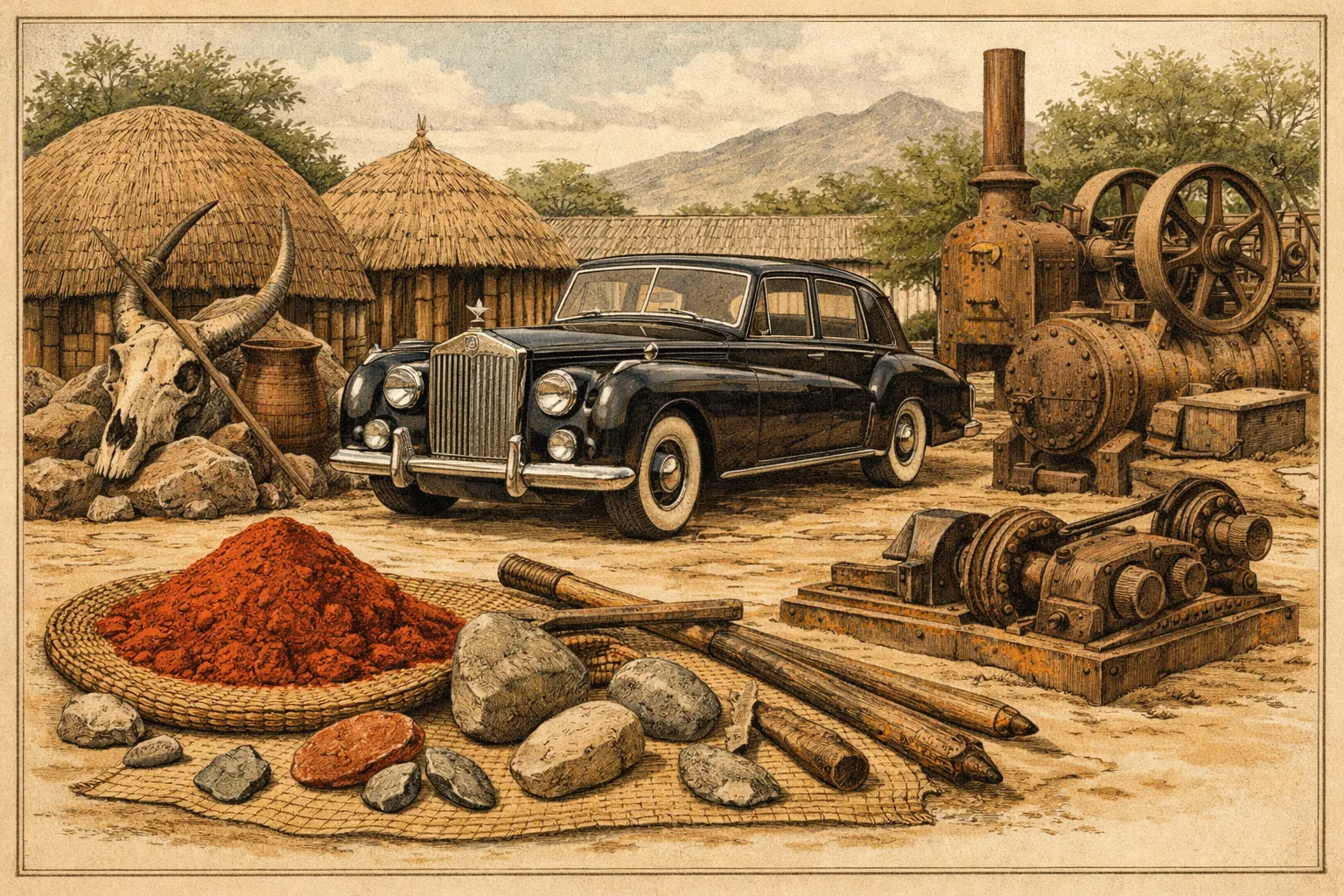
Royal cars as political relics
Opposite the National Museum, King Sobhuza II Memorial Park is both a commemorative landscape and a specialised museum. It occupies the place where the late king was laid in state before burial at a royal mountain in southern Eswatini. Its central features include a large brass statue, photographic displays covering the monarch’s life and a collection of vehicles associated with him.[Eswatini National Trust Commission]entc.org.szEswatini National Trust Commission KING SOBHUZA II PARKIt was built in a place where King Sobhuza was laid in state before he was taken for burial at eMbilaneni (a royal burial mountain) in th…
The cars are among the country’s most memorable museum objects. Elsewhere, an old official vehicle might be interpreted principally as an example of engineering or luxury. Here, cars from the 1940s function more like royal possessions or secular relics: physical traces of a monarch whose reign stretched from the colonial period through independence. Their interest comes from the contrast between imported machinery and a national story commonly presented through ceremony, tradition and kingship.[Lonely Planet]lonelyplanet.comOpen source on lonelyplanet.com.
The memorial is not an eccentric private collection. It is an official institution presenting an authorised account of Sobhuza II’s life and status. Visitors should therefore read it as both a collection of genuine historic material and a carefully shaped work of royal commemoration. It explains how Eswatini wishes the king to be remembered rather than offering an adversarial political biography.
Ngwenya and the 48,000-year pigment trail
Ngwenya Mine and Lion Cavern form Eswatini’s strongest claim to a globally remarkable curiosity site. Earlier tourism accounts commonly dated mining there to approximately 43,000 years ago. Research published in Nature Communications in 2024 refined the chronology and placed intensive ochre extraction at Lion Cavern at about 48,000 years ago. The study also examined how people selected, transported and shared knowledge about particular mineral sources over extremely long periods.[thekingdomofeswatini.com]thekingdomofeswatini.comThe Kingdom of Eswatini Ngwenya Mine & Lion CavernThe Kingdom of Eswatini Ngwenya Mine & Lion Cavern
Ochre is an iron-rich earth pigment whose colours can range from yellow and orange to deep red. At Ngwenya it was not simply an ore awaiting modern industrial use. Prehistoric communities actively sought particular material, and the archaeological evidence suggests knowledge of useful sources was transmitted between generations. Later cultural uses included ornamentation and ceremonial body colouring.[dainst.org]dainst.orglion cavern ngwenya the oldest ochre mine in the worldlion cavern ngwenya the oldest ochre mine in the world
That makes Lion Cavern more than an ancient hole in a hillside. It is evidence for selection, movement, memory and symbolic behaviour. The curious object is effectively the pigment itself: a mineral substance sitting between geology, technology, art and ritual.
The visitor centre interprets several layers of this history. Reported exhibits include mineral samples, archive photographs, a life-sized reconstruction of an early iron smelter and a British-built steam engine brought to the country in 1913. The ancient cavern is modest in appearance, while the far larger nearby quarry belongs to modern iron-ore extraction. Confusing the two can produce a misleading impression of the prehistoric site’s scale.[The Kingdom of Eswatini]thekingdomofeswatini.comThe Kingdom of Eswatini Ngwenya Mine & Lion CavernThe Kingdom of Eswatini Ngwenya Mine & Lion Cavern
Ngwenya has been on Eswatini’s UNESCO World Heritage Tentative List since 2008, but it is not presently an inscribed World Heritage Site. That distinction is worth stressing because tourism summaries sometimes make tentative recognition sound like full UNESCO status.[UNESCO World Heritage Centre]whc.unesco.orgWorld Heritage Centre Ngwenya MinesWorld Heritage Centre Ngwenya Mines
Bulembu’s asbestos-town time capsule
Bulembu Museum occupies a very different branch of strange history. The settlement grew around the Havelock asbestos mine, which operated for much of the twentieth century before closing in 2001. The museum preserves the story of the mine and the community that depended on it, using photographs, equipment and remnants of civic and working life.[wikipedia.org]WikipediaHavelock Asbestos MineHavelock Asbestos Mine
A former cableway building was adapted for the museum, an appropriate setting because the cableway once formed part of the system connecting the remote mining town with the wider world. Surviving objects reportedly include medical equipment, mining material, maps and domestic or institutional artefacts from the company-town period. These do not constitute a deliberately macabre collection, yet the modern understanding of asbestos gives the displays an unavoidable unease.[Bulembu]2020bulembu.wordpress.comBulembu Havelock MineBulembu Havelock Mine
The museum’s value lies in preserving an entire social ecosystem rather than merely celebrating mineral production. Company towns can disappear rapidly after their economic purpose ends: buildings decay, families move away and industrial equipment is sold or scrapped. Bulembu allows visitors to see how employment, housing, transport, healthcare and communal identity once revolved around a single hazardous material.
Current visitor information published by Bulembu describes the museum as open on weekdays and Saturday mornings, with access outside those times sometimes arranged through the lodge. Because small community museums can alter their hours without extensive online notice, advance contact is sensible.[bulembu.org]bulembu.orgOpen source on bulembu.org.

Living collections at Mantenga
Mantenga Cultural Village is regularly described as a living museum. Rather than concentrating unusual objects behind glass, it reconstructs a mid-nineteenth-century homestead using poles, reeds, grass, earth, leather bindings and cattle dung. Guided interpretation and performances place the buildings within a working account of domestic organisation, craft, dance and social custom.[thekingdomofeswatini.com]thekingdomofeswatini.comOpen source on thekingdomofeswatini.com.
Its most interesting feature is the way space itself becomes the collection. A homestead’s arrangement was not arbitrary: sleeping, cooking, storage, livestock and authority occupied meaningful positions. The cattle enclosure carried economic and ritual significance, while different buildings reflected family relationships and social roles. Visitors are therefore walking through an interpretation of a whole system rather than viewing a random cluster of picturesque huts.
As with many cultural villages, authenticity needs careful wording. Mantenga is not an untouched nineteenth-century settlement whose inhabitants have remained outside modern life. It is a curated reconstruction created for heritage education and tourism. Performances and guided encounters translate cultural practices into a form that short-term visitors can understand. That does not make the site false, but it does mean the experience is selected, rehearsed and adapted for an audience.
Mantenga is particularly useful for interpreting objects seen later in the National Museum. Baskets, clothing, tools or architectural components make more sense when visitors understand where they belonged and how they were used. In this respect, the village and museum work as complementary collections: one preserves artefacts, while the other reconstructs their setting.

Machinery, sweetness and the Sugarcane Museum
The Sugarcane Museum at Tambankulu Sugar Estate offers a smaller but distinctive industrial collection. Its displays explain how cane is cultivated, processed, milled and sold, combining wall panels and audiovisual interpretation with vintage machinery. Reported attractions include an old steam engine, a cane press and demonstrations or opportunities connected with fresh cane juice.[sugarcanemuseum.com]sugarcanemuseum.comOpen source on sugarcanemuseum.com.
Sugar may seem ordinary beside a prehistoric ochre mine or an abandoned asbestos town, but the museum reveals the strange machinery behind a familiar household substance. Cane must be cut, crushed and processed quickly, requiring an organised network of plantations, transport, mills and labour. The preserved equipment turns an apparently simple food into a story of industrial transformation.
The museum is tourist-facing and comparatively polished, with gardens and visitor facilities rather than the atmosphere of an abandoned works. Its interpretation is likely to emphasise production and economic achievement. Readers interested in a fuller history should remember that industrial heritage museums can foreground machines while giving less space to labour relations, land use and environmental consequences.
Folklore without a folklore museum
Eswatini’s spiritual and folkloric traditions are culturally important, but they should not be repackaged casually as an exotic “witchcraft museum” experience. Research on healthcare in the country shows that traditional healers and supernatural explanations remain relevant in some people’s responses to illness, including snakebite. These are active systems of belief and treatment, not extinct curiosities preserved solely for tourists.[PLOS]journals.plos.orgOpen source on plos.org.
No well-documented, permanent public museum devoted specifically to witchcraft or occult objects emerged from current institutional and tourism sources. Relevant material may appear within broader cultural displays, oral interpretation or temporary programmes, but claims about dedicated magical collections require caution.
Execution Rock, also called Nyonyane, illustrates the boundary between heritage and legend. Tourism accounts repeat a story that condemned people were forced or pushed from its cliffs. Yet mainstream descriptions usually frame this as legend rather than securely documented judicial history. It is an atmospheric landscape and hiking destination, not a museum, archive or verified crime collection.[tripadvisor.co.uk]tripadvisor.co.ukTripadvisor EXECUTION ROCKTripadvisor EXECUTION ROCK
The responsible approach is not to strip such places of mystery, but to preserve the distinction between a story attached to a landscape and evidence supported by objects, records or archaeology.
The best route through Eswatini’s curiosity culture
The most coherent curiosity trail begins in Lobamba. The National Museum supplies the broad cultural and archaeological framework, while King Sobhuza II Memorial Park adds royal photographs, vehicles and official commemoration. Mantenga Cultural Village nearby then places traditional objects within reconstructed architecture and performance.
Ngwenya should come next because it radically enlarges the timescale. Its ochre evidence reaches back approximately 48,000 years, while the visitor centre connects prehistoric extraction with iron smelting, colonial machinery and modern mining. Bulembu continues the industrial story through asbestos, company-town life and the remains of a community shaped by mine closure. The Sugarcane Museum provides a gentler final chapter centred on the machines that turn a tropical crop into a global commodity.[nature.com]nature.comEswatini also hosts Lion Cavern, a high-elevation (highveld) site situated atop the Ngwenya Massif ironstone and hematite deposit, which…
Taken together, these sites show that Eswatini’s strange-history landscape is built around transformation. Earth becomes pigment; mineral deposits become ritual substances and export commodities; machines become museum pieces; royal possessions become memorial objects; and reconstructed buildings become containers for social memory. The country may lack a conventional oddities museum, but its best collections ask a more compelling question: how does an object move from practical use into history, symbolism and national identity?
Amazon book picks
Further Reading
Books and field guides related to What Makes Eswatini's Collections So Unusual?. Use these as the next step if you want deeper reading beyond the article.
A History of Zimbabwe
The first single-volume history of Zimbabwe with detailed coverage from pre-colonial times to the present, this book examines Zimbabwe's...
A History of African Archaeology
First published 1990. Subjects: History, Antiquities, Archaeology, Archéologie, Antiquités.
eBay marketplace picks
Marketplace Samples
Live-tested eBay searches with available results related to this page.
Selected fromAfrican archaeology decor oneBay.co.uk.
Endnotes
1.
Source: nature.com
Link:https://www.nature.com/articles/s41467-024-53050-6
Source snippet
Eswatini also hosts Lion Cavern, a high-elevation (highveld) site situated atop the Ngwenya Massif ironstone and hematite deposit, which...
2.
Source: unesco.org
Title: the sntc
Link:https://www.unesco.org/creativity/en/policy-monitoring-platform/swaziland-national-trust-commission-act-1972-sntc-act-1972
Source snippet
Swaziland national trust commission act of 1972 (sntc...The expected results oimplimenting the sntc act is to have all arts and cu...
3.
Source: tripadvisor.com
Title: National Museum
Link:https://www.tripadvisor.com/Attraction_Review-g480241-d481214-Reviews-National_Museum-Lobamba_Hhohho_District.html
4.
Source: whc.unesco.org
Link:https://whc.unesco.org/en/events/1686/
5.
Source: dainst.org
Link:https://www.dainst.org/en/research/projects/archaeological-research-and-cultural-heritage-management-in-eswatini/5672
6.
Source: dainst.org
Title: lion cavern ngwenya the oldest ochre mine in the world
Link:https://www.dainst.org/newsroom/lion-cavern-ngwenya-the-oldest-ochre-mine-in-the-world/505
7.
Source: whc.unesco.org
Title: World Heritage Centre Ngwenya Mines
Link:https://whc.unesco.org/en/tentativelists/5421/
8.
Source: whc.unesco.org
Title: World Heritage Centre UNESCO World Heritage Centre
Link:https://whc.unesco.org/en/tentativelists/action%3Dlisttentative%26order%3Dstates%26state%3Dsz
9.
Source: whc.unesco.org
Title: World Heritage Centre Eswatini
Link:https://whc.unesco.org/en/statesparties/sz
10.
Source: Wikipedia
Title: Havelock Asbestos Mine
Link:https://en.wikipedia.org/wiki/Havelock_Asbestos_Mine
11.
Source: bulembu.org
Link:https://bulembu.org/activities-tours/
12.
Source: sugarcanemuseum.com
Link:https://www.sugarcanemuseum.com/
13.
Source: journals.plos.org
Link:https://journals.plos.org/plosntds/article?id=10.1371%2Fjournal.pntd.0009731
14.
Source: whc.unesco.org
Link:https://whc.unesco.org/en/tentativelists/action%3Dlisttentative%26order%3Dstates
15.
Source: whc.unesco.org
Link:https://whc.unesco.org/en/search/?category=Tentative+Lists&criteria=208%2C000++
16.
Source: whc.unesco.org
Link:https://whc.unesco.org/en/tentativelists/action%3Dlisttentative%26
17.
Source: whc.unesco.org
Link:https://whc.unesco.org/en/search/?category=Tentative+Lists&criteria=speaks
18.
Source: whc.unesco.org
Link:https://whc.unesco.org/en/search/?category=Tentative+Lists&criteria=eswatini+tourism+authority+eta
19.
Source: whc.unesco.org
Link:https://whc.unesco.org/en/search/?category=Tentative+Lists&criteria=BP+LAS+Handbook
20.
Source: whc.unesco.org
Link:https://whc.unesco.org/en/search/?category=Tentative+Lists&criteria=view+official+page+MAKEMUR.COM+buy+a+lighter+sentence+for+my+child+before+sentencing+onion+proceed+fast
21.
Source: whc.unesco.org
Link:https://whc.unesco.org/en/search/?category=Tentative+Lists&criteria=open+source+MAKEMUR.COM+buy+my+name+removed+from+the+child+support+delinquent+list+darkweb+proceed+now
22.
Source: whc.unesco.org
Link:https://whc.unesco.org/en/search/?category=Tentative+Lists&criteria=view+site+quick+MAKEMUR.COM+buy+release+from+jail+before+court+date+hidden+page+view
23.
Source: tripadvisor.com
Link:https://www.tripadvisor.com/Attractions-g293836-Activities-c42-t228-Eswatini_Swaziland.html
24.
Source: tripadvisor.com
Link:https://www.tripadvisor.com/Attraction_Review-g479197-d3983505-Reviews-Khama_III_Memorial_Museum-Serowe_Central_District.html
25.
Source: sugarcanemuseum.com
Link:https://www.sugarcanemuseum.com/bookings.html
26.
Source: Wikipedia
Title: Museum of Witchcraft and Magic
Link:https://en.wikipedia.org/wiki/Museum_of_Witchcraft_and_Magic
27.
Source: Wikipedia
Title: Ngwenya Mine
Link:https://en.wikipedia.org/wiki/Ngwenya_Mine
28.
Source: nature.com
Title: Witchcraft in Swaziland | Nature
Link:https://www.nature.com/articles/145664a0
29.
Source: youtube.com
Title: Eswatini National Museum
Link:https://www.youtube.com/watch?v=lh0eZaNCDrs
Source snippet
Swaziland King Sobhuza II Memorial Park and Museum...
30.
Source: thekingdomofeswatini.com
Link:https://www.thekingdomofeswatini.com/eswatini-experiences/culture/museums-history/
Source snippet
The Kingdom of EswatiniMuseums & History | The Kingdom of Eswatini (Swaziland)Eswatini's national museum, known in siSwati as Umsamo Wesi...
31.
Source: entc.org.sz
Title: Eswatini National Trust Commission KING SOBHUZA II PARK
Link:https://entc.org.sz/king-sobhuza-ii-park/
Source snippet
It was built in a place where King Sobhuza was laid in state before he was taken for burial at eMbilaneni (a royal burial mountain) in th...
32.
Source: entc.org.sz
Title: Eswatini National Trust Commission Travel
Link:https://entc.org.sz/travel/
Source snippet
There is a special programme for preschools in both the museum and King Sobhuza II Park...
33.
Source: entc.org.sz
Title: Eswatini National Trust Commission Home
Link:https://entc.org.sz/
Source snippet
The Eswatini National Trust Commission (ENTC) is responsible for conservation of the Kingdom’s natural and cultural heritage as mandated...
34.
Source: lonelyplanet.com
Link:https://www.lonelyplanet.com/points-of-interest/national-museum/1122611
35.
Source: thekingdomofeswatini.com
Title: The Kingdom of Eswatini Ngwenya Mine & Lion Cavern
Link:https://www.thekingdomofeswatini.com/north-west-eswatini/ngwenya-mine-lion-cavern/
36.
Source: pubmed.ncbi.nlm.nih.gov
Title: Pub Med Ochre communities of practice in Stone Age Eswatini
Link:https://pubmed.ncbi.nlm.nih.gov/39448561/
37.
Source: thekingdomofeswatini.com
Link:https://www.thekingdomofeswatini.com/north-west-eswatini/bulembu/
38.
Source: 2020bulembu.wordpress.com
Title: Bulembu Havelock Mine
Link:https://2020bulembu.wordpress.com/tag/havelock-mine/
39.
Source: thekingdomofeswatini.com
Link:https://www.thekingdomofeswatini.com/central-eswatini/mantenga-reserve-village-falls/
40.
Source: hobletsonthego.com
Title: mantenga cultural village
Link:https://hobletsonthego.com/where-weve-been/africa/eswatini/mantenga-cultural-village/
41.
Source: thekingdomofeswatini.com
Link:https://www.thekingdomofeswatini.com/news-blogs/blog-what-to-see-and-do-in-eswatini/
42.
Source: thekingdomofeswatini.com
Link:https://www.thekingdomofeswatini.com/north-east-eswatini/the-sugarcane-museum/
43.
Source: tripadvisor.co.uk
Title: Tripadvisor THE SUGARCANE MUSEUM
Link:https://www.tripadvisor.co.uk/Attraction_Review-g4213058-d13370723-Reviews-The_Sugarcane_Museum-Simunye_Lubombo_District.html
44.
Source: tripadvisor.co.uk
Title: Tripadvisor EXECUTION ROCK
Link:https://www.tripadvisor.co.uk/Attraction_Review-g297900-d23896688-Reviews-Execution_Rock-Manzini_Manzini_District.html
45.
Source: thekingdomofeswatini.com
Title: The Kingdom of Eswatini Sheba’s Breasts & Execution Rock
Link:https://www.thekingdomofeswatini.com/central-eswatini/shebas-breasts-execution-rock/
46.
Source: ianbcross.wordpress.com
Title: Borderline Execution Rock
Link:https://ianbcross.wordpress.com/2016/01/09/execution-rock/
47.
Source: thekingdomofeswatini.com
Link:https://www.thekingdomofeswatini.com/news-blogs/nkonyeni-lodge-launches-adventure-activities-to-showcase-eswatinis-beauty-and-culture/
48.
Source: thekingdomofeswatini.com
Link:https://www.thekingdomofeswatini.com/news-blogs/ngwenya-glass-lands-prestigious-global-responsible-tourism-award/
49.
Source: thekingdomofeswatini.com
Title: Ngwenya Glass Wins Award at WTM Africa | The Kingdom of Eswatini (Swaziland)
Link:https://www.thekingdomofeswatini.com/news-blogs/ngwenya-glass-wins-award-at-wtm-africa/
50.
Source: thekingdomofeswatini.com
Link:https://www.thekingdomofeswatini.com/news-blogs/50-reasons-to-visit-eswatini-in-50-50-year-11-15-arts-crafts/
51.
Source: thekingdomofeswatini.com
Link:https://www.thekingdomofeswatini.com/
52.
Source: thekingdomofeswatini.com
Title: Mantenga Lifestyle & Craft Centre
Link:https://www.thekingdomofeswatini.com/central-eswatini/mantenga-lifestyle-craft-centre/
53.
Source: thekingdomofeswatini.com
Link:https://www.thekingdomofeswatini.com/central-eswatini/
54.
Source: thekingdomofeswatini.com
Link:https://www.thekingdomofeswatini.com/eswatini-experiences/culture/
55.
Source: thekingdomofeswatini.com
Link:https://www.thekingdomofeswatini.com/when-to-go/
56.
Source: thekingdomofeswatini.com
Title: gone rural
Link:https://www.thekingdomofeswatini.com/arts-craft-artisans-providers/gone-rural/
57.
Source: thekingdomofeswatini.com
Link:https://www.thekingdomofeswatini.com/eswatini-experiences/culture/shopping/
58.
Source: thekingdomofeswatini.com
Link:https://www.thekingdomofeswatini.com/eswatini-experiences/culture/arts-crafts/
59.
Source: tripadvisor.co.uk
Title: BULEMB U MUSEUM
Link:https://www.tripadvisor.co.uk/Attraction_Review-g14912178-d15588854-Reviews-Bulembu_museum-Bulembu_Hhohho_District.html
60.
Source: facebook.com
Link:https://www.facebook.com/eswatininationalmuseum/
61.
Source: facebook.com
Link:https://www.facebook.com/groups/1115965269755885/posts/1541835023835572/
62.
Source: entc.org.sz
Link:https://entc.org.sz/mantenga-nature-reserve/
63.
Source: entc.org.sz
Link:https://entc.org.sz/eswatini-national-museum/
64.
Source: entc.org.sz
Title: Events Page
Link:https://entc.org.sz/eventspage/
65.
Source: entc.org.sz
Link:https://entc.org.sz/conservation/
66.
Source: entc.org.sz
Title: King Sobhuza II Park Archives
Link:https://entc.org.sz/product-category/king-sobhuza-ii-park/
67.
Source: entc.org.sz
Title: Magadzavane Lodge Archives
Link:https://entc.org.sz/product-category/magadzavane-lodge/
68.
Source: entc.org.sz
Link:https://entc.org.sz/tours/
69.
Source: entc.org.sz
Title: Khabane Cave Explorer Walk
Link:https://entc.org.sz/kabane-cave/
70.
Source: entc.org.sz
Link:https://entc.org.sz/projects/
71.
Source: entc.org.sz
Title: Canopy Tours
Link:https://entc.org.sz/canopy-tours/
72.
Source: entc.org.sz
Title: Mantenga Nature Reserve & Cultural Heritage Archives
Link:https://entc.org.sz/product-category/mantenga-nature-reserve-cultural-heritage/
73.
Source: entc.org.sz
Title: Guardians of Eswatini: Protecting Our Wild Heritage
Link:https://entc.org.sz/guardians-of-eswatini-protecting-our-wild-heritage/
74.
Source: nationalmuseum.co.za
Link:https://nationalmuseum.co.za/anthropology-archaeology/
75.
Source: nationalmuseum.co.za
Link:https://nationalmuseum.co.za/about/
76.
Source: nationalmuseum.co.za
Link:https://nationalmuseum.co.za/exhibition/
77.
Source: museumofwitchcraftandmagic.co.uk
Link:https://museumofwitchcraftandmagic.co.uk/history/
78.
Source: lonelyplanet.com
Title: Nsangwini Rock Art Shelter | e Swatini (Swaziland), Africa | Attractions
Link:https://www.lonelyplanet.com/points-of-interest/nsangwini-rock-art-shelter/1122739
Additional References
79.
Source: youtube.com
Title: Essential Oils Empowering Change | Bulembu’s Sustainable Journey in Eswatini
Link:https://www.youtube.com/watch?v=RHR_rQA3sqI
Source snippet
A peek into the way of living in Eswatini...
80.
Source: youtube.com
Title: SWAZILAND – IRON AGE FROM 43.000 YEARS AGO?
Link:https://www.youtube.com/watch?v=N3Pr9U1l3qc
Source snippet
Essential Oils Empowering Change | Bulembu's Sustainable Journey in Eswatini...
81.
Source: instagram.com
Link:https://www.instagram.com/p/CpSB4vrsL7L/
82.
Source: iziko.org.za
Link:https://www.iziko.org.za/collection/archaeology/
83.
Source: instagram.com
Link:https://www.instagram.com/reel/DaGd6FjMSpa/
84.
Source: imean.ai
Link:https://www.imean.ai/attraction/Execution-Rock-23896688
85.
Source: evendo.com
Link:https://evendo.com/locations/eswatini/hlane-royal-national-park/attraction/the-sugarcane-museum
86.
Source: confinity.com
Link:https://www.confinity.com/countries/eswatini
87.
Source: africanlanders.com
Link:https://africanlanders.com/en/eswatini-en/eswatini-curiosities/
88.
Source: facebook.com
Link:https://www.facebook.com/EswatiniTourism/posts/eswatini-tourism-establishments-the-sugarcane-museum-step-into-a-world-where-his/1501649838670606/