Within Saudi Curiosities
Why the Hejaz Railway Still Haunts the Desert
Abandoned stations, locomotives and tracks turn the broken Hejaz Railway into a scattered open-air archive of pilgrimage and empire.
On this page
- Pilgrimage, empire and the railway's original purpose
- Stations, locomotives and surviving desert remains
- War, abandonment and heritage tourism
Page outline Jump by section
Introduction
The broken remains of the Hejaz Railway are among Saudi Arabia’s most atmospheric open-air historical collections. Rather than existing inside a single museum, they are scattered across hundreds of kilometres of desert as abandoned stations, rusting locomives, collapsed water towers, stone workshops and stretches of narrow-gauge track. Together they preserve the story of an ambitious Ottoman railway built to carry pilgrims to Madinah while strengthening imperial control over western Arabia, only to be shattered by war and rapidly overtaken by modern transport. Today these fragments occupy a distinctive place within Saudi Arabia’s curiosity landscape: they are part industrial archaeology, part pilgrimage history and part desert ruin, with several restored stations functioning as museums while other remains still stand where they were left more than a century ago.[saudipedia.com]saudipedia.comThe Railway MuseumThe Railway Museum - SaudipediaFebruary 8, 2021…
Pilgrimage, empire and the railway’s original purpose
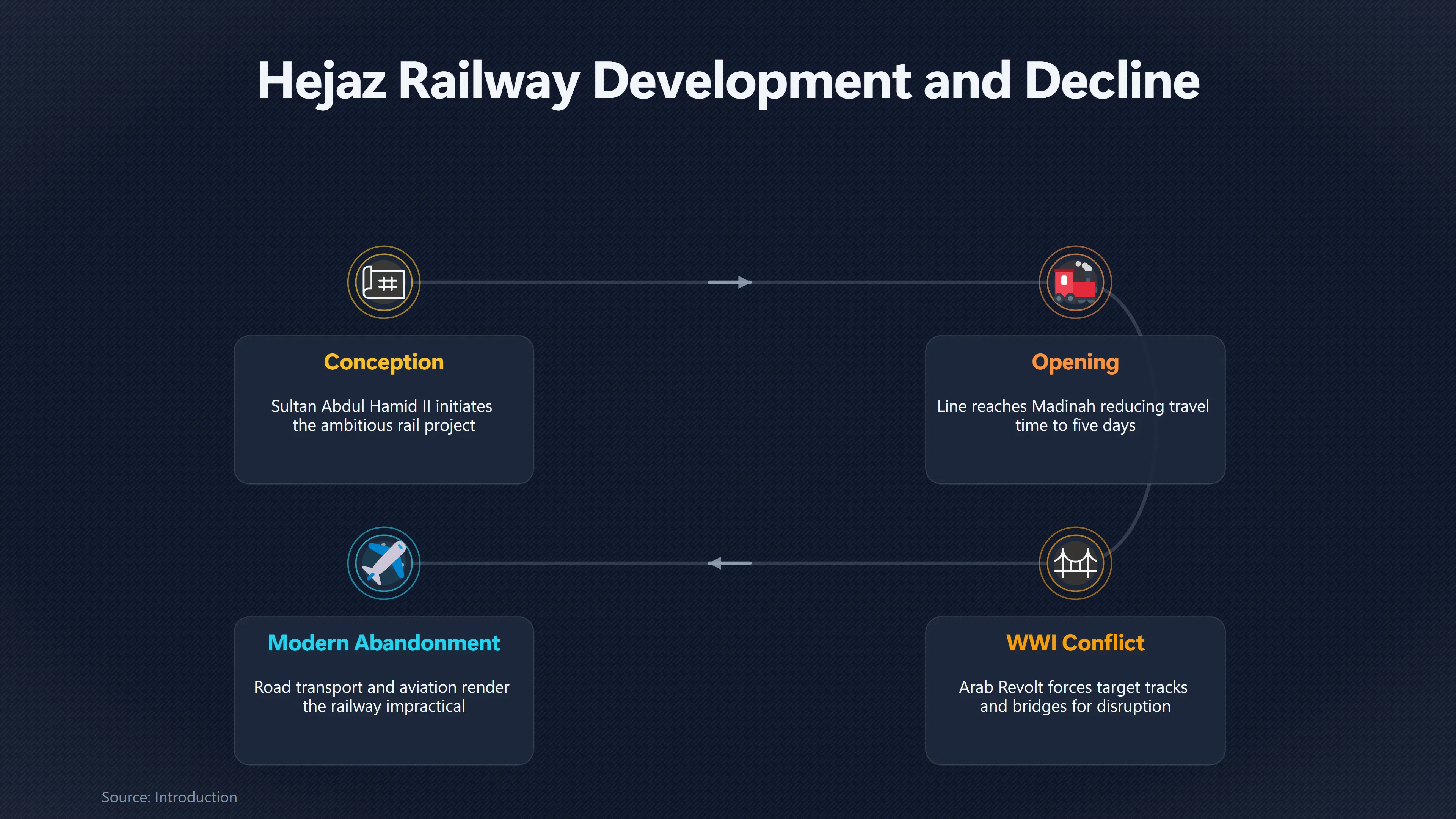
The Hejaz Railway was conceived in 1900 under Ottoman Sultan Abdul Hamid II. Officially, its primary purpose was to make the pilgrimage to Madinah safer, faster and more affordable for Muslims travelling from Damascus and other parts of the empire. Before the railway, the journey could take around forty days by camel caravan through difficult terrain exposed to weather, disease and raids. Once the line opened to Madinah in 1908, the same journey could be completed in roughly five days.[Saudipedia]saudipedia.comThe Railway MuseumThe Railway Museum - SaudipediaFebruary 8, 2021…
The railway also had a clear political role. By linking distant provinces with a permanent transport corridor, the Ottoman government could move troops and supplies far more efficiently while reinforcing its authority across the Hejaz. Pilgrimage and imperial strategy therefore became inseparable. What appears today as a chain of isolated ruins once formed a carefully engineered system of stations, workshops, bridges, wells and defensive structures stretching across one of the world’s harshest landscapes.[openarchive.icomos.org]openarchive.icomos.orgConserving and interpreting the Hijaz Railway in the Kingdom of Saudi ArabiaICOMOS Open Archive: EPrints on Cultural Heritage…
For visitors interested in unusual heritage, this dual purpose makes the railway especially compelling. Unlike many abandoned railways that served commerce alone, every surviving station also belonged to one of the Islamic world’s most significant pilgrimage routes. The landscape preserves evidence of both religious travel and geopolitical ambition in the same surviving buildings.
Stations, locomotives and surviving desert remains
The fascination of the Saudi section lies in its fragmentation. Rather than encountering one complete preserved railway, visitors find scattered relics that collectively function as a vast outdoor archive.
Among the most significant surviving sites are:
- Madinah Station, now restored as the Hejaz Railway Museum, where original workshops, station buildings, locomotives and rolling stock have been conserved alongside archaeological exhibitions explaining the wider history of the city.[Saudipedia]saudipedia.comThe Railway MuseumThe Railway Museum - SaudipediaFebruary 8, 2021…
- Tabuk Station, where the original Ottoman station complex survives with its stone buildings, water tower and restored railway vehicles. The station now operates as a heritage museum rather than a functioning railway.[islamicarchitecturalheritage.com]islamicarchitecturalheritage.comhijaz railway station tabuk stationHijaz Railway Tabuk Station | IRCICASeptember 29, 2020…
- The AlUla and Hegra (Mada’in Salih) corridor, where embankments, bridges, sidings and station remains still cut across the desert near one of Saudi Arabia’s most important archaeological landscapes. These remains demonstrate how modern industrial infrastructure was threaded through an area already rich in ancient monuments.[Hejaz Railway]thehejazrailway.comHejaz Railway HOME | Hejaz RailwayHejaz Railway HOME | Hejaz Railway
What makes these remains unusual is that many survive in their original setting rather than having been relocated into galleries. Steam locomotives, freight wagons and passenger coaches have often remained close to the places where they were abandoned after the railway ceased operating. The dry desert climate has slowed deterioration, allowing ironwork and masonry to survive remarkably well despite decades of exposure.[Hejaz Railway]thehejazrailway.comHejaz Railway HOME | Hejaz RailwayHejaz Railway HOME | Hejaz Railway
Even apparently modest structures tell important stories. Water towers reveal the enormous logistical challenge of supplying steam engines in an arid environment. Repair workshops demonstrate that maintaining locomotives deep inside the desert required substantial engineering facilities. Stone station buildings provided accommodation for railway workers, military personnel and pilgrims, turning isolated outposts into small settlements.
Unlike carefully reconstructed heritage railways elsewhere, the Saudi remains often preserve an unfinished quality. Empty platforms, disconnected rails and silent workshops convey abandonment as much as technological achievement, giving the sites an atmosphere closer to industrial archaeology than conventional transport museums.
Why the ruins became symbols of war
The railway’s working life proved remarkably short.
During the First World War, the line became a strategic military target because it carried Ottoman soldiers, weapons and supplies. Arab Revolt forces, supported by British officers including T. E. Lawrence, repeatedly attacked bridges, tracks and trains in an effort to disrupt Ottoman communications. These operations entered popular culture through memoirs and later films, but the surviving ruins demonstrate that the conflict was fought against a very real industrial landscape rather than an empty desert.[Hejaz Railway]thehejazrailway.comHejaz Railway HOME | Hejaz RailwayHejaz Railway HOME | Hejaz Railway
Many dramatic photographs showing overturned locomotives or damaged rolling stock are associated with this wartime campaign. However, not every abandoned locomotive visible today can be confidently linked to a specific attack. Some equipment was simply left behind after operations ceased or during the railway’s gradual abandonment. Distinguishing documented wartime wreckage from later abandonment is therefore important when interpreting individual sites.[Hejaz Railway]thehejazrailway.comHejaz Railway HOME | Hejaz RailwayHejaz Railway HOME | Hejaz Railway
After the war, changing political borders, the collapse of Ottoman rule, growing road transport and eventually commercial aviation made reconstruction increasingly impractical. Although proposals to revive the railway appeared over subsequent decades, the Saudi sections never returned to regular operation.[openarchive.icomos.org]openarchive.icomos.orgConserving and interpreting the Hijaz Railway in the Kingdom of Saudi ArabiaICOMOS Open Archive: EPrints on Cultural Heritage…
Why the railway still haunts the desert
The Hejaz Railway occupies an unusual position within Saudi Arabia’s heritage. It is neither a fully preserved museum railway nor a completely forgotten ruin. Instead, different sections exist at different stages of preservation.
Some stations have been carefully restored and adapted for public interpretation, allowing visitors to walk through workshops, inspect locomotives and understand the railway’s engineering. Other stretches remain almost untouched, where broken masonry, disappearing embankments and isolated rails gradually merge into the surrounding desert.[Saudipedia]saudipedia.comThe Railway MuseumThe Railway Museum - SaudipediaFebruary 8, 2021…
Heritage specialists increasingly describe the railway as a cultural route rather than a collection of isolated monuments. The significance lies not only in individual stations but also in the continuous landscape connecting pilgrimage roads, Ottoman engineering, archaeological sites and modern heritage tourism. This broader interpretation recognises that the railway followed corridors used for centuries by traders and pilgrims before the first locomotive arrived.[openarchive.icomos.org]openarchive.icomos.orgConserving and interpreting the Hijaz Railway in the Kingdom of Saudi ArabiaICOMOS Open Archive: EPrints on Cultural Heritage…
The railway therefore belongs naturally within Saudi Arabia’s wider landscape of unusual heritage. Its abandoned engines and silent stations are not curiosities because they are mysterious or supernatural, but because they preserve a rare moment when steam technology, imperial politics and one of the world’s greatest pilgrimage traditions briefly converged in the Arabian desert. Few historic railways elsewhere leave such an extensive chain of authentic industrial ruins scattered across an otherwise timeless landscape.
Amazon book picks
Further Reading
Books and field guides related to Why the Hejaz Railway Still Haunts the Desert. Use these as the next step if you want deeper reading beyond the article.

The Seven Pillars of Wisdom
First published 1905. Subjects: Arabs, Bedouins, Campaigns, Social life and customs, Wahhabis.
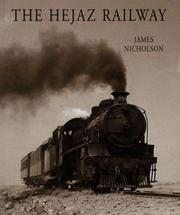
The Hejaz Railway and the Ottoman Empire: Modernity, Industri...
First published 2005. Subjects: History, Railroads, Design and construction, Hejaz Railway.
The Ottoman Empire,
This major new survey treats the most important trends during the latter years of the Ottoman Empire. In this second edition, Donald Quat...
eBay marketplace picks
Marketplace Samples
Live-tested eBay searches with available results related to this page.
Selected fromtrain station decor oneBay.co.uk.

Endnotes
1.
Source: saudipedia.com
Title: The Railway Museum
Link:https://saudipedia.com/en/the-railway-museum
Source snippet
The Railway Museum - SaudipediaFebruary 8, 2021...
Published: February 8, 2021
2.
Source: openarchive.icomos.org
Title: Conserving and interpreting the Hijaz Railway in the Kingdom of Saudi Arabia
Link:https://openarchive.icomos.org/412/
Source snippet
ICOMOS Open Archive: EPrints on Cultural Heritage...
3.
Source: islamicarchitecturalheritage.com
Title: hijaz railway station tabuk station
Link:https://www.islamicarchitecturalheritage.com/listings/hijaz-railway-station-tabuk-station
Source snippet
Hijaz Railway Tabuk Station | IRCICASeptember 29, 2020...
Published: September 29, 2020
4.
Source: youtube.com
Link:http://www.youtube.com/watch?v=9pNZH8PiASo
5.
Source: youtube.com
Link:http://www.youtube.com/watch?v=u26OmiEFdZ8
6.
Source: thehejazrailway.com
Title: Hejaz Railway Medina Station | Hejaz Railway
Link:https://www.thehejazrailway.com/medina-station
7.
Source: thehejazrailway.com
Title: Hejaz Railway HOME | Hejaz Railway
Link:https://www.thehejazrailway.com/
8.
Source: arabnews.com
Title: Hejaz Railway Museum Opened | Arab News
Link:https://www.arabnews.com/node/279191
9.
Source: thehejazrailway.com
Link:https://www.thehejazrailway.com/route-guide
10.
Source: thehejazrailway.com
Link:https://www.thehejazrailway.com/rollingstock
11.
Source: rehlat.com.sa
Title: Hejaz Railway Station, Tabuk
Link:https://www.rehlat.com.sa/en/explore/tabuk/hejaz-railway-station-tabuk-saudi-h8m79jq655
Additional References
12.
Source: houseofsaud.com
Title: Tabuk Castle and Ottoman Heritage Sites: History and Visiting Guide
Link:https://houseofsaud.com/travel/tabuk-castle-heritage-guide/
Source snippet
House of SaudApril 28, 2026 — TABUK CASTLE AND OTTOMAN HERITAGE SITES: HISTORY AND VISITING GUIDE House of Saud Image TABUK CASTLE AND OT...
Published: April 28, 2026
13.
Source: spa.gov.sa
Title: Al Ula Transforms Historic Buildings into Living Cultural Spaces
Link:https://www.spa.gov.sa/en/N2635022
Source snippet
"AlUla Transforms Historic Buildings into Living Cultural SpacesJuly 15, 2026 — Image: [https://portalcdn.spa.gov.sa/backend/original/20260..."](https://portalcdn.spa.gov.sa/backend/original/20260...")...
Published: July 15, 2026
14.
Source: saudi-travel-treasures.com
Title: Dr. Hans’ Saudi Travel Treasures Tabuk City – Hejaz Railway Museum
Link:https://saudi-travel-treasures.com/tabuk-city-hejaz-railway-museum/
Source snippet
Dr. Hans' Saudi Travel TreasuresTabuk City – Hejaz Railway Museum - Dr. Hans' Saudi Travel Treasures...
15.
Source: whc.unesco.org
Title: World Heritage Centre Hejaz Railway
Link:https://whc.unesco.org/en/tentativelists/6026/
Source snippet
UNESCO World Heritage CentreHejaz Railway - UNESCO World Heritage Centre...
16.
Source: tandfonline.com
Link:https://www.tandfonline.com/doi/abs/10.1080/17438730802138873
17.
Source: visitmadinahsa.com
Link:https://visitmadinahsa.com/sa-en/destinations/Hijaz-Railway-Museum
18.
Source: travellino.net
Link:https://www.travellino.net/places/2275
19.
Source: youtube.com
Link:http://www.youtube.com/watch?v=ling2ko5cPE
20.
Source: youtube.com
Link:http://www.youtube.com/watch?v=HyXToHPVxG8
21.
Source: youtube.com
Link:http://www.youtube.com/watch?v=TRgSb4AvNnY