Where South Africa Keeps Its Strangest Stories
South Africa does not have a single famous “museum of the weird” bringing witchcraft, cryptids, medical oddities and uncanny objects under one roof. Its curiosity culture is more scattered and more revealing than that.
Page outline Jump by section
Introduction
The best-known example is the Owl House in Nieu-Bethesda, a private home transformed into a glittering world of concrete camels, owls, prophets and hybrid creatures. Elsewhere, visitors can enter the rooms used for the world’s first human heart transplant, inspect old medical and pharmaceutical equipment, or confront collections shaped by racial science, political imprisonment and the treatment of ancestral remains. These are not interchangeable attractions. Some are carefully curated academic institutions; others are preserved personal worlds, commercial businesses or morally difficult heritage sites. Together, they show how South Africa’s unusual collections sit at the meeting point of imagination, science, spirituality, exploitation and historical memory.
The Owl House: South Africa’s great visionary environment
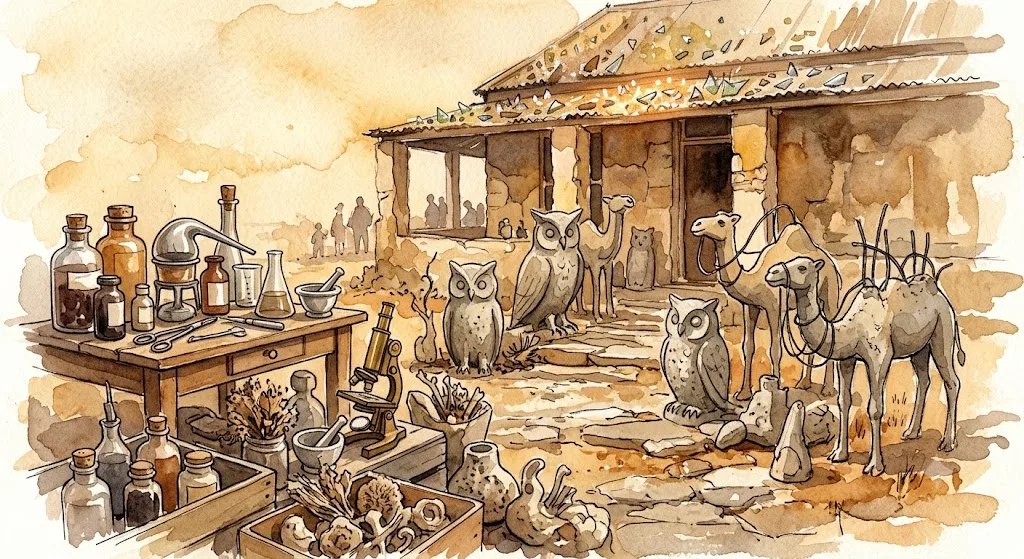
The Owl House in the small Eastern Cape village of Nieu-Bethesda is the clearest starting point for anyone interested in South Africa’s stranger museums. It was created between 1945 and 1976 by Helen Martins, who gradually converted an ordinary Karoo house into an intensely personal environment of coloured glass, mirrors, painted surfaces and sculpted figures. The site is now preserved as a public museum and described by its operators as a work of outsider art: art made beyond conventional institutions, training systems and commercial movements.[The Owl House]theowlhouse.co.zaThe Owl HouseThe Owl House – Where History and Art MeetThe Owl House is a work of outsider art created by Helen Martins between 1945 and…
Inside, crushed glass and reflective surfaces manipulate the Karoo light. Outside, the Camel Yard contains hundreds of cement-and-wire figures, including owls, camels, peacocks, mermaids, pilgrims and human-animal forms. Many face east, reflecting Martins’s fascination with Mecca and with spiritual journeying rather than adherence to a single coherent religion. The imagery also drew on Christian writing, poetry and her own private symbolism.[Wikipedia]WikipediaThe Owl House (museumThe Owl House (museum
The site is sometimes marketed as the solitary creation of an eccentric recluse, but that version obscures the labour and imagination of Martins’s collaborators. Koos Malgas, a local craftsman and former sheep shearer, worked closely with her on much of the Camel Yard, translating discussed or sketched ideas into wire-framed concrete sculptures. Their collaboration took place within the racial restrictions and social inequalities of apartheid-era South Africa, making questions of authorship more complicated than the familiar “lone visionary” story suggests.[Wikipedia]WikipediaThe Owl House (museumThe Owl House (museum
Visitors should expect something closer to an inhabited artwork than a conventional gallery. Labels and chronological explanation are secondary to the physical atmosphere: glittering rooms, narrow spaces and a crowded procession of weathered figures. It can feel enchanting, devotional, comic and unsettling at once. Martins’s depression, failing sight and death by suicide in 1976 add a sombre layer, although reducing the house to a psychological symptom would be as misleading as presenting it as a cheerful fantasy garden.[The New Yorker]newyorker.comIt was once a thriving farming community, but nowadays, the primary reason to visit is the Owl House, built by reclusive artist Helen Mar…
The Owl House matters because it has become both a serious work of South African outsider art and a tourism symbol. It has inspired books, scholarship, films and Athol Fugard’s play The Road to Mecca, while the surrounding village has developed a visitor economy partly around Martins’s legacy. That commercialisation helps preserve the site, but it can also soften its harsher themes and turn a difficult artistic life into an easily packaged tale of eccentricity.[The New Yorker]newyorker.comIt was once a thriving farming community, but nowadays, the primary reason to visit is the Owl House, built by reclusive artist Helen Mar…
Where medicine becomes spectacle and history
South Africa’s medical collections offer some of its most unusual museum experiences. Their exhibits may include obsolete instruments, reconstructed surgeries, pharmaceutical containers and objects connected with changing ideas about the body. Unlike commercial “medical oddity” attractions, the leading examples are tied to universities, hospitals and the history of professional medicine.
The Adler Museum of Medicine
The Adler Museum of Medicine at the University of the Witwatersrand in Johannesburg preserves the history of health sciences in southern Africa, particularly Gauteng. Founded in 1962, it supports university teaching and research as well as public exhibitions. Johannesburg’s municipal museum guide describes a collection of more than 40,000 objects covering medicine, dentistry and pharmacy.[Wits University]wits.ac.zaWits University Adler MuseumWits UniversityAdler Museum - Wits UniversityThe Adler Museum of Medicine preserves the history of the health sciences in Southern Africa…
Its interest lies in the accumulated material culture of treatment: instruments designed for procedures that have since changed or disappeared, dental equipment, medicines, pharmacy furnishings and reconstructed professional spaces. Government tourism material has also highlighted its coverage of traditional medicines, placing different systems of healing within the broader history of healthcare rather than treating medicine as a simple march from superstition to modern science.[GCIS]gcis.gov.zaOpen source on gcis.gov.za.
The Adler is primarily an academic collection, not a horror attraction. That distinction affects the experience. Objects that might appear gruesome or bizarre are interpreted as evidence of changing scientific knowledge, professional practice and social attitudes. Its location within a medical university also means access may be less straightforward than at a major city-centre museum, so opening and booking arrangements should be checked directly before visiting.[Wits University]wits.ac.zaWits University Adler MuseumWits UniversityAdler Museum - Wits UniversityThe Adler Museum of Medicine preserves the history of the health sciences in Southern Africa…
The Heart of Cape Town Museum
At Groote Schuur Hospital, the Heart of Cape Town Museum occupies the setting of the first human-to-human heart transplant, performed on 3 December 1967. The museum uses the original operating-theatre complex and guided interpretation to reconstruct the operation involving surgeon Christiaan Barnard, recipient Louis Washkansky and donor Denise Darvall.[Heart of Cape Town Museum]heartofcapetown.co.zaOpen source on heartofcapetown.co.za.
The experience is unusually theatrical for a medical-history museum. Rather than displaying instruments in detached cases, it leads visitors through reconstructed scenes and spaces associated with the accident, the donor, experimental work, surgery and postoperative care. The museum also addresses the religious and ethical questions raised by transplantation, including how death was defined and how the donor’s heart could be removed for another person.[Wikipedia]WikipediaHeart of Cape Town MuseumHeart of Cape Town Museum
Its storytelling has an obvious heroic centre, but a credible reading requires attention to the wider team and to the unequal society surrounding the achievement. The museum itself states that it honours all those involved, while archival material at the University of Cape Town preserves documents relating to the transplant and its international reception.[Heart of Cape Town Museum]heartofcapetown.co.zaOpen source on heartofcapetown.co.za.
The museum remains visitor-facing, but tours are structured rather than casual walk-ins. Its published information lists weekday guided tours and says booking is essential, with weekend access generally arranged for groups.[Heart of Cape Town Museum]heartofcapetown.co.zaOpen source on heartofcapetown.co.za.
Traditional healing, animal materials and the limits of the word “museum”
Johannesburg’s Museum of Man and Science is one of the country’s most frequently cited oddity destinations, but its name can mislead. It is not a conventional publicly funded museum with a detached curatorial mission. It is associated with a long-established commercial supply business serving traditional healers and customers seeking plant, animal and mineral materials. Travel accounts describe shelves and displays containing animal skins, bones, preserved specimens and other ingredients used or sold for medicinal and ritual purposes.[Atlas Obscura]atlasobscura.commuseum man and sciencemuseum man and science
For visitors accustomed to European cabinets of curiosity, the visual resemblance can be immediate: densely arranged objects, taxidermy and substances whose functions may not be obvious. The cultural setting is different, however. Many items are not collected merely because they are rare or grotesque. They belong to living systems of healing, protection, diagnosis, spirituality and trade.
That makes the site important but difficult to interpret responsibly. A casual visitor may see “witchcraft objects” where practitioners see medicine, ritual technology or inherited knowledge. Conversely, calling every product “traditional culture” can conceal concerns about wildlife conservation, sourcing, animal welfare and commercial exploitation. The establishment is best understood as a working commercial collection with ethnographic interest, not as an authoritative museum explaining South African belief systems from a neutral distance.[Atlas Obscura]atlasobscura.commuseum man and sciencemuseum man and science
South Africa does not appear to have a nationally prominent, purpose-built museum devoted solely to witchcraft or the occult in the manner of some European institutions. Material connected with spiritual practice is more likely to appear in ethnographic collections, traditional-medicine displays, private businesses or community contexts. Visitors should therefore be cautious about attractions advertised informally as “witchcraft museums”, especially when there is little evidence of stable opening arrangements, documented provenance or professional curation.
Fossils, extinct creatures and deep-time curiosities
Natural-history museums can seem ordinary until the collections themselves are considered. The Iziko South African Museum in Cape Town holds more than 1.5 million specimens, ranging from fossils hundreds of millions of years old to recently collected insects and fish. Its breadth places prehistoric creatures, taxidermy, archaeology and human cultural material within the older museum tradition of bringing the world into one encyclopaedic building.[iziko.org.za]iziko.org.zaOpen source on iziko.org.za.
South Africa’s fossil museums and heritage centres are particularly significant because the country contains some of the world’s most important sites for studying early human relatives. This gives its “bones and stones” collections scientific weight beyond their visual strangeness. Fossil skulls, casts and reconstructions may look like classic cabinet curiosities, but they sit within active debates about human evolution, dating and classification.
These collections also carry the legacy of older museum practices. Human remains and ancestral materials were historically acquired, classified and circulated through institutions shaped by colonial power and racial pseudoscience. In March 2026, South Africa held a reburial ceremony for the remains of at least 63 Khoi and San individuals repatriated from the Hunterian Museum in Glasgow. The individuals had been exhumed and taken to Europe between the late nineteenth and early twentieth centuries for scientific study.[AP News]apnews.comOpen source on apnews.com.
The episode changes how a visitor might view older anthropological collections. A skull or skeleton is not simply a scientific specimen with an interesting label; it may be an ancestor whose removal involved grave robbery, coercion or profound inequality. South Africa’s contemporary curiosity culture therefore includes not only displaying unusual things, but deciding when some things should cease to be displayed and should instead be returned and reburied.

Prisons where the building is the collection
Some of South Africa’s most affecting museums preserve architecture rather than eccentric objects. Former prisons, cells, compounds and administrative buildings make systems of confinement physically legible. They belong within the country’s strange-history landscape because visitors enter environments designed for surveillance, isolation and control.
Robben Island is the most famous. It served at different times as a place of banishment, imprisonment and isolation, and is now a museum and UNESCO World Heritage Site. Its history extends well beyond Nelson Mandela’s imprisonment and includes colonial confinement, a leper settlement and a maximum-security political prison.[robben-island.org.za]robben-island.org.zaRobben Island Museum HomeRobben Island Museum Home
The strongest part of the visitor experience is not a cabinet of relics but the relationship between place and testimony. Tours have traditionally included guides with personal experience of political imprisonment, although staffing and formats can change. Cells, yards, quarries and institutional buildings become evidence of how political power was exercised through routine, deprivation and enforced separation.[Department of Sport, Arts and Culture]dsac.gov.zaUnlock History at Robben Island Museum with the Next Gen Heritage Free PassUnlock History at Robben Island Museum with the Next Gen Heritage Free Pass
Durban’s KwaMuhle Museum offers a different form of institutional unease. Housed in a former municipal Native Administration Department building, it documents the bureaucratic mechanisms used to regulate Black urban life. Its exhibitions address labour control, segregated accommodation and Durban’s municipal beer monopoly. The beer-hall system was not merely a colourful local drinking custom: revenue and regulation were bound into a wider structure of racial administration.[riversidehotel.co.za]riversidehotel.co.zaKwa Muhle Museum is near to The Riverside HotelKwa Muhle Museum is near to The Riverside Hotel
These sites are unusual without being whimsical. Their preserved spaces reveal that archives of control can consist of buildings, forms, photographs, uniforms and mundane administrative objects. The apparent ordinariness of the material is precisely what makes it disturbing.
What is credible, contested or commercial?
South Africa’s unusual collections vary enormously in purpose. Treating them all as equivalent “weird museums” risks confusing artistic achievement, scientific evidence, living religious practice and human suffering.
A useful distinction is:
- Professionally curated and academic: The Adler Museum and major natural-history collections use documented objects for teaching, conservation and research.
- Historic-site interpretation: The Heart of Cape Town Museum, Robben Island and KwaMuhle derive much of their authority from occupying places where significant events or systems operated.
- Preserved personal environment: The Owl House is authentic as Martins and her collaborators’ artistic world, but interpretations of her psychology and symbolism remain open to debate.
- Commercial or practice-based collection: The Museum of Man and Science is a working business as well as a curiosity destination. Its displays should not be mistaken for neutral ethnographic interpretation.
- Tourism-led retelling: Popular articles and tours can make difficult sites accessible, but may simplify collaborators’ roles, ethical disputes or painful historical contexts.
Provenance is especially important. An old surgical instrument can usually be interpreted through institutional records. A ritual object, animal part or ancestral remain raises different questions: who made or collected it, whether it was acquired lawfully, whether it was intended for public view and whether descendant communities accept its display. Recent repatriations show that museum ownership does not automatically settle those moral questions.[southafricanculturalobservatory.org.za]southafricanculturalobservatory.org.zaThe Value of the Repatriation of South African museum artefactsThe Value of the Repatriation of South African museum artefacts
Planning an unusual-museum route
South Africa’s curiosity sites are widely dispersed, so they work better as additions to regional journeys than as a single national trail.
Johannesburg and Gauteng offer the strongest concentration of medical and scientific material, particularly the Adler Museum. The Museum of Man and Science provides a much more commercial and culturally sensitive encounter, while the city’s political museums supply the broader context needed to understand how science, classification and racial government became entangled.
Cape Town combines the Heart of Cape Town Museum with Iziko’s natural-history collections and access to Robben Island. These institutions are very different, but together they cover anatomical innovation, deep time, colonial collecting and political imprisonment.
Nieu-Bethesda and the Karoo are essential for the Owl House. The remote setting is part of the experience: Martins’s luminous, crowded environment is intensified by the quiet and spaciousness of the surrounding landscape.
Durban offers KwaMuhle, where unusual heritage lies in the preservation of an administrative system and its everyday machinery rather than in supernatural or grotesque artefacts.
Opening hours should always be confirmed directly. University museums may have limited access, hospital museums often require guided bookings, and heritage sites can be affected by transport, maintenance or operational changes. The Heart of Cape Town Museum explicitly requires bookings for its scheduled tours, while smaller or commercially run collections may provide less dependable public information.[Heart of Cape Town Museum]heartofcapetown.co.zaOpen source on heartofcapetown.co.za.

Why South Africa’s strange collections matter
South Africa’s most distinctive curiosity museums are not chiefly about monsters, aliens or theatrical horror. They are about the unstable boundary between an object and the meaning imposed on it. A cement camel becomes outsider art, a heart becomes both organ and symbol, a bottle becomes evidence of racial administration, and human remains once treated as specimens become ancestors awaiting return.
That gives the country’s unusual collections an unusually serious edge. Even the visually fantastical Owl House is inseparable from collaboration, isolation, apartheid-era social relations and the later tourist economy. Medical museums combine genuine scientific achievement with ethical questions about bodies and recognition. Natural-history collections preserve extraordinary evidence while confronting the legacies of colonial acquisition.
For curious travellers, the reward is not a checklist of bizarre exhibits but a more demanding form of looking. South Africa’s strange museums ask who had the power to collect, classify, display and explain—and who now has the authority to reinterpret, reclaim or remove what was preserved.
Amazon book picks
Further Reading
Books and field guides related to Where South Africa Keeps Its Strangest Stories. Use these as the next step if you want deeper reading beyond the article.

House of Phalo
First published 2007. Subjects: Xhosa (african people), History, Xhosa (Peuple d'Afrique), Histoire.

The Atlas of Amazing Architecture: The Most Incredible Buildi...
First published 2020.
eBay marketplace picks
Marketplace Samples
Live-tested eBay searches with available results related to this page.
Selected fromSouth Africa art print oneBay.co.uk.
Endnotes
1.
Source: Wikipedia
Title: The Owl House (museum)
Link:https://en.wikipedia.org/wiki/The_Owl_House_%28museum%29
2.
Source: gcis.gov.za
Link:https://www.gcis.gov.za/sites/default/files/docs/Tourism.pdf
3.
Source: Wikipedia
Title: Heart of Cape Town Museum
Link:https://en.wikipedia.org/wiki/Heart_of_Cape_Town_Museum
4.
Source: iziko.org.za
Link:https://www.iziko.org.za/museums/south-african-museum/
5.
Source: whc.unesco.org
Link:https://whc.unesco.org/document/154589
6.
Source: riversidehotel.co.za
Title: Kwa Muhle Museum is near to The Riverside Hotel
Link:https://riversidehotel.co.za/kwamuhle-museum-is-near-to-the-riverside-hotel/
7.
Source: southafricanculturalobservatory.org.za
Title: The Value of the Repatriation of South African museum artefacts
Link:https://www.southafricanculturalobservatory.org.za/download/2789ee8b
8.
Source: iziko.org.za
Link:https://www.iziko.org.za/museums/the-castle-of-good-hope/
9.
Source: Wikipedia
Title: Hobby Lobby smuggling scandal
Link:https://en.wikipedia.org/wiki/Hobby_Lobby_smuggling_scandal
10.
Source: nieu-bethesda.com
Title: The Owlhouse
Link:https://www.nieu-bethesda.com/about/the-owlhouse/
11.
Source: youtube.com
Title: The Owl House
Link:https://www.youtube.com/watch?v=bx-8qd_Y3eg
Source snippet
The Heart Of Cape Town Museum Intro...
12.
Source: youtube.com
Link:https://www.youtube.com/watch?v=RGvm-YAyQ94
Source snippet
The Owl House documentary...
13.
Source: theowlhouse.co.za
Link:https://theowlhouse.co.za/
Source snippet
The Owl HouseThe Owl House – Where History and Art MeetThe Owl House is a work of outsider art created by Helen Martins between 1945 and...
14.
Source: newyorker.com
Link:https://www.newyorker.com/culture/culture-desk/a-visit-to-south-africas-strange-astonishing-owl-house
Source snippet
It was once a thriving farming community, but nowadays, the primary reason to visit is the Owl House, built by reclusive artist Helen Mar...
15.
Source: wits.ac.za
Title: Wits University Adler Museum
Link:https://www.wits.ac.za/health/adlermuseum/
Source snippet
Wits UniversityAdler Museum - Wits UniversityThe Adler Museum of Medicine preserves the history of the health sciences in Southern Africa...
16.
Source: joburg.org.za
Title: Adler Museum of Medicine.aspx
Link:https://www.joburg.org.za/play_/Pages/Play%20in%20Joburg/Culture%20and%20Heritage/Links/Museums/Specialist%20museum/Adler-Museum-of-Medicine.aspx
Source snippet
Adler Museum of Medicine - City of JohannesburgToday the collection consists of over 40 000 objects depicting the history of medicine, de...
17.
Source: heartofcapetown.co.za
Link:https://heartofcapetown.co.za/
18.
Source: heartofcapetown.co.za
Link:https://heartofcapetown.co.za/history/
19.
Source: atlasobscura.com
Title: museum man and science
Link:https://www.atlasobscura.com/places/museum-man-and-science
20.
Source: apnews.com
Link:https://apnews.com/article/e24fdaf956357d9325c448cc0b5d363d
21.
Source: robben-island.org.za
Title: Robben Island Museum Home
Link:https://www.robben-island.org.za/
22.
Source: dsac.gov.za
Title: Unlock History at Robben Island Museum with the Next Gen Heritage Free Pass
Link:https://www.dsac.gov.za/Unlock%20History%20at%20Robben%20Island%20Museum%20with%20the%20NextGen%20Heritage%20Free%20Pass
23.
Source: national.archives.gov.za
Title: dir entries pg4 2005
Link:https://www.national.archives.gov.za/dir_entries_pg4_2005.htm
24.
Source: youtube.com
Link:https://www.youtube.com/watch?v=ChuucHuqmDo
25.
Source: youtube.com
Link:https://www.youtube.com/watch?v=SpcMdrBBpDI
26.
Source: vukuzenzele.gov.za
Link:https://www.vukuzenzele.gov.za/learn-more-about-freedom
27.
Source: atlasobscura.com
Link:https://www.atlasobscura.com/things-to-do/south-africa/outsider-art
28.
Source: atlasobscura.com
Title: heart of cape town museum south africa
Link:https://www.atlasobscura.com/places/heart-of-cape-town-museum-south-africa
29.
Source: gcis.gov.za
Link:https://www.gcis.gov.za/sites/default/files/docs/resourcecentre/yearbook/Tourism-SAYB1516.pdf
30.
Source: gcis.gov.za
Title: 22 Tourism
Link:https://www.gcis.gov.za/sites/default/files/docs/resourcecentre/yearbook/2012/22%20Tourism.pdf
31.
Source: gcis.gov.za
Title: 2013 4Tourism
Link:https://www.gcis.gov.za/sites/default/files/docs/resourcecentre/yearbook/2013-4Tourism.pdf
32.
Source: africacommons.net
Link:https://africacommons.net/collections/32982/adler-museum-of-medicine/
33.
Source: gov.za
Link:https://www.gov.za/issues/join-us-sharing-stories-make-south-africa-unique
34.
Source: roxannereid.co.za
Title: the owl house nieu bethesda a world helen martins created
Link:https://www.roxannereid.co.za/blog/the-owl-house-nieu-bethesda-a-world-helen-martins-created
35.
Source: tripadvisor.com
Title: Heart of Cape Town Museum
Link:https://www.tripadvisor.com/Attraction_Review-g312659-d2035157-Reviews-Heart_of_Cape_Town_Museum-Cape_Town_Central_Western_Cape.html
36.
Source: instagram.com
Link:https://www.instagram.com/owlhousenieubethesda/
37.
Source: justice.gov.za
Link:https://www.justice.gov.za/trc/special/health/health01.htm
38.
Source: dirco.gov.za
Link:https://www.dirco.gov.za/wp-content/uploads/2023/01/ubuntu_issue13a_compressed.pdf
39.
Source: outsiderartnow.com
Title: TH E OWL HOUSE
Link:https://www.outsiderartnow.com/helen-martins/
40.
Source: wheretostay.co.za
Title: Adler Museum of Medicine
Link:https://www.wheretostay.co.za/topic/2018-adler-museum-of-medicine-wits-university
41.
Source: durban.org.za
Title: Kwamuhle Museum
Link:https://www.durban.org.za/artculture/museums/kwamuhle.html
42.
Source: theowlhouse.co.za
Title: the owl house
Link:https://theowlhouse.co.za/the-owl-house/
43.
Source: dsti.gov.za
Title: dacst strategic plan
Link:https://www.dsti.gov.za/images/pdfs/dacst_strategic_plan.pdf
Additional References
44.
Source: phillymagicgardens.org
Link:https://www.phillymagicgardens.org/about-philadelphias-magic-gardens/visit-from-home/art-environments/art-environment-creators/helen-martins-owl-house/
Source snippet
Philadelphia's Magic GardensHelen Martins' Owl HouseHelen Martins' Owl House Nieu-Bethesda, South Africa. The site remains open to the pu...
45.
Source: sapeople.com
Title: seven out of the ordinary museums to visit in south africa
Link:https://www.sapeople.com/travel/seven-out-of-the-ordinary-museums-to-visit-in-south-africa/
Source snippet
SA PeopleSeven out-of-the-ordinary museums to visit in South Africa15 Oct 2024 — The Owl House is an eccentric art museum created by outs...
46.
Source: thetimes.com
Title: tomb raiders african victims are reinterred rnjp0shkv
Link:https://www.thetimes.com/uk/scotland/article/tomb-raiders-african-victims-are-reinterred-rnjp0shkv
Source snippet
Steph Scholten, director of The Hunterian, who participated in the ceremony under the blazing heat, highlighted the emotional weight and...
47.
Source: youtube.com
Title: Joburg muthi market unchecked in its trade of illegal wildlife products
Link:https://www.youtube.com/watch?v=6rF3C4PCyXs
Source snippet
The Cradle of Humankind World Heritage Site: Maropeng and the Sterkfontein Caves, South Africa...
48.
Source: youtube.com
Title: The Adler Museum: Past, Present & Future
Link:https://www.youtube.com/watch?v=BGZ65HHMjCk
Source snippet
Joburg muthi market unchecked in its trade of illegal wildlife products...
49.
Source: apartheidmuseum.org
Link:https://www.apartheidmuseum.org/exhibitions/a-place-of-healing
50.
Source: liverpoolmuseums.org.uk
Link:https://www.liverpoolmuseums.org.uk/collections/world-cultures/african-collections
51.
Source: researchgate.net
Link:https://www.researchgate.net/publication/7990329_Antiquities_fraud_Reality_check
52.
Source: ees.ac.uk
Link:https://www.ees.ac.uk/whats-on/events/ethical-approaches-to-the-care-and-display-of-ancient-egyptian-mummified-human-remains-in-museums-and-the-field.html
53.
Source: facebook.com
Link:https://www.facebook.com/groups/827611048652074/posts/1507246894021816/