Within Bosnia Curiosities
How Ordinary Toys Became Wartime Evidence
Toys, letters and improvised belongings become powerful records when paired with memories of childhood under war.
On this page
- Why personal objects carry historical weight
- How testimony changes the meaning of a collection
- Curating childhood without sensationalising war
Page outline Jump by section
Introduction
The most unusual objects in Sarajevo’s War Childhood Museum are often the least remarkable at first glance: a worn toy, a school notebook, a hand-sewn doll, a letter, a pair of shoes or an improvised game. None of these items is historically important because of its rarity or monetary value. Instead, each becomes evidence when it is paired with the first-person testimony of the child who owned it. The object and the memory are treated as inseparable, transforming everyday belongings into records of lived experience rather than anonymous museum pieces. This approach distinguishes the museum from conventional military collections, shifting attention away from weapons and political leaders towards the experiences of children whose lives were shaped by the Bosnian War. The result is one of Bosnia and Herzegovina’s most distinctive contributions to the preservation of difficult history.
Why personal objects carry historical weight
Most war museums rely heavily on official documents, military equipment or chronological narratives. The War Childhood Museum deliberately reverses that perspective. It starts with the individual child rather than the conflict itself, asking what object best captures a person’s experience of growing up during war.
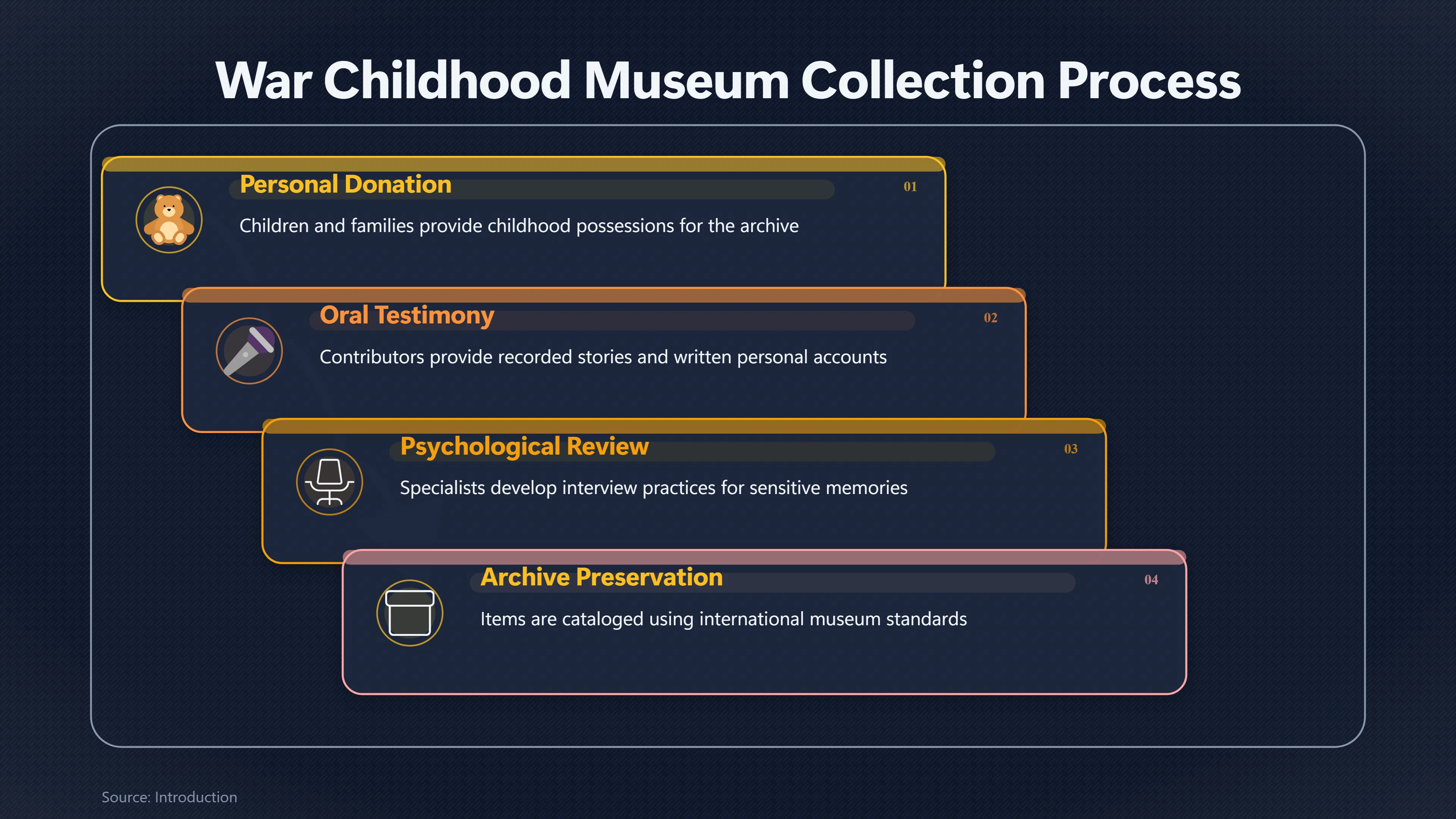
A teddy bear is therefore not exhibited because it survived a siege. It is exhibited because its owner explains why it mattered: perhaps it was carried into shelters every night, repaired repeatedly because replacements were impossible to obtain, or became a source of comfort when family life was disrupted. Without the accompanying story, it would simply be an ordinary toy.
This pairing of object and testimony turns familiar belongings into first-person historical evidence. Visitors are encouraged to understand that the object’s significance lies not in its physical characteristics but in its relationship to memory. A broken pencil case, a birthday card or an improvised football can reveal daily routines, fear, resilience and creativity that rarely appear in official wartime archives. The museum explicitly collects books, letters, photographs, broken toys, improvised clothing and other childhood possessions because their meaning comes from the experiences attached to them rather than from their appearance.[War Childhood]warchildhood.orgWar Childhood Contribute Your Memories to the WCMWar ChildhoodContribute Your Memories to the WCM - War Childhood Museum…
The collection therefore documents aspects of conflict that military history often overlooks:
- maintaining friendships despite siege conditions;
- inventing games during bombardment;
- preserving family rituals;
- adapting ordinary childhood activities to extraordinary danger;
- remembering moments of happiness alongside trauma.
These experiences become historically visible only because contributors explain what the objects meant to them.
How testimony changes the meaning of a collection
The museum’s defining curatorial decision is that stories are not labels attached after an object has entered the collection. Instead, testimony is treated as part of the object itself.
Every donated item is accompanied by a written personal account, and many contributors also provide recorded oral histories. Researchers document these memories using collection procedures adapted from international museum standards while recognising that emotionally sensitive interviews require different methods from conventional object cataloguing. Psychologists are involved in developing interview practice, reflecting the fact that contributors are recalling deeply personal experiences rather than simply identifying artefacts.[War Childhood]warchildhood.orgWar Childhood Research methodologyWar ChildhoodResearch methodology - War Childhood Museum…
This changes how visitors interpret even the simplest exhibit.
A visitor might first notice:
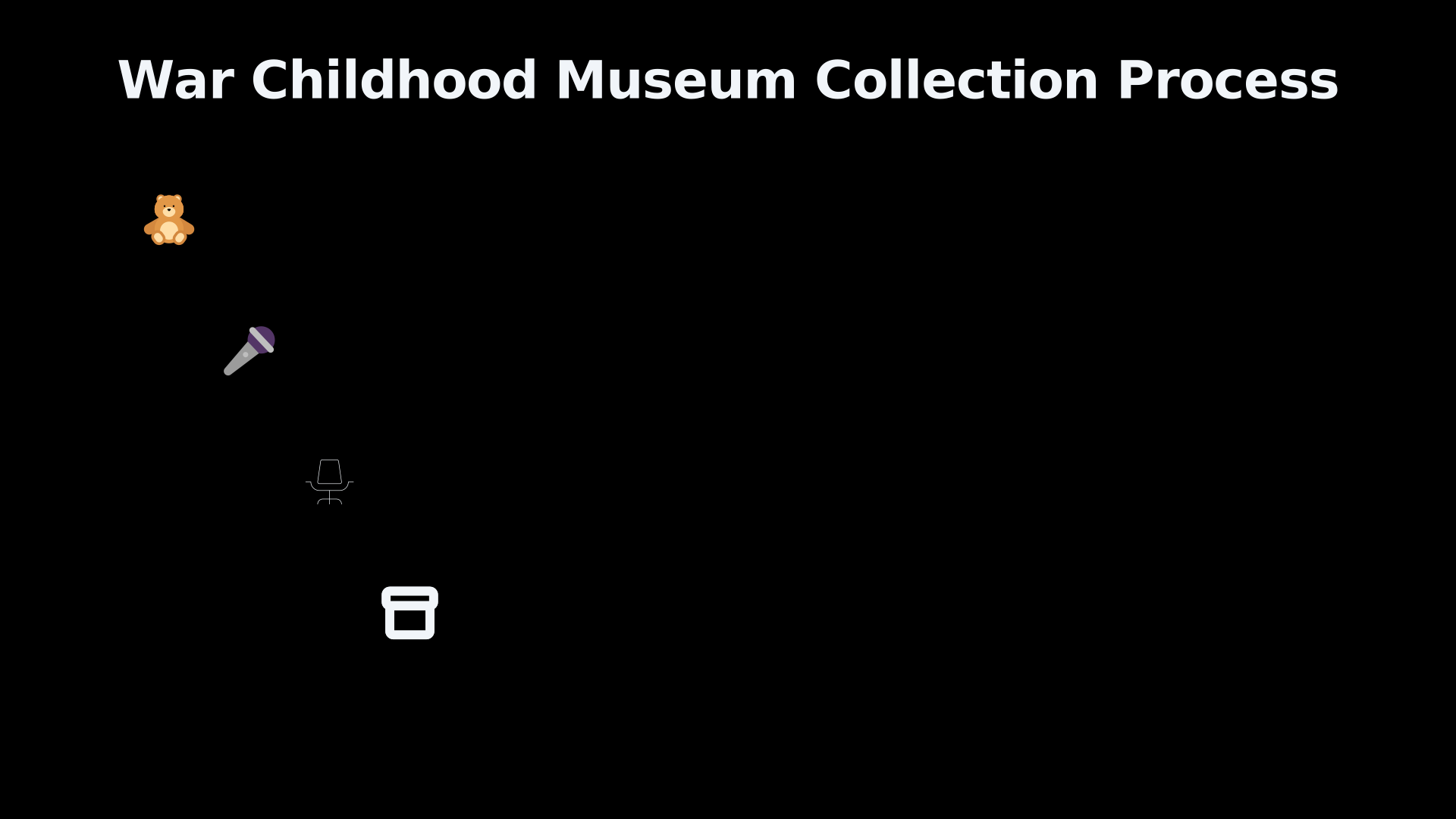
- a marble;
- a handwritten letter;
- a school exercise book;
- a homemade toy.
Only after reading the testimony does the item acquire its historical meaning. The evidence is therefore cumulative: the physical object demonstrates survival, while the accompanying narrative explains its emotional, social and practical importance.
Unlike collections where curators interpret anonymous artefacts on behalf of the public, the primary voice belongs to the former child. The museum deliberately reduces the distance between witness and visitor by allowing contributors to explain their own memories in the first person.

Curating childhood without sensationalising war
One of the museum’s most distinctive achievements is its refusal to compete with more graphic war museums. Rather than relying on shocking imagery or displays of violence, it demonstrates the effects of conflict through ordinary domestic life.
This approach avoids presenting childhood solely through victimhood. Many testimonies describe humour, friendships, games, family celebrations or small moments of normality that persisted despite siege conditions. The collection therefore presents wartime childhood as complex rather than uniformly tragic.
Annual exhibition rotations reinforce this philosophy. Only a small proportion of the museum’s thousands of donated objects can be displayed at one time, so exhibitions are organised around different dimensions of childhood experience rather than attempting to tell a complete military history. Visitors encounter roughly forty carefully selected stories during each rotation, allowing each object sufficient space for reflection instead of overwhelming audiences with large quantities of material.[War Childhood]warchildhood.orgWar Childhood Permanent Exhibition SarajevoWar ChildhoodPermanent Exhibition Sarajevo - War Childhood Museum…
The emphasis remains on individual lives rather than spectacle.
From personal memory to historical evidence
The museum demonstrates that first-person evidence can consist of far more than written memoirs. Material culture—the objects people keep, repair and carry through difficult periods—can preserve historical knowledge that would otherwise disappear.
Many contributors donated possessions decades after the Bosnian War because they had quietly kept them at home as reminders of childhood. The museum’s founders recognised that these fragile collections were at constant risk of being discarded during house moves, damaged through age or simply forgotten as generations changed. Creating a formal museum collection transformed private keepsakes into a protected historical archive.[War Childhood]warchildhood.orgWar Childhood The Idea, Mission and Vision | War Childhood MuseumWar ChildhoodThe Idea, Mission and Vision | War Childhood MuseumJuly 27, 2015…
The institution now preserves thousands of objects alongside photographs, letters, documents and hundreds of hours of recorded testimony, allowing researchers to study not only the physical artefacts but also the memories attached to them. Collection management follows recognised museum standards while adapting acquisition procedures to ensure that personal stories remain inseparable from the donated belongings.[War Childhood]warchildhood.orgWar Childhood Research methodologyWar ChildhoodResearch methodology - War Childhood Museum…
Why this collection stands out in Bosnia and Herzegovina
Within Bosnia and Herzegovina’s landscape of unusual museums and collections, the War Childhood Museum is distinctive because its principal artefacts are neither rare nor mysterious. Their significance comes entirely from human experience.
Where other museums preserve military hardware, political documents or archaeological treasures, this collection preserves the evidence of ordinary childhood. A toy, letter or handmade object becomes historically valuable only because someone who lived through war explains why it mattered.
That combination of physical object and first-person testimony gives the collection an unusual authority. It records not simply what happened during conflict, but how war was experienced by children in their everyday lives. In doing so, it turns the most ordinary possessions into some of the most powerful evidence of Bosnia and Herzegovina’s recent past.
Amazon book picks
Further Reading
Books and field guides related to How Ordinary Toys Became Wartime Evidence. Use these as the next step if you want deeper reading beyond the article.
The Diary of a Young Girl
In Amsterdam, in the summer of 1942, the Nazis forced teenager Anne Frank and her family into hiding. For over two years, they, another f...
The Origins Of Totalitarianism
Hannah Arendt's definitive work on totalitarianism—an essential component of any study of twentieth-century political history. The Origin...
Testimony: Crises of Witnessing in Literature, Psychoanalysis...
In this unique collection, Yale literary critic Shoshana Felman and psychoanalyst Dori Laub examine the nature and function of memory and...

On Killing: The Psychological Cost of Learning to Kill in War...
First published 1995. Subjects: Combat, Homicide, Military Psychology, Psychological aspects, Psychological aspects of Combat.
eBay marketplace picks
Marketplace Samples
Live-tested eBay searches with available results related to this page.
Selected fromBalkan art print oneBay.co.uk.


Endnotes
1.
Source: warchildhood.org
Title: War Childhood Contribute Your Memories to the WCM
Link:https://warchildhood.org/contribute-your-memories-to-the-wcm/
Source snippet
War ChildhoodContribute Your Memories to the WCM - War Childhood Museum...
2.
Source: warchildhood.org
Title: War Childhood Collecting and Cataloguing
Link:https://warchildhood.org/collecting-and-cataloguing/
Source snippet
War ChildhoodCollecting and Cataloguing - War Childhood Museum...
3.
Source: warchildhood.org
Title: War Childhood Research methodology
Link:https://warchildhood.org/research-methodology/
Source snippet
War ChildhoodResearch methodology - War Childhood Museum...
4.
Source: warchildhood.org
Title: War Childhood Permanent Exhibition Sarajevo
Link:https://warchildhood.org/permanent-exhibition-sarajevo/
Source snippet
War ChildhoodPermanent Exhibition Sarajevo - War Childhood Museum...
5.
Source: warchildhood.org
Title: War Childhood Childhoods Affected by the Bosnian War
Link:https://warchildhood.org/childhoods-affected-by-the-bosnian-war/
Source snippet
War ChildhoodChildhoods Affected by the Bosnian War - War Childhood Museum...
6.
Source: warchildhood.org
Title: War Childhood The Idea, Mission and Vision | War Childhood Museum
Link:https://warchildhood.org/the-idea-mission-and-vision/
Source snippet
War ChildhoodThe Idea, Mission and Vision | War Childhood MuseumJuly 27, 2015...
Published: July 27, 2015
7.
Source: warchildhood.org
Title: War Childhood Museum
Link:https://warchildhood.org/
Source snippet
July 11, 2026 — Become a Member of the WCM Community Join the growing circle of supporters of the War Childhood Museum arrow_forward Lear...
Published: July 11, 2026
8.
Source: bosnia-spirit.com
Title: War Childhood Museum Sarajevo: tickets, hours and what to expect
Link:https://www.bosnia-spirit.com/guides/war-childhood-museum-sarajevo/
Source snippet
May 26, 2026 — Image: War Childhood Museum Sarajevo — a visitor guide WAR CHILDHOOD MUSEUM SARAJEVO — A VISITOR GUIDE Updated:May 26, 202...
Published: May 26, 2026
9.
Source: warchildhood.org
Title: The New Rotation of the WCM’s Exhibition in Sarajevo
Link:https://warchildhood.org/the-new-rotation-of-the-wcms-exhibition-in-sarajevo/
10.
Source: warchildhood.org
Title: War Childhood Museum Bosnian Collection
Link:https://warchildhood.org/bosnian-collection/
11.
Source: warchildhood.org
Title: War Childhood Museum Global Collection
Link:https://warchildhood.org/global-collection/
12.
Source: warchildhood.org
Title: RESOURCE S LIBRARY
Link:https://warchildhood.org/resources-library/
13.
Source: warchildhood.org
Title: Interviewing process
Link:https://warchildhood.org/interviewing-process/
14.
Source: iwm.org.uk
Link:https://www.iwm.org.uk/collections
15.
Source: atthemuseum.org
Title: War Childhood Museum
Link:https://atthemuseum.org/museums/war-childhood-museum
Additional References
16.
Source: iwm.org.uk
Title: Access to Collections Policy | Imperial War Museums
Link:https://www.iwm.org.uk/policies/access-to-collections-policy
Source snippet
## Access to Collections principles 1. ### IWM’s approach to collections access 1. IWM is a global leader in developing and communicating...
17.
Source: youtube.com
Title: The suffering of children in war is universal | Jasminko Halilovic
Link:https://www.youtube.com/watch?v=019LJOAONLI
Source snippet
Al Jazeera Documentary: War Childhood Museum (with English subtitles)...
18.
Source: youtube.com
Title: Al Jazeera Documentary: War Childhood Museum (with English subtitles)
Link:https://www.youtube.com/watch?v=foHjcDdolhg
Source snippet
Showcase: 'War Childhood Museum' opens in Sarajevo...
19.
Source: youtube.com
Title: War Child Museum: Childhood wartime artifacts on display
Link:https://www.youtube.com/watch?v=Sn9h_gr2F6s
Source snippet
Josep Borrell visited War Childhood Museum in Sarajevo...
20.
Source: youtube.com
Title: Showcase: ‘War Childhood Museum’ opens in Sarajevo
Link:https://www.youtube.com/watch?v=ridQt3O2Mtg
Source snippet
War Child Museum: Childhood wartime artifacts on display...
21.
Source: iwm.org.uk
Link:https://www.iwm.org.uk/collections/collections-information
22.
Source: iwm.org.uk
Link:https://www.iwm.org.uk/collections/managing/offer-material
23.
Source: nms.ac.uk
Link:https://www.nms.ac.uk/national-war-museum/see-and-do/explore-the-galleries
24.
Source: culturecard.ba
Link:https://culturecard.ba/en/pages/muzej-ratnog-djetinjstva
25.
Source: iwm.org.uk
Link:https://www.iwm.org.uk/research/research-facilities