Within Curious South Korea
Can a Museum Preserve a Living Ritual?
Seoul's ritual collections reveal how Koreans have sought protection, healing and good fortune through objects, images and performance.
On this page
- What Korean shamanic objects were made to do
- Specialist archives, national collections and private museums
- What display cases preserve and what they leave out
Page outline Jump by section
Introduction
South Korea’s shamanic collections are unusual because many of the objects on display were never created as art in the conventional sense. They were working ritual tools: paintings that invited particular spirits, bells and drums used during ceremonies, costumes worn while mediating between the human and spirit worlds, and paper offerings designed to be burned or discarded after use. Museums preserve these objects because they are culturally significant, but the traditions that gave them meaning are still practised in parts of Korea today. That creates an unusual challenge: how can a museum conserve something whose real significance lies in movement, sound, performance and living belief rather than in the physical object alone?

Rather than presenting Korean shamanism as an extinct religion or an exotic curiosity, the strongest collections place ritual objects within everyday concerns such as illness, family welfare, protection, prosperity and remembrance. The result is a distinctive form of museum experience in which ethnography, art history, folklore and living religious practice overlap rather than sitting in separate categories.[NFM]nfm.go.krNFMNational Folk Museum of Korea영어 > Introduction > Introduction…
Can a Museum Preserve a Living Ritual?
The central tension running through Korea’s shamanic collections is that museums are designed to preserve stable objects, while shamanic practice is centred on changing relationships between people, spirits, communities and places.
A ceremonial knife displayed behind glass once formed part of an active ritual. A painted spirit image originally functioned as a point of contact during ceremonies rather than as a decorative artwork. Costumes were intended to move through dance, music and dramatic performance. Even paper decorations and offerings were often deliberately temporary, created to be cut, folded, displayed briefly and then destroyed as part of the ceremony itself. Removing such objects from ritual protects them physically but inevitably changes their purpose.[Shamanism Museum]shamanismmuseum.orgShamanism Museum샤머니즘박물관Shamanism Museum샤머니즘박물관
For this reason, Korean museums increasingly combine physical collections with photographs, field notes, film, sound recordings and oral testimony. These records acknowledge that the ritual cannot be fully captured by preserving objects alone.
What Korean Shamanic Objects Were Made to Do
Visitors expecting mysterious relics often discover that Korean shamanic collections are remarkably practical. Most objects existed to solve problems rather than simply express belief.
Common collections include:
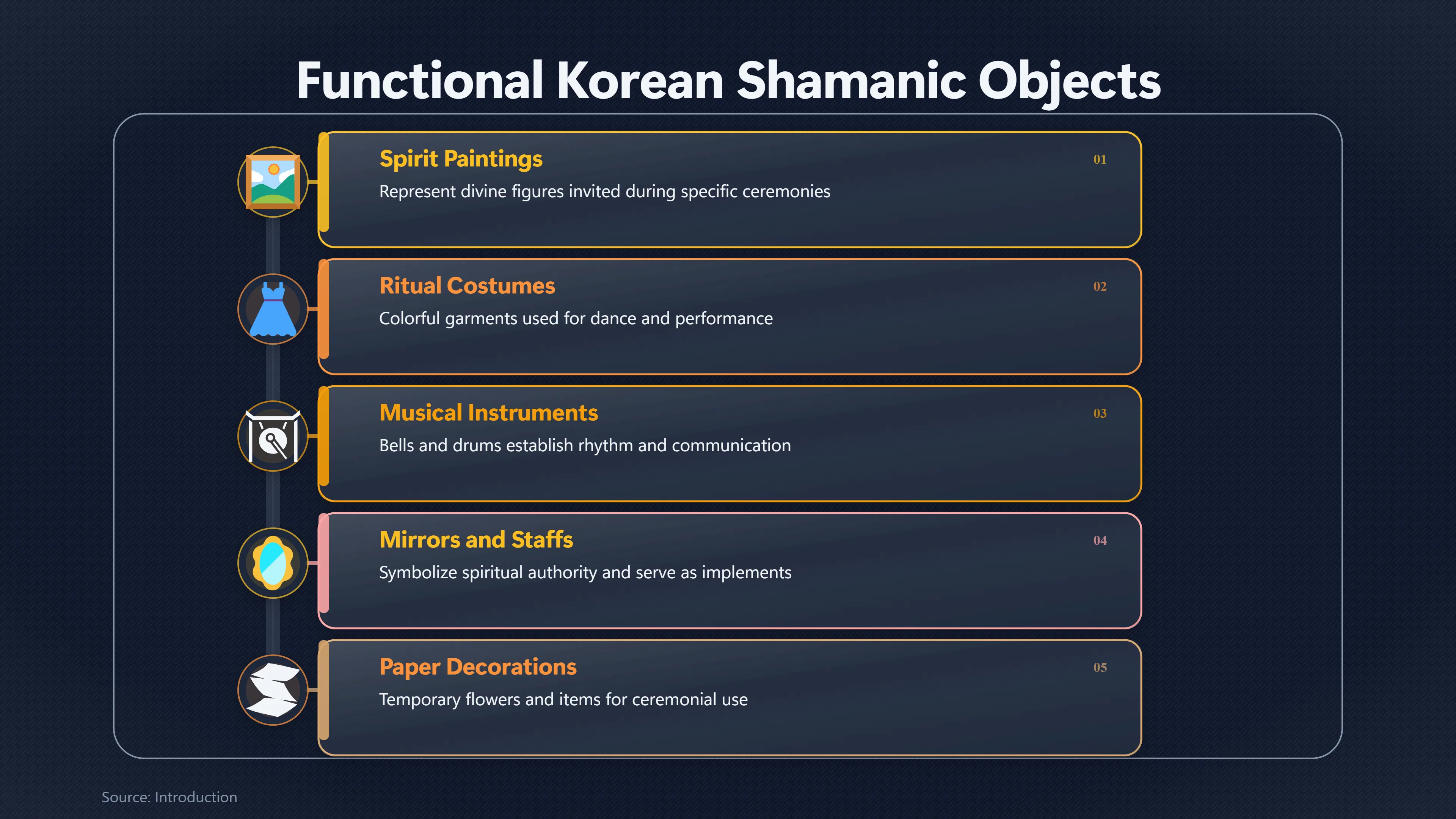
- Spirit paintings used to represent particular divine figures invited during ceremonies.
- Ritual costumes whose colours, accessories and changing garments formed part of ceremonial performance.
- Hand bells, drums and gongs used to establish rhythm and communication during rituals.
- Mirrors that symbolised spiritual authority and were handled during ceremonies.
- Fans, knives and staffs carried as ritual implements rather than weapons.
- Paper flowers and paper decorations, many intended for temporary ceremonial use.
- Divination equipment and protective amulets associated with fortune, health and household wellbeing.
Unlike many religious museums, these collections emphasise function alongside appearance. Labels frequently explain not simply what an object is, but how it was handled, when it appeared during a ceremony and which kinds of practical concerns—illness, dangerous journeys, business success or family conflict—it addressed.[Shamanism Museum]shamanismmuseum.orgShamanism Museum샤머니즘박물관Shamanism Museum샤머니즘박물관
Specialist Archives, National Collections and Private Museums
South Korea preserves shamanic heritage through several complementary approaches rather than one definitive institution.
The Museum of Shamanism in Seoul was established in 2013 specifically for education and research and later relocated beside the historic Geumseongdang Shamanic Shrine. Its collection numbers roughly 30,000 objects, including ritual paintings, costumes, mirrors, bells, incense burners, paper decorations, ritual tools, divination equipment and extensive photographic and video archives. Its founder, folklorist Yang Jongsung, deliberately designed the museum as both a research centre and a place where visitors could encounter a living cultural tradition rather than a collection of supernatural curiosities.[Shamanism Museum]shamanismmuseum.orgShamanism Museum샤머니즘박물관Shamanism Museum샤머니즘박물관
The National Folk Museum of Korea approaches the subject differently. Instead of isolating shamanism, it places ritual life alongside domestic customs, seasonal festivals, agriculture and everyday Korean society. The museum also maintains extensive folklore archives, recognising that recordings, photographs and interviews can be as historically valuable as ritual artefacts themselves. Modernisation has transformed many local traditions, making documentation an important form of preservation.[NFM]nfm.go.krNFMNational Folk Museum of Korea영어 > Introduction > Introduction…
One of the museum’s most significant acquisitions came through folklorist Kim Taegon, whose family donated more than 31,700 items in 2012 after decades of nationwide fieldwork. The donation included spirit paintings, ceremonial clothing, ritual equipment, notebooks, photographs and films documenting ceremonies that had already disappeared or were rapidly changing. In several cases, these recordings later helped reconstruct rituals that would otherwise have been lost.[NFM]nfm.go.krNFMNational Folk Museum of Korea영어 > Exhibitions > Special Exhibition 상세정보 페이지April 22, 2015…

Why Field Records Matter as Much as Ritual Objects
Kim Taegon’s archive illustrates why Korean shamanic collections extend far beyond display cases.
Beginning in the 1960s, he travelled widely to record ceremonies before urbanisation and social change altered local traditions. His notebooks documented ritual sequences, while photographs captured shrine arrangements and costumes. Film preserved music, dance and performance that static objects cannot communicate.
One frequently cited example concerns the recording of a Seoul village ritual that had ceased by the early 1970s. Because detailed film documentation survived, researchers and practitioners later had sufficient evidence to reconstruct elements of the ceremony. Without those audiovisual records, the surviving ritual objects would have revealed only part of the tradition.[NFM]nfm.go.krNFMNational Folk Museum of Korea영어 > Exhibitions > Special Exhibition 상세정보 페이지April 22, 2015…
This emphasis on documentation reflects a broader shift within folklore museums: preserving intangible cultural heritage increasingly requires preserving knowledge, performance and memory alongside physical artefacts.
What Display Cases Preserve — and What They Leave Out
Museum collections successfully preserve craftsmanship, regional artistic styles and historical evidence, but several essential aspects of Korean shamanism inevitably remain outside the gallery.
A visitor cannot experience:
- the soundscape created by chanting, percussion and singing;
- the interaction between the ritual specialist and participants;
- changing emotional states during ceremonies;
- offerings that were intended to be consumed or destroyed;
- the social role of rituals within families or neighbourhoods.
Many exhibitions therefore avoid presenting shamanic objects as magical curiosities in their own right. Instead, they explain that these objects gained significance through relationships and performance. A beautifully painted spirit image may have artistic value, but within ritual it functioned primarily as part of communication between visible and invisible worlds rather than as an independent artwork.[NFM]nfm.go.krNFMNational Folk Museum of Korea영어 > Exhibitions > Special Exhibition 상세정보 페이지…
A Living Tradition Rather Than a Fossil
Perhaps the most distinctive feature of Korea’s shamanic collections is that they document a tradition that continues to evolve.
Museums acknowledge that ceremonies are still performed in parts of South Korea, although practice varies widely by region, family tradition and individual ritual specialists. This makes curatorial decisions unusually sensitive. Displaying ritual equipment solely as historical artefacts risks implying that the beliefs belong entirely to the past, while presenting them only as contemporary religion overlooks their importance as historical, artistic and ethnographic material.
The strongest Korean collections navigate this balance by treating shamanic objects simultaneously as works of craftsmanship, records of community life and evidence of continuing cultural practice. Rather than asking visitors to believe in the spiritual power of the objects, they explain why generations of Koreans created, used and preserved them in response to everyday hopes, fears and uncertainties. That approach makes these collections distinctive within South Korea’s wider landscape of unusual museums: they preserve not merely strange objects, but material traces of a living relationship between ritual, memory and community.[shamanismmuseum.org]shamanismmuseum.orgShamanism Museum샤머니즘박물관Shamanism Museum샤머니즘박물관
Amazon book picks
Further Reading
Books and field guides related to Can a Museum Preserve a Living Ritual?. Use these as the next step if you want deeper reading beyond the article.
The Anthropology of Religion, Magic, and Witchcraft
AutoCite helps to correctly cite sources in a variety of formats.
The Predicament of Culture: Twentieth-Century Ethnography, Li...
The Predicament of Culture is a critical ethnography of the West in its changing relations with other societies. Analyzing cultural pract...
The Birth of Korean Cool
How did a really unhip country suddenly become cool? How could a nation that once banned miniskirts, long hair on men and rock 'n' roll c...
eBay marketplace picks
Marketplace Samples
Live-tested eBay searches with available results related to this page.
Selected fromKorean folk art oneBay.co.uk.
Endnotes
1.
Source: nfm.go.kr
Title: NFMNational Folk Museum of Korea
Link:https://www.nfm.go.kr/english/subIndex/436.do
Source snippet
영어 > Introduction > Introduction...
2.
Source: nfm.go.kr
Title: NFMNational Folk Museum of Korea
Link:https://www.nfm.go.kr/user/bbs/english/17/469/bbsDataView/7540.do?bbsDataCategory=&column=&page=7&search=&searchEDate=&searchSDate=
Source snippet
영어 > Exhibitions > Special Exhibition 상세정보 페이지...
3.
Source: nfm.go.kr
Title: NFMNational Folk Museum of Korea
Link:https://www.nfm.go.kr/user/bbs/english/17/469/bbsDataView/7560.do?page=1
Source snippet
영어 > Exhibitions > Special Exhibition 상세정보 페이지April 22, 2015...
Published: April 22, 2015
4.
Source: shamanismmuseum.org
Title: Shamanism Museum샤머니즘박물관
Link:https://www.shamanismmuseum.org/sub07/sub01.php
5.
Source: nfm.go.kr
Title: National Folk Museum of Korea
Link:https://www.nfm.go.kr/user/bbs/english/17/469/bbsDataView/7567.do?bbsDataCategory=&column=&page=4&search=&searchEDate=&searchSDate=
Source snippet
Title | Kim Soo Nam Period | 2016-04-06 ~ 2016-06-26 Venue | ExhibitionⅠ In 2015, National Folk Museum of Korea receiv...
Published: April 6, 2016
6.
Source: english.visitseoul.net
Link:https://english.visitseoul.net/attractions/National-Folk-Museum-of-Korea/ENP001644
Source snippet
National Folk Museum of Korea | The Official Travel Guide to SeoulApril 9, 2014 — NATIONAL FOLK MUSEUM OF KOREA [Input] [Input] [Input] [...
Published: April 9, 2014
7.
Source: english.visitseoul.net
Title: national folk museum of korea
Link:https://english.visitseoul.net/museum/national-folk-museum-of-korea_/1645
Source snippet
The Official Travel Guide to SeoulApril 9, 2014 — 홈 > Things to Do > Museums & Art Galleries Attractions NATIONAL FOLK MUSEUM OF KOREA...
Published: April 9, 2014
8.
Source: nfm.go.kr
Title: National Folk Museum of Korea
Link:https://nfm.go.kr/user/bbs/english/16/439/bbsDataView/6890.do?bbsDataCategory=&column=&page=7&search=&searchEDate=&searchSDate=
Source snippet
영어 > Introduction > NoticesNovember 30, 2011 — Image NOTICES MEDIATOR BETWEEN HEAVEN AND EARTH - SHAMAN 2011-11-30 Views: 1596 A shaman...
Published: November 30, 2011
Additional References
9.
Source: museum.seoul.go.kr
Link:https://museum.seoul.go.kr/eng/images/html/res/1172985_650.html
Source snippet
The National Folk Museum of Korea, located inside the representative royal palace of Gyeongbokgung, is a pla...
10.
Source: kci.go.kr
Link:https://www.kci.go.kr/kciportal/ci/sereArticleSearch/ciSereArtiView.kci?sereArticleSearchBean.artiId=ART002548518
Source snippet
ECTION OF THE SMITHSONIAN NATIONAL MUSEUM OF NATURAL HISTORY 무형유산 이 학술지 인용지수 조회 이 학술지 논문 검색...
11.
Source: kci.go.kr
Title: 132-151 (20 pages) 발행기관: 한국민화학회 정
Link:https://www.kci.go.kr/kciportal/ci/sereArticleSearch/ciSereArtiView.kci?sereArticleSearchBean.artiId=ART002907643
Source snippet
원광대학교박물관 김태곤 컬렉션 무화의 특색과 의의원광대학교박물관 김태곤 컬렉션 무화의 특색과 의의 SHAMAN PAINTINGS IN THE KIM TAE-GON COLLECTION AT WONKWANG UNIVERSITY MUSEUM 한국민화...
12.
Source: museum.seoul.go.kr
Title: korean Folk Music.jsp
Link:https://museum.seoul.go.kr/eng/about/annex/koreanFolkMusic.jsp
Source snippet
us > Branch > Seoul Museum of Korean Folk Music | SEOUL MUSEUM OF HISTORYSEOUL MUSEUM OF KOREAN FOLK MUSIC SEOUL MUSEUM OF KOREAN FOLK MU...
13.
Source: youtube.com
Title: ‘God Pictures Korean Shaman Paintings’
Link:https://www.youtube.com/watch?v=5UvAufB_FVM
Source snippet
Korean shamanism museum spirit paintings ritual objects Art & Magic: Shaman Paintings of Korea with Dr. Laurel Kendall The Korea Society...
14.
Source: youtube.com
Title: The Lives of Painted Gods in the Korean Shaman World
Link:https://www.youtube.com/watch?v=_TiOWdXe0CI
Source snippet
LECTURE | Shamans, Gods, and Painted Images...
15.
Source: youtube.com
Title: Sacred Images and Magical Things
Link:https://www.youtube.com/watch?v=QWZtvlQJr_M
Source snippet
The Lives of Painted Gods in the Korean Shaman World...
16.
Source: youtube.com
Title: Art & Magic: Shaman Paintings of Korea with Dr. Laurel Kendall
Link:https://www.youtube.com/watch?v=PXbvj4tg7TM
Source snippet
Sacred Images and Magical Things...
17.
Source: youtube.com
Title: LECTURE | Shamans, Gods, and Painted Images
Link:https://www.youtube.com/watch?v=_r06OldZSVM
Source snippet
God Pictures Korean Shaman Paintings...