What Makes Brazil's Strangest Collections Matter?
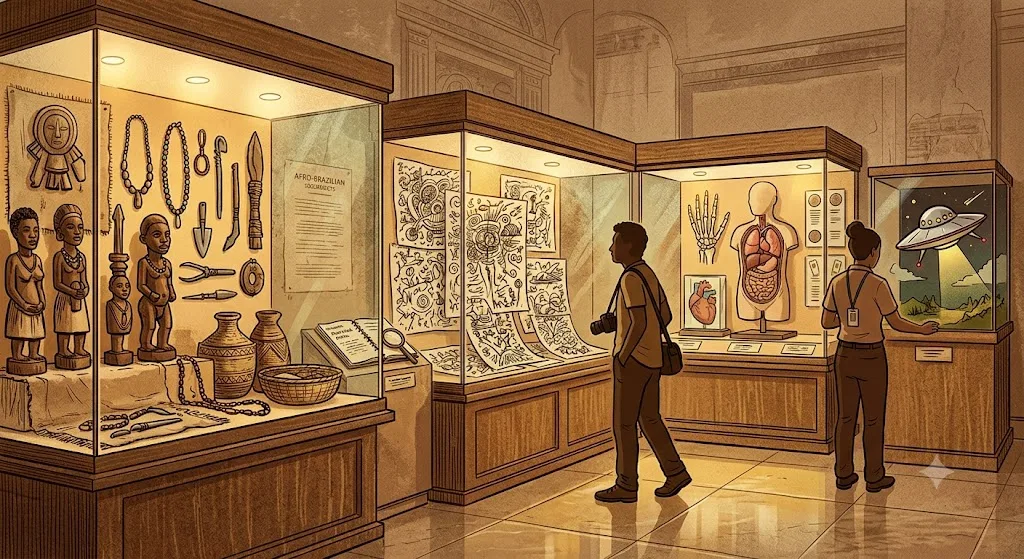
Brazil’s strangest museums are not mainly collections of novelty objects. They are places where the country’s difficult histories, religious conflicts, scientific ambitions and modern legends have become material displays.
Page outline Jump by section
Introduction
The most rewarding sites combine unusual objects with serious interpretation. The Museu da Loucura in Barbacena confronts institutional abuse rather than turning it into horror entertainment. Rio de Janeiro’s Museu de Imagens do Inconsciente and Museu Bispo do Rosário challenge the boundary between clinical records and art. Varginha’s alien attractions show how an unresolved story can become civic folklore and a commercial identity. Together, these collections reveal a Brazilian curiosity culture in which the supposedly strange is rarely neutral: it is shaped by policing, medicine, faith, tourism, scholarship and arguments over who has the right to interpret the past.
Where Brazil’s strangest collections are found
Brazil does not have one recognised national route of oddity museums. Its unusual collections are scattered across large cities, former hospitals, police institutions, university departments and regional tourist sites. Rio de Janeiro and Minas Gerais contain many of the strongest examples, while São Paulo’s universities and scientific institutions preserve anatomical, zoological and medical material that can feel like a modern continuation of the cabinet of curiosity.
Several broad types recur:
- Institutions of confinement: psychiatric hospitals, police museums and archives created from seized or classified material.
- Visionary and outsider art: collections produced beyond the conventional gallery system, often in psychiatric settings.
- Religious objects under dispute: sacred pieces that entered museums through police raids or unequal colonial relationships.
- Scientific curiosities: skeletons, fossils, anatomical preparations, meteorites, mummies and zoological specimens.
- Modern folklore attractions: visitor sites built around UFOs, local legends and heavily commercialised mysteries.
This mixture matters because the word “museum” can conceal very different relationships with the objects on display. Some collections were gathered for research or public education. Others were created through coercion, confiscation or confinement. A visitor looking for the unusual therefore needs to ask not only “What is this?” but also “Who collected it, under what authority, and how is it being explained now?”
Sacred objects once treated as evidence of sorcery
One of the most important cases in Brazil’s unusual museum history is the group of Afro-Brazilian religious objects formerly known as the Collection of the Museum of Black Magic. The pieces were taken during police actions against religious communities, particularly in the early twentieth century, when Afro-Brazilian worship was criminalised or treated by officials as superstition, fraud and public disorder. Rather than entering a museum through ordinary collecting, many objects first became police evidence.[openedition.org]journals.openedition.orgOpenEdition JournalsSorcery objects under institutional tutelageby UN Rafael · 2013 · Cited by 32 — This essay returns to a discussion of…
Part of the collection was officially protected as national heritage in 1938, making it Brazil’s first protected ethnographic collection. That status preserved the objects physically, but it also fixed them within a deeply prejudiced institutional description. Religious implements were classified as curiosities of “magic” rather than as sacred possessions belonging to living communities. Researchers have consequently treated the collection as evidence not merely of religion, but of the state’s historic surveillance and repression of African-descended Brazilians.[Museus Forum]forum.museus.gov.brIdentificar os atores envolvidos nas solicitações de repatriaçãMuseus ForumBRASILEIROS SOB A GUARDA DO MUSEU DA POLÍCIA…April 5, 2017 — Museu da Polícia Civil do Rio de Janeiro, oficialmente denomi…
The collection is now called Coleção Nosso Sagrado, meaning “Our Sacred Collection”. Brazil’s heritage authority reported in 2024 that the renaming covered 519 objects and formed part of a wider effort at historical reparation. The pieces had been moved from the Civil Police Museum to the Museu da República in 2020, following campaigning by religious leaders and heritage specialists. They remain a collection under preservation and study rather than a conventional room of occult curiosities open for casual viewing. Serviços e Informações do Brasil[gov.br]gov.brServiços e Informações do Brasil TED Iphan-Uni Rio | SEIServiços e Informações do Brasil TED Iphan-Uni Rio | SEI
This change in language is not cosmetic. To describe the pieces as “black magic” is to repeat the police perspective that produced the collection. To describe them as sacred objects foregrounds their devotional significance and the communities from which they were removed. The case is therefore one of Brazil’s clearest examples of a museum collection changing meaning without changing its physical contents.
For travellers interested in witchcraft or occult museums, this is an essential distinction. Brazil has abundant traditions involving spirits, divination, healing and ritual power, but Afro-Brazilian religions should not be presented as exotic versions of European witchcraft. Their objects belong to established religious systems, and some are understood by practitioners as spiritually active rather than merely symbolic or artistic. The collection’s fascination lies in that conflict between sacred life and institutional classification, not in claims that it contains supernatural evidence.
Psychiatry remembered through objects and art
Brazil’s former psychiatric institutions have produced several of the country’s most powerful and unsettling collections. These museums do contain strange-looking equipment, dense archives and highly individual artworks, but their significance rests on the history of confinement behind them.
The Museu da Loucura
The Museu da Loucura stands within the psychiatric hospital complex at Barbacena in Minas Gerais. Opened in 1996, it was created to preserve the history of mental-health care and the former Colônia hospital. Displays include documents, photographs and equipment associated with psychiatric treatment, while the institution’s interpretation contrasts older custodial practices with approaches based on autonomy and social reintegration.[Prefeitura Municipal de Barbacena]www1.barbacena.mg.gov.brmuseu da loucuramuseu da loucura
The setting carries an exceptionally difficult history. Large numbers of people were sent to Barbacena without clear medical need, and many endured hunger, exposure, disease, neglect and degrading treatment. The death toll is commonly given as about 60,000 over the institution’s history, although visitors should understand that this figure describes decades of systemic mortality rather than a single documented killing programme. The site became nationally notorious through survivor testimony, journalism and the history of Brazil’s movement against asylum-style confinement.[Agência Minas]agenciaminas.mg.gov.brAgência Minas Museu da Loucura completa 25 anosAgência Minas Museu da Loucura completa 25 anos
This is not a theatrical “madness museum”. Its purpose is remembrance and public education. The historic medical objects can be disturbing, but the central subject is the treatment of people who lost control over their own lives and identities. That makes it more comparable to a memorial museum than to a collection of medical oddities.
The museum is a public visitor attraction and has operated regular visiting hours, although current arrangements should be checked with the municipal or hospital authorities before travelling. Earlier state figures reported an average of roughly 20,000 visitors a year, indicating that it functions as a significant regional heritage site rather than a little-known private display.[Prefeitura Municipal de Barbacena]www1.barbacena.mg.gov.brOpen source on mg.gov.br.
Images from the unconscious
Rio de Janeiro’s Museu de Imagens do Inconsciente offers a markedly different encounter with psychiatric history. Founded by psychiatrist Nise da Silveira in 1952, it grew from painting and modelling workshops established for hospital patients. Silveira opposed the routine use of aggressive treatments and regarded creative work as a means of communication, research and therapeutic engagement.[Museu de Imagens do Inconsciente]museuimagensdoinconsciente.org.brOpen source on museuimagensdoinconsciente.org.br.
The collection contains thousands of works made by people undergoing profound psychological experiences. Repeated circles, animals, mythic figures, houses and dense symbolic landscapes appear across the archive. These images have been studied through psychology and art history, but the museum does not reduce them to diagnostic illustrations. It preserves them as individual creative works as well as records of long-term therapeutic relationships.[Museu de Imagens do Inconsciente]museuimagensdoinconsciente.org.brOpen source on museuimagensdoinconsciente.org.br.
For visitors, the unusual quality comes from the setting and the collection’s original purpose. These works were not initially produced for galleries or the art market. Yet many possess such formal complexity that they helped alter Brazilian thinking about artistic value, mental illness and authorship. The museum is open to the public, offers free admission and publishes regular visiting information, making it one of the most accessible serious collections within Brazil’s stranger cultural landscape.[Museu de Imagens do Inconsciente]museuimagensdoinconsciente.org.brOpen source on museuimagensdoinconsciente.org.br.
Arthur Bispo do Rosário’s private universe
Arthur Bispo do Rosário spent much of his life in a psychiatric institution in Rio de Janeiro, where he created embroidered garments, banners, miniature vessels, catalogues and constructions assembled from everyday materials. He believed he had a divine mission to represent the world for presentation at the Last Judgement. His objects therefore occupy an uneasy position between religious undertaking, personal cosmology and contemporary art.[PMC]pmc.ncbi.nlm.nih.govPMCThe work of Arthur Bispo Do RosárioPMCThe work of Arthur Bispo Do Rosário
The Museu Bispo do Rosário Arte Contemporânea preserves the principal body of this work on the grounds of the former institution where he lived. The collection contains hundreds of pieces, including his famous embroidered presentation cloak and arrangements that appear to catalogue names, objects and systems of knowledge. Bispo did not necessarily understand himself as an artist in the conventional sense, even though his work was later exhibited internationally and incorporated into the established art world.[farmerofthoughts.co.uk]farmerofthoughts.co.ukTom Shakespeare Arthur Bispo do RosárioTom Shakespeare Arthur Bispo do Rosário
It is tempting to market Bispo as a mysterious visionary, but that description can obscure the conditions under which he worked. A responsible interpretation holds two facts together: he created an extraordinary and coherent material universe, and he did so while living under institutional confinement. The museum’s continuing connection with mental-health services and community art activities helps prevent the collection from becoming merely a spectacle of eccentricity.
Varginha: when a UFO story becomes a museum landscape
Varginha, in southern Minas Gerais, has transformed Brazil’s best-known alleged alien encounter into an urban identity. In January 1996, several residents reported seeing an unusual creature, while later stories introduced military activity, captured beings and a possible crashed craft. The claims received extensive media attention and became known internationally as the Varginha incident.
The official military explanation did not validate an extraterrestrial event. Investigators concluded that one prominent sighting involved a local man whom witnesses had mistaken for a strange creature, and that nearby military movements were routine. The release and discussion of official investigation material have not ended public interest, however. On the thirtieth anniversary in January 2026, the city hosted further UFO events while the story continued to be debated by witnesses, enthusiasts and sceptics.[Wikipedia]WikipediaVarginha UFO incidentVarginha UFO incident
Varginha’s Memorial do ET is consequently better understood as a museum of modern folklore than as an evidence archive proving alien visitation. Its exhibits use colourful figures, UFO imagery, local testimony and educational or entertainment material. A planetarium has also formed part of the attraction, although municipal notices in May 2026 stated that it was temporarily under maintenance while the memorial itself continued operating.[turismo.varginha.mg.gov.br]turismo.varginha.mg.gov.brMemorial do ETMemorial do ET
The city has extended the theme well beyond one building. Alien sculptures, murals, themed street furniture, a flying-saucer-shaped water tower and a mapped route of sites connected with the 1996 story have turned the centre into an open-air folklore display. Municipal tourism material openly describes the incident as something continually recreated through journalism, books, films, crafts, games and public architecture.[turismo.varginha.mg.gov.br]turismo.varginha.mg.gov.brmapa caso et de varginhamapa caso et de varginha
That makes Varginha particularly valuable as a case study in how mysteries are commercialised. The attraction does not depend upon the incident being scientifically verified. It depends upon the story being recognisable, adaptable and locally meaningful. Souvenirs and comic alien statues can coexist with sincere witness belief, organised UFO research and sceptical explanations.
Visitors should therefore expect three overlapping experiences:
- A civic attraction, designed for families, school groups and tourists.
- A folklore site, preserving how the story has been remembered and retold.
- A contested UFO case, in which claims exceed what official evidence has established.
The memorial is real and publicly visitor-facing; the extraterrestrial interpretation remains unproven. That distinction is precisely what makes Varginha one of Brazil’s most revealing curiosity destinations.
Scientific collections that resemble cabinets of curiosity
Brazil’s universities and natural-history institutions contain some of its most spectacular strange objects, although they are usually interpreted through science rather than mystery. Anatomical preparations, preserved animals, giant fossils and meteorites belong to the long history of museums as places where nature is classified and made visible.
The Museum of Veterinary Anatomy at the University of São Paulo is a strong example. Its displays use skeletons, organs and anatomical models to explain the structures of domestic and wild animals. The museum receives substantial numbers of school visitors and has worked to publish high-resolution images of its collection. It is unusual in appearance, but its curation is academic and educational rather than sensational.[FMVZ USP]portal.fmvz.usp.brOpen source on usp.br.
The wider scientific museum tradition also contains objects that once belonged comfortably in a cabinet of curiosity: animals with dramatic adaptations, pathological specimens, ancient skeletons, fossils from Brazil’s rich Cretaceous formations and organisms preserved for comparison. Their credibility comes from documented provenance, specialist cataloguing and ongoing research. This separates a university specimen collection from commercial oddity displays in which dramatic labels may exceed the available evidence.
The greatest example was the Museu Nacional in Rio de Janeiro. Before the catastrophic fire of 2 September 2018, it held around 20 million objects spanning archaeology, anthropology, palaeontology, zoology and ancient cultures. Its famous displays included Egyptian mummies, South American human remains, dinosaurs, Indigenous material and the enormous Bendegó meteorite. The museum was not an oddity attraction, but the range and scale of its collections made it one of the world’s great descendants of the universal curiosity cabinet.[theguardian.com]theguardian.comOpen source on theguardian.com.
The fire destroyed more than 16 million objects, according to the museum’s later estimates. Some robust pieces survived, notably the Bendegó meteorite, while researchers salvaged fragments and rebuilt collections through fieldwork, donations and international cooperation. A limited public exhibition reopened in 2025, and further access has followed during reconstruction, but the recovery remains phased rather than a restoration of the pre-fire museum.[Finestre sull'Arte]finestresullarte.infobrazil rio de janeiro s national museum reopens seven years after firebrazil rio de janeiro s national museum reopens seven years after fire
One of the most significant new or returning objects is a seventeenth-century sacred feather cloak belonging to the Tupinambá people. Denmark returned it to Brazil in 2024 after more than three centuries abroad. Its arrival was celebrated as repatriation, yet Indigenous leaders also criticised aspects of the museum’s initial handling because they regarded the cloak as an ancestor and sacred presence, not simply an artefact.[Reuters]reuters.comBrazil officially welcomes return of sacred Indigenous cloak from DenmarkBrazil officially welcomes return of sacred Indigenous cloak from Denmark
The cloak exposes the same question raised by Coleção Nosso Sagrado: can a museum preserve an object responsibly if it ignores the living community’s understanding of what that object is? In Brazil’s most compelling collections, unusualness often results from incompatible categories. A museum may call something ethnography, while worshippers call it sacred; doctors may call an image clinical evidence, while others call it art; tourists may call an alien a mascot, while witnesses call it memory.

Crime, policing and the danger of spectacle
Police museums naturally attract curiosity because they contain confiscated weapons, forensic equipment, documents, contraband and material connected with notorious investigations. The Civil Police Museum in Rio de Janeiro historically assembled collections involving technical policing, political movements, illegal gambling, weapons and objects seized during criminal or political operations.[Wikipedia]WikipediaCivil Police Museum (Rio de JaneiroCivil Police Museum (Rio de Janeiro
Such museums can provide valuable evidence about forensic practice and the state’s changing definition of crime. They can also reproduce institutional prejudice when labels are inherited from the authorities who seized the objects. The history of Coleção Nosso Sagrado demonstrates this risk particularly clearly: the police archive preserved material that might otherwise have been dispersed, but it originally interpreted religious communities through criminalisation.
A responsible crime museum should distinguish among an object’s different histories. A seized ritual object is evidence of a police action, but not necessarily of a harmful act by its owner. A political banner may document both an extremist organisation and the state’s response to it. A forensic specimen may educate visitors, but it may also concern a real victim whose dignity should take priority over shock value.
Brazil’s strongest collections in this category are therefore not necessarily those with the grisliest exhibits. They are those that explain how policing, race, religion and political power affected what was collected and why.
What makes a Brazilian oddity collection credible?
The word “strange” describes a visitor’s reaction, not the quality of a collection. Brazil’s unusual museums range from research institutions to playful tourist sites, and they should not be judged by identical standards.
Academic and medical collections are strongest when specimens have documented origin, clear conservation records and interpretation by relevant specialists. Anatomical museums and natural-history institutions generally fit this model.
Memorial museums should be judged by their treatment of people, testimony and historical responsibility. At Barbacena, the crucial issue is not whether an old medical device looks frightening, but whether the museum explains the system in which it was used.
Religious collections require attention to consent and community authority. Labels written by police officers, colonial collectors or early ethnographers may preserve historical evidence while still expressing racism or religious intolerance.
Outsider-art museums need to avoid turning psychiatric diagnosis into a marketing device. The work should be treated as creative production without erasing the artist’s material circumstances or imposing interpretations the artist never claimed.
UFO and folklore attractions are credible when they distinguish documented events, eyewitness recollection, later additions, official explanations and tourist storytelling. A museum does not need to solve a mystery, but it should make clear which claims remain disputed.
Commercial oddity displays deserve particular caution where provenance is vague. Human remains, ritual objects, alleged supernatural artefacts and supposed anomalies can be misidentified, fabricated or stripped of context. The stranger the claim, the more useful it is to look for an accession record, named source, scientific examination or transparent statement that the object is a reconstruction.
Why these collections matter
Brazil’s unusual collections reveal more than a national appetite for the bizarre. They show how institutions decide what counts as knowledge, illness, religion, art, evidence or folklore.
The objects once called “black magic” expose the criminalisation of Afro-Brazilian faiths and the continuing work of cultural repair. Psychiatric collections show both the violence of confinement and the creative lives that persisted within it. Varginha demonstrates that a modern legend can become architecture, tourism and civic identity without becoming scientifically established fact. Scientific museums reveal how vulnerable even monumental collections can be when cultural infrastructure is neglected.
For visitors, the best approach is curiosity without credulity and fascination without disrespect. Brazil’s strangest museums are most memorable when the uncanny object is only the beginning of the story. Behind it is usually a deeper question about who had the power to collect, classify, confine, believe, display or speak.
Amazon book picks
Further Reading
Books and field guides related to What Makes Brazil's Strangest Collections Matter?. Use these as the next step if you want deeper reading beyond the article.
The Brazil Reader: History, Culture, Politics
An interdisciplinary anthology that includes many primary resources never before published in English.
Ways of Seeing
"Seeing comes before words. The child looks and recognizes before it can speak. "But there is also another sense in which seeing comes be...
eBay marketplace picks
Marketplace Samples
Live-tested eBay searches with available results related to this page.
Selected fromcultural art print oneBay.co.uk.
Endnotes
1.
Source: journals.openedition.org
Link:https://journals.openedition.org/vibrant/788
Source snippet
OpenEdition JournalsSorcery objects under institutional tutelageby UN Rafael · 2013 · Cited by 32 — This essay returns to a discussion of...
2.
Source: museudarepublica.museus.gov.br
Title: Artigo Outra Historia que a Historia nao conta julho 2021 B
Link:https://museudarepublica.museus.gov.br/wp-content/uploads/2021/07/Artigo-Outra-Historia-que-a-Historia-nao-conta-julho-2021-B.pdf
Source snippet
Outra História que a História não conta1 - Museu da República29 Oct 2020 — À época, foi assumido o nome depreciativo de “Coleção Museu da...
3.
Source: rio.rj.gov.br
Link:https://www.rio.rj.gov.br/dlstatic/10112/4204430/4304914/MEL_revista_201203.pdf
Source snippet
A coleção devia ser tombada para servir de testemunha da arte e.Read more...
4.
Source: forum.museus.gov.br
Title: Identificar os atores envolvidos nas solicitações de repatriaçã
Link:https://forum.museus.gov.br/wp-content/uploads/tainacan-items/2466/4338/Apresentacao-Oral-127-NOVOS-OLHARES-SOBRE-A-COLECAO-DE-OBJETOS-SAGRADOS-AFROBRASILEIROS.pdf
Source snippet
Museus ForumBRASILEIROS SOB A GUARDA DO MUSEU DA POLÍCIA...April 5, 2017 — Museu da Polícia Civil do Rio de Janeiro, oficialmente denomi...
Published: April 5, 2017
5.
Source: forum.museus.gov.br
Title: Museus Forum7º FNM – Novos olhares sobre a coleção de objetos sagrados
Link:https://forum.museus.gov.br/memorias-do-forum-nacional-de-museus/7o-fnm-novos-olhares-sobre-a-colecao-de-objetos-sagrados-afrobrasileiros-apresentacao-oral-2017/
Source snippet
Museu da Polícia Civil do Rio de Janeiro, oficialmente denominada coleção Museu de Magia Negra em virtude de seu tombamento efetuado pelo...
6.
Source: gov.br
Title: Serviços e Informações do Brasil TED Iphan-Uni Rio | SEI
Link:https://www.gov.br/iphan/pt-br/acesso-a-informacao/convenios-e-transferencias/instrumentos-celebrados/iphan-sede-uasg-400088/termos-de-execucao-descentralizada/vigente/2023/PlanodeTrabalhpoSimplificadoTED182023.pdf/%40%40download/file
7.
Source: gov.br
Title: articulacao e esforco tecnico em defesa do patrimonio cultural material
Link:https://www.gov.br/iphan/pt-br/assuntos/noticias/articulacao-e-esforco-tecnico-em-defesa-do-patrimonio-cultural-material
8.
Source: www1.barbacena.mg.gov.br
Title: museu da loucura
Link:https://www1.barbacena.mg.gov.br/portal/turismo/0/9/1475/museu-da-loucura
9.
Source: fhemig.mg.gov.br
Title: centro hospitalar psiquiatrico de barbacena
Link:https://www.fhemig.mg.gov.br/atendimento/complexo-hospitalar-de-barbacena/centro-hospitalar-psiquiatrico-de-barbacena
10.
Source: agenciaminas.mg.gov.br
Title: Agência Minas Museu da Loucura completa 25 anos
Link:https://agenciaminas.mg.gov.br/noticia/museu-da-loucura-completa-25-anos
11.
Source: cremesp.gov.br
Link:https://cremesp.gov.br/?id=176&siteAcao=Revista
12.
Source: www1.barbacena.mg.gov.br
Link:https://www1.barbacena.mg.gov.br/portal/noticias/0/3/2129/museu-da-loucura-adota-novo-horario-de-funcionamento-neste-mes-de-janeiro
13.
Source: www1.barbacena.mg.gov.br
Link:https://www1.barbacena.mg.gov.br/portal/noticias/0/3/984/museu-da-loucura-participa-da-semana-nacional-de-museus
14.
Source: pmc.ncbi.nlm.nih.gov
Title: PMCThe work of Arthur Bispo Do Rosário
Link:https://pmc.ncbi.nlm.nih.gov/articles/PMC7214720/
15.
Source: outsiderartfair.com
Title: Arthur Bispo do Rosário
Link:https://www.outsiderartfair.com/artists/arthur-bispo-do-rosario
16.
Source: Wikipedia
Title: [Varginha UFO]({{ ‘varginha-ufo/’ | relative_url }}) incident
Link:https://en.wikipedia.org/wiki/Varginha_UFO_incident
17.
Source: turismo.varginha.mg.gov.br
Title: Memorial do ET
Link:https://turismo.varginha.mg.gov.br/memorial-do-et/
18.
Source: turismo.varginha.mg.gov.br
Link:https://turismo.varginha.mg.gov.br/memorial-do-et-funciona-normalmente-planetario-passa-por-manutencao-em-varginha/
19.
Source: turismo.varginha.mg.gov.br
Title: mapa caso et de varginha
Link:https://turismo.varginha.mg.gov.br/mapa-caso-et-de-varginha/
20.
Source: varginha.mg.gov.br
Link:https://www.varginha.mg.gov.br/portal/noticias/0/3/9340/secretaria-de-turismo-e-comercio-inaugura-escultura-de-4-metros-do-et-em-varginha
21.
Source: portal.fmvz.usp.br
Link:https://portal.fmvz.usp.br/en/home-en/
22.
Source: Wikipedia
Title: Collection of mummies in the National Museum of Brazil
Link:https://en.wikipedia.org/wiki/Collection_of_mummies_in_the_National_Museum_of_Brazil
23.
Source: reuters.com
Title: Brazil officially welcomes return of sacred Indigenous cloak from Denmark
Link:https://www.reuters.com/world/brazil-officially-welcomes-return-sacred-indigenous-cloak-denmark-2024-09-12/
24.
Source: Wikipedia
Title: Civil Police Museum (Rio de Janeiro)
Link:https://en.wikipedia.org/wiki/Civil_Police_Museum_%28Rio_de_Janeiro%29
25.
Source: conexaoambiental.pr.gov.br
Title: aconservation biology for all
Link:https://www.conexaoambiental.pr.gov.br/sites/conexao-ambiental/arquivos_restritos/files/documento/2018-11/aconservation_biology_for_all.pdf
26.
Source: varginha.mg.gov.br
Title: Prefeitura de Varginha
Link:https://www.varginha.mg.gov.br/
27.
Source: varginha.mg.gov.br
Link:https://www.varginha.mg.gov.br/portal/noticias/0/3/9864/memorial-do-et-recebe-a-tardezinha-do-et-no-dia-24-de-maio
28.
Source: varginha.mg.gov.br
Title: memorial do et inaugura novo cenario em celebracao aos 30 anos do caso varginha
Link:https://www.varginha.mg.gov.br/portal/noticias/0/3/9590/memorial-do-et-inaugura-novo-cenario-em-celebracao-aos-30-anos-do-caso-varginha
29.
Source: varginha.mg.gov.br
Link:https://www.varginha.mg.gov.br/portal/noticias/0/3/9603/memorial-do-et-tera-entrada-gratuita-no-dia-20-de-janeiro-em-celebracao-aos-30-anos-dos-acontecimentos-de-varginha
30.
Source: varginha.mg.gov.br
Link:https://www.varginha.mg.gov.br/portal/noticias/0/3/10072/prefeitura-de-varginha-promove-roda-de-conversa-historica-com-revelacoes-sobre-o-caso-do-et
31.
Source: varginha.mg.gov.br
Link:https://www.varginha.mg.gov.br/portal/noticias/0/3/10035/memorial-do-et-promove-encontro-com-dr-italo-venturelli-para-celebrar-o-dia-mundial-da-ufologia
32.
Source: varginha.mg.gov.br
Title: prefeitura de varginha inaugura memorial do et
Link:https://www.varginha.mg.gov.br/portal/noticias/0/3/7216/prefeitura-de-varginha-inaugura-memorial-do-et
33.
Source: Wikipedia
Link:https://pt.wikipedia.org/wiki/Varginha
34.
Source: Wikipedia
Link:https://en.wikipedia.org/wiki/Varginha
35.
Source: Wikipedia
Title: Museu de Imagens do Inconsciente
Link:https://pt.wikipedia.org/wiki/Museu_de_Imagens_do_Inconsciente
36.
Source: Wikipedia
Title: Funerary art
Link:https://en.wikipedia.org/wiki/Funerary_art
37.
Source: Wikipedia
Title: National Museum of Brazil
Link:https://en.wikipedia.org/wiki/National_Museum_of_Brazil
38.
Source: dados.ancine.gov.br
Title: diretores de obras nao publicitarias estrangeiras.csv
Link:https://dados.ancine.gov.br/dados-abertos/diretores-de-obras-nao-publicitarias-estrangeiras.csv
39.
Source: funartemaisdigital.funarte.gov.br
Link:https://funartemaisdigital.funarte.gov.br/periodicos/the-magia-negra-collection-and-the-terreiro-casa-branca-imaterial-culture-heritage-and-decolonialitya-colecao-de-magia-negra-e-o-terreiro-d/
40.
Source: gov.br
Link:https://www.gov.br/ancine/pt-br/oca/agentes-economicos-e-obras-1/xlsx/lancamentos-comerciais-por-distribuidoras-ago-25.xlsx
41.
Source: gov.br
Title: www.gov.br Conselho Nacional do Ministério Público
Link:https://www.gov.br/museus/pt-br/acesso-a-informacao/licitacoes-e-contratos/licitacoes/licitacoes-2020-e-2021/anexos-site-antigo/pregao-eletronico-n01_2021-mnba-aviso-de-licitacao.pdf
42.
Source: internationaloffice.usp.br
Link:https://internationaloffice.usp.br/wp-content/uploads/docs/catalogo.pdf
43.
Source: repositorio.usp.br
Link:https://repositorio.usp.br/directbitstream/57106cb7-bac8-450a-a2dd-1a78dc61cac3/003104497.pdf
44.
Source: fm.usp.br
Link:https://fm.usp.br/en/news/hc-and-imt-of-fmusp-investigate-a-virus-that-has-resurfaced-in-brazil-after-20-years-without-detection
45.
Source: repositorio.usp.br
Link:https://repositorio.usp.br/bitstreams/a4203558-0a43-4e66-9e2b-bd717fdc6745
46.
Source: teses.usp.br
Link:https://teses.usp.br/teses/disponiveis/41/41133/tde-14082021-135310/publico/Lucas_Piazentin_vol_I_CORRIG.pdf
47.
Source: teses.usp.br
Link:https://teses.usp.br/teses/disponiveis/10/10134/tde-17092019-113219/publico/Jairo_Alfonso_Mendoza_Roldan_corrigida.pdf
48.
Source: teses.usp.br
Link:https://teses.usp.br/teses/disponiveis/10/10133/tde-30052022-145802/publico/Pedro_Enrique_Navas_Suaresz_original.pdf
49.
Source: repositorio.usp.br
Link:https://repositorio.usp.br/directbitstream/9ab161ec-d4be-4426-8650-0e73643ee708/CAT_429_3015753_R.pdf
50.
Source: teses.usp.br
Link:https://teses.usp.br/teses/disponiveis/44/44141/tde-11042023-084125/publico/TESE_GUSTAVO_PRADO_RESUMIDO.pdf
51.
Source: www1.barbacena.mg.gov.br
Link:https://www1.barbacena.mg.gov.br/portal/0/galeria-de-videos/171/museu-da-loucura/
52.
Source: museudarepublica.museus.gov.br
Title: museus.gov.br17 semana nacional de museus
Link:https://museudarepublica.museus.gov.br/wp-content/uploads/2017/12/BOLETIM-MAIO-2019.pdf
53.
Source: museudarepublica.museus.gov.br
Title: museus.gov.brcuidando da vida
Link:https://museudarepublica.museus.gov.br/wp-content/uploads/2023/02/Livro_Cuidando-da-Vida_Etnografia-da-Vacinacao-060223.pdf
54.
Source: pinheiral.rj.gov.br
Link:https://pinheiral.rj.gov.br/artigo/48682/site/?url=http%3A%2F%2Fbarincapitalpartners.com%2Fjob%2F02465
55.
Source: agenciaminas.mg.gov.br
Title: museu da loucura de barbacena abre exposicao no dia 18 2 44227
Link:https://www.agenciaminas.mg.gov.br/noticia/museu-da-loucura-de-barbacena-abre-exposicao-no-dia-18-2-44227
56.
Source: camaragba.sc.gov.br
Link:https://camaragba.sc.gov.br/
57.
Source: ccs.saude.gov.br
Title: saude.gov.br Museus
Link:https://www.ccs.saude.gov.br/saudemental/museus.php
58.
Source: saude.mg.gov.br
Title: ses inaugura obras de revitalizacao do museu da loucura de barbacena 2
Link:https://www.saude.mg.gov.br/noticias/ses-inaugura-obras-de-revitalizacao-do-museu-da-loucura-de-barbacena-2/
59.
Source: museuimagensdoinconsciente.org.br
Link:https://museuimagensdoinconsciente.org.br/
60.
Source: museuimagensdoinconsciente.org.br
Link:https://museuimagensdoinconsciente.org.br/en/
61.
Source: farmerofthoughts.co.uk
Title: Tom Shakespeare Arthur Bispo do Rosário
Link:https://farmerofthoughts.co.uk/collected_pieces/arthur-bispo-do-rosario/
62.
Source: theguardian.com
Link:https://www.theguardian.com/world/article/2024/may/07/rio-national-museum-fossil-donation-fire
63.
Source: newyorker.com
Link:https://www.newyorker.com/news/dispatch/brazil-lost-more-than-the-past-in-the-national-museum-fire
64.
Source: finestresullarte.info
Title: brazil rio de janeiro s national museum reopens seven years after fire
Link:https://www.finestresullarte.info/en/museums/brazil-rio-de-janeiro-s-national-museum-reopens-seven-years-after-fire
65.
Source: theguardian.com
Link:https://www.theguardian.com/world/article/2024/jul/16/brazil-indigenous-cloak-returned
66.
Source: theguardian.com
Title: brazil queer art show cancelled protest
Link:https://www.theguardian.com/world/2017/sep/12/brazil-queer-art-show-cancelled-protest
67.
Source: infojustice.org
Link:https://infojustice.org/archives/41001
Additional References
68.
Source: research-repository.st-andrews.ac.uk
Title: Brulon Soares 2024 Curat Objects imprisonment diasporic museum collections CC
Link:https://research-repository.st-andrews.ac.uk/bitstream/handle/10023/30280/Brulon_Soares_2024Curat_Objects-_imprisonment-diasporic-museum-collections_CC.pdf?isAllowed=y&sequence=1
Source snippet
St Andrews Research RepositoryDiasporic museum collections on ethnographic displayby B Brulon Soares · 2024 · Cited by 1 — - Brazilian re...
69.
Source: youtube.com
Link:https://www.youtube.com/watch?v=5tgWPVQ8JHY
Source snippet
Museu da Loucura Barbacena English Indo conhecer O Museu da Loucura - Minas Gerais Barbacena Pastora Marcia M. Cunha...
70.
Source: youtube.com
Title: Brazil’s National Museum tries to recover one year after devastating fire
Link:https://www.youtube.com/watch?v=fXiAIQC8mOs
Source snippet
The Varginha UFO Incident — First Brazilian TV Report + Timeline of Events (1996)...
71.
Source: youtube.com
Title: Varginha UFO Crash: Alien Contact, Government Denial and Coverup
Link:https://www.youtube.com/watch?v=E76kpPjxMcw
Source snippet
Brazil’s National Museum tries to recover one year after devastating fire...
72.
Source: youtube.com
Title: Former asylum exhibits artworks from patients past and present
Link:https://www.youtube.com/watch?v=c6nR_gJW6jo
Source snippet
Varginha UFO Crash: Alien Contact, Government Denial and Coverup...
73.
Source: youtube.com
Title: Exhibit in ex-psychiatric ward celebrates artist
Link:https://www.youtube.com/watch?v=2yLkhxHevEY
Source snippet
Former asylum exhibits artworks from patients past and present...
74.
Source: atlasobscura.com
Link:https://www.atlasobscura.com/things-to-do/brazil/museums
75.
Source: tripadvisor.com
Link:https://www.tripadvisor.com/Attraction_Review-g303374-d4375972-Reviews-Abradjin_Museu_de_Historia_da_Inquisicao-Belo_Horizonte_State_of_Minas_Gerais.html
76.
Source: as-coa.org
Link:https://www.as-coa.org/sites/default/files/imce_files/AMS_exhib_Rosario_Low%20Res.pdf
77.
Source: facebook.com
Link:https://www.facebook.com/unescobrasil/videos/museu-de-imagens-do-inconsciente/763627397308495/