Within Curious Oman
Why Are Oman's Natural History Collections So Unusual?
Oman's most striking scientific curiosities range from giant whale skeletons to meteorites recovered from its deserts.
On this page
- Whales and marine giants
- Meteorites from Oman's deserts
- Where to see these collections
Page outline Jump by section
Introduction
Oman’s most remarkable natural history collections are defined less by quantity than by the exceptional specimens they preserve. Rather than cabinets of mythical creatures or Victorian-style curiosities, the country’s standout exhibits are genuine scientific discoveries: a towering sperm whale skeleton that dominates the Natural History Museum in Muscat, fossil remains revealing prehistoric life, and meteorites recovered from some of the world’s most productive hot-desert search areas. Together, these collections demonstrate how Oman’s coastline, mountains and deserts have produced specimens of international scientific importance while remaining accessible to curious visitors interested in unusual natural heritage.
Why are Oman’s natural history collections so unusual?
Oman’s natural-history curiosities are unusual because they combine spectacular scale with strong scientific credibility. The country’s museums do not present natural specimens as mysterious relics or sensational attractions. Instead, they use extraordinary objects to explain marine biology, geology, evolution and the history of the Arabian Peninsula.
The result is a distinctive form of curiosity culture. Visitors encounter exhibits that are visually striking enough to resemble the classic cabinets of curiosity found elsewhere in the world, yet each specimen is carefully interpreted through modern science. This evidence-led approach makes Oman an interesting destination for travellers who enjoy unusual collections without the embellishment of folklore or fabricated mysteries.
The country’s geography also helps explain why these collections are so distinctive. A coastline stretching for thousands of kilometres, ancient rock formations and vast, sparsely vegetated deserts have created ideal conditions for preserving both marine specimens and meteorites that are rare in many other parts of the world.[Ministry of Heritage and Tourism]mht.gov.omMinistry of Heritage and TourismUnder the theme of "Museums,Sustainability and Well-Being" The Sultanate of Oman celebrates the Internat…
Whales and marine giants
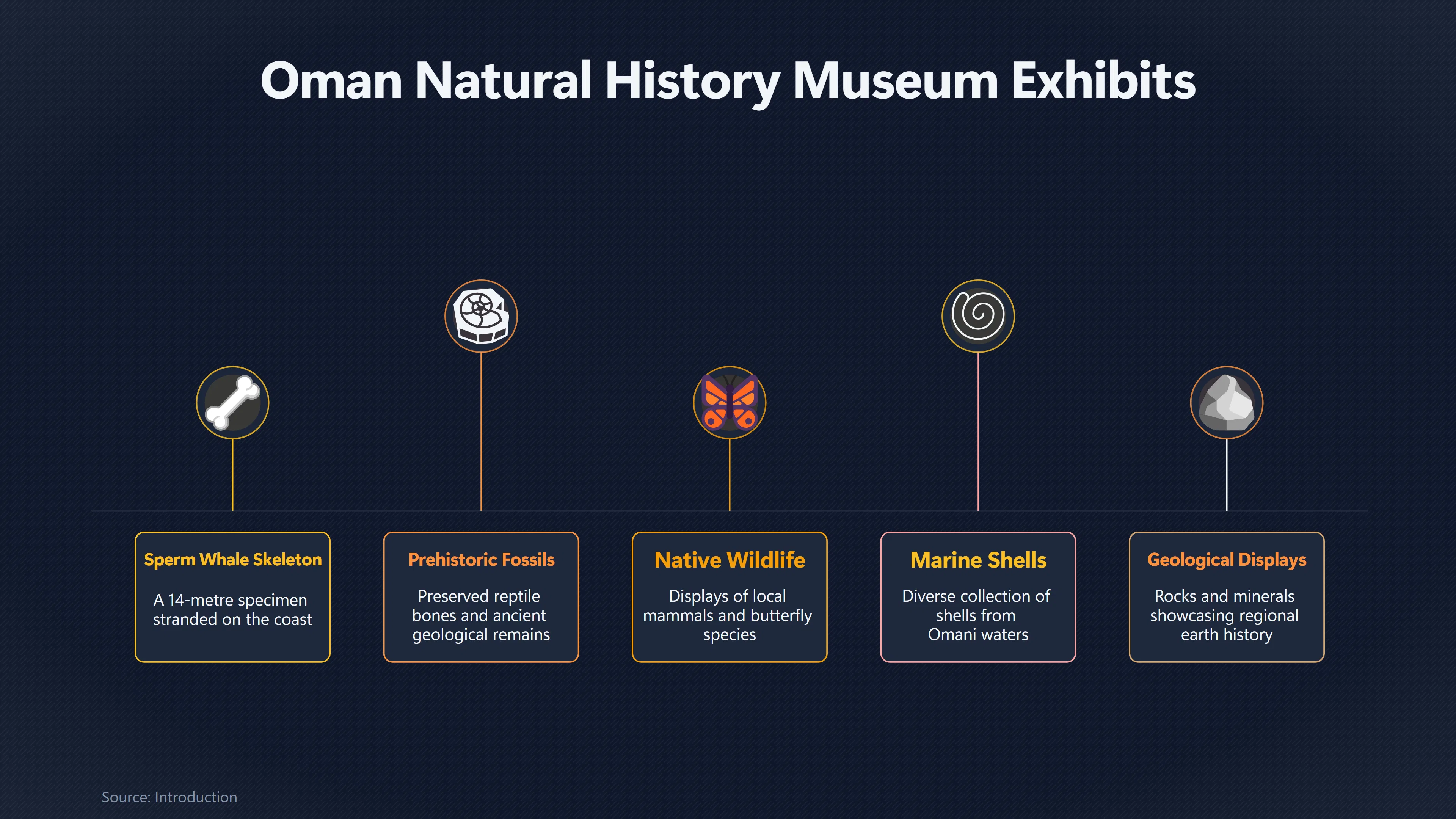
The centrepiece of Oman’s Natural History Museum is its Whale Hall, dominated by the approximately 14-metre skeleton of a sperm whale. Rather than being reconstructed from multiple animals, the skeleton came from a whale that stranded on the Omani coast, giving it both scientific and local significance. The sheer size of the display makes it one of the country’s most memorable museum objects.[Ministry of Heritage and Tourism]mht.gov.omMinistry of Heritage and TourismUnder the theme of "Museums,Sustainability and Well-Being" The Sultanate of Oman celebrates the Internat…
The whale does not stand alone. The hall also includes additional whale skeletons and skulls that place the specimen within the wider diversity of cetaceans found in Omani waters. Instead of encouraging myths about sea monsters, the exhibition explains anatomy, marine ecology and the biological richness of the Arabian Sea, whose seasonal upwelling supports unusually productive marine ecosystems.[Ministry of Heritage and Tourism]mht.gov.omMinistry of Heritage and TourismUnder the theme of "Museums,Sustainability and Well-Being" The Sultanate of Oman celebrates the Internat…
Elsewhere in the museum, visitors encounter fossil bones, preserved reptiles, butterflies, shells and displays of native mammals. These are presented as evidence of Oman’s biodiversity across both geological and modern times, extending the museum beyond a single spectacular exhibit into a broader natural-history collection.[Ministry of Heritage and Tourism]mht.gov.omMinistry of Heritage and TourismUnder the theme of "Museums,Sustainability and Well-Being" The Sultanate of Oman celebrates the Internat…
Meteorites from Oman’s deserts
If the whale skeleton is Oman’s largest natural-history curiosity, its meteorites are arguably its most scientifically significant.
Oman’s deserts rank among the world’s most productive locations for meteorite recovery. Sparse vegetation, dry conditions and light-coloured desert surfaces make dark meteorites relatively easy to detect while also helping preserve them over long periods. Systematic expeditions have recovered thousands of meteorites, making Oman an internationally important source of material for planetary science.[LPI]lpi.usra.eduLPIMeteoritical Bulletin: Entry for Sayh al Uhaymir 008LPIMeteoritical Bulletin: Entry for Sayh al Uhaymir 008
Among the most famous discoveries is Sayh al Uhaymir 008, a Martian meteorite discovered in 1999. Classified as a basaltic shergottite, it was blasted from Mars by an ancient impact before eventually falling to Earth. Fragments entered major scientific collections, including the Natural History Museum in London, where they are used for both research and public display.[usra.edu]lpi.usra.eduLPIMeteoritical Bulletin: Entry for Sayh al Uhaymir 008LPIMeteoritical Bulletin: Entry for Sayh al Uhaymir 008
Oman has also yielded lunar meteorites and numerous ordinary chondrites, allowing researchers to investigate the history of the Moon, Mars and the early Solar System. Scientific programmes involving Omani and international researchers have examined meteorites collected during organised desert surveys, using techniques such as gamma-ray spectroscopy to estimate terrestrial ages, weathering histories and exposure to cosmic radiation.[arxiv.org]arxiv.orgarXiv A gamma-ray spectroscopy survey of Omani meteoritesarXiv A gamma-ray spectroscopy survey of Omani meteorites
These finds distinguish Oman from many countries whose meteorite collections rely largely on imported specimens. In Oman’s case, many of the scientifically valuable rocks were discovered within its own landscape.
Why these specimens matter beyond curiosity
The whale skeleton and meteorites occupy different branches of natural history, yet they share an important characteristic: both are globally significant scientific specimens that also work exceptionally well as public exhibits.
The whale immediately communicates the scale of marine life along Oman’s coast, while the meteorites connect the country’s deserts with planetary science. One specimen represents the largest animals ever to have lived on Earth; the other consists of rocks that originated on bodies millions of kilometres away.
This combination gives Oman’s natural-history collections a distinctive identity. Rather than emphasising eccentric collecting or sensational storytelling, they reveal how ordinary landscapes can produce extraordinary scientific evidence. The collections therefore appeal equally to museum visitors, families, geology enthusiasts and travellers interested in unusual places grounded firmly in evidence rather than legend.

Where to see these collections
Visitors interested in Oman’s natural-history curiosities should focus on a small number of institutions rather than expecting a network of specialist museums.
- Natural History Museum, Muscat – The principal destination for the 14-metre sperm whale skeleton, additional whale remains, fossils, preserved native wildlife and geological displays.[Ministry of Heritage and Tourism]mht.gov.omMinistry of Heritage and TourismUnder the theme of "Museums,Sustainability and Well-Being" The Sultanate of Oman celebrates the Internat…
- International research collections – Some of Oman’s most significant meteorites, including material from Sayh al Uhaymir 008, are held in research institutions such as the Natural History Museum in London, reflecting their importance to planetary science rather than local exhibition alone.[Natural History Museum]nhm.ac.ukNatural History Museum Meteorites | Natural History MuseumNatural History Museum Meteorites | Natural History Museum
Taken together, these collections demonstrate that Oman’s most compelling natural oddities are not mythical creatures or mysterious relics, but authentic specimens whose scientific value is every bit as remarkable as their appearance.
Amazon book picks
Further Reading
Books and field guides related to Why Are Oman's Natural History Collections So Unusual?. Use these as the next step if you want deeper reading beyond the article.
Geology of the Oman Mountains, Eastern Arabia
This book describes in detail numerous geological sites throughout the mountains of Oman and the United Arab Emirates (UAE) in Eastern Ar...
Meteorites: The Story of Our Solar System
"A well-illustrated overview of the science and (literal) impact of these space rocks." -- Science News, on the first edition Leading exp...
Whales, Dolphins and Porpoises
Presents the latest research about whales, dolphins, and porpoises, covering their biology and behavior, and how to identify and observe...
eBay marketplace picks
Marketplace Samples
Live-tested eBay searches with available results related to this page.
Selected fromwhale shark model oneBay.co.uk.



Endnotes
1.
Source: lpi.usra.edu
Title: LPIMeteoritical Bulletin: Entry for Sayh al Uhaymir 008
Link:https://www.lpi.usra.edu/meteor/metbull.cfm?ants=&browse=&categ=All&code=23200&country=Oman&falls=&lrec=50&map=ge&mblist=All&nwas=&phot=no&pnt=Normal+table&rect=&sea=Al+Wusta&sfor=places&snew=0&srt=mass&strewn=no&stype=exact&valids=
2.
Source: arxiv.org
Title: arXiv A gamma-ray spectroscopy survey of Omani meteorites
Link:https://arxiv.org/abs/1602.00915
3.
Source: youtube.com
Title: Whale Skeletons at Muscat Natural History Museum, Oman
Link:https://www.youtube.com/watch?v=O_fSJdG0dfc
Source snippet
Natural History Museum Oman / Oman's best museum...
4.
Source: youtube.com
Title: Natural History Museum Oman / Oman’s best museum
Link:https://www.youtube.com/watch?v=r8-QC7Dvnug
Source snippet
Visiting Muscat Natural History Museum, Oman...
5.
Source: youtube.com
Title: Visiting Muscat Natural History Museum, Oman
Link:https://www.youtube.com/watch?v=IWuyxuqqTWU
Source snippet
The Natural History Museum in Muscat...
6.
Source: youtube.com
Title: The Natural History Museum in Muscat
Link:https://www.youtube.com/watch?v=5jtHbJgWUxA
Source snippet
Dudu in Oman Natural History Museum...
7.
Source: mht.gov.om
Link:https://mht.gov.om/en/media-center/news/under-the-theme-of-museums-sustainability-and-well-being-the-sultanate-of-oman-celebrates-the-international-museum-day/
Source snippet
Ministry of Heritage and TourismUnder the theme of "Museums,Sustainability and Well-Being" The Sultanate of Oman celebrates the Internat...
8.
Source: nhm.ac.uk
Title: Natural History Museum Meteorites | Natural History Museum
Link:https://www.nhm.ac.uk/our-science/services/collections/mineralogy/meteorites.html
9.
Source: nhm.ac.uk
Link:https://www.nhm.ac.uk/discover/space-highlights-mars-moon-meteorites.html
10.
Source: nhm.ac.uk
Title: Natural History Museum The Moon | Natural History Museum
Link:https://www.nhm.ac.uk/our-science/research/projects/moon.html
11.
Source: nhm.ac.uk
Title: Natural History Museum Meteoritics group | Natural History Museum
Link:https://www.nhm.ac.uk/our-science/research/projects/meteoritics.html
12.
Source: gov.om
Title: get license to search for meteorites
Link:https://gov.om/en/w/get-license-to-search-for-meteorites
Source snippet
11, 2026 — GET LICENSE TO SEARCH FOR METEORITES Menu Search SEARCH GOV.OM Search Bar [Input] [Input: Search...] [Input] العربية Sign in [...
13.
Source: omannews.gov.om
Title: Oman News Agency
Link:https://omannews.gov.om/topics/en/79/show/120220
Source snippet
December 22, 2024 — NEWS Heritage Ministry Announces Documentation of “Rajae” Meteorite وضع القراءة * * * * * * Image: Heritage Ministry...
Published: December 22, 2024
14.
Source: mht.gov.om
Link:https://mht.gov.om/media-center/news/mht-hosts-second-edition-of-meteorite-workshop/
15.
Source: omannews.gov.om
Title: Oman News Agency
Link:https://omannews.gov.om/topics/en/128/show/109390
16.
Source: nhm.ac.uk
Title: New piece of the Moon arrives at the Museum | Natural History Museum
Link:https://www.nhm.ac.uk/discover/news/2017/december/new-piece-of-the-moon-arrives-at-the-museum.html
17.
Source: lpi.usra.edu
Link:https://www.lpi.usra.edu/meteor/metbull.cfm?code=50969
18.
Source: nhm.ac.uk
Link:https://www.nhm.ac.uk/our-science/services/collections/mineralogy.html
19.
Source: squjs.squ.edu.om
Link:https://squjs.squ.edu.om/squjs/vol22/iss1/5/
Additional References
20.
Source: youtube.com
Title: Dudu in Oman Natural History Museum
Link:https://www.youtube.com/watch?v=tNLqDx9JvDQ
Source snippet
Natural History Museum Muscat Oman whale skeleton Whale Skeletons at Muscat Natural History Museum, Oman هياكل الحيتان متحف التاريخ الطبي...
21.
Source: flickr.com
Title: The photograph wa
Link:https://www.flickr.com/photos/george-anderson/54886553795/
Source snippet
Sayh al Uhaymir 008_Martian shergottite_(IMG_0293a) | FlickrOctober 28, 2025 — SAYH AL UHAYMIR 008_MARTIAN SHERGOTTITE_(IMG_0293A) [Input...
Published: October 28, 2025
22.
Source: amnh.org
Link:https://www.amnh.org/exhibitions/permanent/meteorites
23.
Source: wifi.nhm.ac.uk
Link:https://wifi.nhm.ac.uk/our-science/services/collections/mineralogy/meteorites.html
24.
Source: oumnh.ox.ac.uk
Link:https://www.oumnh.ox.ac.uk/learn-museum-highlights
25.
Source: oumnh.ox.ac.uk
Link:https://oumnh.ox.ac.uk/learn-meteorites
26.
Source: oumnh.ox.ac.uk
Link:https://oumnh.ox.ac.uk/mineralogy-and-petrology
27.
Source: youtu.be
Title: Malavika Nisha
Link:https://youtu.be/s1davWL-Ofs
Source snippet
Visiting Muscat Natural History Museum, Oman 23.09.2017 زيارة متحف التاريخ الطبيعي في مسقط عُمان Prof. Dr. Sc. Norman Ali Bassam Ali Tahe...
28.
Source: researchgate.net
Title: 42791302 Sayh al Uhaymir 094 A new Martian meteorite from the Oman Desert
Link:https://www.researchgate.net/publication/42791302_Sayh_al_Uhaymir_094_A_new_Martian_meteorite_from_the_Oman_Desert
29.
Source: omaninfo.om
Title: البوابة الإعلامية -وزارة الإعلام
Link:https://www.omaninfo.om/mainsections/15/show/158