Within Micronesian Curiosities
How Does Yap's Giant Stone Money Work?
Yap's immense stone discs are not oversized coins but visible records of ownership, exchange, memory and community status.
On this page
- What a stone money bank actually is
- How ownership and value were remembered
- What visitors should understand before visiting
Page outline Jump by section
Introduction
Yap’s famous stone money is often described as the world’s largest currency, but that description can be misleading. The immense limestone discs, known in English as rai stones, were never simply oversized coins. Their significance lies in the way ownership, history and social relationships were remembered by the community rather than in the physical movement of the stones themselves. Many of the largest examples remain where they have stood for generations, arranged in open-air village settings commonly described as “stone money banks”. These are not museums in the conventional sense but living cultural landscapes where visible objects preserve invisible records of exchange, status and memory.[UNESCO World Heritage Centre]whc.unesco.orgWorld Heritage Centre Yapese Disk Money Regional SitesUNESCO World Heritage CentreYapese Disk Money Regional Sites - UNESCO World Heritage CentreDecember 29, 2004…
For visitors interested in unusual collections, Yap offers something rare: a place where a globally famous artefact still exists within the cultural system that gave it meaning. Rather than viewing isolated objects behind glass, visitors encounter stones that remain embedded in village life and local historical knowledge.
What a stone money bank actually is
A Yap stone money bank is an outdoor communal place where numerous rai stones are displayed together. The English word “bank” can be confusing because there is no vault, cashier or institution holding deposits. Instead, the landscape itself serves as a visible register of wealth, genealogy and historical agreements.
Many banks are located beside village paths, meeting grounds or ceremonial spaces. Individual stones may belong to families, clans or other recognised owners, but they remain where everyone can see them. Their visibility is important because ownership has traditionally depended upon public knowledge rather than private documentation.[bankofcanadamuseum.ca]bankofcanadamuseum.caRai: big moneyBank of Canada Museum…
The UNESCO Tentative World Heritage nomination highlights the Mangyol Stone Money Bank in Makiy village as one of Yap’s most significant surviving examples. Unlike many other sites, Mangyol forms part of a cross-shaped ceremonial ground containing dozens of stones, stone platforms, seating places for chiefs and spaces used for traditional gatherings. The nominated landscape demonstrates that the “bank” functioned simultaneously as a ceremonial, political and social centre rather than merely a storage area for valuables.[UNESCO World Heritage Centre]whc.unesco.orgWorld Heritage Centre Yapese Disk Money Regional SitesUNESCO World Heritage CentreYapese Disk Money Regional Sites - UNESCO World Heritage CentreDecember 29, 2004…
This combination makes the site unusual within the world’s museum and heritage landscape. Visitors are not looking at an abandoned economic system but at an organised cultural space where wealth, leadership and community memory intersect.
How ownership and value were remembered
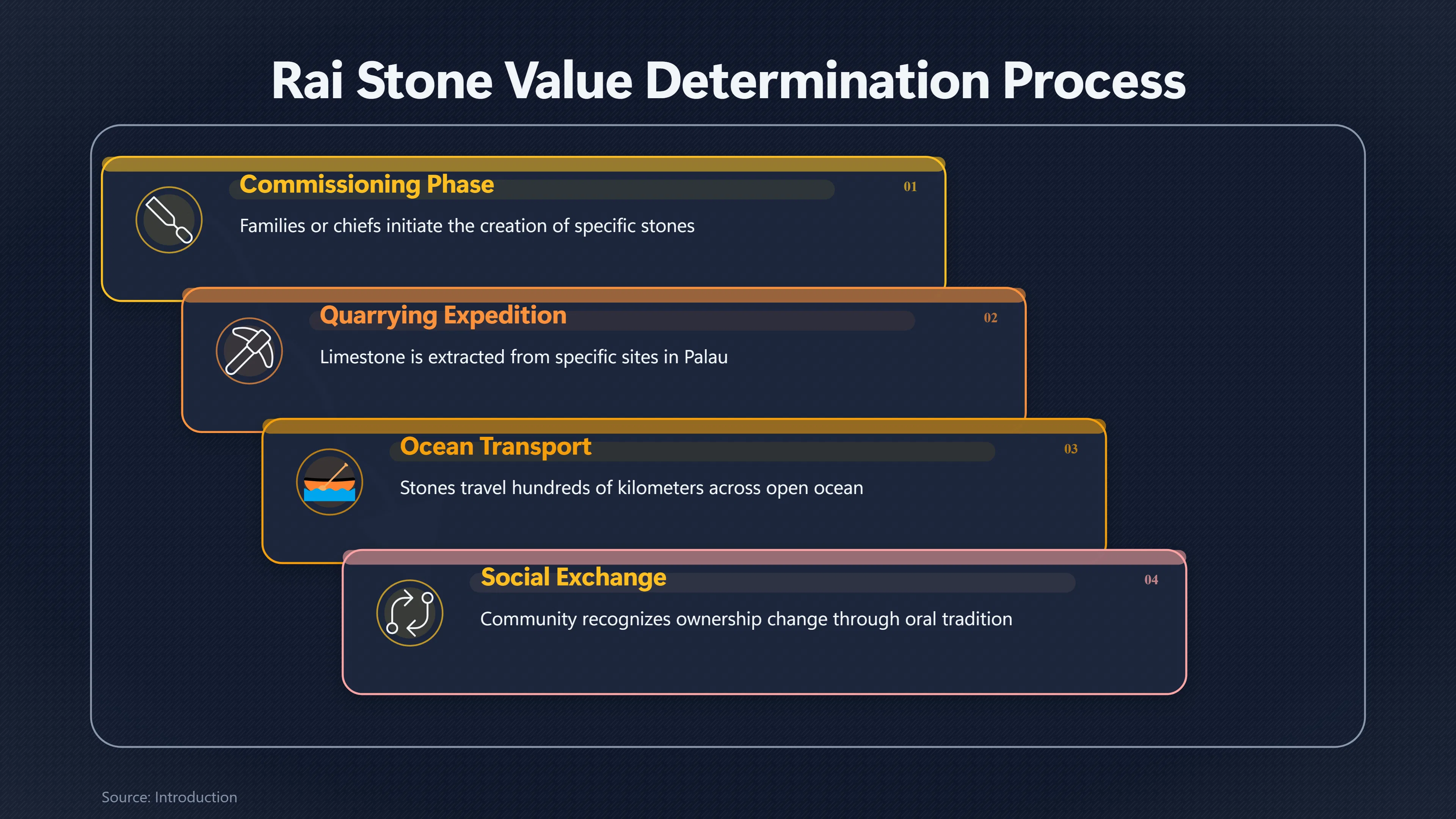
The most remarkable feature of Yap’s stone money is that ownership could change without the stone moving.
When an important transaction occurred—such as a marriage alliance, compensation payment, land transfer or settlement between communities—the stone often stayed exactly where it already stood. Instead, everyone with a legitimate interest recognised that its ownership had changed. Community memory performed the role that written ledgers, land registries or banking records fulfil elsewhere.[bankofcanadamuseum.ca]bankofcanadamuseum.caRai: big moneyBank of Canada Museum…
This system worked because value depended upon much more than size. People remembered:
- who commissioned the stone;
- where it had been quarried in Palau;
- the difficulty of transporting it across hundreds of kilometres of open ocean;
- whether people had been injured or killed during the expedition;
- which chiefs or families had owned it;
- the ceremonies or settlements in which it had been exchanged.
Each stone therefore carried its own biography. A large, beautifully carved disc with an ordinary history might be considered less valuable than a smaller stone associated with prestigious voyages, important chiefs or significant historical events.[bankofcanadamuseum.ca]bankofcanadamuseum.caRai: big moneyBank of Canada Museum…
One well-known traditional story illustrates this principle. A valuable rai reportedly sank during transport yet continued to be recognised as legitimate wealth because everyone knew it existed and accepted its ownership. Whether treated as history or as a teaching story, the example captures the central idea that the social record mattered more than the physical possession of the object itself.[bankofcanadamuseum.ca]bankofcanadamuseum.caRai: big moneyBank of Canada Museum…

Why the stones stayed in place
Modern visitors often assume enormous stones remained stationary simply because they were too heavy to move. Weight certainly mattered, but it was not the main reason.
Leaving the stones where they already stood provided several advantages:
- Public visibility. Everyone knew which stone was being discussed.
- Shared verification. Ownership depended upon collective recognition instead of private documents.
- Historical continuity. The stone accumulated additional significance each time it participated in an important exchange.
- Protection of prestige. Moving an enormous disc repeatedly would have risked damage while adding nothing to its recognised value.
In this sense, the landscape itself became a durable public archive. The stones acted as physical reminders, while the community preserved the accompanying historical record through oral tradition.[bankofcanadamuseum.ca]bankofcanadamuseum.caRai: big moneyBank of Canada Museum…
Why “living village banks” are different from museum collections
Stone money banks are frequently described in travel writing as open-air museums, but that comparison only goes so far.
Unlike archaeological displays where objects have been removed from their original context, many Yap stone money sites remain connected to living communities. Ownership traditions, local knowledge and customary authority continue to shape how the stones are understood. Even where modern economic life relies on US dollars, rai still retain ceremonial and cultural importance during major social occasions.[bankofcanadamuseum.ca]bankofcanadamuseum.caThe Yap Stone ReturnsBank of Canada MuseumJune 16, 2017…
This living status explains why many stones have remained on Yap despite international interest from collectors and museums. The Bank of Canada Museum notes that very few rai left Yap before local restrictions effectively ended their export during the mid-1960s, reflecting growing recognition that their cultural meaning depends heavily on remaining within their original landscape.[bankofcanadamuseum.ca]bankofcanadamuseum.caRai: big moneyBank of Canada Museum…
What visitors should understand before visiting
Visitors gain far more from a stone money bank if they approach it as a cultural landscape rather than a curiosity.
Several points are worth remembering:
- The stones are heritage, not props. They may appear outdoors without barriers, but many remain culturally significant.
- Photography may be acceptable, but local customs matter. Village permissions and respectful behaviour should always take precedence over sightseeing.
- The largest stone is not necessarily the most valuable. Historical associations often outweigh physical size.
- The stones tell collective stories. Local guides can explain family histories, ceremonial uses and village traditions that are invisible to someone simply looking at the limestone discs.
- The setting matters as much as the object. Stone platforms, meeting grounds, pathways and ceremonial spaces form part of the same cultural system recognised by heritage specialists.[UNESCO World Heritage Centre]whc.unesco.orgWorld Heritage Centre Yapese Disk Money Regional SitesUNESCO World Heritage CentreYapese Disk Money Regional Sites - UNESCO World Heritage CentreDecember 29, 2004…
Understanding these points transforms a visit from viewing unusual rocks into appreciating one of the world’s most distinctive systems for recording ownership, social relationships and historical memory.
Why Yap’s stone banks remain globally distinctive
Many cultures have preserved ceremonial objects, ancient currencies or monumental sculptures, but Yap’s stone money banks are exceptional because the objects remain tied to an enduring social mechanism rather than existing solely as historical artefacts.
The stones demonstrate that value can depend upon reputation, trusted public knowledge and shared history as much as physical possession. Their continued presence within village landscapes makes them both an extraordinary curiosity for visitors and an important example of intangible cultural heritage expressed through monumental objects. Instead of functioning as relics of a vanished economy, Yap’s living village banks continue to illustrate how communities can preserve wealth, identity and history in plain sight.[unesco.org]whc.unesco.orgWorld Heritage Centre Yapese Disk Money Regional SitesUNESCO World Heritage CentreYapese Disk Money Regional Sites - UNESCO World Heritage CentreDecember 29, 2004…
Amazon book picks
Further Reading
Books and field guides related to How Does Yap's Giant Stone Money Work?. Use these as the next step if you want deeper reading beyond the article.
Debt: The First 5,000 Years
Economic history states that money replaced a bartering system, yet there isn't any evidence to support this axiom. Anthropologist Graebe...
The History of Money
Traces the historical evolution of humankind's relationship with money, from ancient times to the present-day revolutionary transformatio...
Money: The Unauthorized Biography
From ancient currency to Adam Smith, from the gold standard to shadow banking and the Great Recession: a sweeping historical epic that tr...
Sapiens: A Brief History of Humankind
One hundred thousand years ago, at least six human species inhabited the earth. Today there is just one. Us. Homo sapiens. How did our sp...
eBay marketplace picks
Marketplace Samples
Live-tested eBay searches with available results related to this page.
Selected fromMicronesia map print oneBay.co.uk.
Endnotes
1.
Source: whc.unesco.org
Title: World Heritage Centre Yapese Disk Money Regional Sites
Link:https://whc.unesco.org/en/tentativelists/1994/
Source snippet
UNESCO World Heritage CentreYapese Disk Money Regional Sites - UNESCO World Heritage CentreDecember 29, 2004...
Published: December 29, 2004
2.
Source: bankofcanadamuseum.ca
Title: Rai: big money
Link:https://www.bankofcanadamuseum.ca/2024/07/rai-big-money/
Source snippet
Bank of Canada Museum...
3.
Source: whc.unesco.org
Link:https://whc.unesco.org/en/intassistance/2509/
Source snippet
UNESCO World Heritage CentreReview old nomination and compile data to complete the nomination of the transboundary site of Chelchol Ra Or...
4.
Source: unesdoc.unesco.org
Link:https://unesdoc.unesco.org/in/rest/annotationSVC/DownloadWatermarkedAttachment/attach_import_ab5511f7-5cb3-4653-a269-47a0d0568b96?_=217235eng.pdf
Source snippet
World Heritage papers World Heritage in a Sea o...
5.
Source: bankofcanadamuseum.ca
Title: The Yap Stone Returns
Link:https://www.bankofcanadamuseum.ca/2017/06/yap-stone-returns/
Source snippet
Bank of Canada MuseumJune 16, 2017...
Published: June 16, 2017
6.
Source: bankofcanadamuseum.ca
Title: First Artifacts to Leave the Museum: And they were big
Link:https://www.bankofcanadamuseum.ca/2013/09/first-artifacts-to-leave-the-museum-and-they-were-big/
7.
Source: whc.unesco.org
Link:https://whc.unesco.org/en/documents/143647
8.
Source: whc.unesco.org
Link:https://whc.unesco.org/en/documents/115023
9.
Source: whc.unesco.org
Link:https://whc.unesco.org/en/tentativelists/1932/
10.
Source: flickr.com
Link:https://www.flickr.com/photos/bankofcanada/51250262210/
Source snippet
Rai or stone money / Rai ou monnaie de pierre | Around 1850-… | FlickrJune 15, 2021 — Image: Rai or stone money / Rai ou monnaie de pierr...
Published: June 15, 2021
Additional References
11.
Source: museedelabanqueducanada.ca
Title: Le rai: une monnaie de taille
Link:https://www.museedelabanqueducanada.ca/2024/07/le-rai-une-monnaie-de-taille/
Source snippet
Musée de la Banque du CanadaJuly 16, 2024 — LE RAI: UNE MONNAIE DE TAILLE Par: Graham Iddon 16 juillet 2024 Partager cette page sur Fac...
Published: July 16, 2024
12.
Source: youtube.com
Title: The Island With 12-Foot Stones That People Use as Money | The Story of Money
Link:https://www.youtube.com/watch?v=MFM_JqnJVog
Source snippet
Ancient Pacific Currency Yapese Rai Stones: The Fascinating History...
13.
Source: youtube.com
Title: Yap Catholic HS Summer Education with Yap State Historic Preservation
Link:https://www.youtube.com/watch?v=EheMH9PdklE
Source snippet
Stone Money of Yap: The Island Where Wealth Was Too Heavy to Steal...
14.
Source: youtube.com
Title: Mangyol Cultural Site, Makiy Village, Gagil Municipality, Yap
Link:https://www.youtube.com/watch?v=lbzWwQ8-dAc
Source snippet
Yap Catholic HS Summer Education with Yap State Historic Preservation...
15.
Source: americanhistory.si.edu
Link:https://www.americanhistory.si.edu/pt/collections/object/nmah_1069139
16.
Source: americanhistory.si.edu
Link:https://americanhistory.si.edu/explore/exhibitions/value-money/online/origins-money/forms-money
17.
Source: youtube.com
Title: Ancient Pacific Currency Yapese Rai Stones: The Fascinating History
Link:https://www.youtube.com/watch?v=Byy6RMVNkvo