Within Burkina Faso Curiosities
Why Burkina Faso's Masks Are Never Just Objects
A mask's meaning often depends on its costume, dancer, music and ritual setting rather than the carved face alone.
On this page
- Funerals, initiations and social order
- Costume, movement and sacred performance
- Authenticity, provenance and collector demand
Page outline Jump by section
Introduction
Masks in Burkina Faso are not primarily created to be admired as carved artworks. Their meaning emerges only when they are activated through costume, dance, music and ritual. In many communities, the carved wooden face is just one element of a complete ceremonial performance that links the living with ancestors, spiritual forces and the moral order of society. Removed from that setting and displayed on a museum wall, a mask becomes only part of a much larger cultural system.[Princeton University Art Museum]artmuseum.princeton.eduUniversity Art Museum Bwa and Wé Masks | Princeton University Art MuseumPrinceton University Art MuseumBwa and Wé Masks | Princeton University Art MuseumNovember 9, 2020…
This distinction is essential when visiting museums or collections in Burkina Faso. Institutions such as the Museum of Manéga preserve remarkable masks, but they also emphasise that these objects once functioned within ceremonies marking death, initiation, harvests and community renewal. Understanding how masks work in performance explains why many communities have traditionally restricted who may carve, wear or even see certain masks outside their proper context.[Princeton University Art Museum]artmuseum.princeton.eduUniversity Art Museum Bwa and Wé Masks | Princeton University Art MuseumPrinceton University Art MuseumBwa and Wé Masks | Princeton University Art MuseumNovember 9, 2020…
Funerals, initiations and social order
Across Burkina Faso, different ethnic communities maintain distinct masquerade traditions, so there is no single national system of mask use. Nevertheless, several common principles appear repeatedly.
Masks frequently emerge at moments when the normal social order is being reshaped. Funeral ceremonies help guide the deceased from the world of the living towards the ancestors while reaffirming the community’s continuity. Initiation ceremonies introduce young people into adult responsibilities, using masked performances to teach values, discipline and shared history. Agricultural celebrations may seek harmony between people, animals and the natural environment, while other masquerades celebrate communal identity or mark important seasonal events.[National Museum of African Art]africa.si.eduNational Museum of African Art Helmet mask | National Museum of African ArtNational Museum of African Art Helmet mask | National Museum of African Art
Among Bobo communities of western and south-western Burkina Faso, museum documentation records that masks appear in initiation ceremonies, burial and funeral rites, harvest celebrations and some performances intended primarily for public entertainment. Different masks therefore have different ritual roles rather than serving a single religious function.[National Museum of African Art]africa.si.eduNational Museum of African Art Helmet mask | National Museum of African ArtNational Museum of African Art Helmet mask | National Museum of African Art
In parts of the Mossi cultural region, masks likewise appear during burials, memorial ceremonies and protective rituals. Their performances do more than honour the dead. They reinforce lineage history, demonstrate legitimate authority and remind spectators of obligations to both ancestors and the wider community.[National Museum of African Art]africa.si.eduNational Museum of African Art Face mask | National Museum of African ArtNational Museum of African Art Face mask | National Museum of African Art
Rather than representing individual spirits in a theatrical sense, many ceremonies use masked figures to make normally invisible relationships visible. The performance creates a temporary meeting point between human society, remembered ancestors, moral authority and forces associated with the natural world. The emphasis lies on maintaining balance rather than producing spectacle.[Princeton University Art Museum]artmuseum.princeton.eduUniversity Art Museum Bwa and Wé Masks | Princeton University Art MuseumPrinceton University Art MuseumBwa and Wé Masks | Princeton University Art MuseumNovember 9, 2020…
Costume, movement and sacred performance
The carved mask itself rarely tells the whole story. A ceremonial mask normally functions as part of a complete costume that may include woven fibres, leaves, cloth, leather, animal hair or raffia, concealing the wearer’s identity almost completely. Museum collections often preserve only the wooden component because organic materials deteriorate more quickly, making surviving objects appear less complete than they originally were.[National Museum of African Art]africa.si.eduOpen source on si.edu.
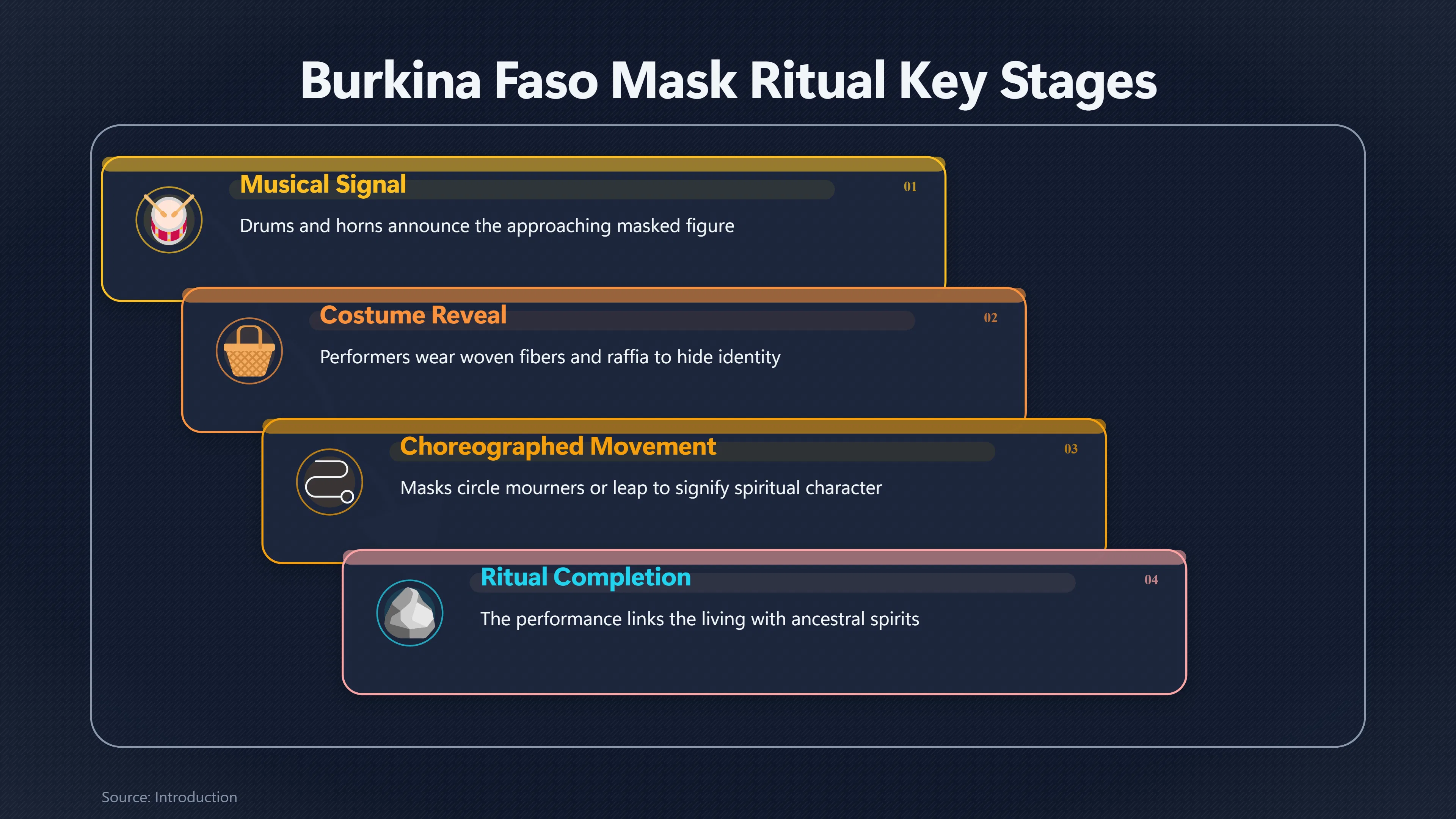
Movement is equally important. Particular masks are recognised not only by their appearance but by their distinctive ways of entering a village, circling mourners, leaping, spinning or responding to musicians. The choreography helps identify the spiritual or symbolic character represented. A museum visitor looking only at the carving therefore misses much of what audiences historically experienced.
Music provides another essential layer. Drums, rattles, horns and songs regulate the mask’s movements while signalling transitions within the ceremony. In some traditions, particular rhythms announce which masked figure is approaching before it can even be seen. Performance, sound and costume combine into a single ritual language rather than functioning as separate artistic elements.[Princeton University Art Museum]artmuseum.princeton.eduUniversity Art Museum Bwa and Wé Masks | Princeton University Art MuseumPrinceton University Art MuseumBwa and Wé Masks | Princeton University Art MuseumNovember 9, 2020…
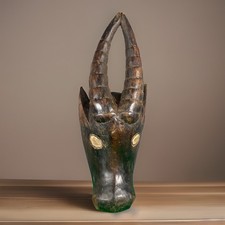
Many masks also incorporate stylised animals such as antelope, birds or buffalo. These are not simple portraits of wildlife. Animal forms express qualities admired within local cosmologies—strength, vigilance, fertility, intelligence or the ordered relationship between humans and nature. A mask’s dramatic horns, beak or crest therefore communicate symbolic ideas through movement as much as through sculpture.[National Museum of African Art]africa.si.eduNational Museum of African Art Face mask | National Museum of African ArtNational Museum of African Art Face mask | National Museum of African Art
Because the performer is hidden beneath the full costume, attention shifts away from the individual and towards the ceremonial role itself. The audience is expected to engage with the masked presence rather than the person wearing it, reinforcing the idea that the performance belongs to the community rather than to a particular performer.[Princeton University Art Museum]artmuseum.princeton.eduUniversity Art Museum Bwa and Wé Masks | Princeton University Art MuseumPrinceton University Art MuseumBwa and Wé Masks | Princeton University Art MuseumNovember 9, 2020…

Authenticity, provenance and collector demand
The international demand for African masks has complicated how Burkina Faso’s ceremonial traditions are understood. Many historic masks entered museum collections during the colonial period or through the twentieth-century art market, often detached from the costumes, music and ceremonies that originally gave them meaning.
Collectors frequently prize carving style, age and rarity, while communities have traditionally valued whether a mask remained embedded within ritual life. A beautifully carved mask with no documented ceremonial history may be artistically significant yet reveal relatively little about how it actually functioned. Conversely, a less visually striking mask with well-recorded community use can be far more important for understanding living tradition.[Princeton University Art Museum]artmuseum.princeton.eduUniversity Art Museum Bwa and Wé Masks | Princeton University Art MuseumPrinceton University Art MuseumBwa and Wé Masks | Princeton University Art MuseumNovember 9, 2020…
This difference also explains why museums increasingly emphasise provenance—the documented history of an object’s ownership and collection. Reliable provenance helps distinguish masks that genuinely participated in ceremonies from later works produced for tourists or export markets. Decorative reproductions have long been made for sale, often inspired by traditional forms but never intended for ritual use. Their existence does not diminish their craftsmanship, but it does change how they should be interpreted.[National Museum of African Art]africa.si.eduOpen source on si.edu.
For visitors exploring Burkina Faso’s unusual collections, the most informative displays are those that reconstruct something of the original ceremonial setting through photographs, costumes, musical instruments or oral history. These exhibits remind audiences that the real cultural significance lies not in isolated wooden objects but in living performances that continue, in varying forms, to connect communities with memory, identity and the unseen dimensions of their world.[Princeton University Art Museum]artmuseum.princeton.eduUniversity Art Museum Bwa and Wé Masks | Princeton University Art MuseumPrinceton University Art MuseumBwa and Wé Masks | Princeton University Art MuseumNovember 9, 2020…
Amazon book picks
Further Reading
Books and field guides related to Why Burkina Faso's Masks Are Never Just Objects. Use these as the next step if you want deeper reading beyond the article.
The Museum Experience Revisited
The first book to take a "visitor's eye view" of the museum visit when it was first published in 1992, The Museum Experience revolutioniz...
The Oxford Encyclopedia of African Thought
From St. Augustine and early Ethiopian philosophers to the anti-colonialist movements of Pan-Africanism and Negritude, this encyclopedia...
eBay marketplace picks
Marketplace Samples
Live-tested eBay searches with available results related to this page.
Selected fromAfrican mask art oneBay.co.uk.
Endnotes
1.
Source: artmuseum.princeton.edu
Title: University Art Museum Bwa and Wé Masks | Princeton University Art Museum
Link:https://artmuseum.princeton.edu/art/stories-perspectives/bwa-and-we-masks-0
Source snippet
Princeton University Art MuseumBwa and Wé Masks | Princeton University Art MuseumNovember 9, 2020...
Published: November 9, 2020
2.
Source: africa.si.edu
Title: National Museum of African Art Helmet mask | National Museum of African Art
Link:https://africa.si.edu/collection/object/nmafa
3.
Source: si.edu
Title: Smithsonian Institution Helmet mask | Smithsonian Institution
Link:https://www.si.edu/object/nmafa
4.
Source: si.edu
Title: Smithsonian Institution Helmet mask | Smithsonian Institution
Link:https://www.si.edu/object/nmafa
5.
Source: africa.si.edu
Title: National Museum of African Art Face mask | National Museum of African Art
Link:https://africa.si.edu/collection/object/nmafa
6.
Source: africa.si.edu
Title: National Museum of African Art Featured Artwork | National Museum of African Art
Link:https://africa.si.edu/collection/selected-artwork/2124
7.
Source: africa.si.edu
Link:https://africa.si.edu/collection/object/nmafa
8.
Source: africa.si.edu
Link:https://africa.si.edu/collection/object/nmafa
9.
Source: si.edu
Link:https://www.si.edu/object/nmafa
10.
Source: si.edu
Link:https://www.si.edu/object/crest-mask-costume%3Anmafa
11.
Source: africa.si.edu
Link:https://africa.si.edu/collection/object/nmafa
12.
Source: unesco.org
Title: Burkina Faso
Link:https://www.unesco.org/en/countries/bf/conventions
Additional References
13.
Source: museenational.bf
Title: CON FÉRENCE PUBLIQUE AU MUSEE NATIONAL: « MASQUES: AU-DELA DU VISIBLE »
Link:https://museenational.bf/conference-publique-au-musee-national-masques-au-dela-du-visible/
Source snippet
CONFÉRENCE PUBLIQUE AU MUSEE NATIONAL: « MASQUES: AU-DELA DU VISIBLE » - Musée National du Burkina FasoJuly 7, 2025 — CONFÉRENCE PUBLIQ...
Published: July 7, 2025
14.
Source: artsbma.org
Title: Behind the Mask | Birmingham Museum of Art
Link:https://www.artsbma.org/behind-the-mask/
Source snippet
Hanna, Ph.D. Senior Curator, Arts of Africa and the Americas Director of Diversity, Equity, and Inclusion This spectacular m...
15.
Source: researchgate.net
Title: (PDF) Etre et devenir Sikoomse
Link:https://www.researchgate.net/publication/30429599_Etre_et_devenir_Sikoomse
Source snippet
February 1, 2000 — Article PDF Available ETRE ET DEVENIR SIKOOMSE * February 2000 * Cahiers d études africaines 40(158) DOI:10.4000/etude...
Published: February 1, 2000
16.
Source: youtube.com
Title: The Mask Collective, le masque Bobo de Pala, Burkina Faso
Link:https://www.youtube.com/watch?v=zksU08i-Frg
Source snippet
Festima Mask Festival, Burkina Faso (West Africa)[https://www.youtube.com/watch?v=tTOroUdKhoY](https://www.youtube.com/watch?v=tTOroUdKhoY) Kumakonda...
17.
Source: youtube.com
Title: The Hidden Mask Rituals of Burkina Faso: A Journey to the Spirit World
Link:https://www.youtube.com/watch?v=z4GGIAWbsaI
Source snippet
The Mask Collective, le masque Bobo de Pala, Burkina Faso...
18.
Source: africabib.org
Link:https://www.africabib.org/rec.php?DB=p&RID=140022244
19.
Source: africabib.org
Link:https://www.africabib.org/rec.php?DB=p&RID=217192270
20.
Source: maskmuseum.org
Link:https://www.maskmuseum.org/mask/nuna-antelope-1/
21.
Source: maskmuseum.org
Link:https://www.maskmuseum.org/mask/nuna-chameleon-1/
22.
Source: maskmuseum.org
Link:https://www.maskmuseum.org/mask/nuna-hornbill-1/