Within Curious Armenia
When Does a Museum Object Become Sacred?
Armenia's reliquaries and venerated manuscripts reveal how museums can preserve faith claims without presenting them as scientific proof.
On this page
- The Holy Lance and Noah's Ark relic
- Manuscripts used as devotional objects
- Belief, provenance and museum credibility
Page outline Jump by section
Introduction
Armenia’s most unusual religious collections are not strange because they claim the supernatural. They are unusual because museums and church treasuries preserve objects that many believers regard as genuinely sacred while presenting them in settings that also serve scholarship, conservation and public education. At the Mother See of Holy Etchmiadzin, visitors encounter relics associated with Christ, the apostles and even Noah’s Ark. At the Matenadaran in Yerevan, ancient Gospel books are displayed as masterpieces of writing and art, yet some continue to attract pilgrims who pray before them rather than simply viewing them behind glass. Together these collections show how Armenia treats sacred heritage as both living faith and historical evidence, without asking museums to prove miracles or asking believers to abandon them.[armenianchurch.org]armenianchurch.orgArmenian Church MSo HE | Mother See of Holy EtchmiadzinArmenian Church MSo HE | Mother See of Holy Etchmiadzin
When does a museum object become sacred?
In many museums, an artefact becomes important because it is rare, beautiful or historically significant. In Armenia, some objects carry an additional status: they are believed to possess spiritual power through their association with saints, biblical events or centuries of devotional use.
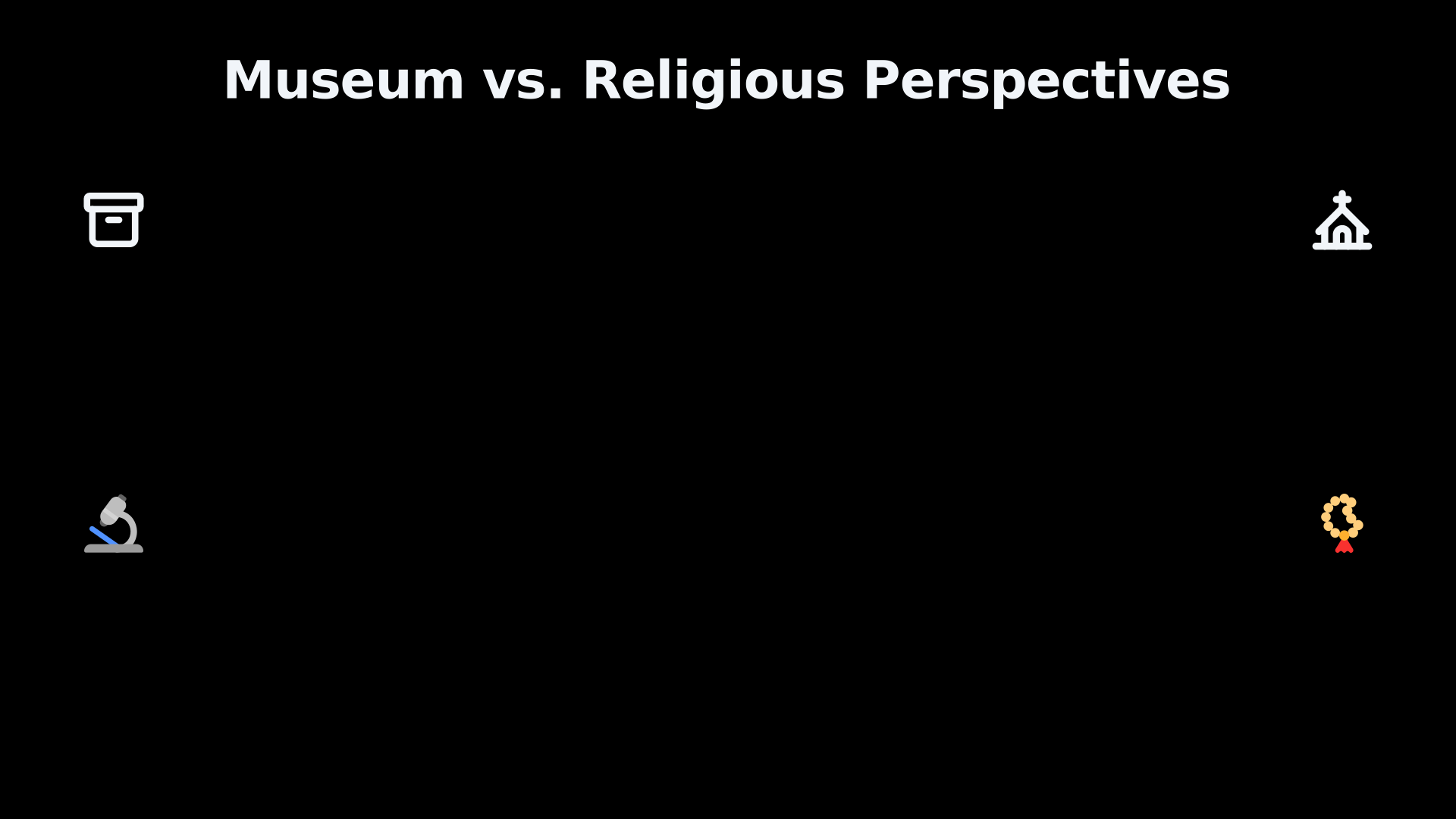
This creates an unusual form of public collection. Conservators study bindings, pigments and materials. Historians trace ownership and provenance. Pilgrims may approach exactly the same object as a focus for prayer, healing or blessing. Rather than treating these approaches as mutually exclusive, Armenia’s leading institutions often accommodate both.[King's College London]kclpure.kcl.ac.ukKing's College LondonScripts, Saints, and Scientists: The Social Life of Gospel Books in an Armenian Museum - King's College London…
The result is a different visitor experience from that of a conventional religious museum. Labels typically explain what is known historically while leaving miraculous claims within the realm of religious belief rather than presenting them as scientifically verified facts.
The Holy Lance and Noah’s Ark relic
The treasury of the Mother See of Holy Etchmiadzin contains some of the Armenian Apostolic Church’s most revered relics. Among the best known is the Holy Lance, traditionally identified as the spear used during the Crucifixion. Armenian tradition associates its arrival with the Apostle Thaddeus, although historians recognise that documentary evidence for its earliest history is incomplete and that several churches elsewhere also preserve lances identified with the same biblical event.[Armenian Church]armenianchurch.orgArmenian Church MSo HE | Mother See of Holy EtchmiadzinArmenian Church MSo HE | Mother See of Holy Etchmiadzin
The treasury also preserves relics identified with Noah’s Ark. According to long-standing Armenian tradition, Saint James of Nisibis received a fragment connected with the Ark after attempting to climb Mount Ararat. Because Mount Ararat dominates Armenia’s religious imagination despite lying across the modern border in Turkey, these relics carry exceptional symbolic importance for Armenian Christianity.[Armenian Church]armenianchurch.orgArmenian Church MSo HE | Mother See of Holy EtchmiadzinArmenian Church MSo HE | Mother See of Holy Etchmiadzin
From a museum perspective, these objects illustrate the distinction between provenance and belief.
- Historical provenance asks when the physical object can first be documented and how it reached its present location.
- Religious tradition asks whether the object has been faithfully preserved through sacred history.
- Scientific investigation can examine materials, craftsmanship and conservation but cannot confirm miraculous associations or biblical identities.
This distinction is usually reflected in responsible interpretation. The relics are displayed as treasures of the Armenian Church while their sacred identities remain matters of faith rather than empirical demonstration.
Why miracle books remain living objects
Perhaps Armenia’s most distinctive contribution to curiosity culture is the survival of manuscripts that function as both books and sacred objects.
The Matenadaran houses around 23,000 manuscripts, fragments and talismans, making it one of the world’s great manuscript repositories. Alongside texts valued for literature, medicine or philosophy are Gospel books that acquired reputations for healing, protection or miraculous intervention during centuries of devotional use.[ՄԱՏԵՆԱԴԱՐԱՆ]matenadaran.amՄԱՏԵՆԱԴԱՐԱՆDepository of Manuscripts – MatenadaranՄԱՏԵՆԱԴԱՐԱՆDepository of Manuscripts – Matenadaran
A striking example is the Charsanjak Gospel. Copied in Jerusalem in 1471, it became known locally as a “miraculous” Gospel believed to possess healing powers. During the upheavals surrounding the Armenian Genocide, the manuscript was rescued, passed between refugees, taken first to France and later the United States, before descendants donated it to the Matenadaran in 2017. Today the institute preserves both the manuscript itself and the remarkable story of how belief in its importance contributed to its survival.[ՄԱՏԵՆԱԴԱՐԱՆ]matenadaran.amՄԱՏԵՆԱԴԱՐԱՆTHE “MIRACULOUS” CHARSANJAK GOSPEL IN MATENADARAN – MatenadaranFebruary 13, 2024…
Other manuscripts have similarly complex identities. The Vehamor Gospel, among the oldest Armenian Gospel manuscripts, is both a treasured historical artefact and a devotional object. Its symbolic authority extends into modern civic life: presidents of the Republic of Armenia traditionally take their oath of office upon it, while pilgrims continue to visit it because of beliefs about its sacred character.[mus.am]mus.amOld Gospel of Banants in Matenadaran. Museum in c. Yerevan | Mus.amOld Gospel of Banants in Matenadaran. Museum in c. Yerevan | Mus.am
These manuscripts therefore resist becoming merely museum exhibits. Their biographies continue after entering institutional collections.
Museums, pilgrimage and the social life of manuscripts
One of the most interesting features of the Matenadaran is that some manuscripts have not been entirely separated from religious practice.
Research on the institution has shown that certain Gospel books continue attracting pilgrims, and since the early 2000s several manuscripts have periodically left the repository to participate in major liturgical celebrations before returning to conservation-controlled storage. This gives them an unusual dual existence: they are simultaneously national heritage, research material, museum exhibits and active devotional objects.[King's College London]kclpure.kcl.ac.ukKing's College LondonScripts, Saints, and Scientists: The Social Life of Gospel Books in an Armenian Museum - King's College London…
For visitors, this means the atmosphere differs noticeably from that of many manuscript museums elsewhere in Europe. Some people come primarily to admire medieval illumination or Armenian calligraphy. Others come because they believe particular books possess spiritual significance independent of their artistic value.
Neither motivation excludes the other.
Belief, provenance and museum credibility
Armenia’s sacred collections demonstrate an important curatorial balance.
Museums and church treasuries generally distinguish between what can be documented and what belongs to religious tradition. Conservation records can establish the age of bindings, identify pigments, reconstruct ownership histories and explain restoration. These methods cannot establish whether a relic truly came from Noah’s Ark or whether a Gospel possesses miraculous healing power.
Likewise, the survival of centuries of pilgrimage demonstrates that many communities sincerely regarded these objects as sacred, but it does not by itself verify the supernatural claims associated with them.
This approach strengthens rather than weakens institutional credibility. Visitors receive enough historical information to understand the objects’ documented histories while also learning why generations of Armenians treated them as far more than historical artefacts.
Within Armenia’s wider landscape of unusual collections, these reliquaries and miracle manuscripts occupy a distinctive place. They are not displayed as curiosities, hoaxes or paranormal evidence. Instead, they reveal how museums can preserve living traditions of belief while remaining transparent about the limits of historical proof, allowing faith, scholarship and public heritage to coexist within the same collection.
Amazon book picks
Further Reading
Books and field guides related to When Does a Museum Object Become Sacred?. Use these as the next step if you want deeper reading beyond the article.
Treasures from the Ark: 1700 Years of Armenian Christian Art
Armenia was the first country to recognize Christianity as the official state religion in 301 AD, twelve years before Constantine's decre...
The Armenians
A comprehensive introduction to the historical forces and recent social and political developments that have shaped today's Armenian peop...

The Armenian Church
First published 2013. Subjects: History of doctrines, Doctrines, Doctrinal Theology, Armenian Church.
eBay marketplace picks
Marketplace Samples
Live-tested eBay searches with available results related to this page.
Selected fromChristian manuscript print oneBay.co.uk.
Endnotes
1.
Source: matenadaran.am
Title: ՄԱՏԵՆԱԴԱՐԱՆDepository of Manuscripts – Matenadaran
Link:https://matenadaran.am/en/matenadaran/research-institute/scientific-and-technical-departments/depository-of-manuscripts/
2.
Source: matenadaran.am
Title: ՄԱՏԵՆԱԴԱՐԱՆTHE “MIRACULOUS” CHARSANJAK GOSPEL IN MATENADARAN – Matenadaran
Link:https://matenadaran.am/en/2024/02/13/the-miraculous-charsanjak-gospel-in-matenadaran/
Source snippet
February 13, 2024...
Published: February 13, 2024
3.
Source: matenadaran.am
Link:https://matenadaran.am/en/2017/07/19/the-15th-century-miraculous-gospel-was-donated-to-matenadaran/
4.
Source: mus.am
Title: Old Gospel of Banants in Matenadaran. Museum in c. Yerevan | Mus.am
Link:https://mus.am/en/expositions/15/
5.
Source: matenadaran.am
Title: Department of Manuscript Study – Matenadaran
Link:https://matenadaran.am/en/matenadaran/research-institute/academic-departments/department-of-manuscript-study/
6.
Source: matenadaran.am
Title: Historical Review – Matenadaran
Link:https://matenadaran.am/en/matenadaran/research-institute/historical-review/
7.
Source: matenadaran.am
Link:https://matenadaran.am/en/category/manuscripts/
8.
Source: armenia.travel
Link:https://armenia.travel/destination/matenadaran/
9.
Source: matenadaran.mus.am
Link:https://matenadaran.mus.am/en/?ya_src=serp300
10.
Source: youtube.com
Title: Holy Lance
Link:https://www.youtube.com/watch?v=XV5LMupx45s
Source snippet
Deep Dive: Geghard Monastery — The Name of the Spear...
11.
Source: armenianchurch.org
Title: Armenian Church MSo HE | Mother See of Holy Etchmiadzin
Link:https://www.armenianchurch.org/en/mother-see
12.
Source: kclpure.kcl.ac.uk
Link:https://kclpure.kcl.ac.uk/portal/en/publications/scripts-saints-and-scientists-the-social-life-of-gospel-books-in-/
Source snippet
King's College LondonScripts, Saints, and Scientists: The Social Life of Gospel Books in an Armenian Museum - King's College London...
13.
Source: armenianchurch.us
Title: The Holy Lance in Armenian Tradition & Legend
Link:https://armenianchurch.us/the-holy-lance-in-armenian-tradition-legend-6/
Source snippet
The Armenian ChurchNovember 19, 2025 — THE HOLY LANCE IN ARMENIAN TRADITION & LEGEND * EasternDiocese * November 19, 2025 * 0 * 6 THE HOL...
Published: November 19, 2025
14.
Source: armenianchurch.org
Title: MSo H E | Holy Lance
Link:https://www.armenianchurch.org/en/videos/holy-lance/1834
16.
Source: armenianchurch.org
Link:https://www.armenianchurch.org/en/alex-marie-manoogian-museum
17.
Source: armnumres.org
Title: Holy Lance
Link:https://armnumres.org/items/show/274
18.
Source: encyclopedia.com
Link:https://www.encyclopedia.com/religion/encyclopedias-almanacs-transcripts-and-maps/holy-lance
Additional References
19.
Source: aiearmeniennes.org
Link:https://aiearmeniennes.org/artsakh/writing-centre/
Source snippet
February 11, 2026 — THE WRITING CENTERS AND MANUSCRIPT HERITAGE OF ARTSAKH Tamar Minasyan (Senior Researcher, Matenadaran, Yerevan) Artsa...
Published: February 11, 2026
20.
Source: armenia-spirit.com
Title: The Armenian Apostolic Church, despite its Oriental Or
Link:https://www.armenia-spirit.com/guides/etchmiadzin-mother-cathedral/
Source snippet
Etchmiadzin: the mother cathedral of Armenia | armenia-spirit.com3 days ago — ETCHMIADZIN AND THE ECUMENICAL LANDSCAPE Etchmiadzin has re...
21.
Source: youtube.com
Title: Deep Dive: Geghard Monastery — The Name of the Spear
Link:https://www.youtube.com/watch?v=csJU3cNPjW4
Source snippet
The First Christian Country in the World? The Most Sacred Places in Armenia | Complete Tour...
22.
Source: researchgate.net
Link:https://www.researchgate.net/publication/392240519_Unusual_burial_of_an_adult_individual_from_the_Cathedral_of_the_Armenian_Apostolic_Orthodox_Church_in_Armenia_preliminary_announcement_The_Mankind_Quarterly_2025_V_654_P
23.
Source: arites.am
Link:https://arites.am/en/echmiadzinmuseum
24.
Source: atb.am
Link:https://www.atb.am/en/armenia/culture/manuscripts/
25.
Source: ebsco.com
Link:https://www.ebsco.com/research-starters/history/holy-lance-relic
26.
Source: atb.am
Link:https://www.atb.am/en/armenia/sights/museum/matenadaran/
27.
Source: journals.ysu.am
Link:https://journals.ysu.am/index.php/hist-cult/en/article/view/8128
28.
Source: vias.univie.ac.at
Link:https://vias.univie.ac.at/en/research/httpsmaterialsscienceunivieacat/projects/archaeometallurgical-analysis-of-the-holy-lance-in-the-treasury-of-the-kunsthistorisches-museum-wien/